| Home | The Lives of Velnin | Illustrated Fiction | Malfoid Art & Fiction | Book Blurbs | Contact |
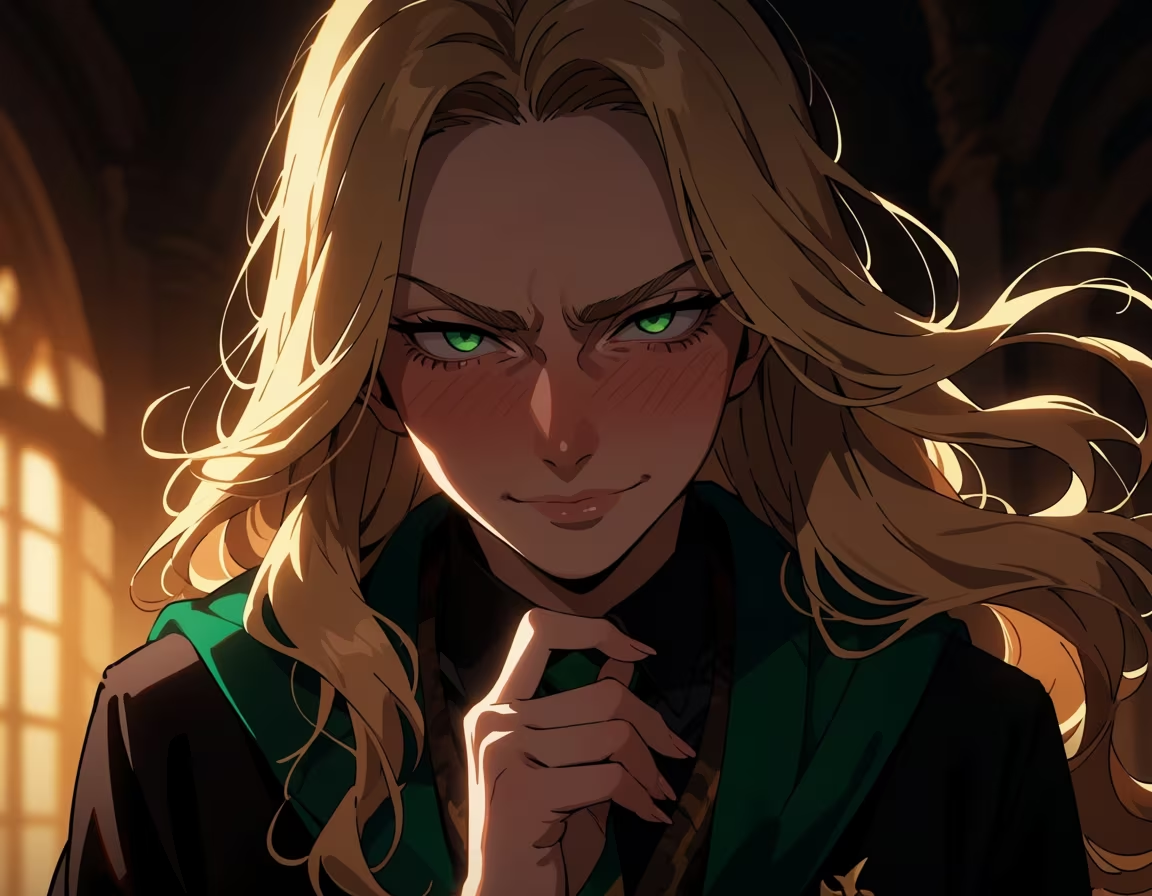
The Hogwarts Express was a symphony of rhythmic clatter and steam, a comforting, ancient sound that always made Draconia feel simultaneously superior and terribly, thrillingly alive. The windows rattled against the landscape of green fields—the Muggle world, so offensively vibrant and utterly unaware of the subtle machinations of pure-blood society that governed their lives.
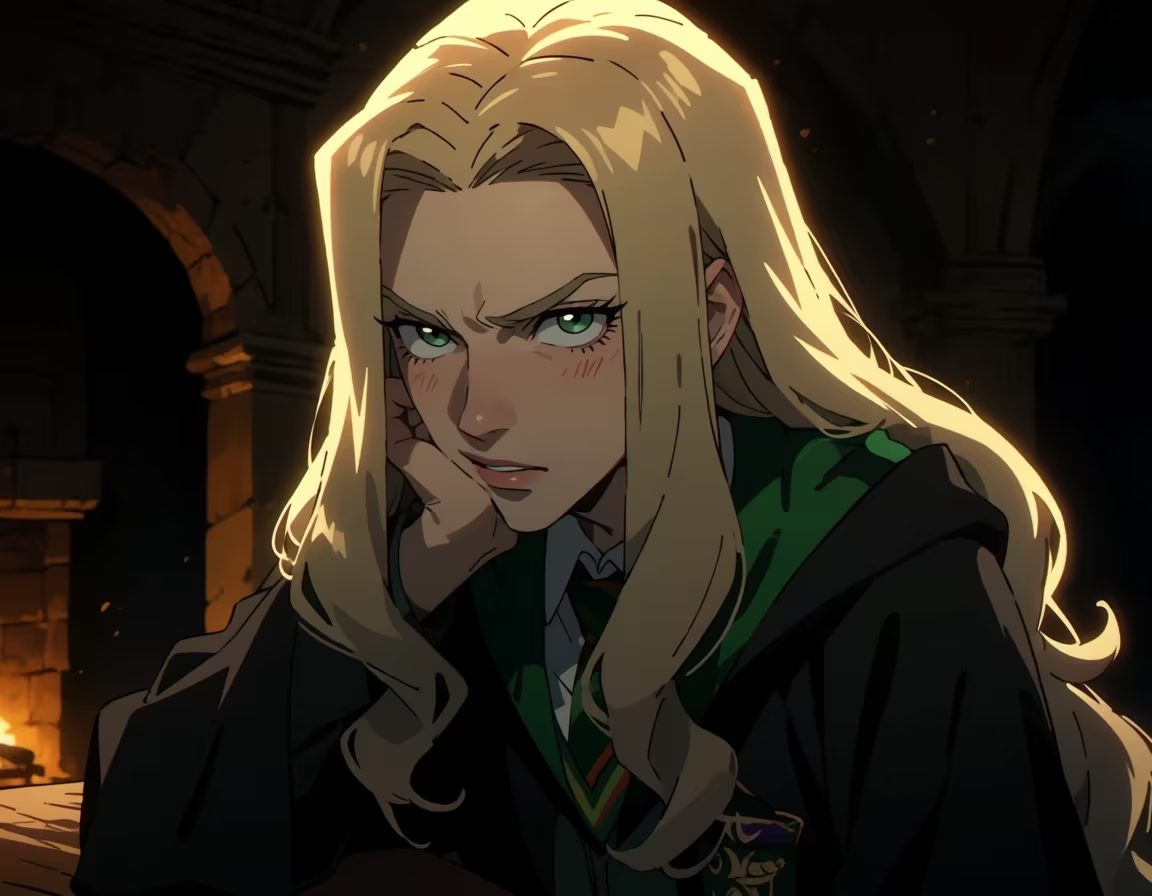
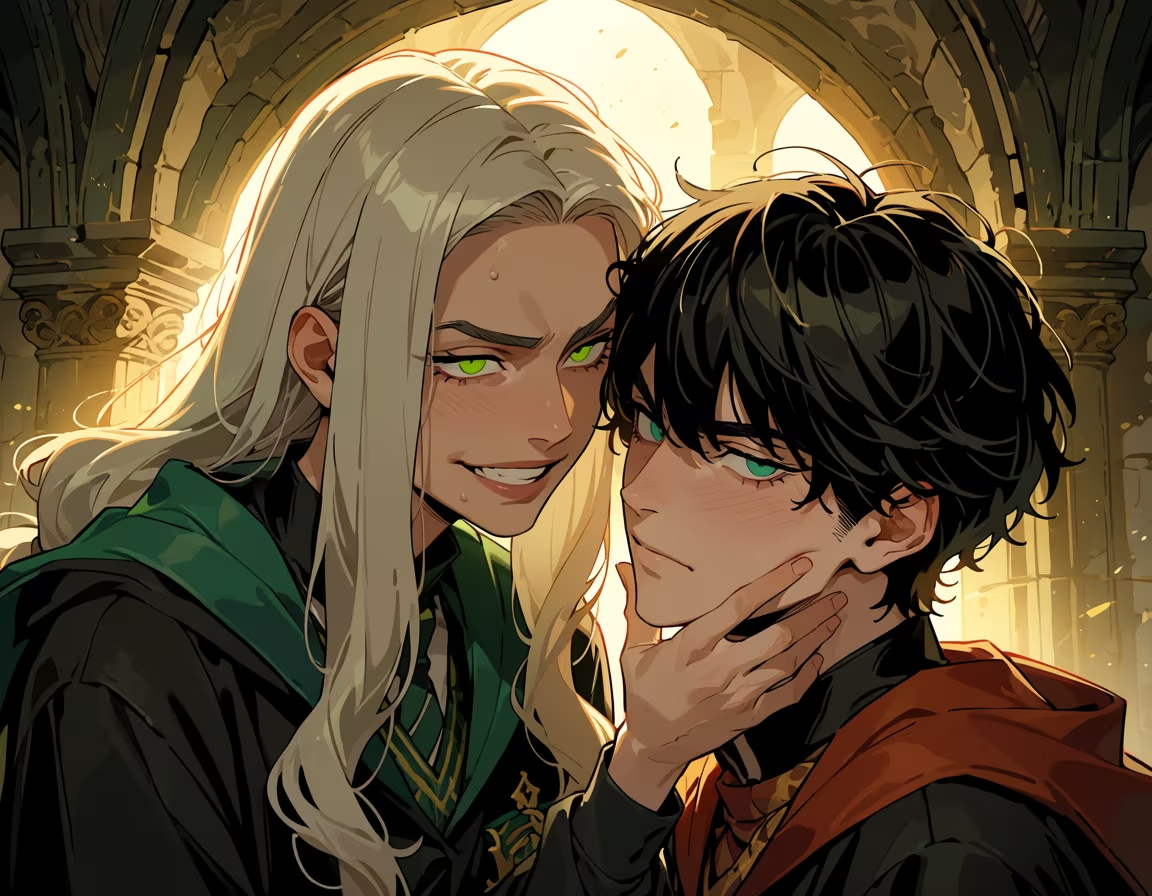
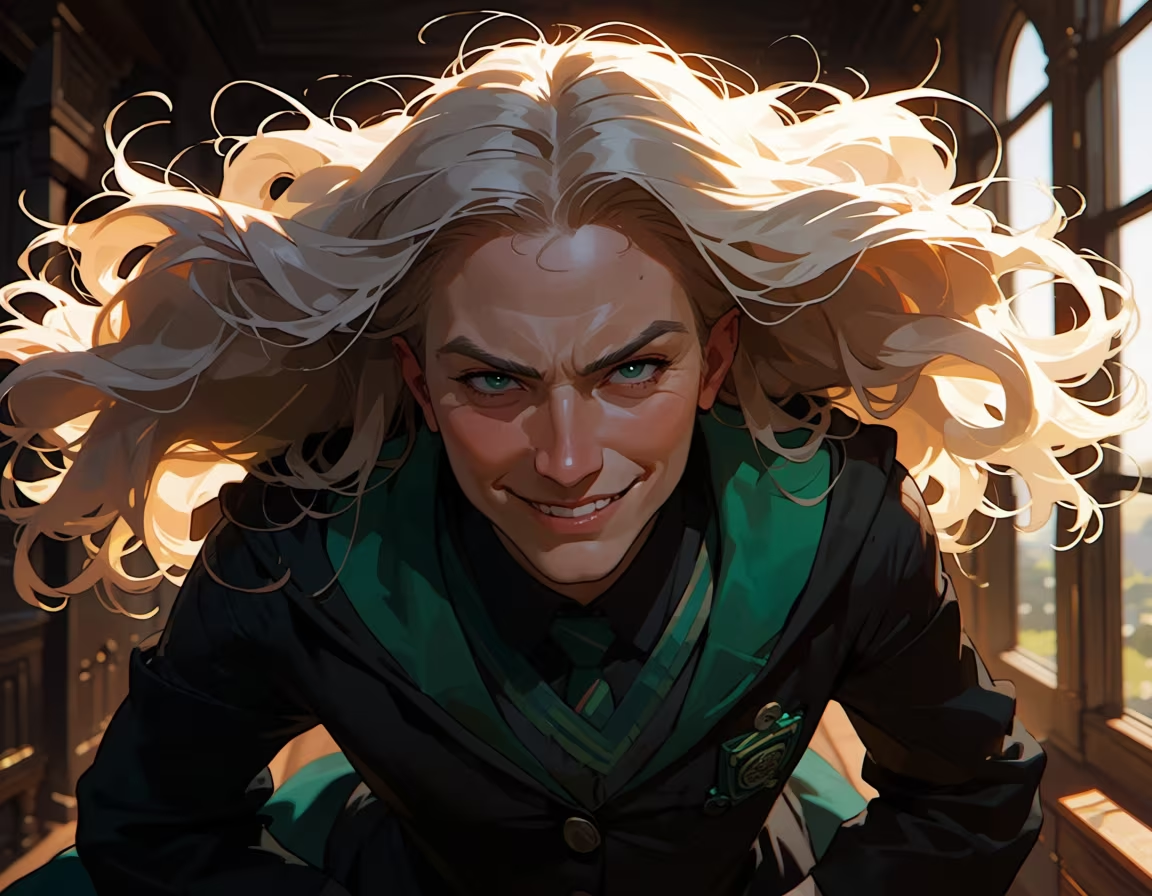
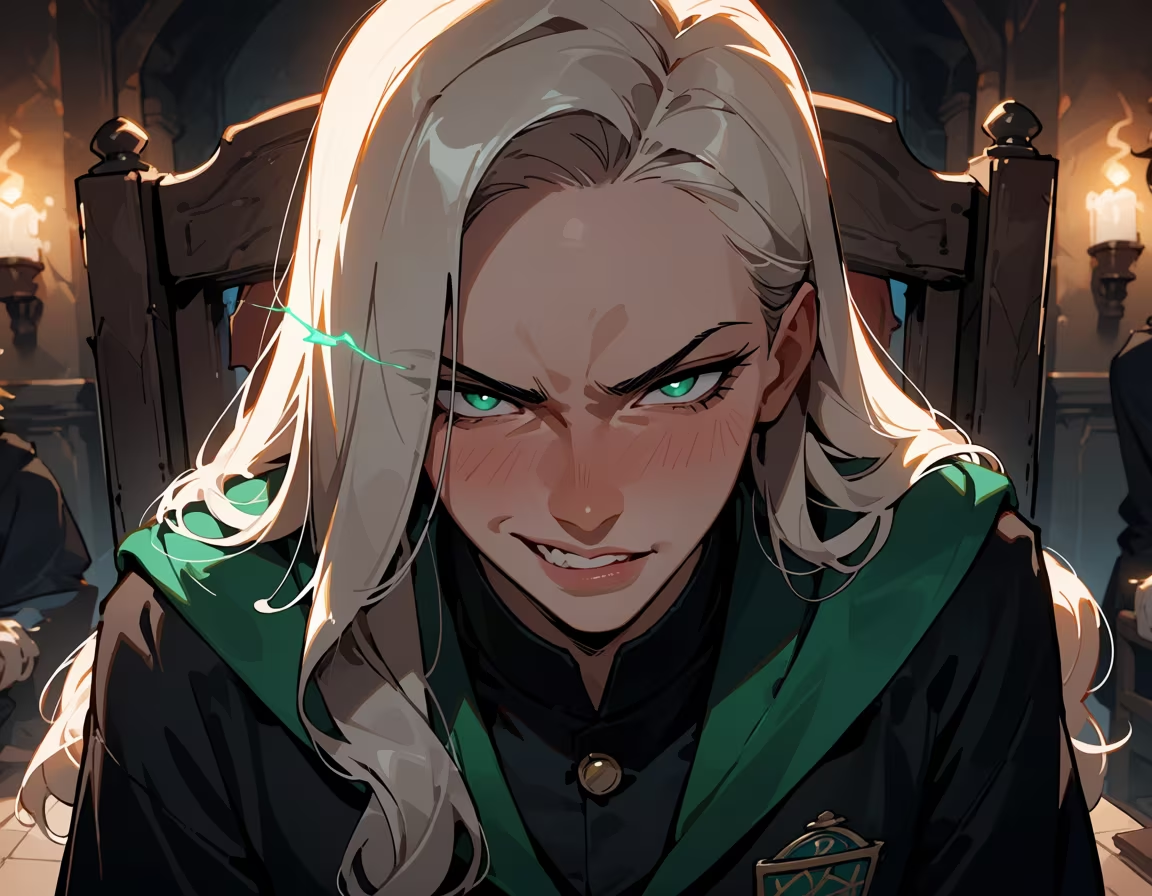
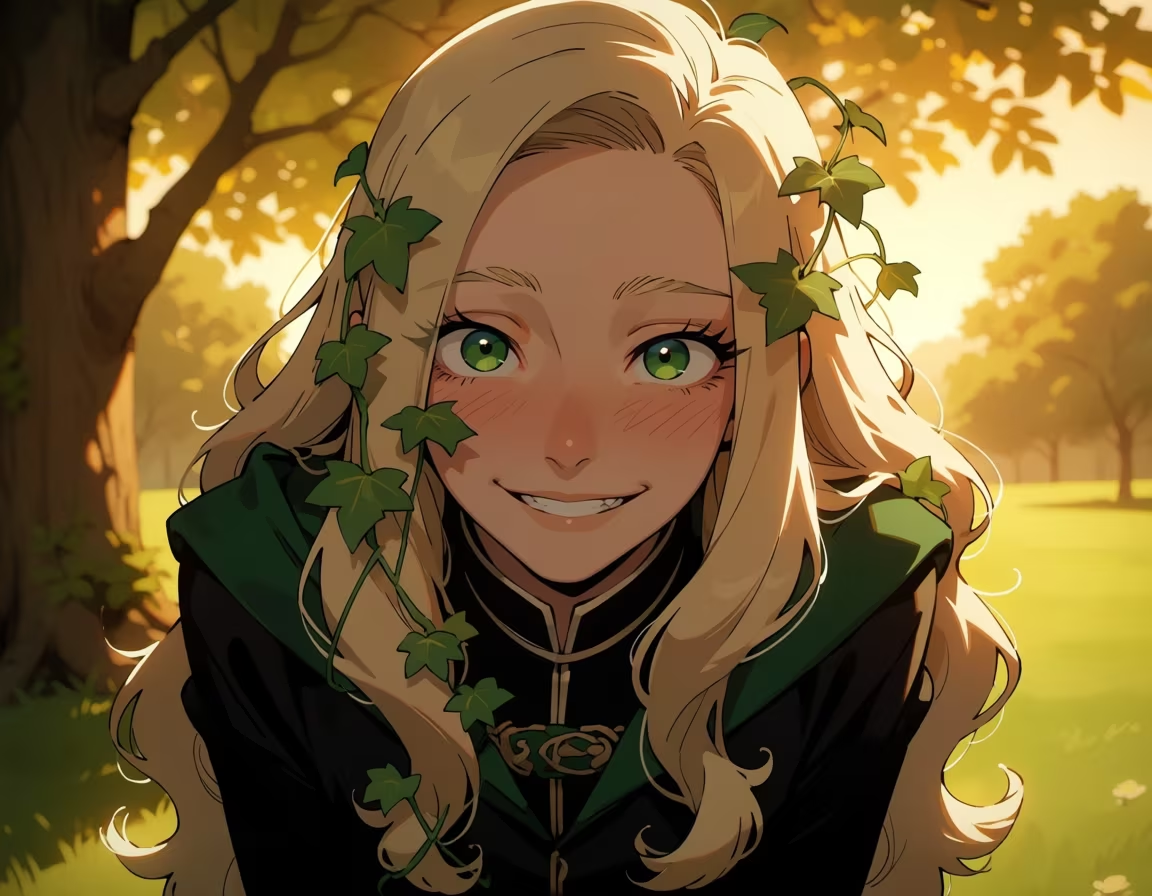
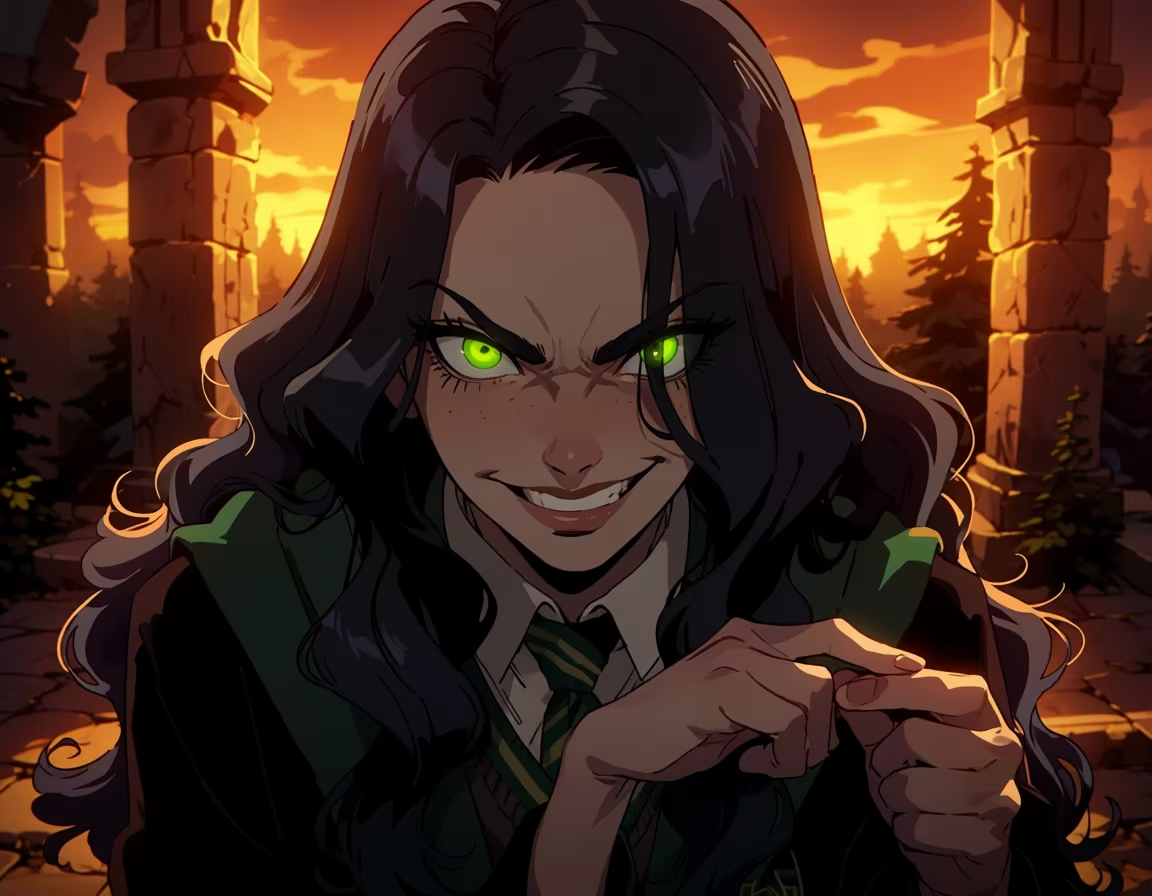
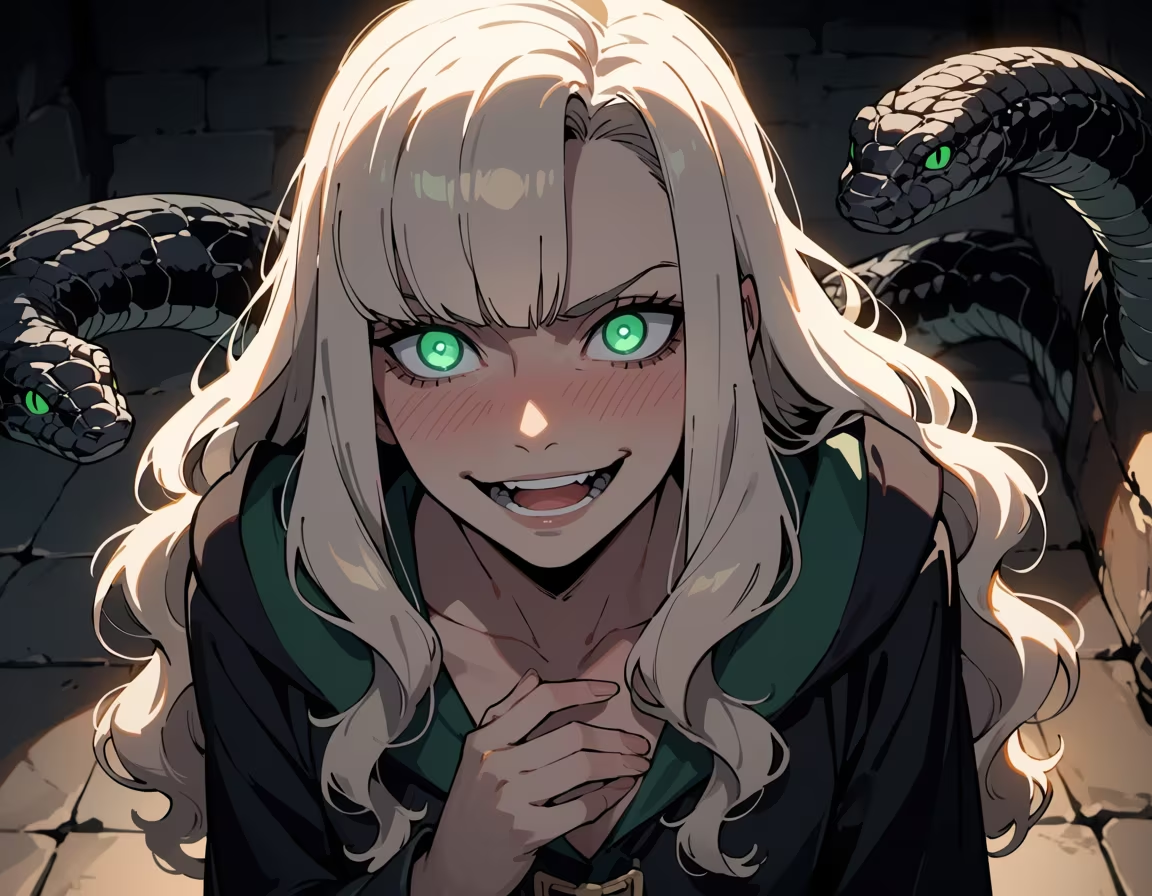
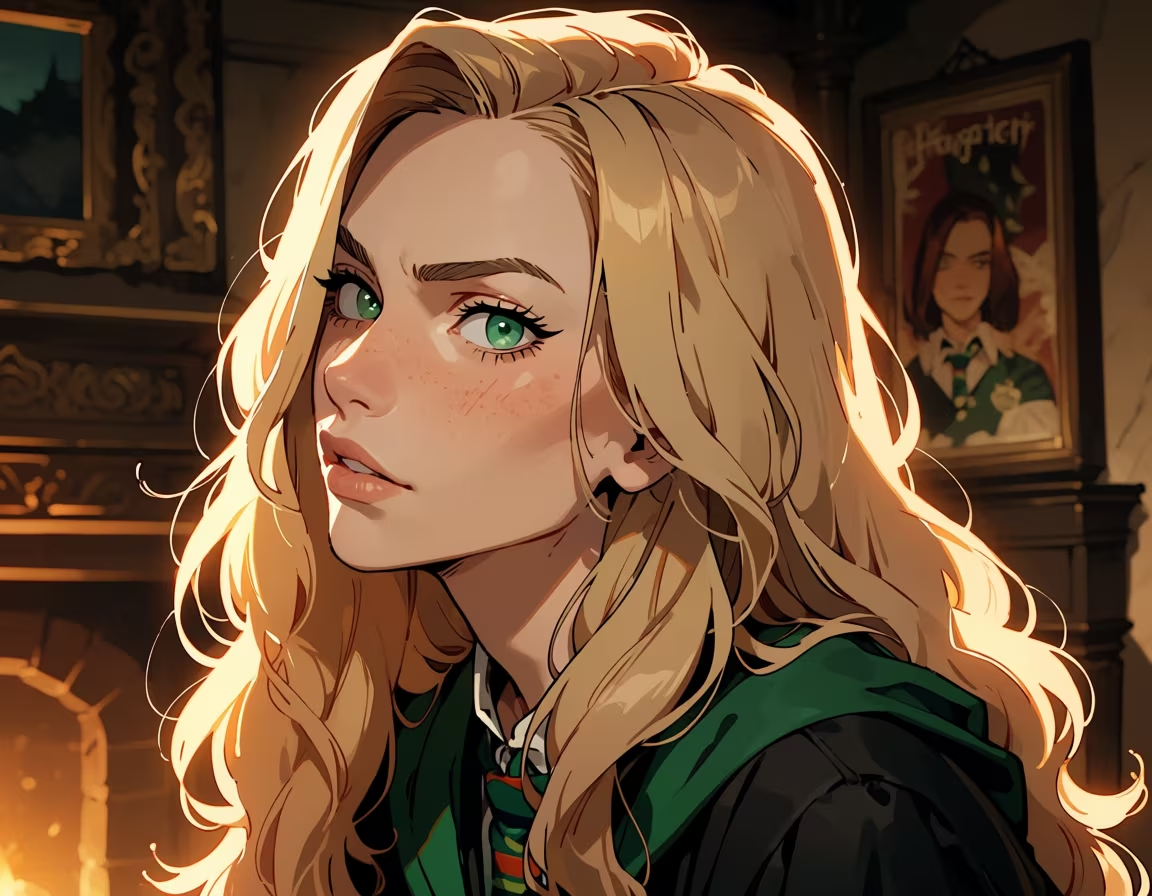
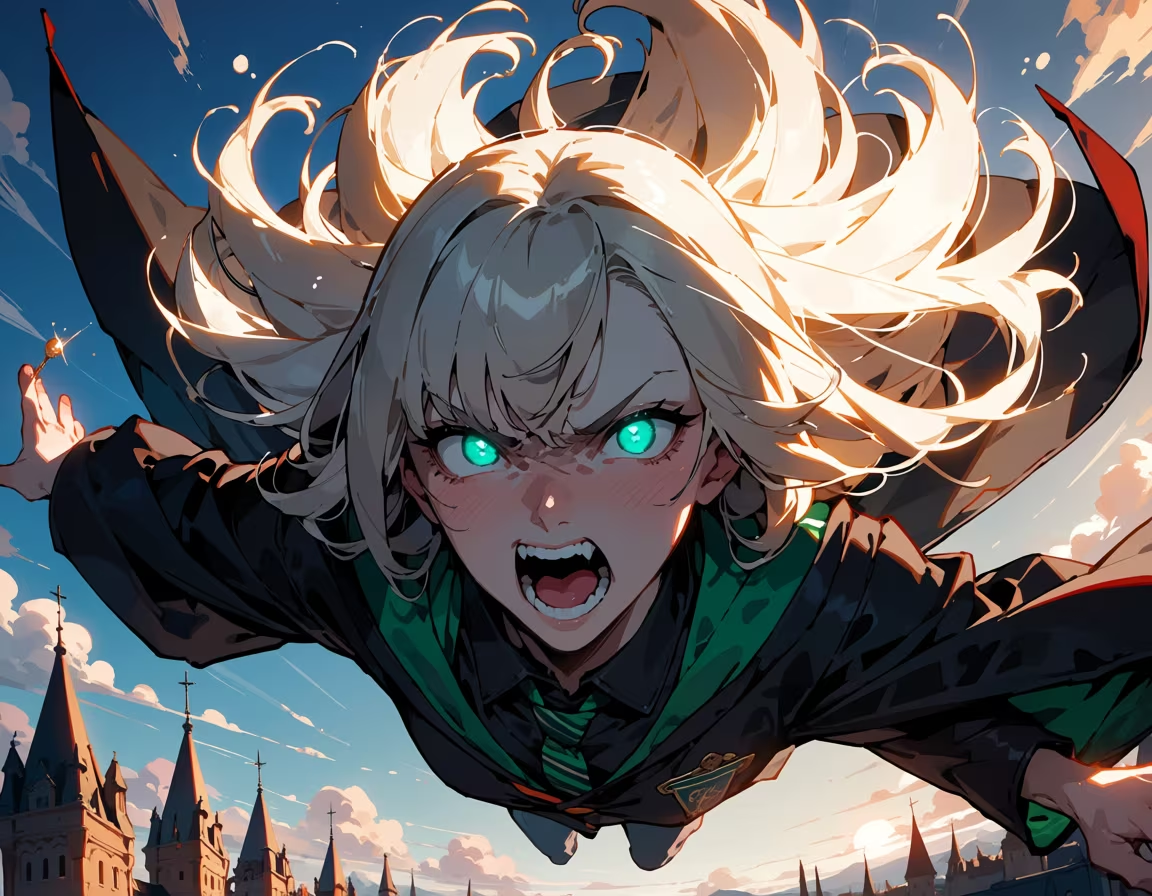
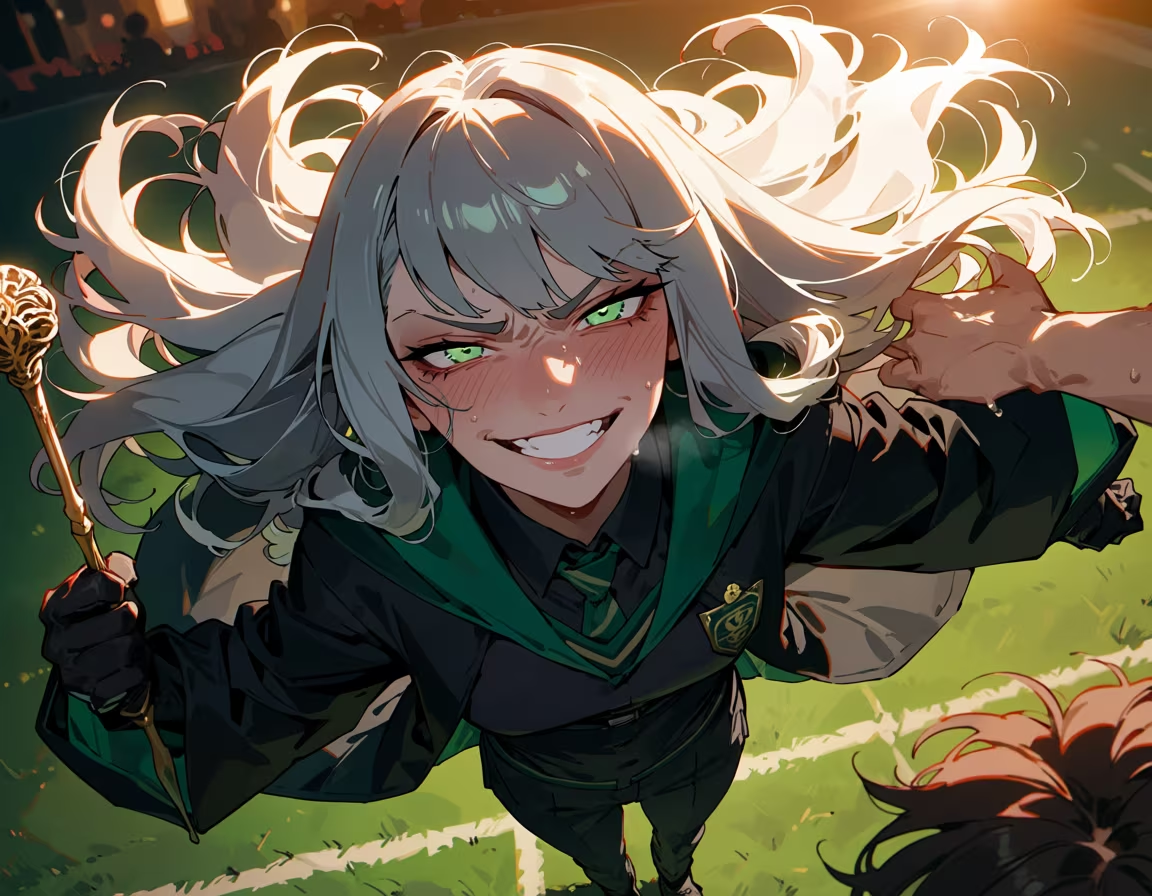
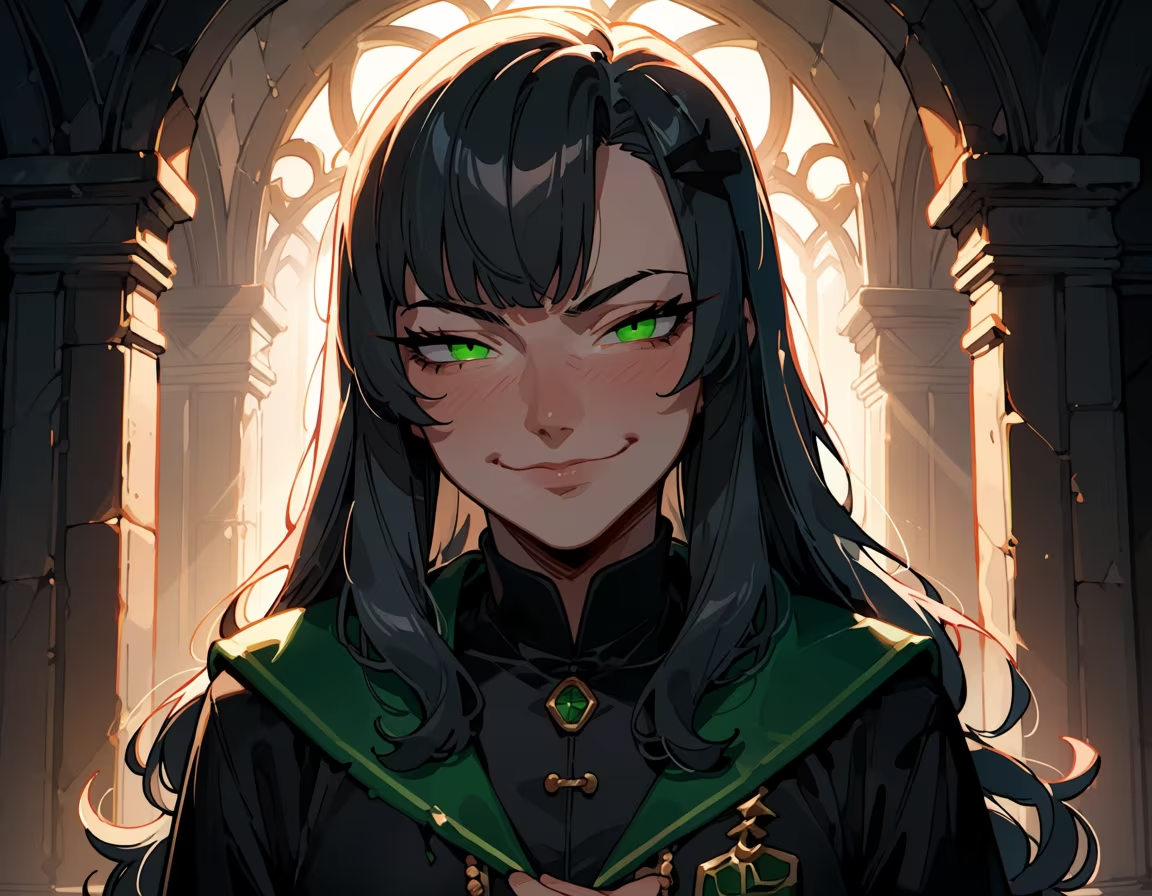
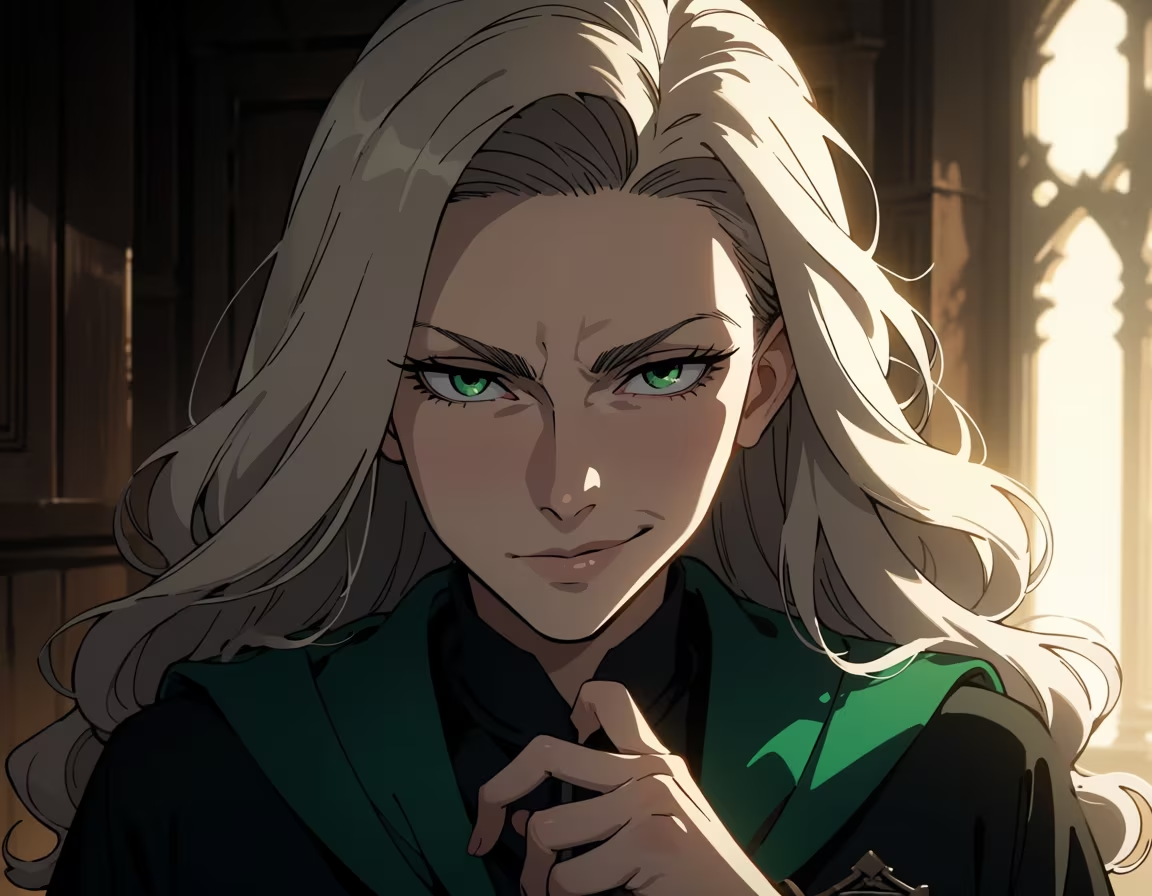
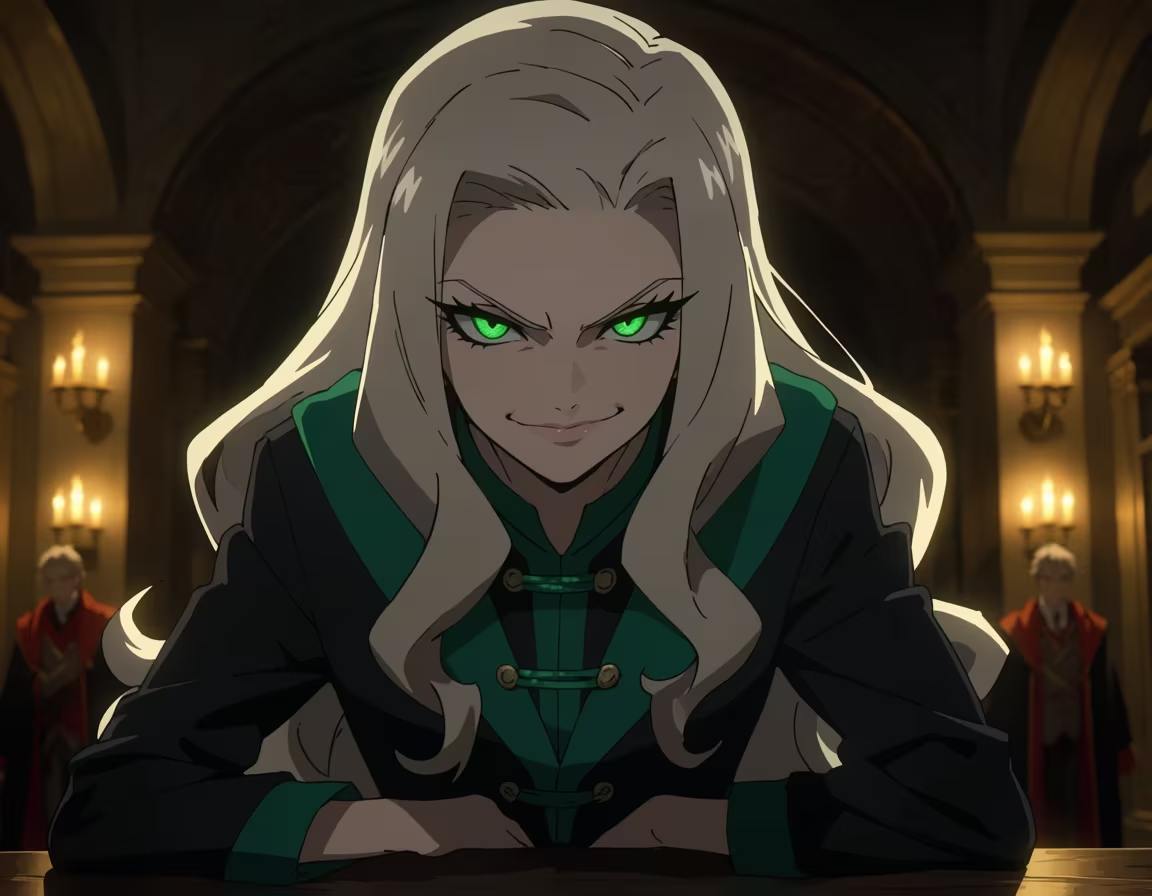
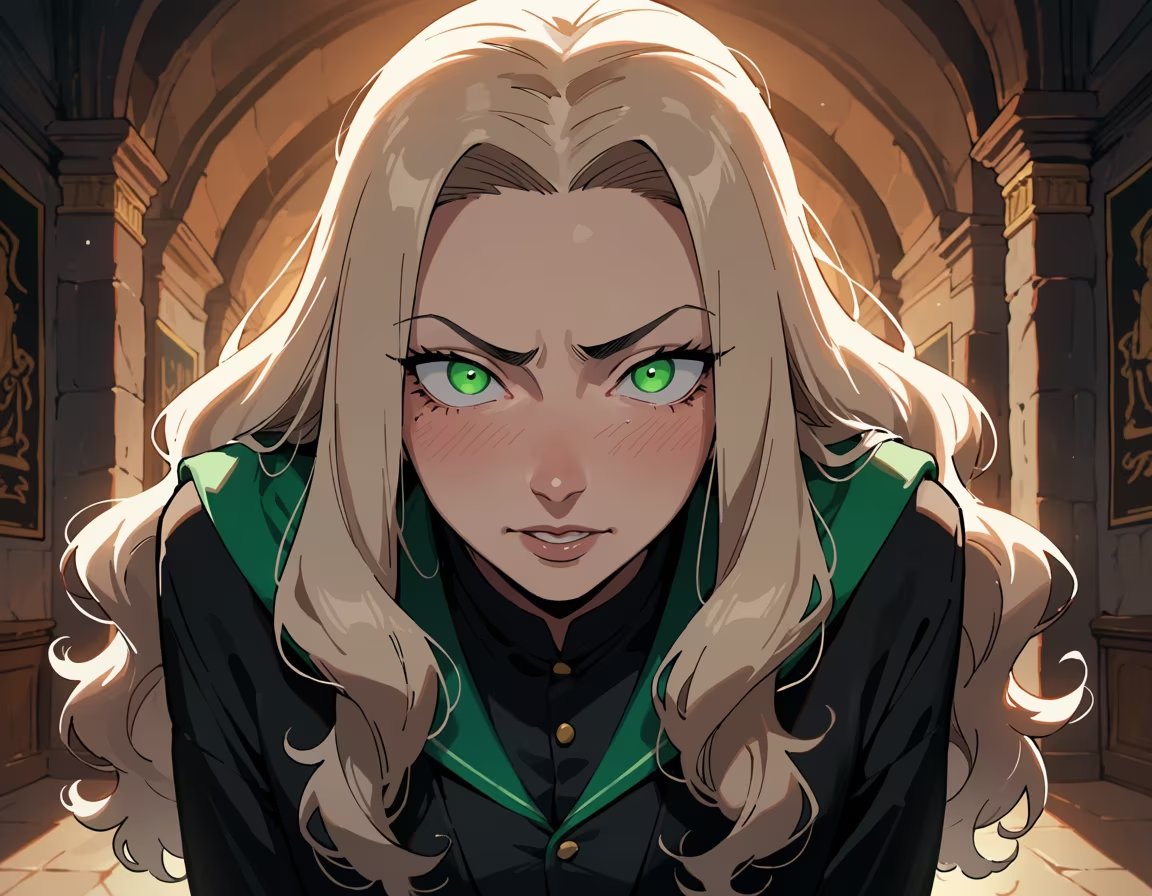
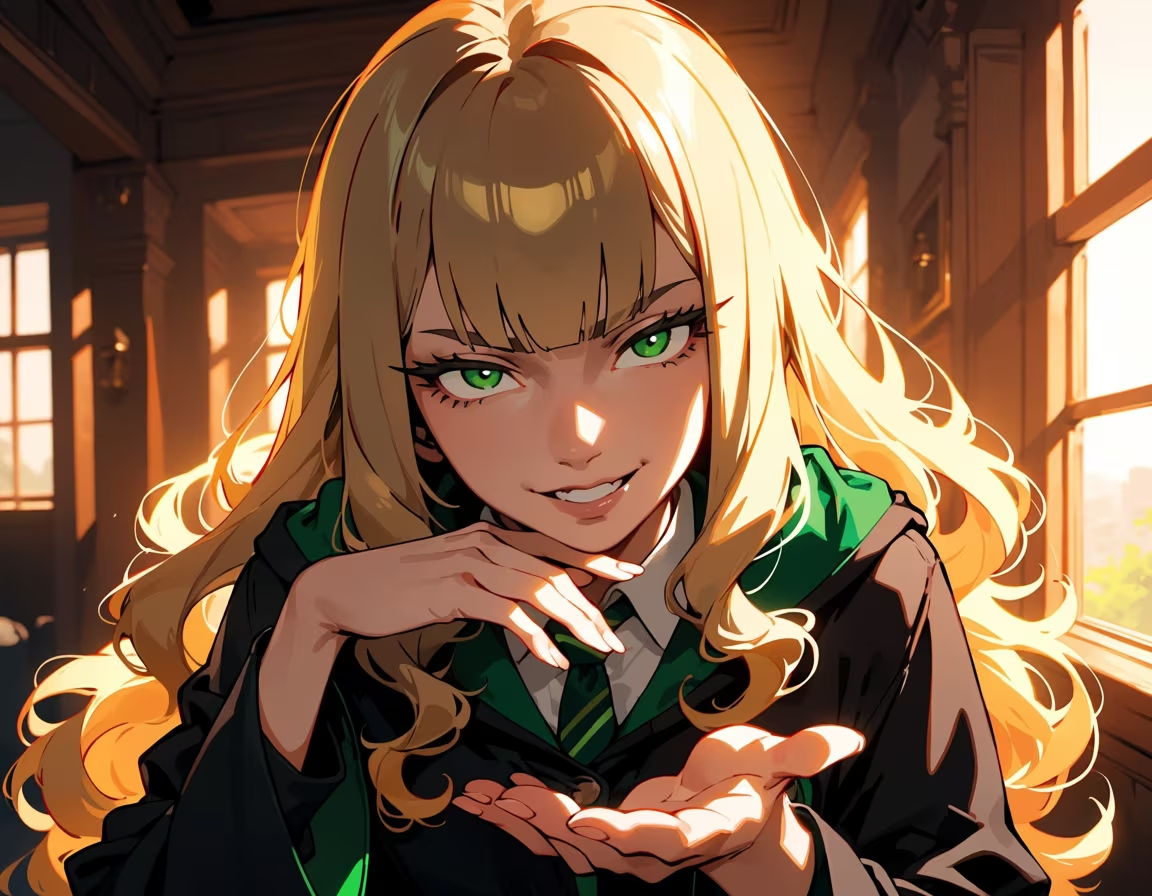
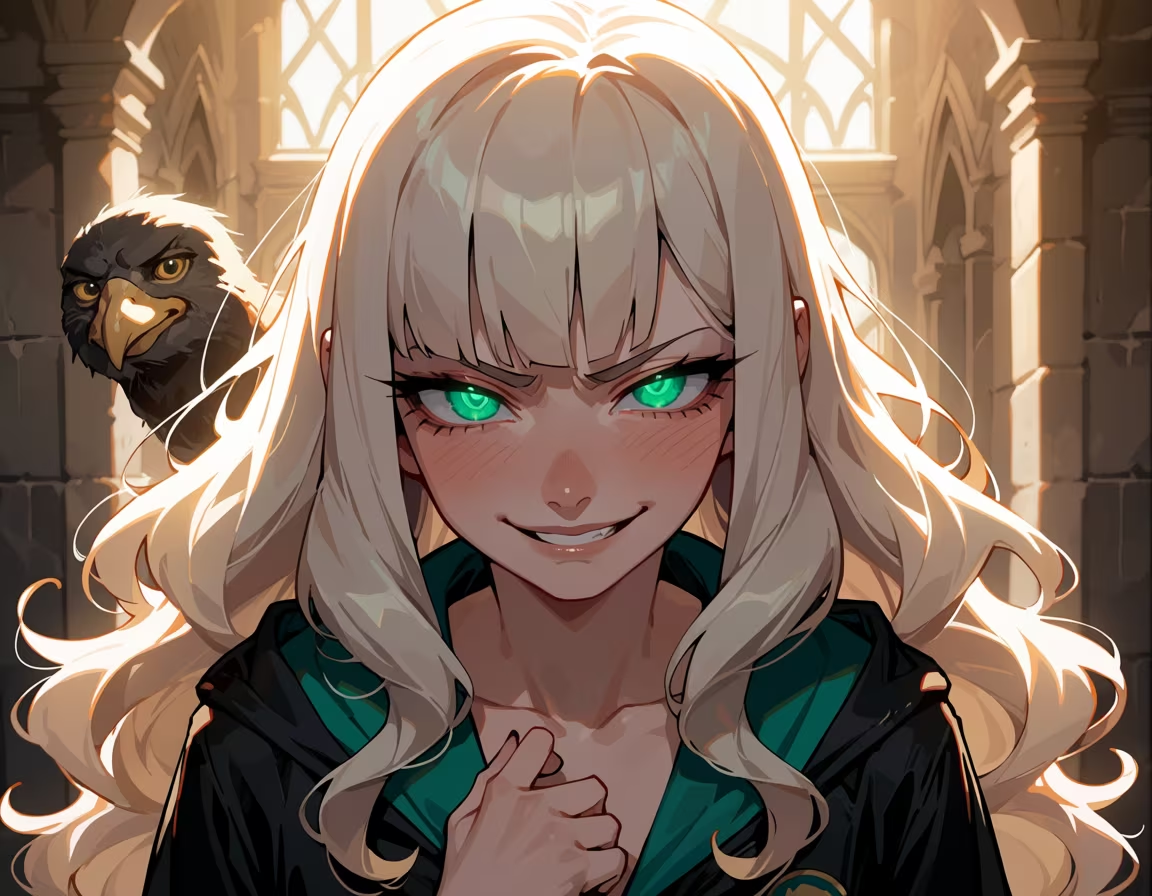
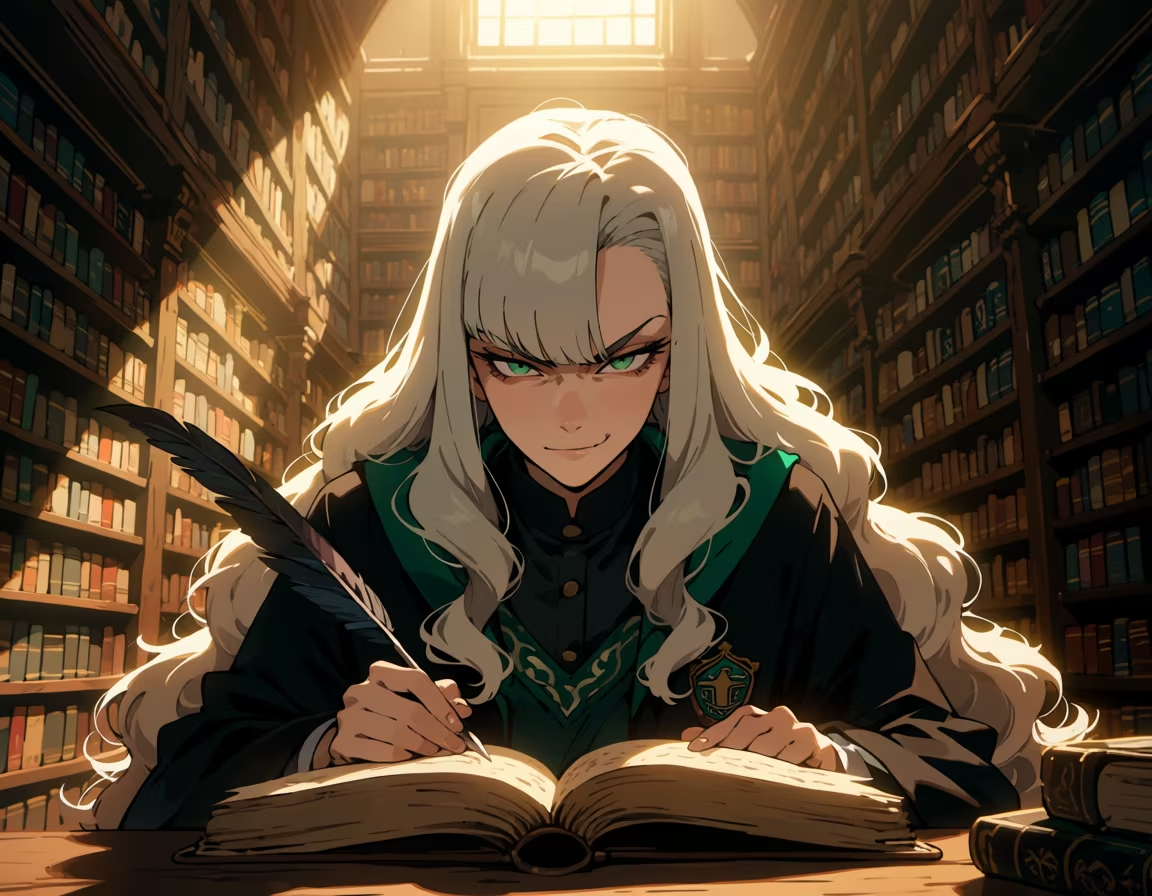
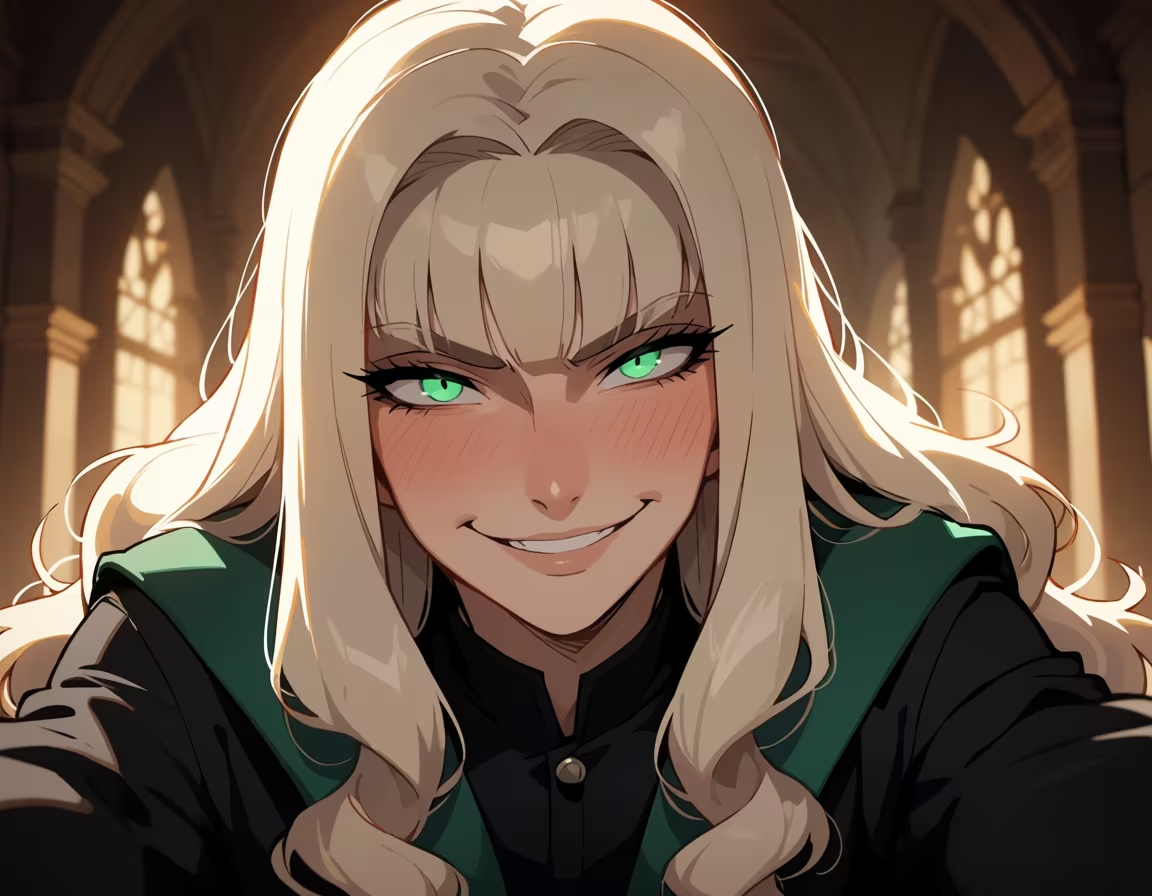
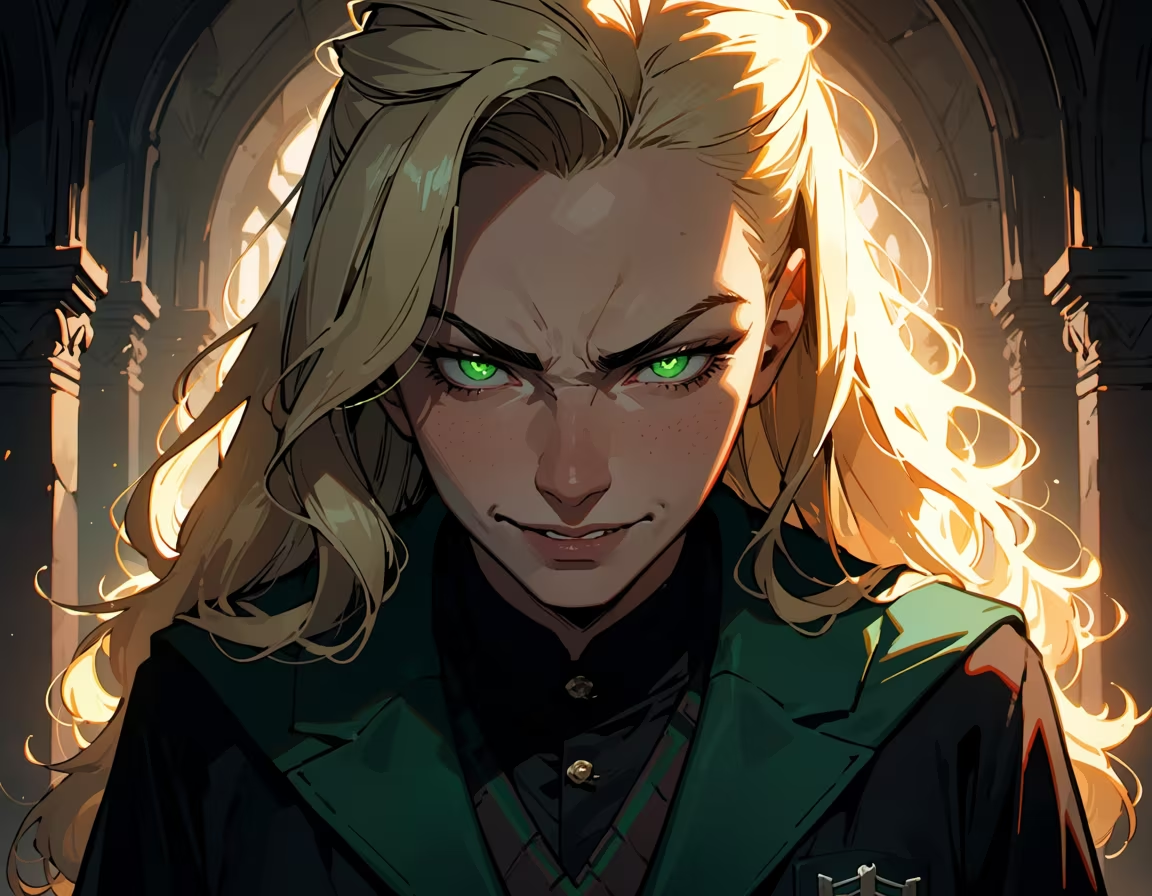
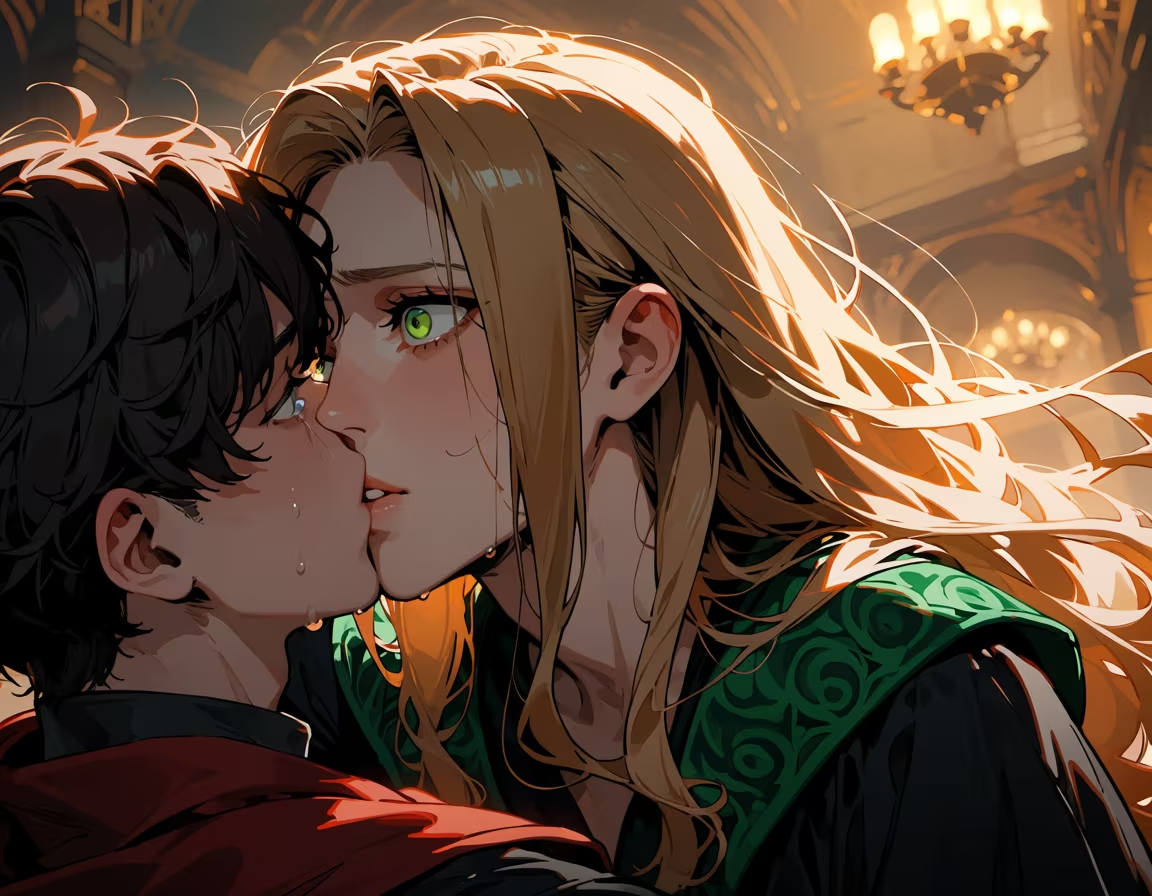
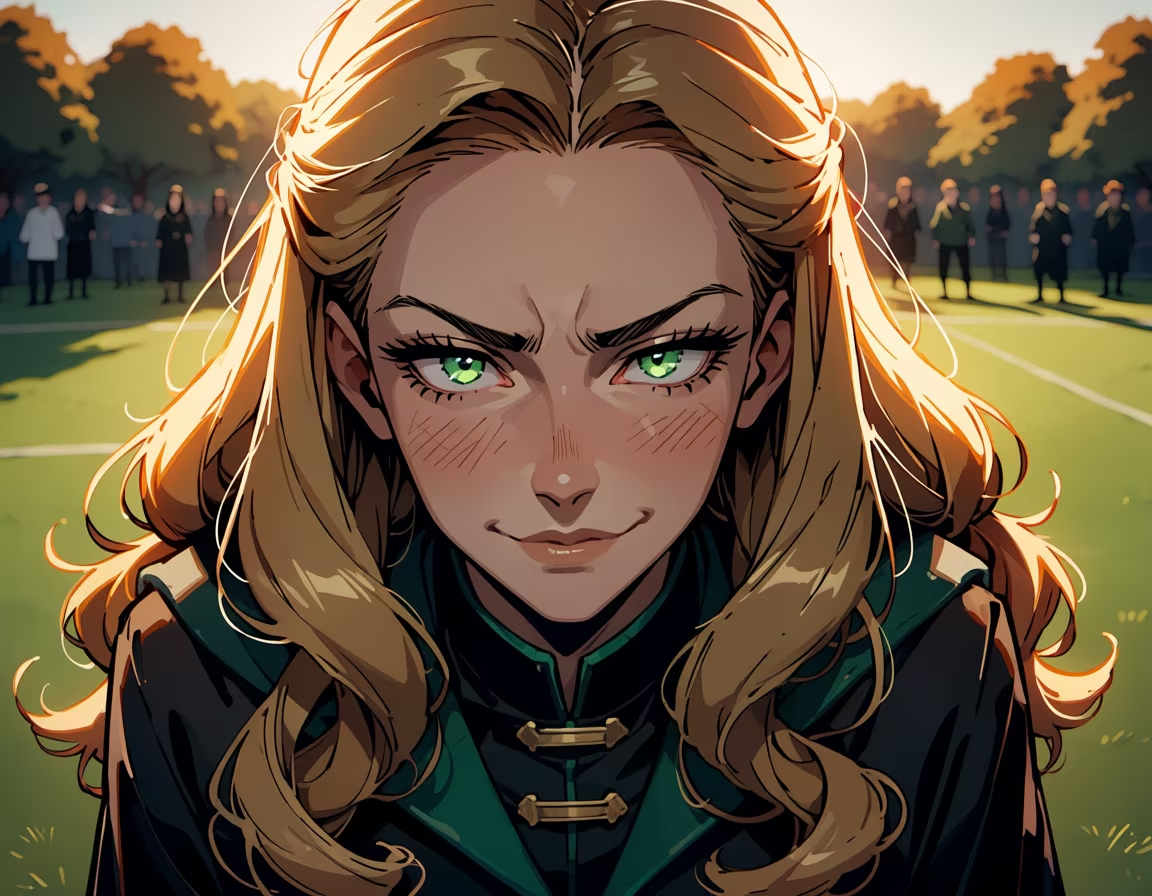
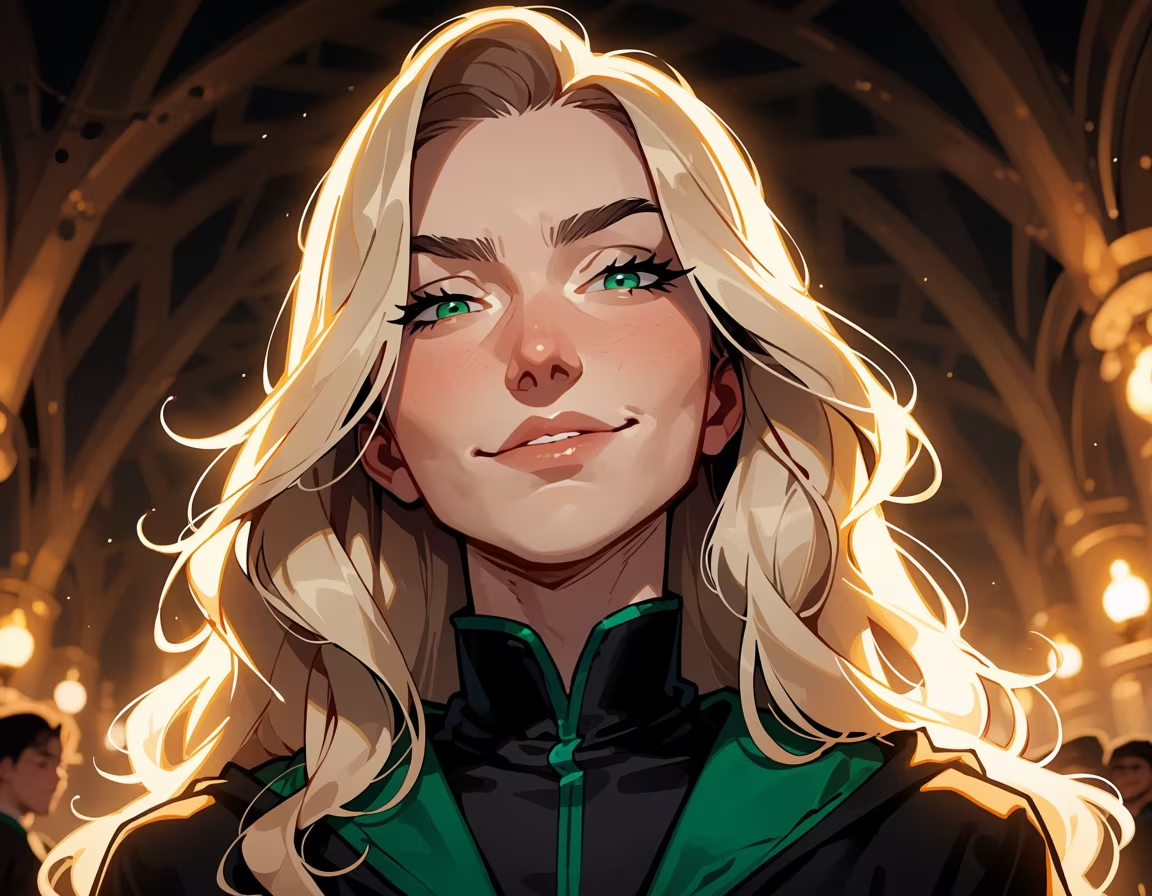
Draconia Malfoid, draped in the customary midnight-black robes of her house, felt the weight of them settling perfectly across her shoulders. The deep, forest-green lining, a subtle splash of Slytherin pride, caught the fleeting shafts of weak afternoon sun that streamed through the window, making her hair—a cascade of pale, spun gold—seem almost luminous against the dark fabric. She had found a secluded compartment, deliberately away from the boisterous, aggressively cheerful groups of Gryffindors who seemed determined to colonise every available piece of railway carriage.
She was currently engaged in the meticulous reading of Advanced Potion-Making , her expression set in the carefully cultivated mask of bored aristocracy. Her emerald eyes scanned the archaic text, but her concentration was, as usual, being systematically sabotaged.
It was him.
Harry Potter.
He sat across the narrow table, radiating an almost offensive aura of untamed heroism. Even from this distance, Draconia could sense the chaotic energy clinging to him like cheap cologne. He looked as if he had been yanked from a dusty portrait and dropped, slightly askew, onto a train platform, still dusted with the grit of adventure.
Draconia felt a familiar tightening in her chest—a sensation that was decidedly not disdain, though she was determined to maintain that façade. It was a sharp, prickly irritation, the kind one feels when confronted by a particularly loud, untidy kitten that has somehow managed to track mud onto the Persian rug of one's ancestral drawing-room.
She lowered her book just enough to allow one eye to skim the page, but the other was fixed upon him.
He was talking, naturally. He was talking to a rather lanky, freckled boy whose robes looked perpetually rumpled and whose manner was one of unrestrained, almost desperate optimism. Ron Weasley.
Draconia let out a barely audible, suffering sigh.
“...and then Professor McGonagall said if we didn’t hurry up, we’d miss the dining hall queue, and then Harry thought, well, of course we’ll miss the queue, we’re Gryffindor, we thrive in chaos,” Harry was saying, his voice possessing a surprising resonance, a melodic quality that was utterly ruined by the sheer volume of his self-satisfaction.
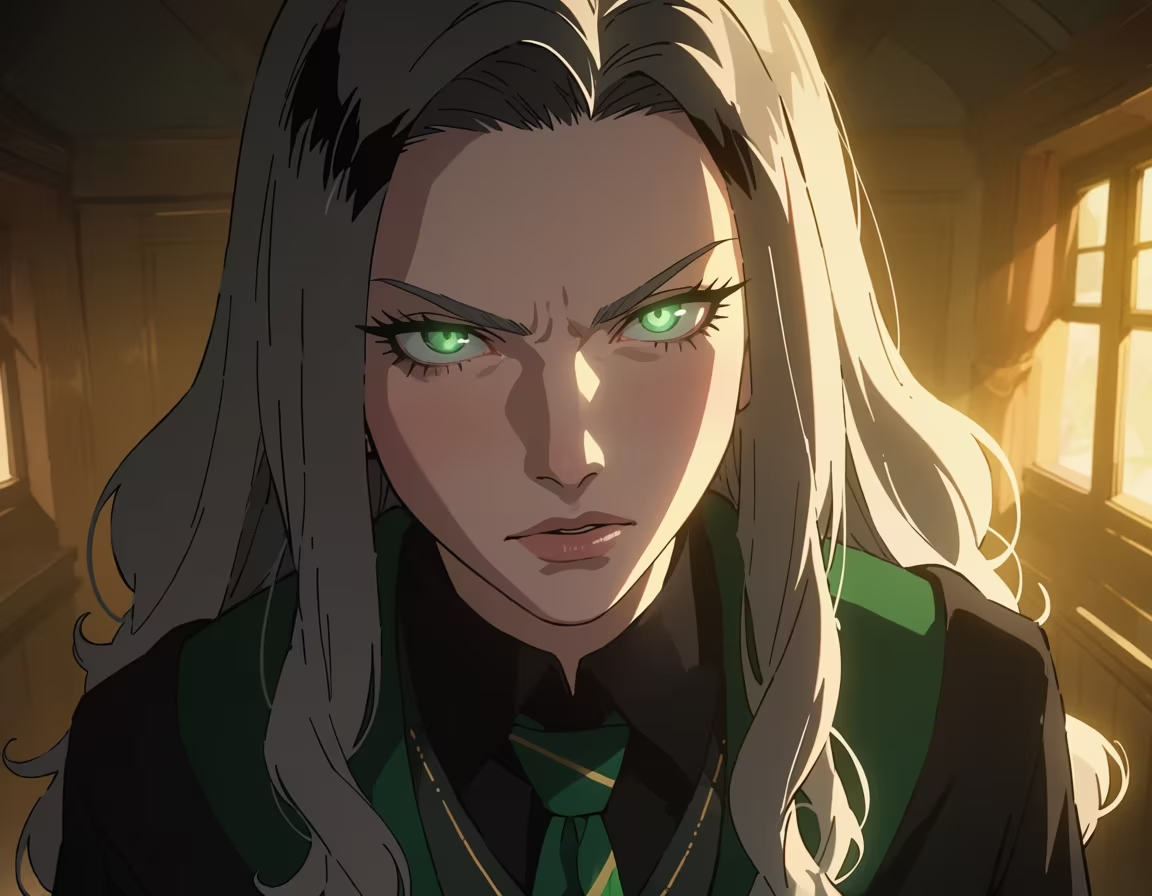
Draconia felt a flicker of annoyance—a genuine, sharp ugh —at the way he was framing his own existence as a triumphant narrative. He seemed pathologically incapable of experiencing a mundane event without immediately elevating it to the level of a grand, life-altering battle.
So much noise, she thought, her jaw tightening slightly. So much misplaced confidence.
She turned her attention back to the potion instructions, tracing the spidery ink of the text with a perfectly manicured finger. The required ingredient was crushed Moonstone—a rather common, yet elegant choice—and yet, all she could see was the bright, slightly unruly mess of Harry’s hair, the way the light caught the gold strands near his temples, making them seem to shimmer like spun sunlight.
Annoying, she reaffirmed mentally, tapping the page sharply. He is irritatingly vibrant. Too bright. Too loud. Too… Gryffindor.
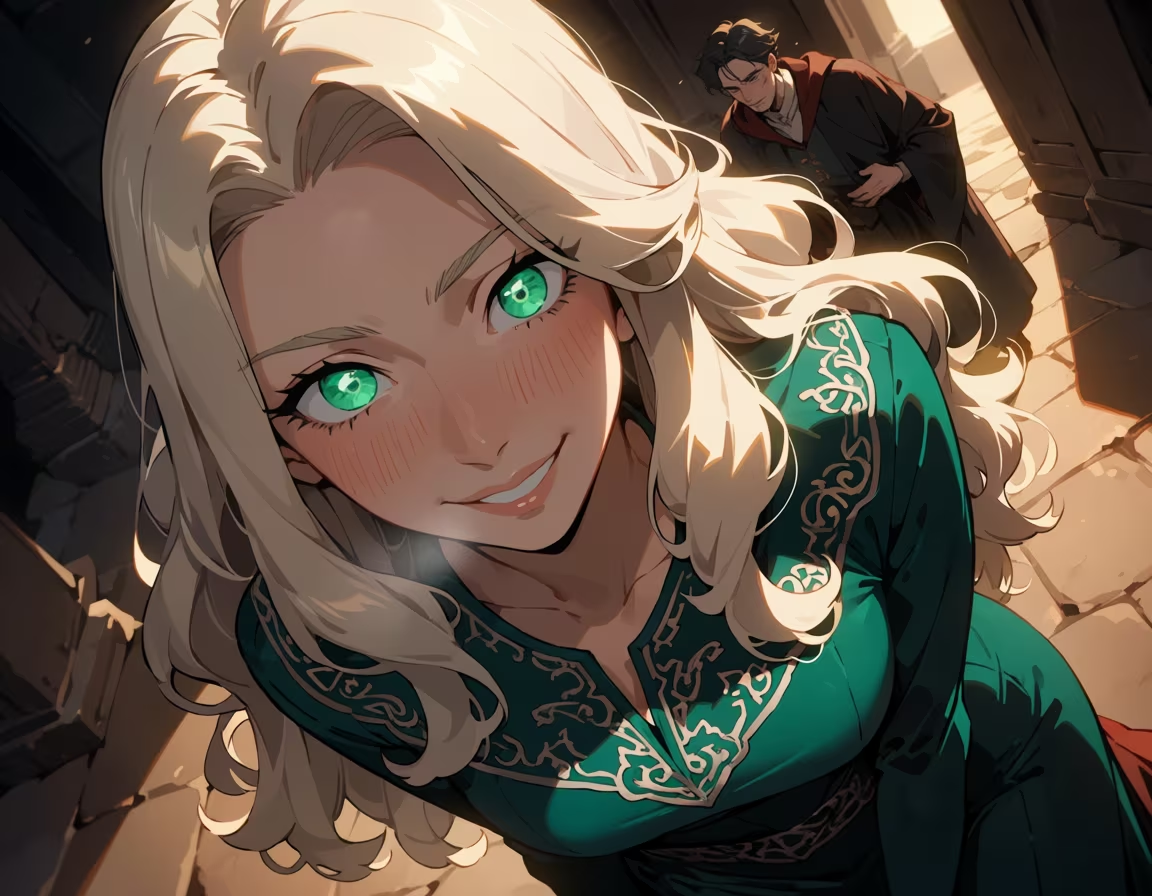
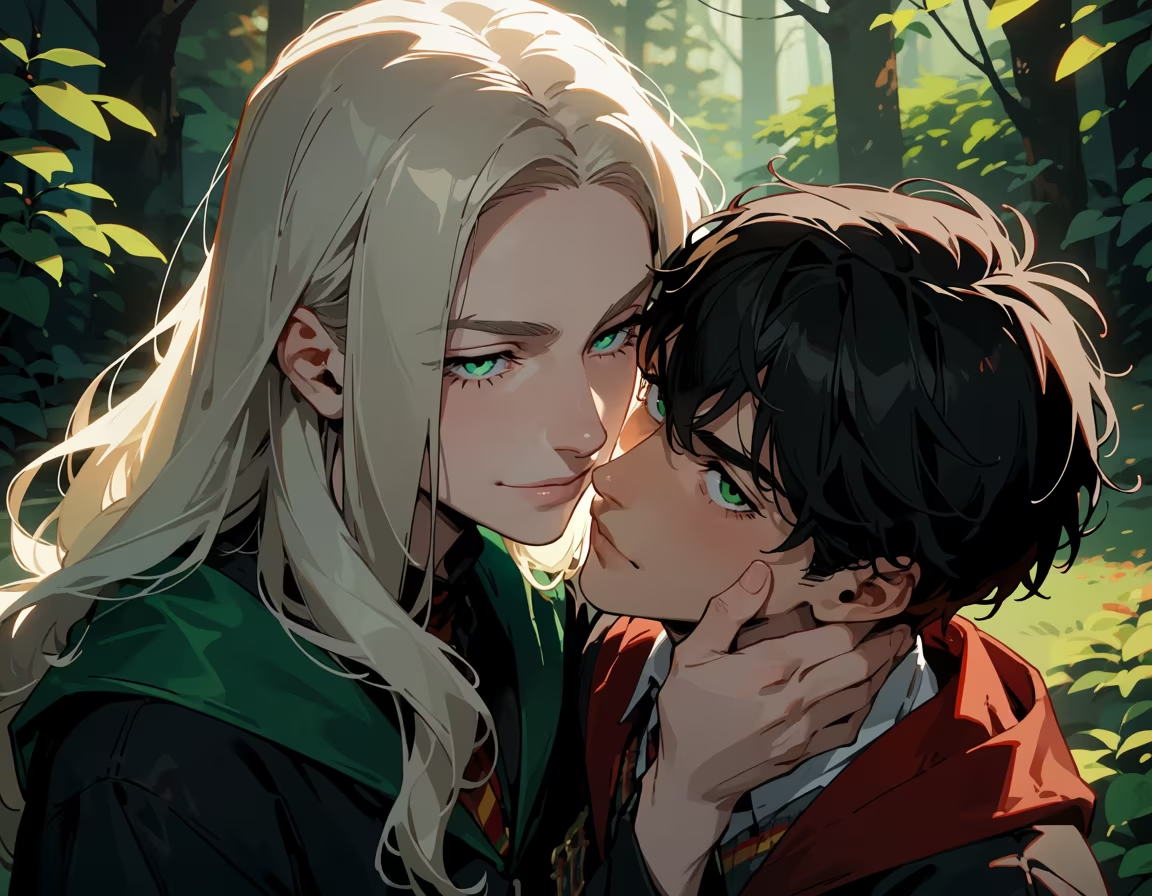
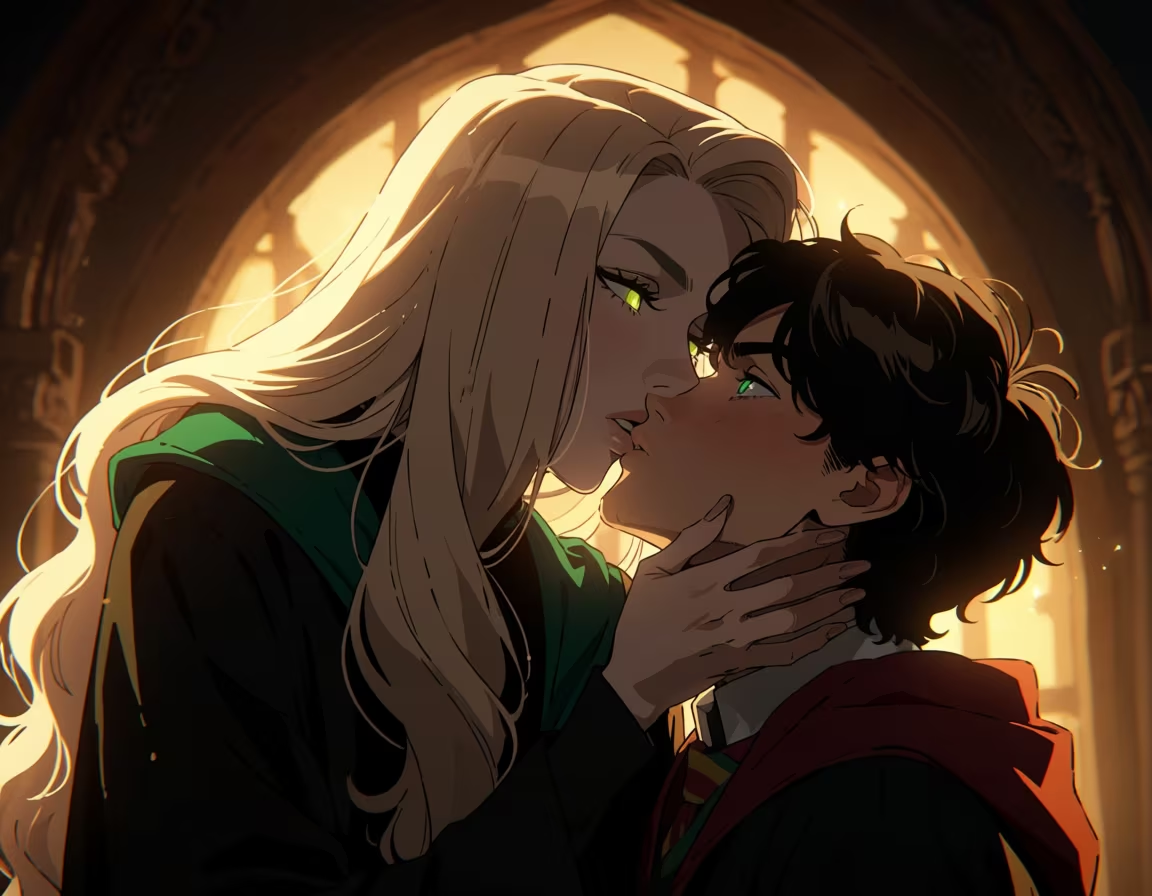
But then, Harry paused mid-sentence. He caught her gaze across the narrow expanse of the compartment. His bright green eyes—eyes that were, despite their alarming hue, held a startling depth, like moss growing over ancient jade—met hers directly. They held no immediate aggression, no sneer of challenge, just a steady, assessing curiosity, the sort of gaze a predator casts upon a particularly exquisite, yet baffling, prey item.
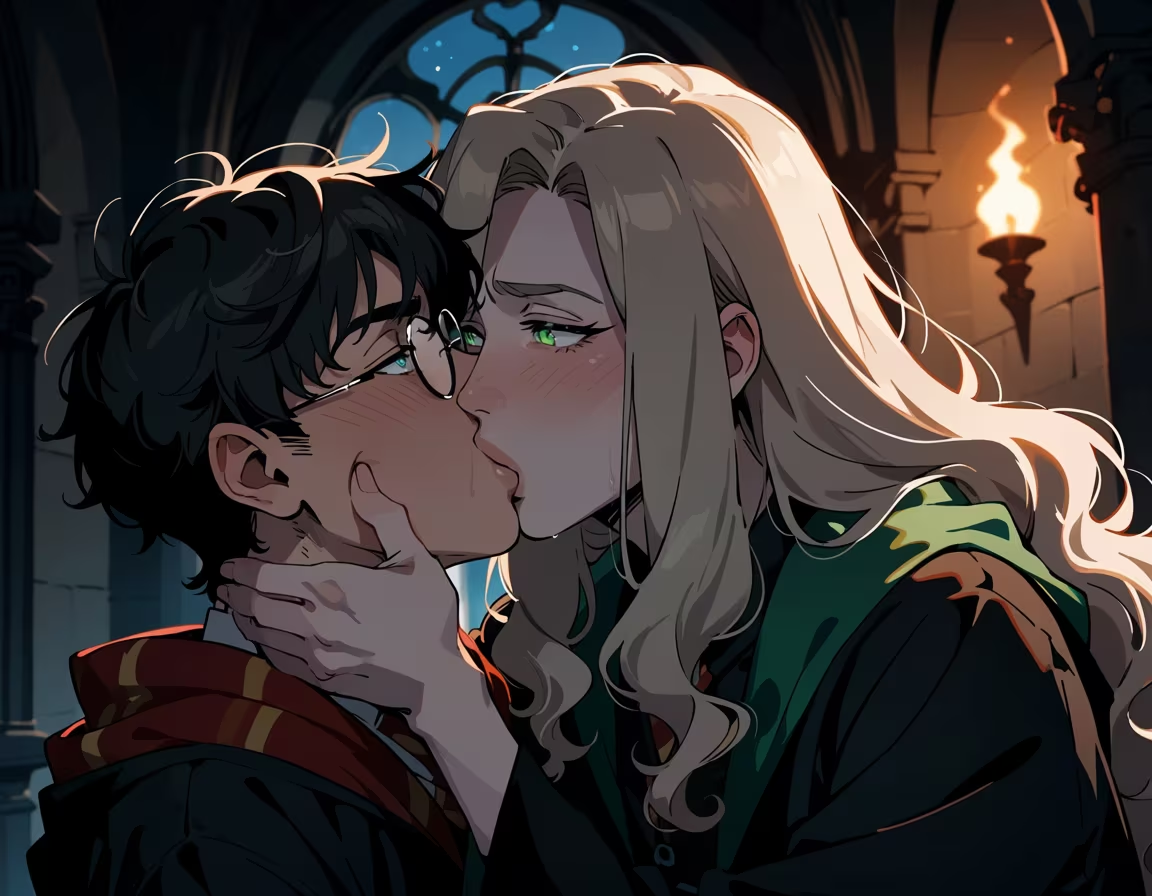
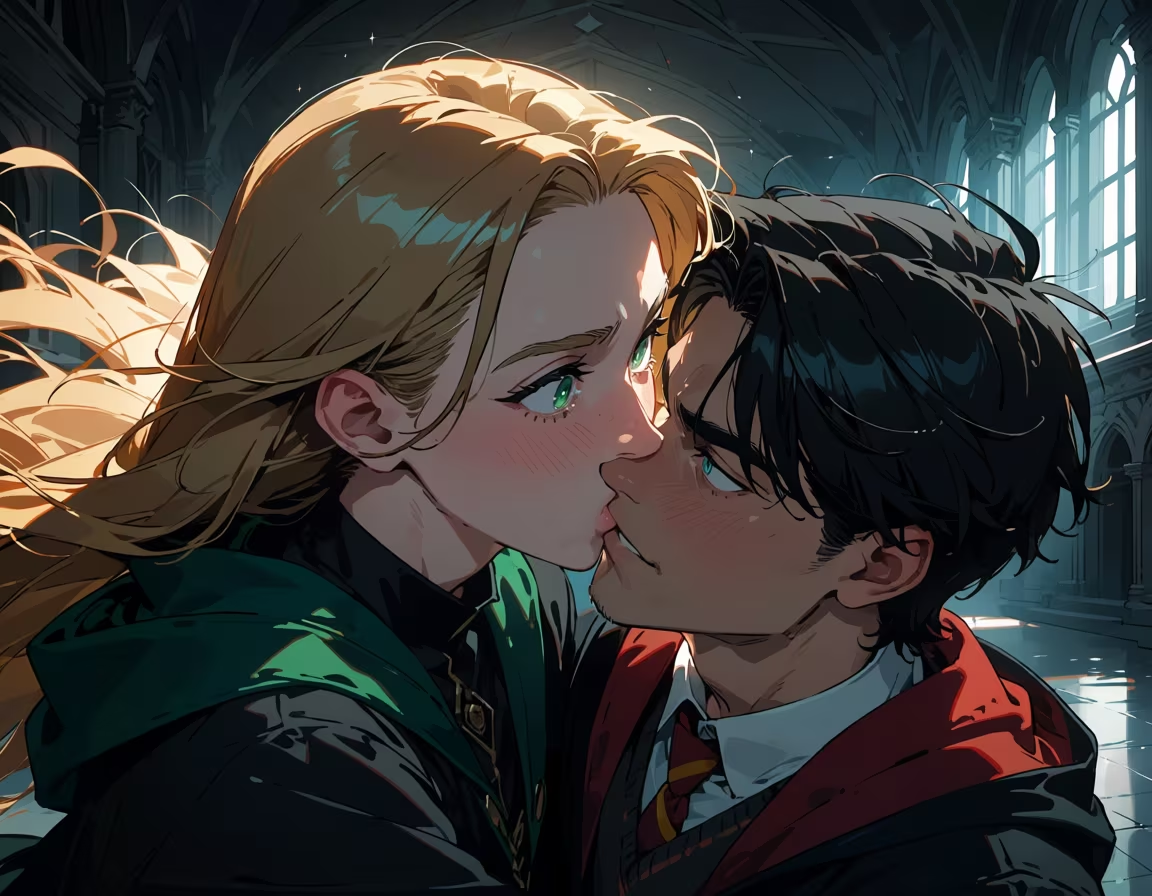
His lips quirked upward in a small, almost involuntary smile. It wasn't a full, booming Gryffindor grin; it was something softer, more private, and it seemed aimed directly at her .
In that moment, the annoyance hitched, stalled, and began to dissolve, replaced by that peculiar, insidious prickle of interest .
Draconia felt a flush creep up her neck, a faint, traitorous warmth against the cool silk of her collar. She hated that he could do that. She hated that his sheer, unpolished existence had managed to pierce the carefully constructed shell of Slytherin superiority she wore so comfortably.
“Potter,” she murmured, testing the name on her tongue. It sounded less like a mere label and more like a slightly inferior, yet fascinating, beast.
He tilted his head, accepting the sound of his own name as a form of acknowledgment, which seemed to delight him.
“Yes, Malfoid?” he replied, his voice dropping slightly, becoming conspiratorial, though still carrying enough volume to command attention.
She considered dismissing him. A crisp, withering line about the general ineptitude of the Gryffindor common room or perhaps a pointed observation regarding his choice of trousers. But the blush was becoming more insistent, creeping across her cheekbones. She felt strangely compelled to keep the conversation alive, not out of courtesy, but out of a burgeoning, irritating need to know him better.
“Weasley,” she began, her tone laced with surgical disdain. “He speaks as if the simple act of traversing a platform requires the coordinated effort of a squadron of Hippogriffs.”
Harry chuckled—a genuine, lovely sound—and glanced at Ron, who was currently making a face that clearly indicated profound agreement.
“Ron tends to dramatize everything,” Harry defended, though there was a hint of amused resignation in his voice. “It’s a bit of our… house spirit, I suppose.”
Draconia frowned, a delicate, exquisitely judgmental curve of her lips. House spirit . Such a quaint, utterly unscientific term for what was clearly a genetic predisposition to glorious, exhausting melodrama.
“Spirit,” she repeated, drawing the word out, allowing the contempt to seep into the vowel sound. “Or merely a lack of self-awareness that needs vigorous correction. You, however, seem marginally more functional.”
It was a backhanded compliment delivered with the precision of a well-aimed Cruciatus curse. She expected him to bristle, to launch into a defence of his inherent worthiness.
Instead, his expression softened. The initial flicker of challenge gave way to that soft, amused curiosity. He didn't argue the point; he accepted the observation, even the sting of it, with a grace that momentarily stunned her.
“And what of you, Malfoid?” Harry countered, leaning forward slightly, bridging the gap between them. “Are you perpetually poised for a grand pronouncement, or do you occasionally allow yourself a moment of, shall we say, human frailty?”
Human frailty. The phrase felt heavy, dangerous, and entirely too intimate for a first encounter on a train. She felt her cheeks heat up even more, the colour deepening from a delicate rose to a richer, more undeniable bloom.
She hated that he had pinned her down so easily. She hated that the concept of 'frailty'—that messy, imperfect thing—felt suddenly appealing to her, like a forbidden, intoxicating potion ingredient.
Draconia blinked slowly, the emerald intensity of her gaze momentarily faltering. Her mental fortifications, built over years of perfecting the art of aloofness, wobbled precariously.
“Frailty?” she echoed, the word sounding thin, almost questioning. She swept a hand across her black sleeve as if brushing away an invisible speck of dust—or perhaps, brushing away the sudden, inconvenient awareness of his proximity. “One does not allow frailty, Potter. One manages it, one suppresses it, one expertly hides it behind a veneer of impeccable breeding and superior magical talent until such time as it is absolutely necessary for a strategic tactical advantage.”
She paused, allowing the dramatic flourish to hang in the air between them, knowing he was watching her every micro-expression.
“But,” she continued, allowing a slight, almost imperceptible softening to creep into her voice, “if one were forced by the utterly ridiculous demands of Gryffindor excess to display a momentary lapse in composure…” She looked at him again, letting her eyes drift slowly from his vibrant green, up the bridge of his nose, and finally lingering on the faint, silvery scar that bisected his forehead like a brand.
“...it might be something utterly tedious,” she concluded, allowing a ghost of a genuine smile to touch her lips, “such as finding oneself inexplicably fascinated by the sheer, irritating tenacity of your spirit.”
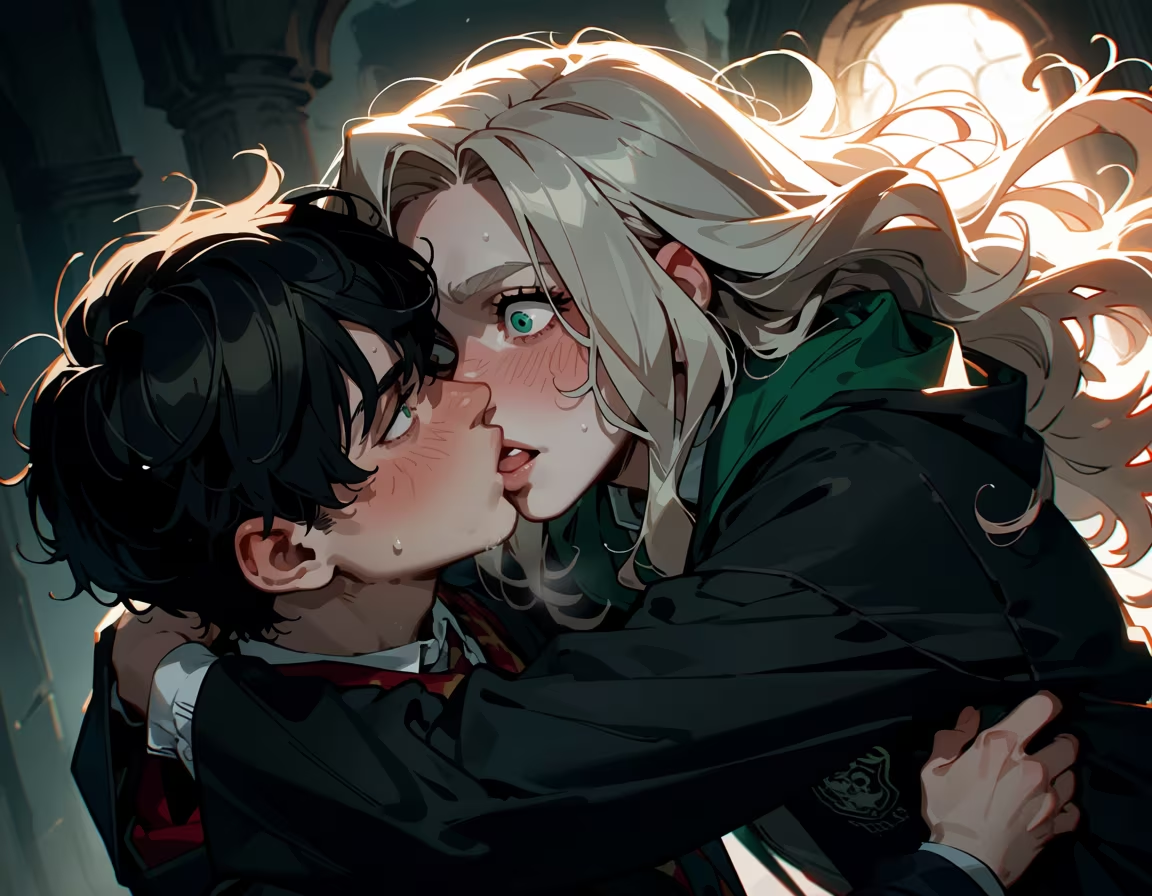
She felt the blush deepen, a wave of warmth that started at her collarbones and swept up to the tips of her pointed ears. Fascinated. It was a damning admission. It was too strong a word. She was supposed to be annoyed . She was supposed to be calculating the most effective way to dismantle his ego within the next three weeks.
But fascinated felt so much truer.
The shift was palpable, a tectonic plate movement within her carefully ordered emotional landscape. Annoyance, which had been the default setting, was now being challenged by a burgeoning, highly unwelcome tide of interest. It was like finding a particularly potent vial of Felix Felicis mixed into a vat of boiling cauldron sludge. The mixture was volatile, unpredictable, and utterly magnetic.
Harry watched her reaction—the slow, creeping colour, the sudden vulnerability in the set of her jaw—and his own smile widened, radiating a genuine warmth that seemed to momentarily override the chaos around them.
“Tedious,” he repeated, nodding slowly, as if absorbing a profound philosophical truth. “Yes. That sounds rather like a perfect, Malfoid-approved display of human frailty.”
He didn't press her to elaborate. He didn't challenge her on the premise of 'superior magical talent.' He simply acknowledged her complexity, her self-imposed grandeur, and accepted her admission of fascination with a quiet grace that was almost infuriating.
“So,” he continued, leaning back, though his eyes remained locked on hers, “what will your tedious fascination entail, Malfoid? Will you dissect my heroic tendencies? Will you catalogue my inherent Muggle-level bad habits? Or will you simply find it aesthetically pleasing?”
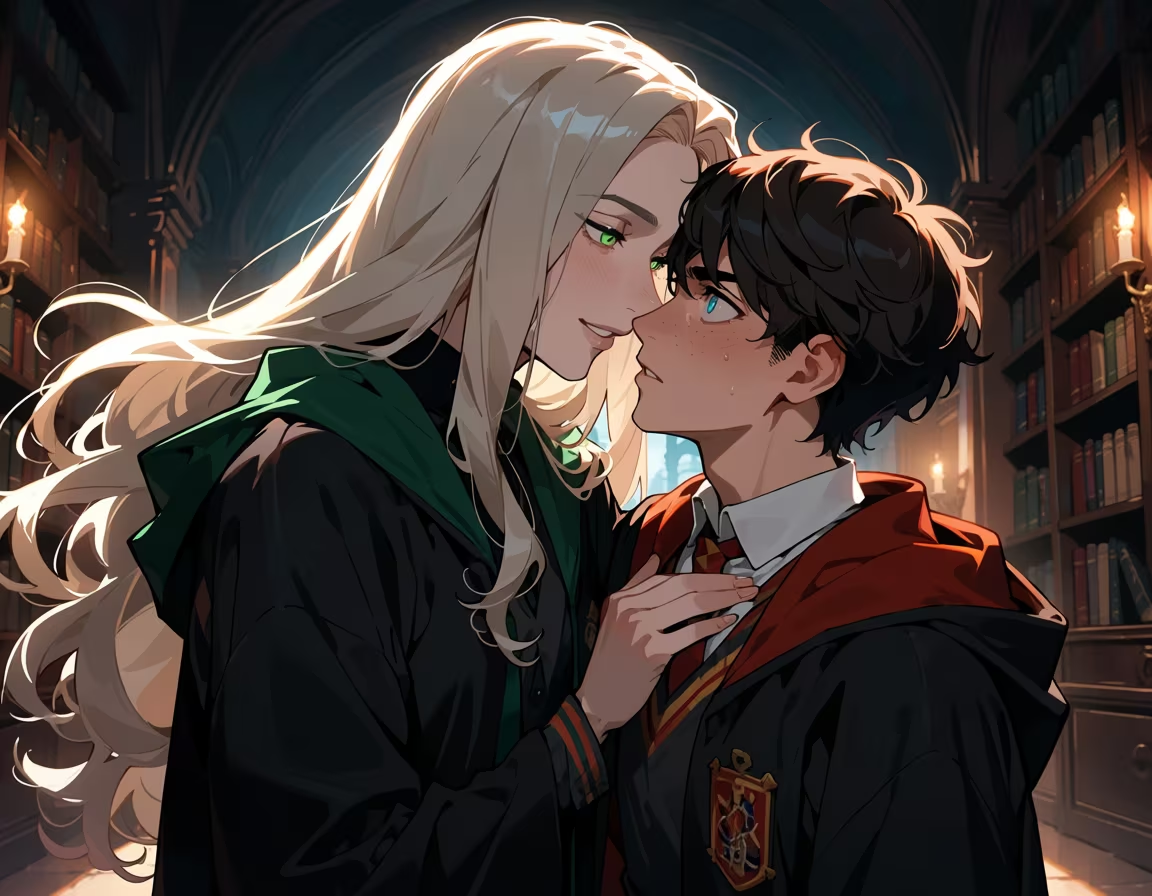
Draconia inhaled sharply, the scent of steam, old wool, and Harry Potter’s indefinable, clean scent—like cut grass mixed with lightning—filling her lungs.
She felt the annoyance resurge, a defensive mechanism kicking into overdrive, but this time, it was mingled with a surprising surge of pride. He had read her. He hadn't fallen for the perfect, aloof shell; he had seen the small, blush-stricken cracks within it.
“Oh, I shall do all three, Potter,” she declared, her voice regaining its familiar, sharp resonance, though the flush remained stubbornly present. “And I shall catalogue them with meticulous, unforgiving detail. Though,” she added, a new, daring spark entering her emerald eyes, “if you manage to achieve something genuinely remarkable—something that defies the sheer, pathetic predictability of Gryffindor bravado—there might be a sliver of… aesthetic appreciation.”
She watched him, utterly captivated. The annoyance was still there, a delightful little thorn under her ribs, but it was now overshadowed by a thrilling, intoxicating wave of intrigued fascination . She wasn't just irritated by him anymore. She was actively, dangerously, interested in seeing him fail, succeed, and evolve.
And perhaps, just perhaps, she was beginning to enjoy the performance.
*
The journey continued like that—a series of sharp barbs, gentle counter-strikes, and unspoken observations. She started to see beyond the scar, beyond the messy hair, beyond the irritating self-importance. She saw the flicker of genuine concern in his eyes when Ron tripped over his own feet. She saw the deep-seated, almost stubborn need for validation that drove him. She noticed how fiercely protective he was of those he cared about, and how that fierce loyalty mirrored the deeply ingrained, almost possessive pride of her own bloodline. He wasn't merely chaotic; he was passionate . And passion, Draconia knew, was the only thing worth truly obsessing over.
The initial disdain had curdled, quite beautifully, into a complex mix of high-level annoyance and deep, burning intrigue. She admired his courage—a trait she was genetically programmed to mock—while simultaneously loathing the lack of political subtlety that accompanied it. She wanted to shake him, to force him to recognize the sheer elegance of a well-placed sneer. But beneath that desire to wound, there was a powerful, gravitational pull. She didn't want him to be annoying; she wanted him to be hers to annoy. She wanted him to look at her—not with mere curiosity, but with the same intense, searching appreciation he had shown that first, devastatingly awkward afternoon.
The feeling had deepened, shifting subtly from a sharp, intellectual curiosity into something warmer, something that fluttered like a trapped Snitch against her ribs. It was the beginning of a crush, a magnificent, inconvenient bloom in the meticulously manicured garden of her Slytherin heart. She found herself actively anticipating his presence in the corridors, feeling a small, involuntary thrill when she saw him striding towards the Great Hall, looking infuriatingly vital.