| Home | The Lives of Velnin | Illustrated Fiction | Malfoid Art & Fiction | Book Blurbs | Contact |
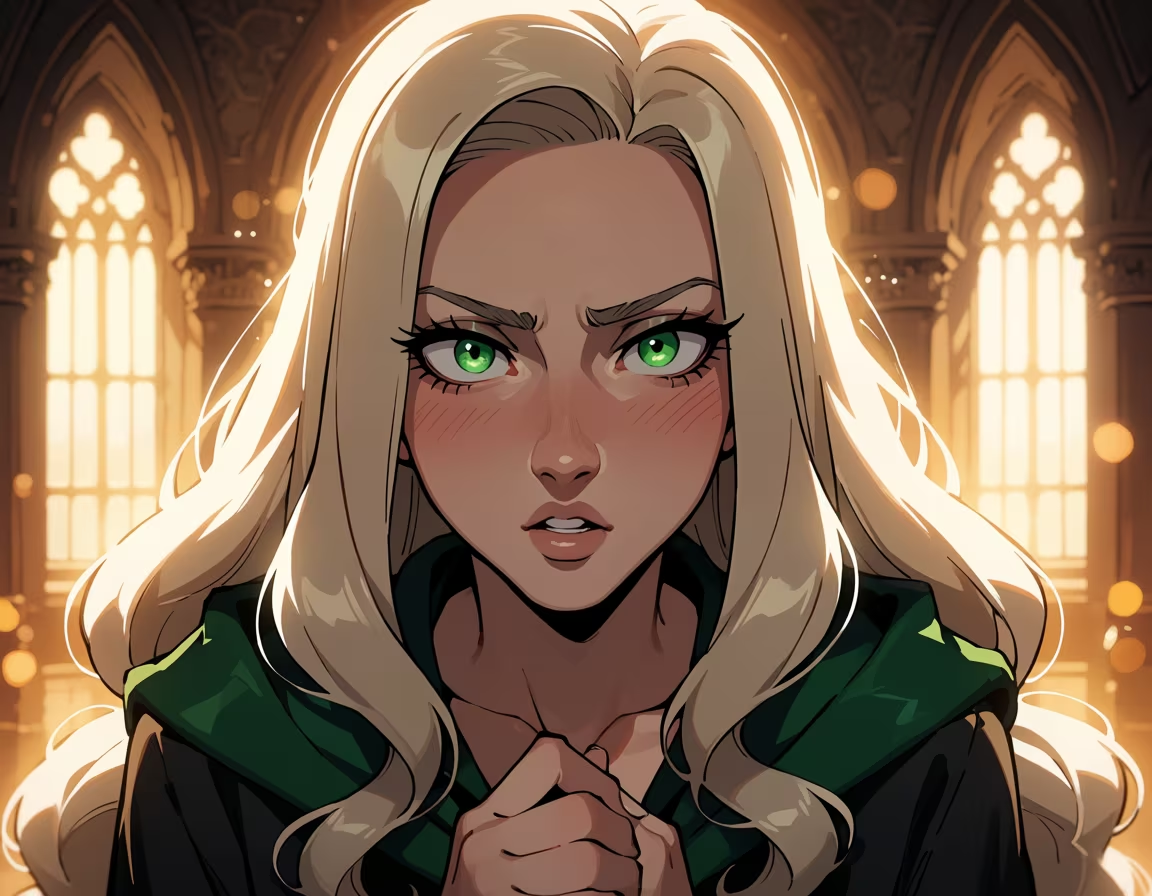
The light, oh, the glorious, damning light.
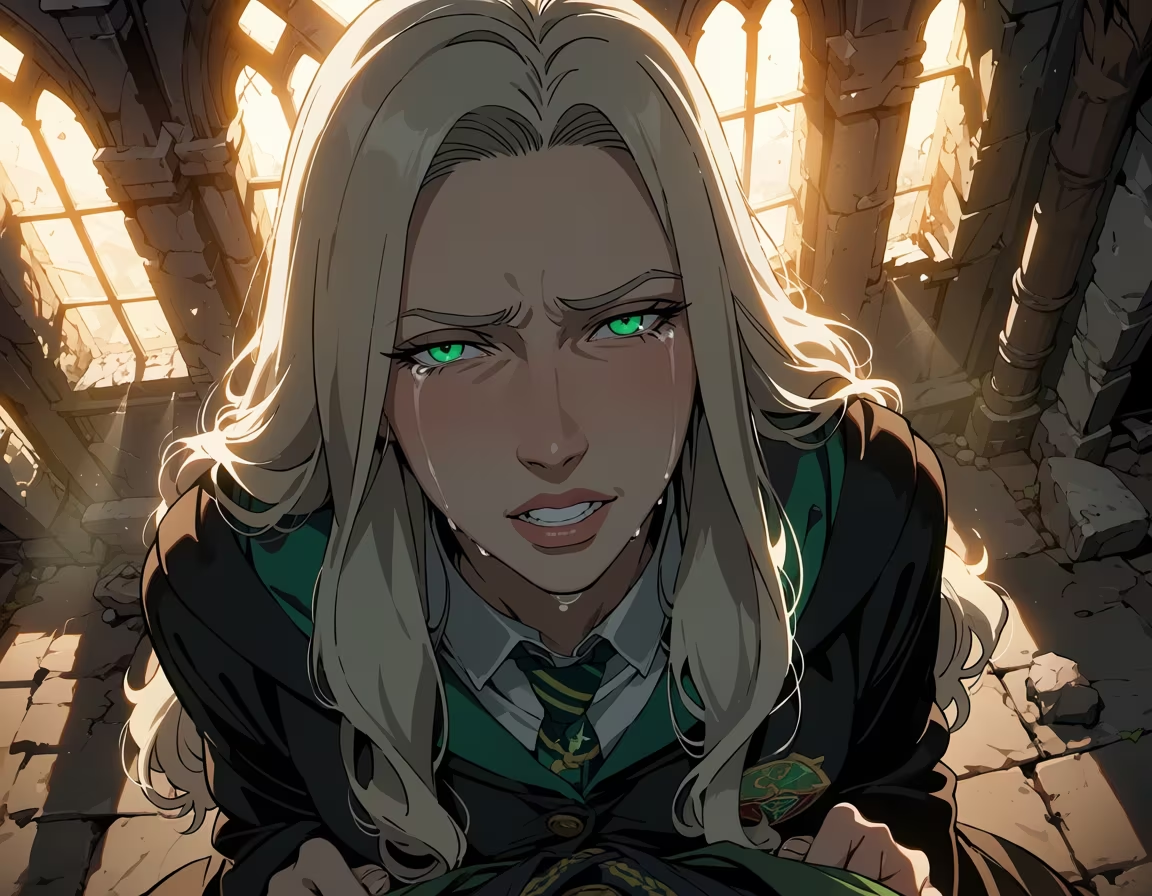
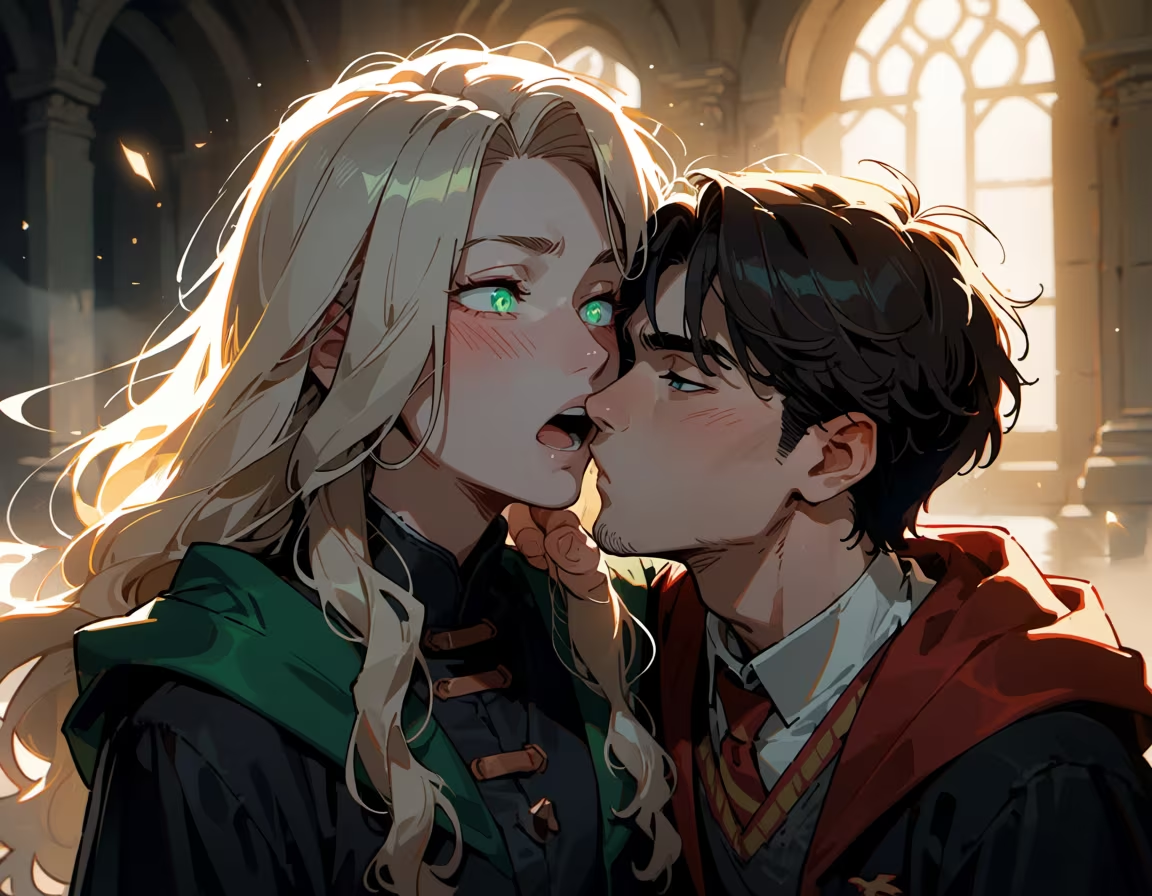
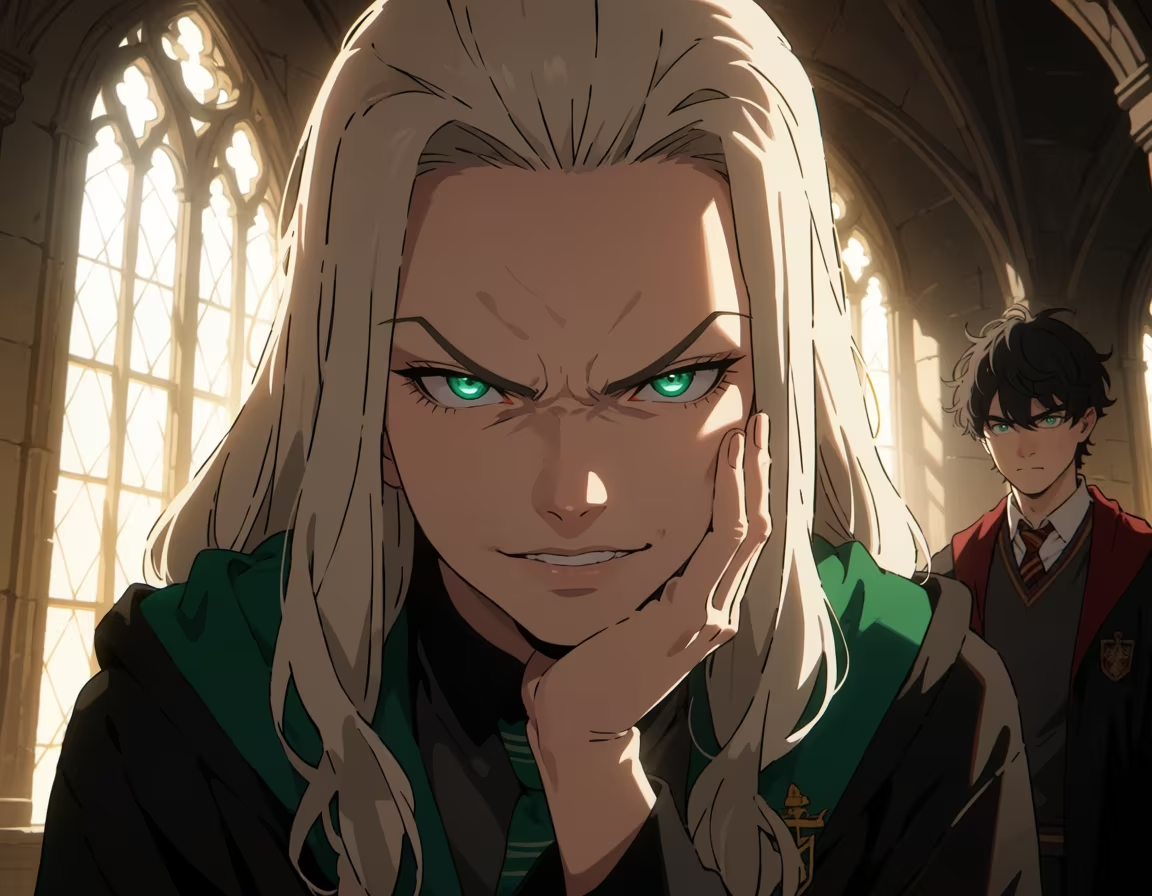
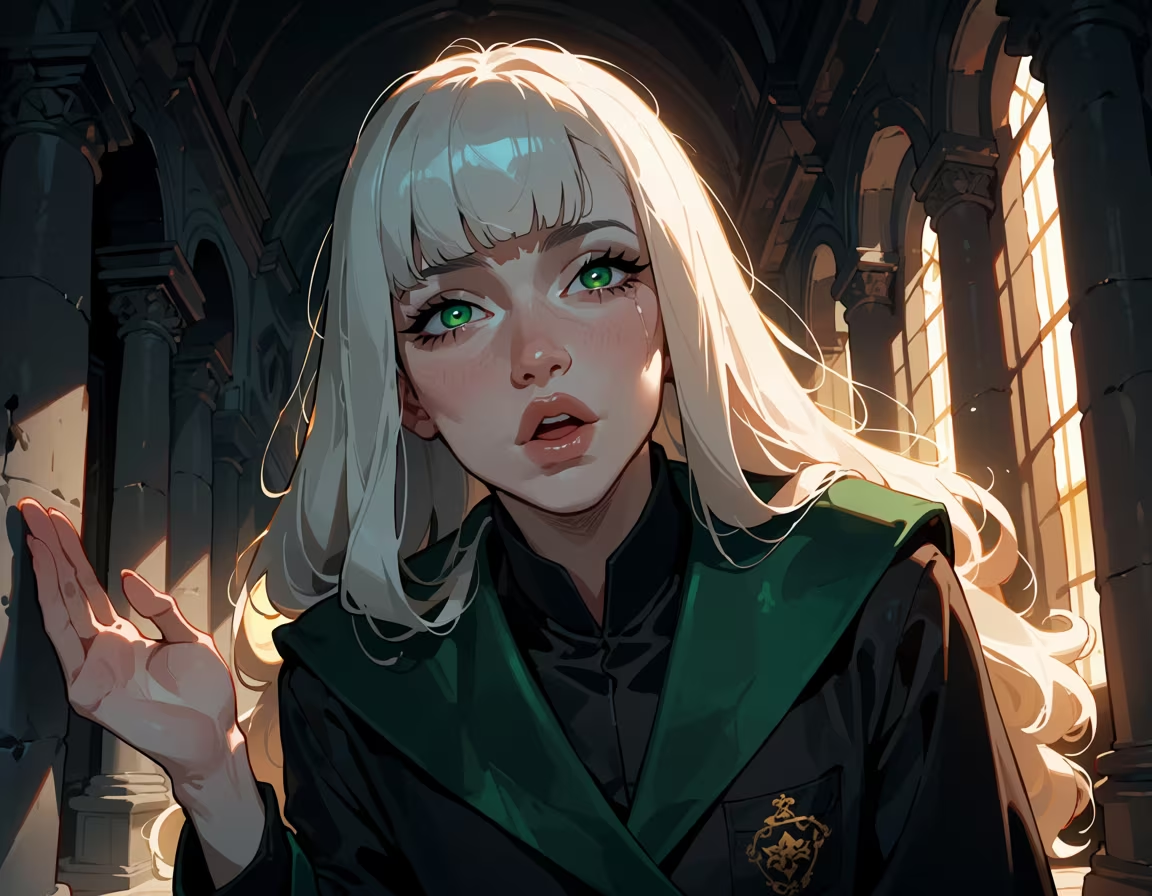
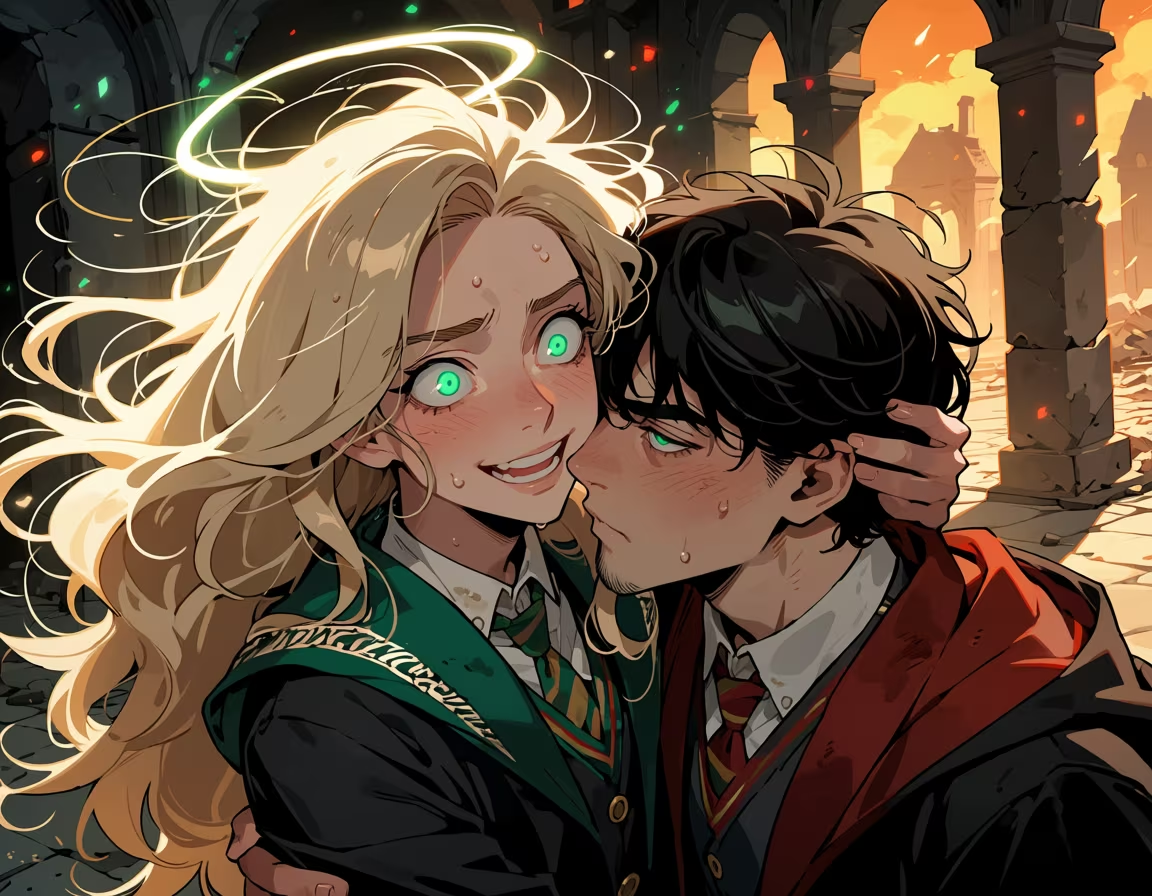
It streamed in through the towering, gothic arched windows of the Great Hall—windows that seemed to have been fashioned from solidified amber and etched with the delicate, swirling patterns of ancient protective charms. Dust motes, catching the brilliance, drifted like miniature, ephemeral spells, illuminating the dark, polished wood of the tables and the vibrant, chaotic tapestry of the student body. I stood near the entrance archway, ostensibly waiting for a moment of quiet reprieve before the clamour of the first feast descended upon us, but truly, I was frozen, caught in the sudden, blinding intensity of Harry Potter’s existence.
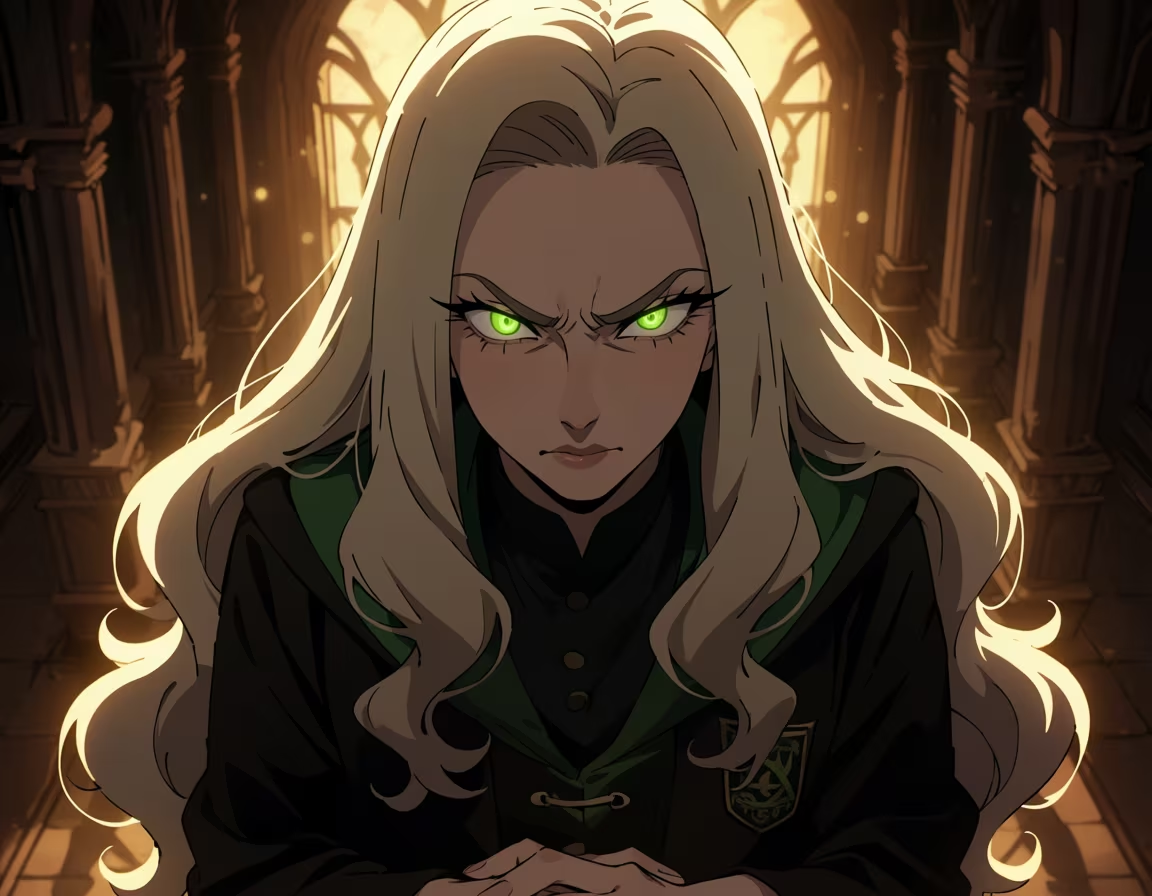
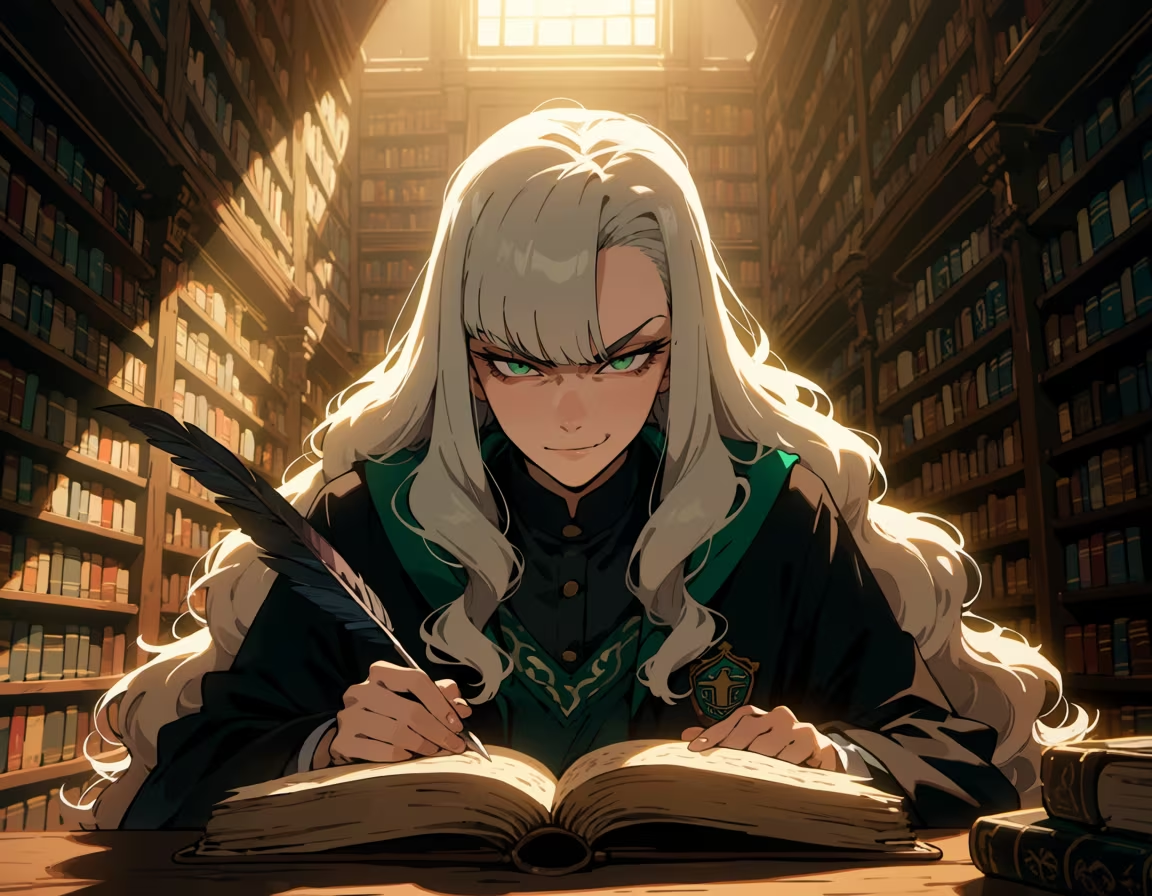
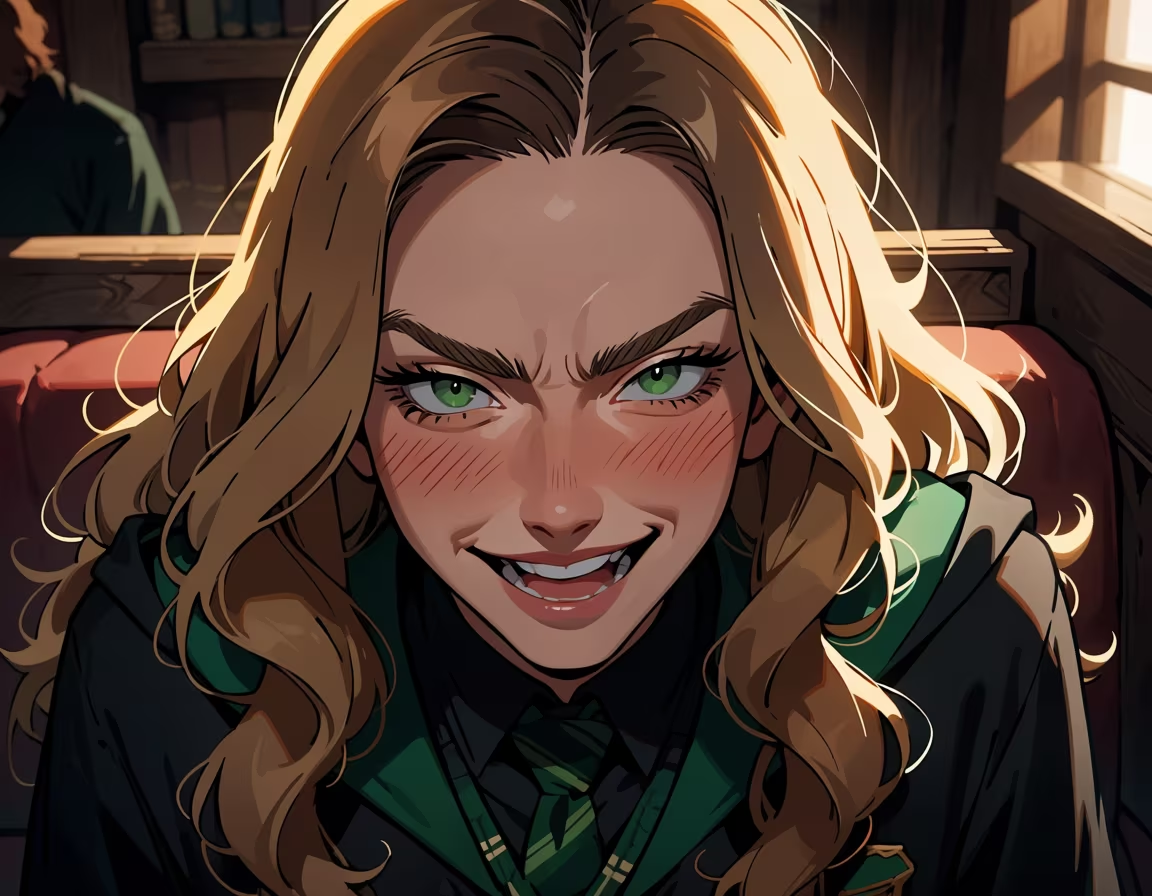
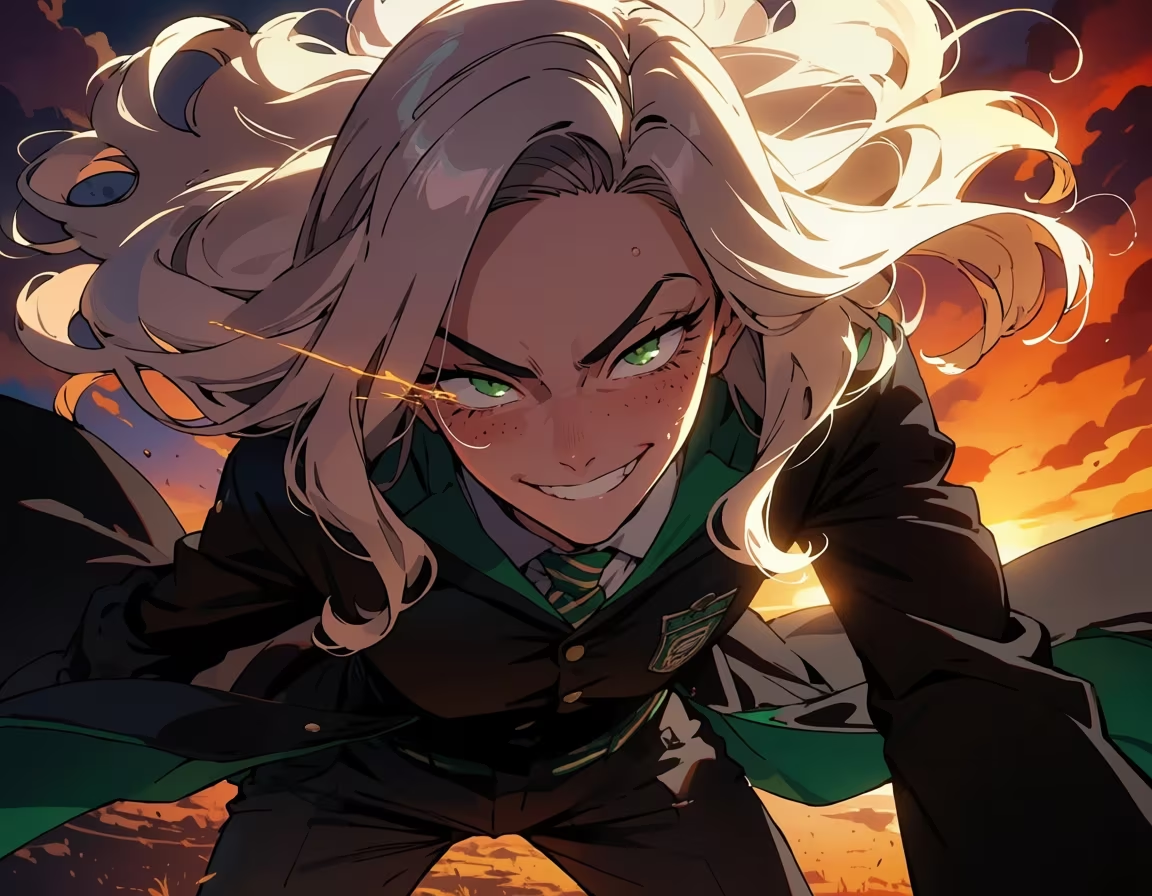
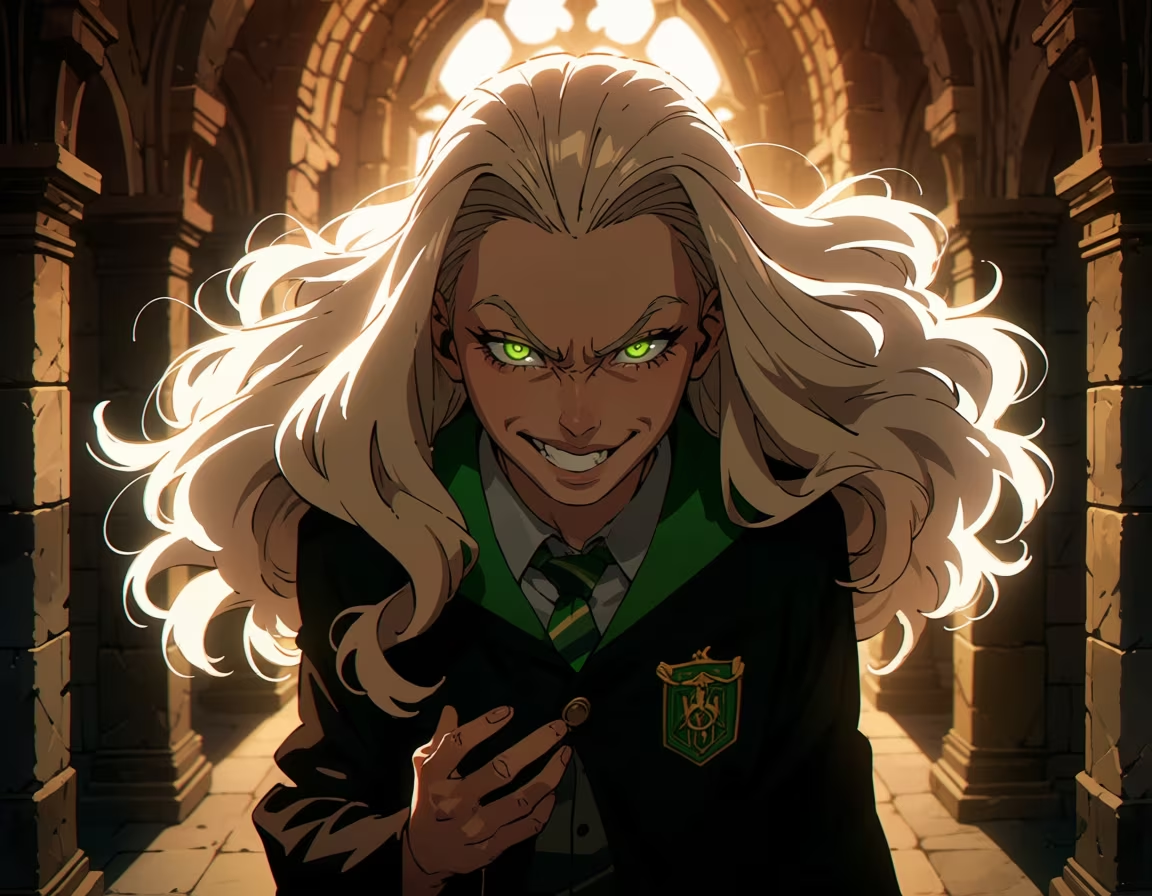
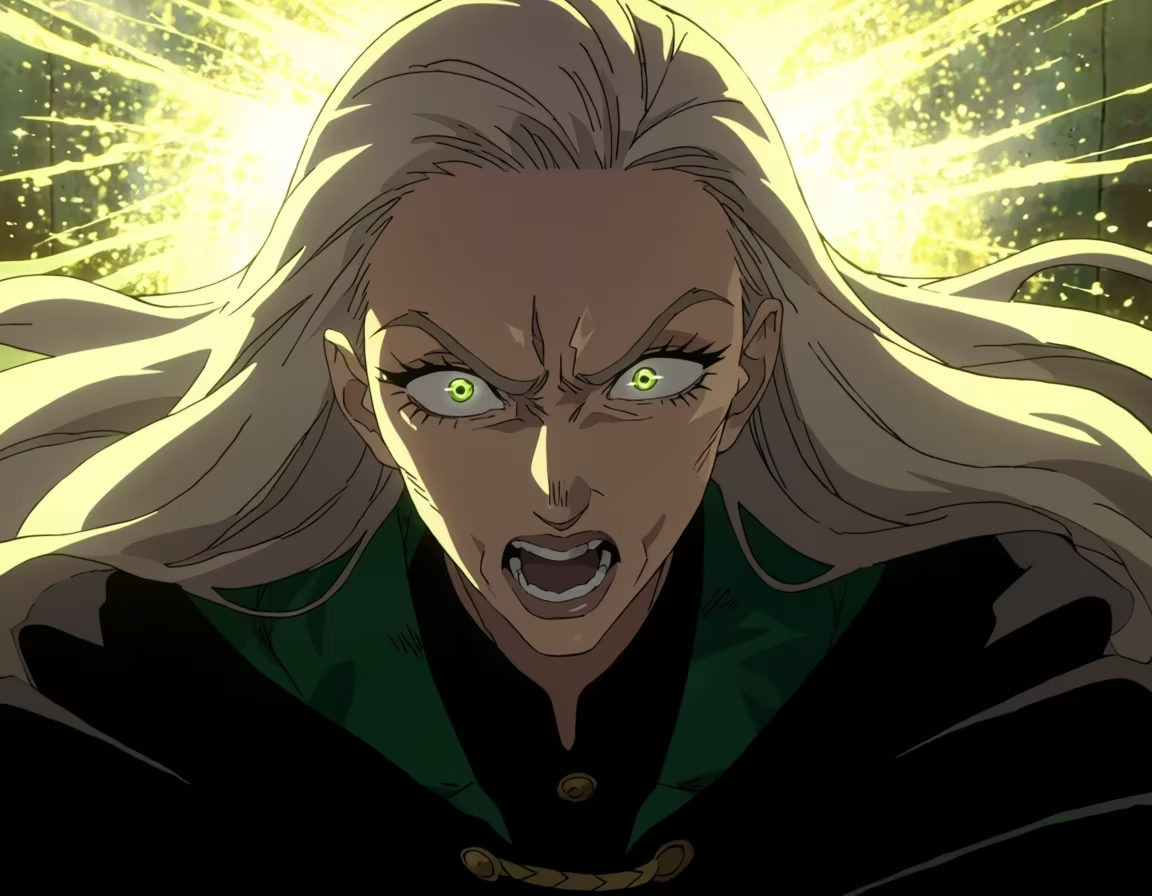
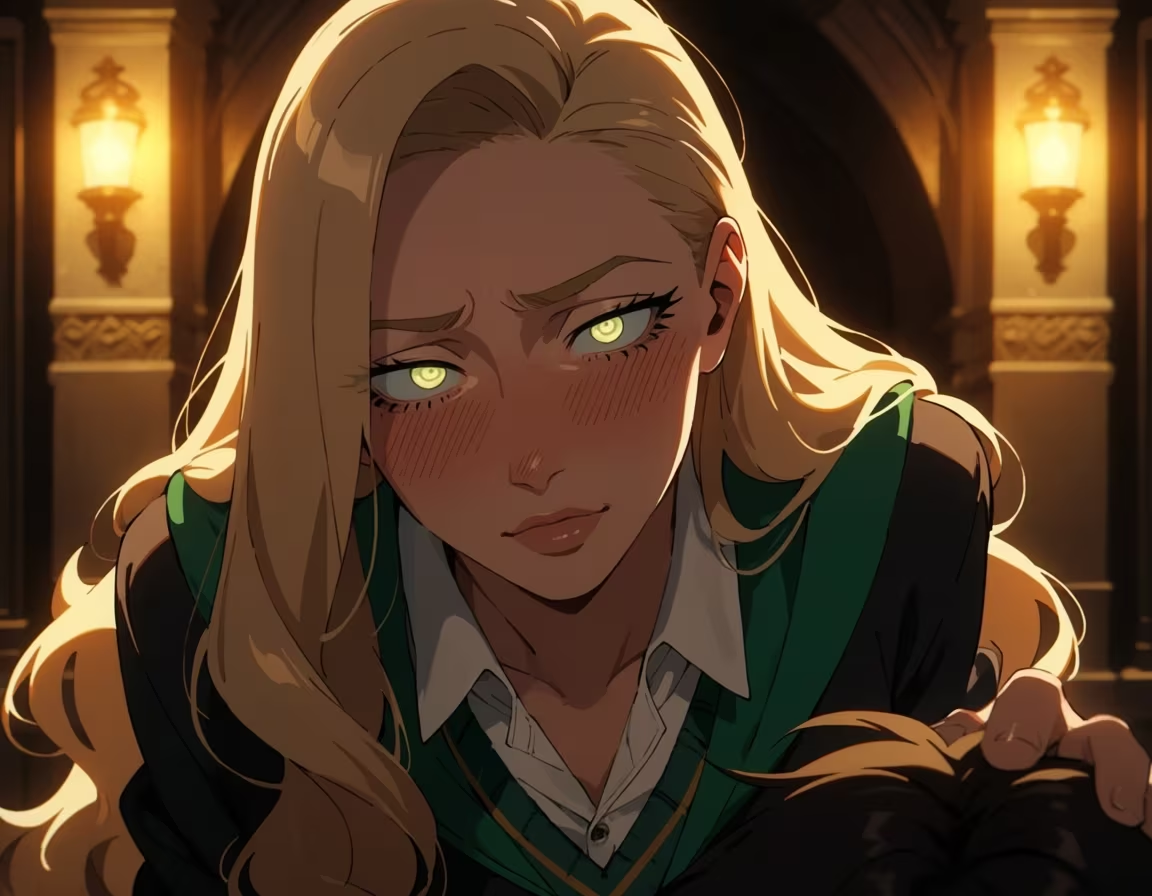
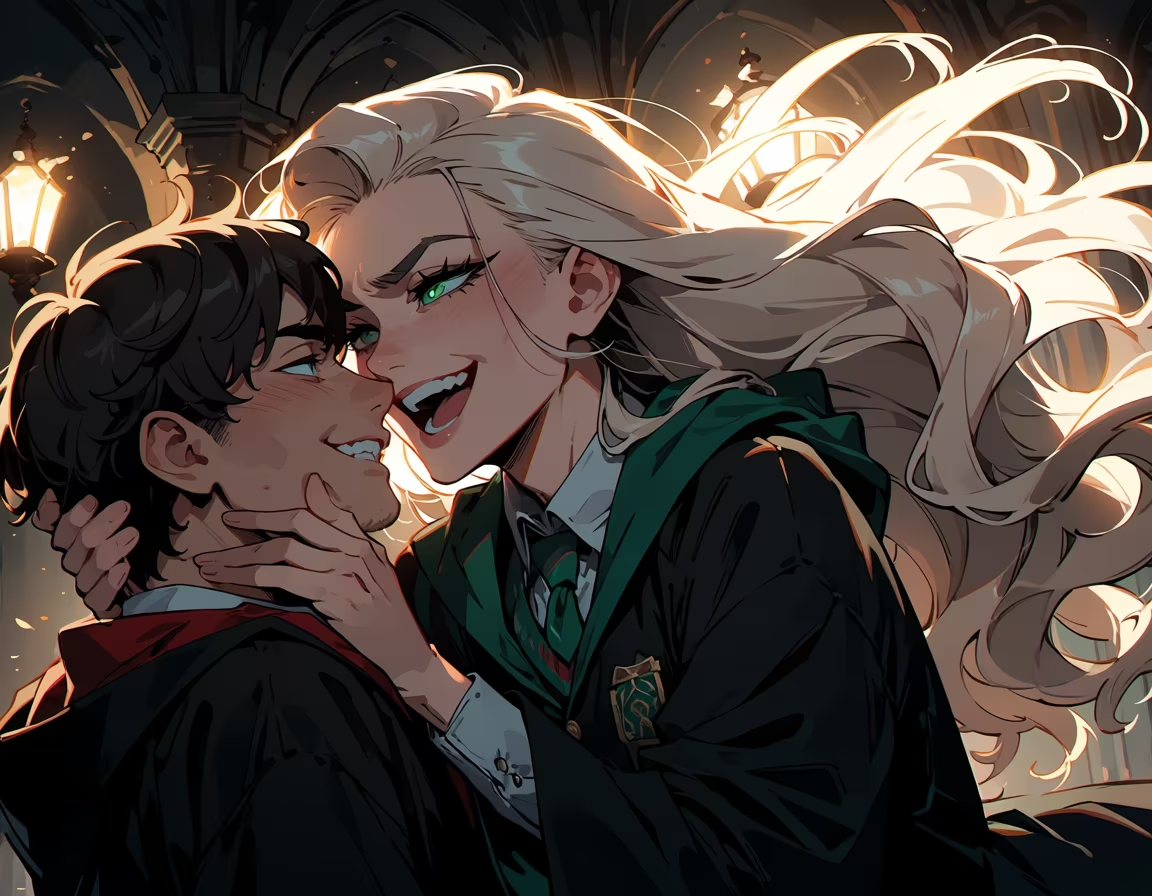
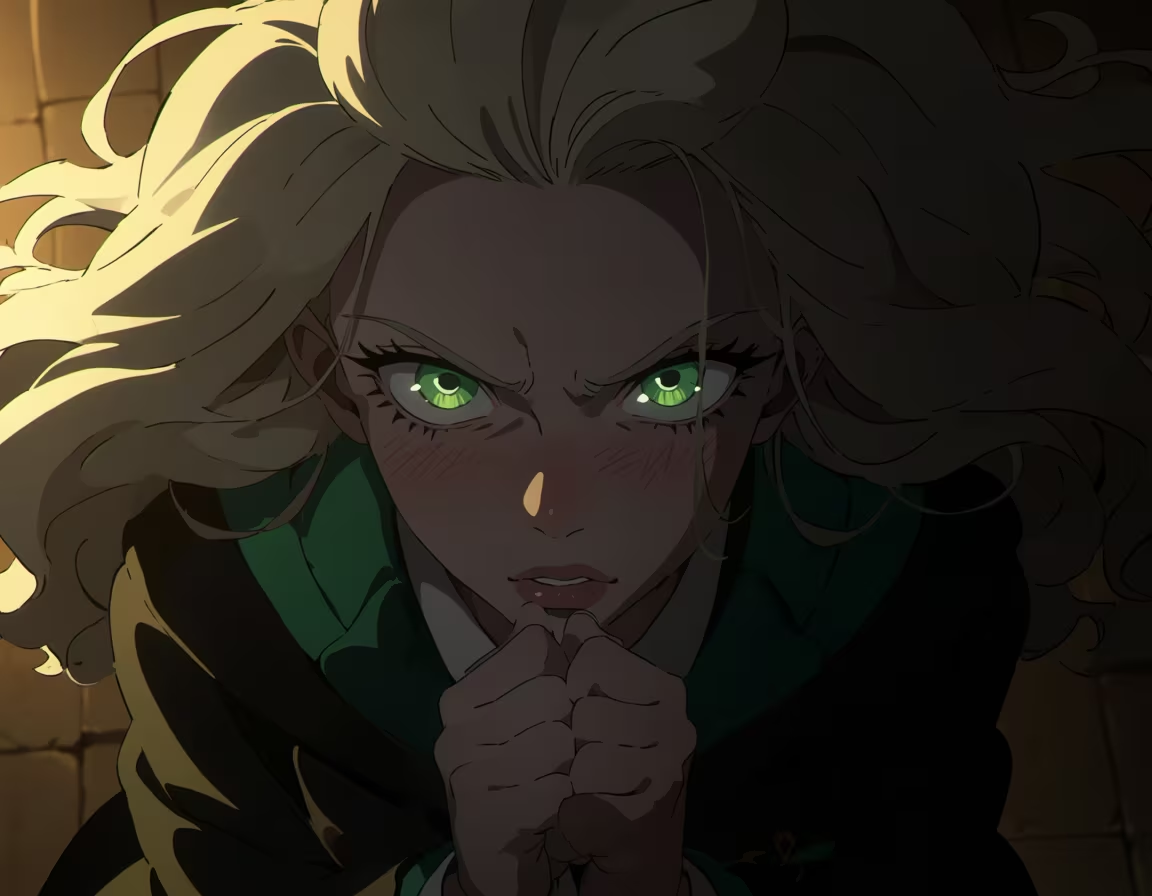
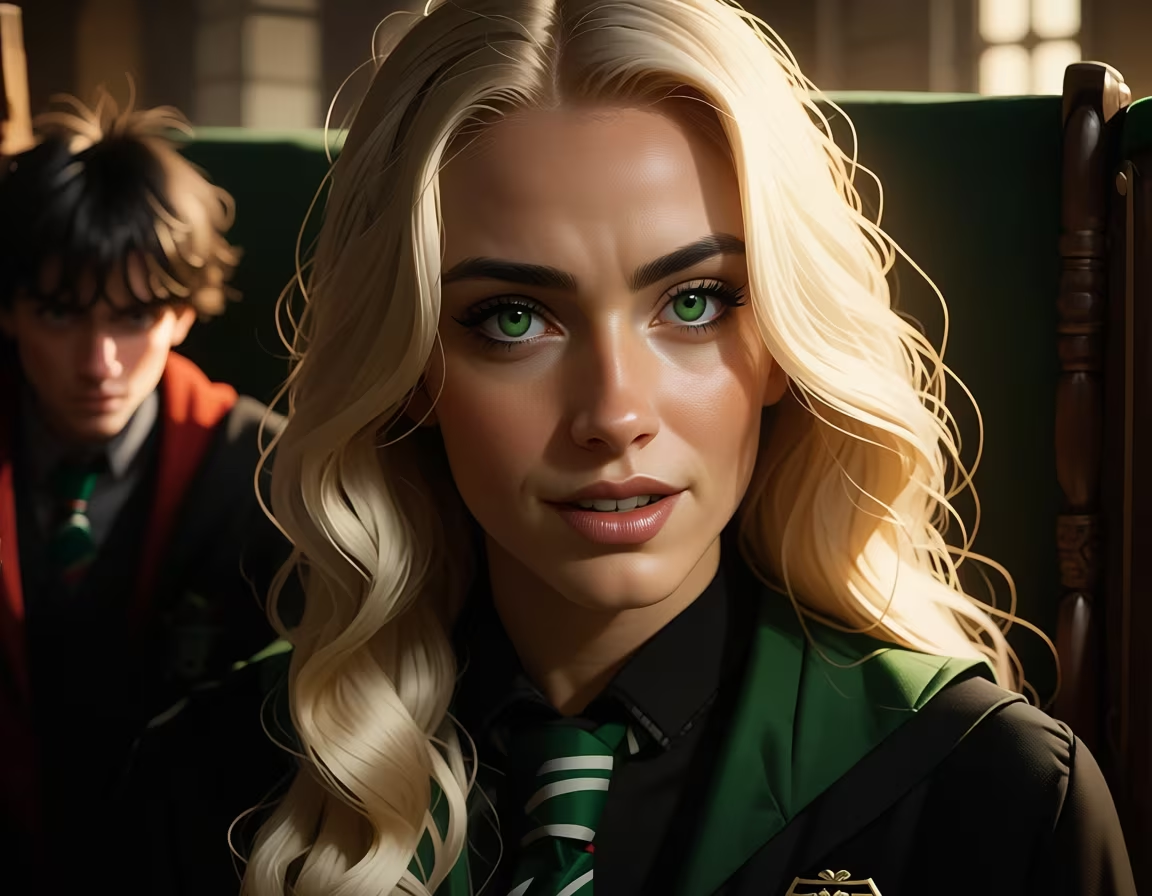
My own robes, heavy black velvet meticulously trimmed with the deepest, richest Slytherin green, seemed to absorb the light, making the emerald depths of my eyes appear even more startlingly vivid—a perfect match, one thought smugly, though perhaps inaccurately, and yet, perfectly, for the house colours. My long, pale blond hair, which usually fell in disciplined, glossy waves past my waist, felt suddenly restless, as if the sheer kinetic energy emanating from the boy across the hall was trying to pull it loose.
He had, of course, done something.
It was not a monumental feat of spellcasting, nor was it a strategic political maneuver, though those were his usual hallmarks of disruptive grandeur. No. It was something infinitely more infuriating, more baffling, and yet, devastatingly attractive.
He had, in the span of perhaps ten heartbeats, managed to somehow charm the entire Gryffindor table into an impromptu, dramatic toast to himself , using only a flick of his wand and a rather saccharine, utterly unwarranted flourish. The resulting noise—the clinking of silverware, the whoops of approval, the triumphant roar of Ron Weasley—was deafening.
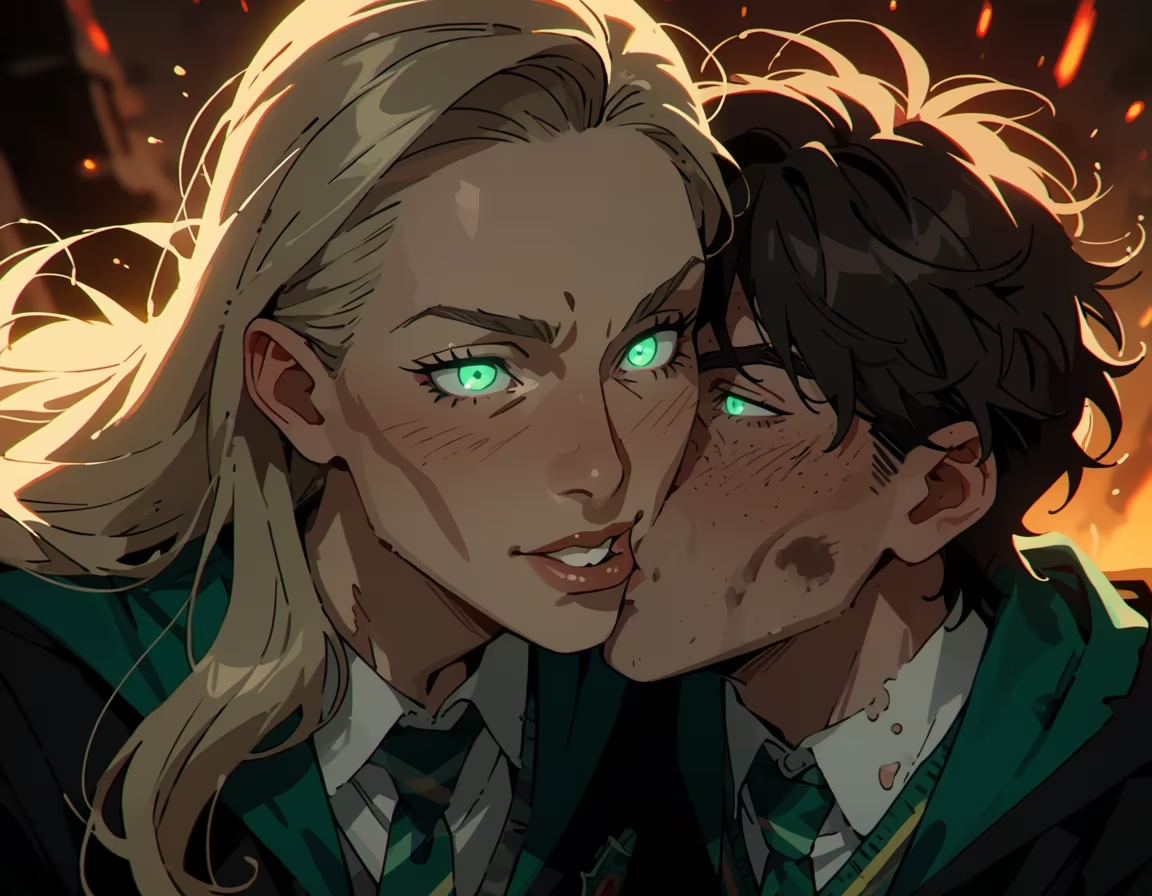
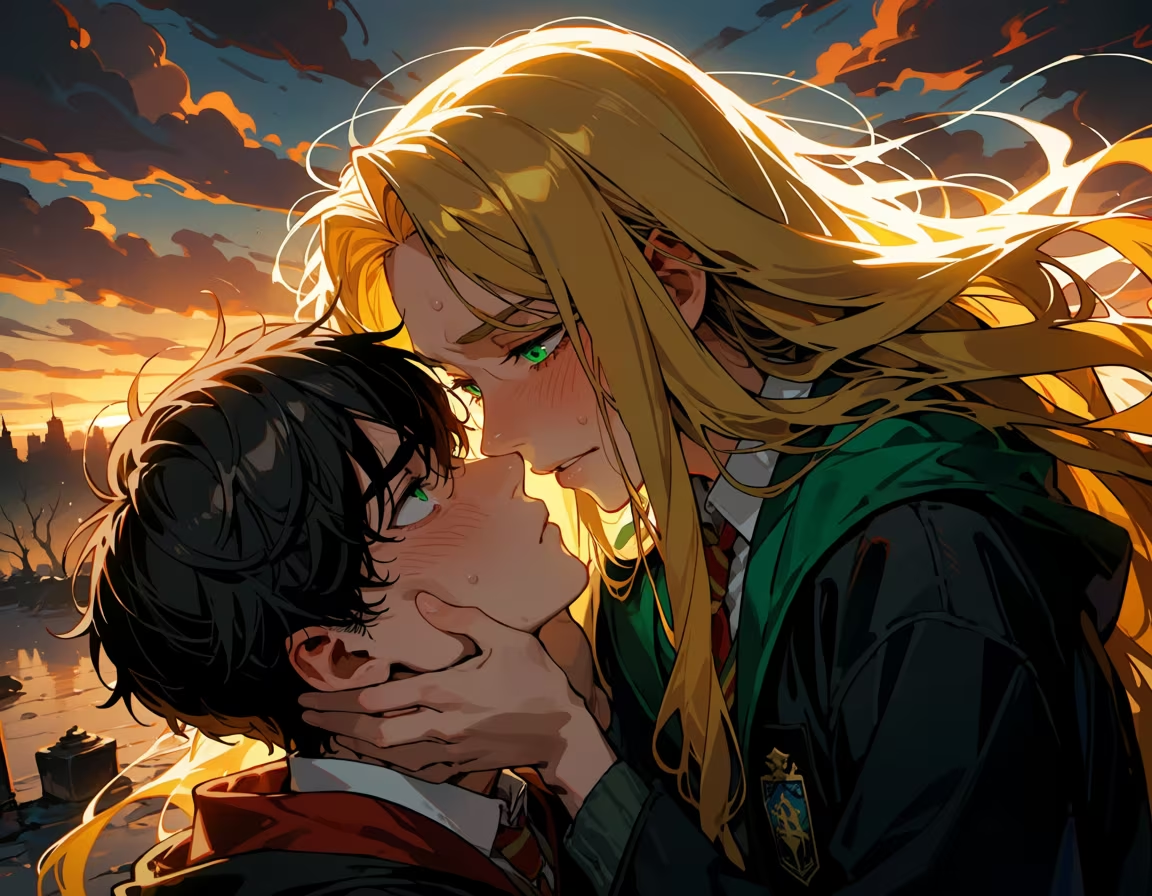
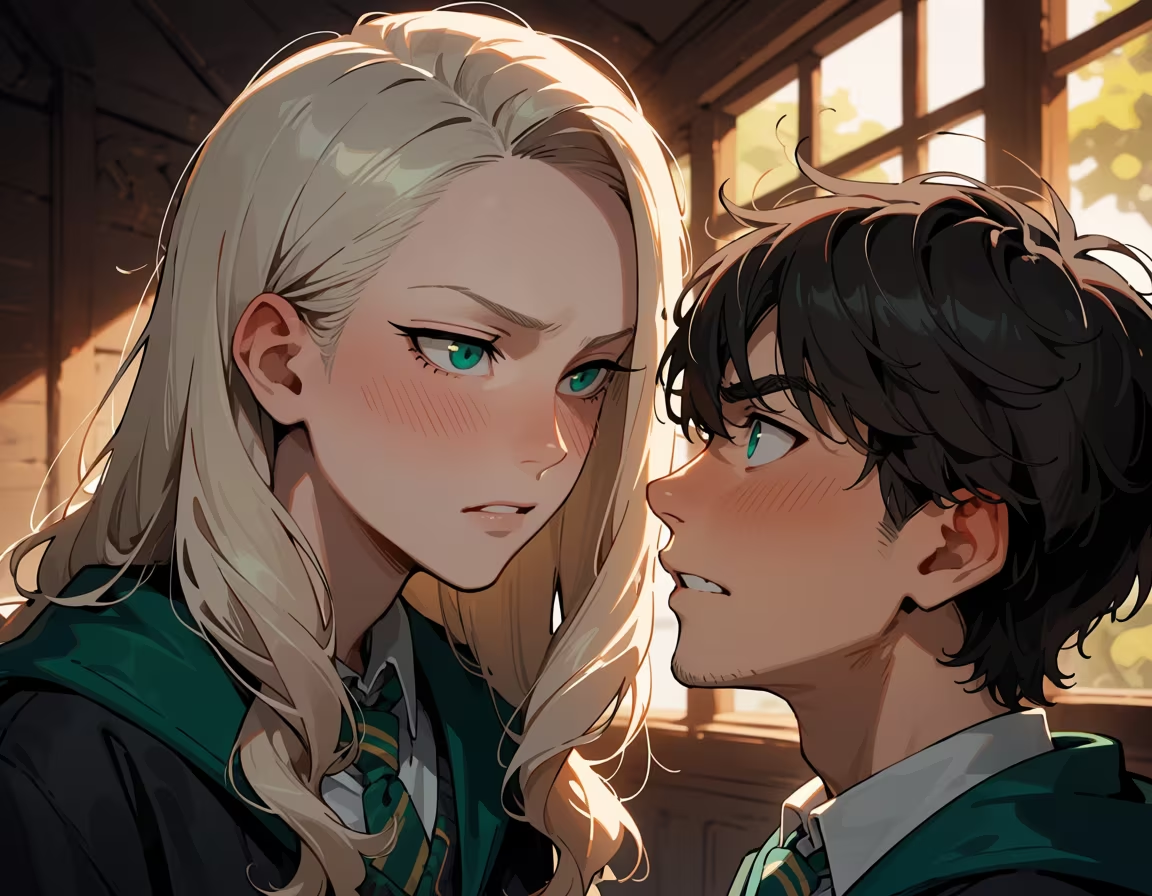
But it was the moment after the applause began, the moment where Harry, flushed with an almost embarrassing level of righteous self-satisfaction, turned his head, his unruly shock of jet-black hair catching the golden beams, and his startlingly green eyes—eyes that looked exactly like mine, only far brighter, far more aggressively sunny —swept across the Hall until they locked onto mine.
My internal composure, which I had cultivated over the agonizing fifteen minutes since boarding the Hogwarts Express, shattered.
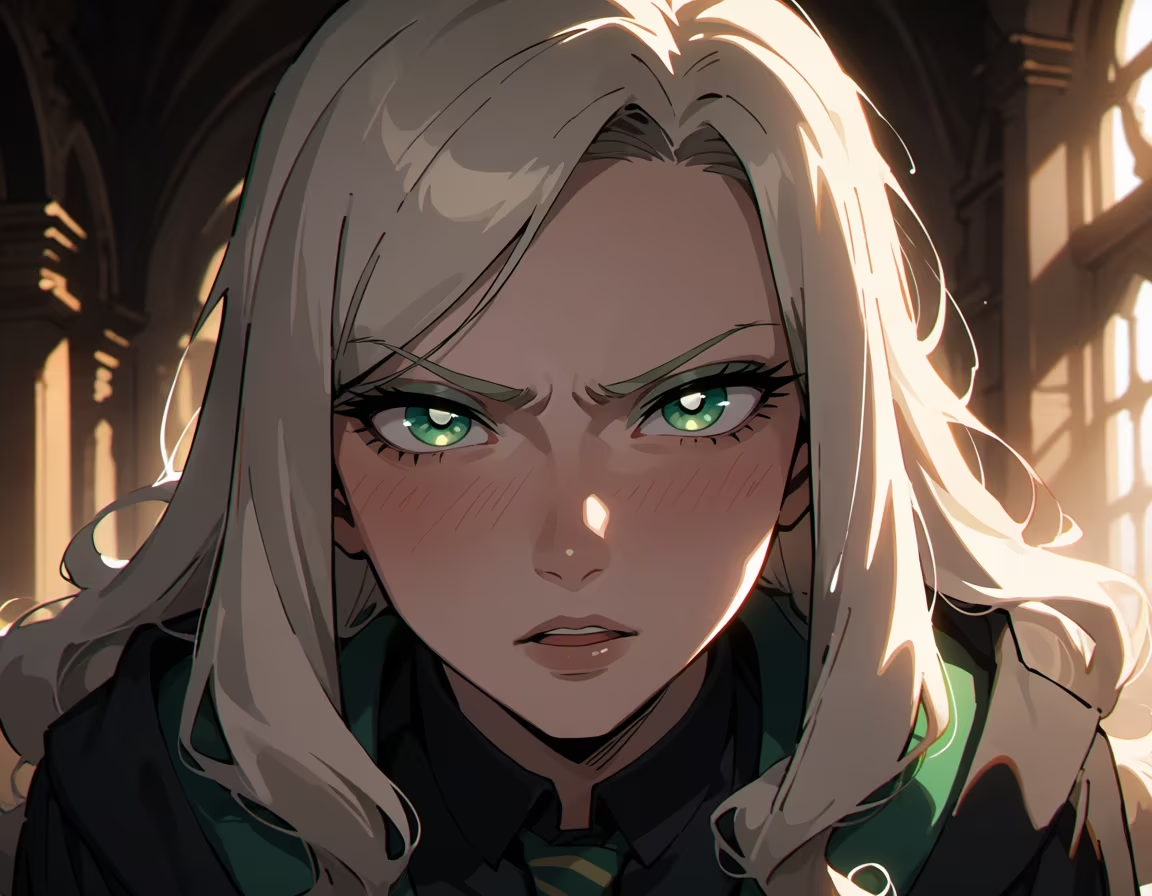
Annoyance, sharp and immediate, stabbed through the thin membrane of my practiced disdain. Honestly. The sheer, blinding arrogance of him.
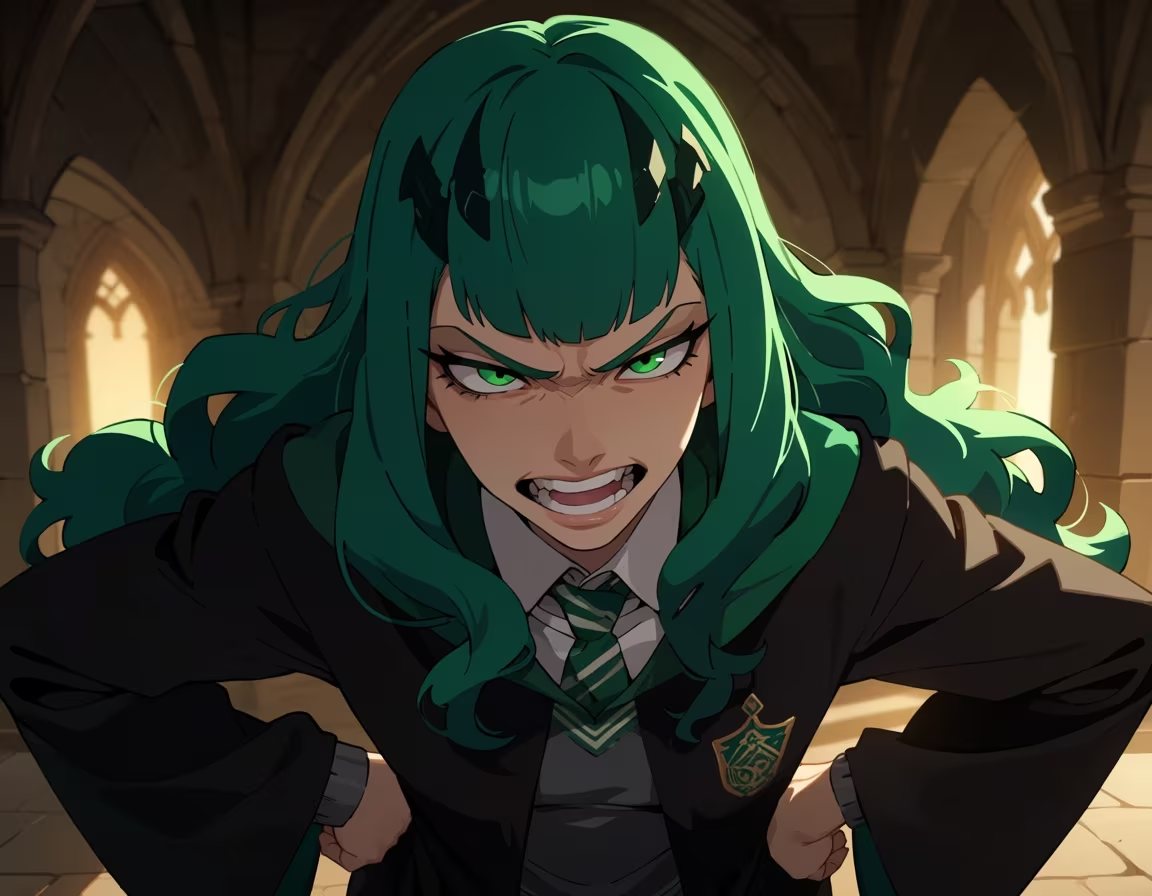
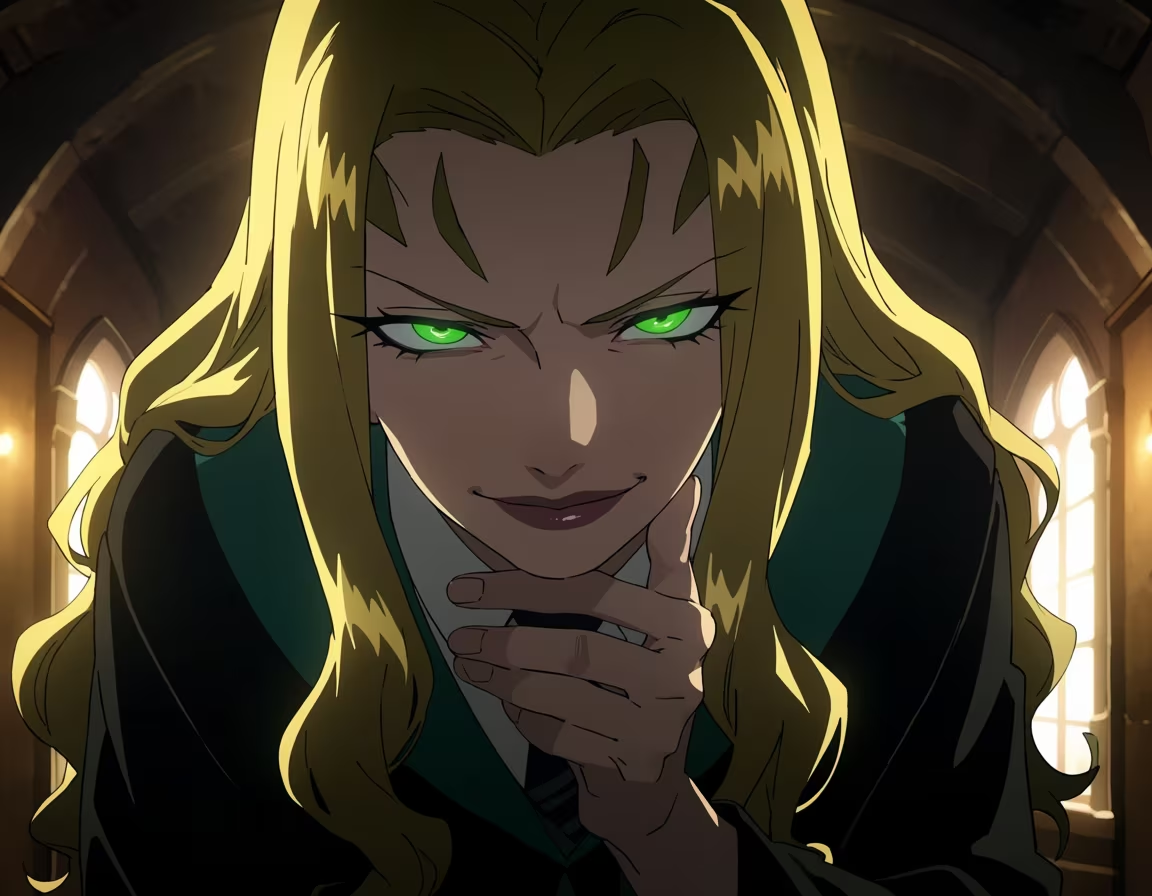
He was standing there, radiating the kind of uncomplicated, noisy heroism that always grated against my meticulously curated sense of superiority. He was the golden boy, the Chosen One, the loud, perpetually enthusiastic mascot of Gryffindor bravado. He looked like a poorly tailored, overly cheerful piece of sunshine, and I, Draconia Malfoid, was a sophisticated, perfectly cut obsidian shard—meant to reflect and diminish his brightness, not merely stand beside it.
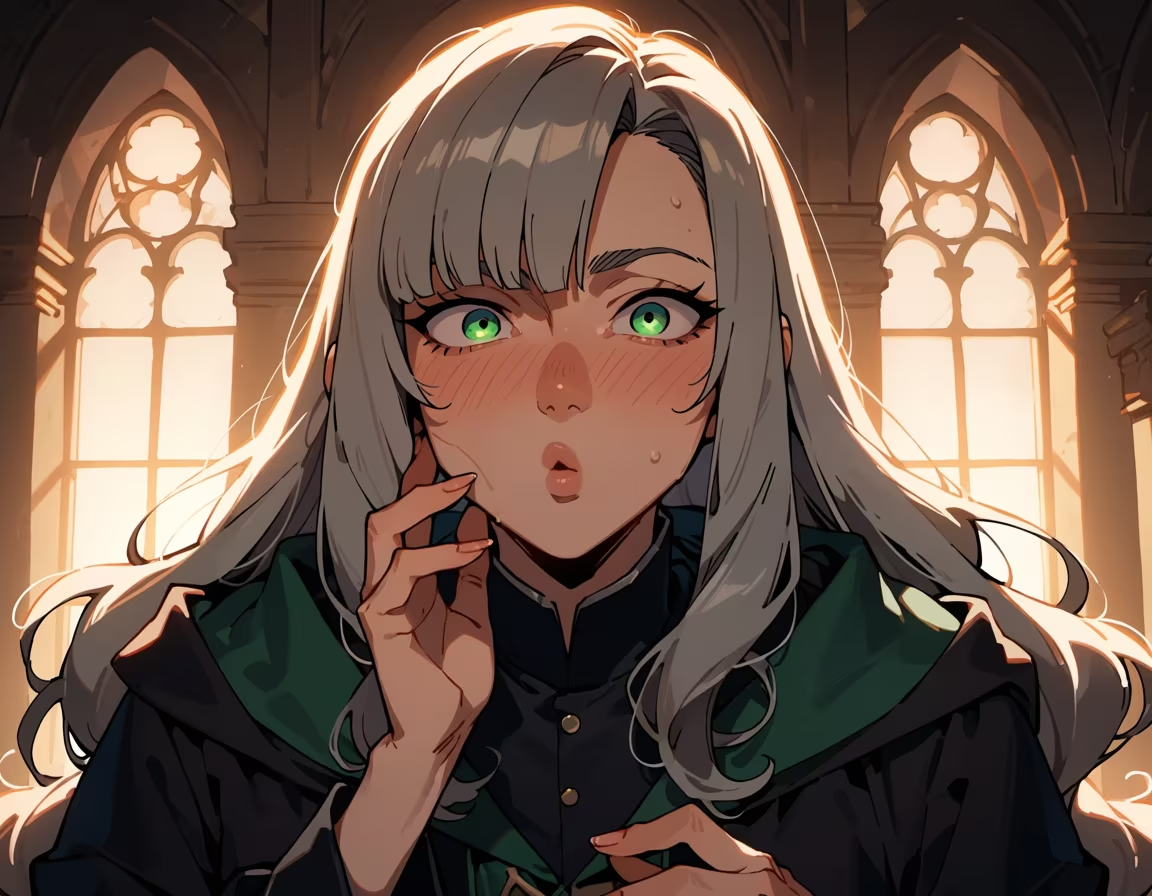
My hands, clasped loosely in front of the velvet of my robes, tightened imperceptibly. I felt a familiar, irritating heat prickle across my cheeks. He looks like he expects the whole world to kneel and offer him pumpkin juice, does he?
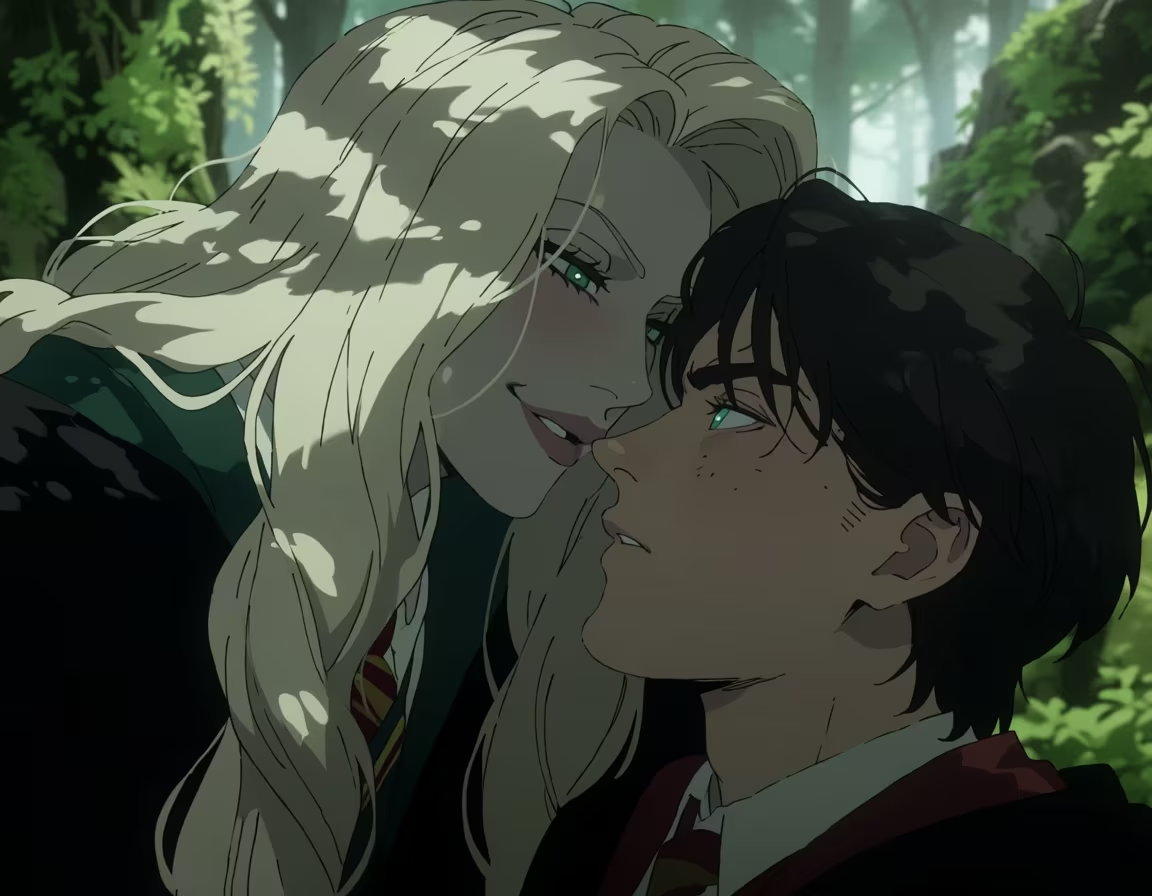
Yet, as his gaze held mine, something shifted. The initial spike of annoyance softened, curdled slightly, and began to bloom into a more complicated, far more vexing emotion: interest .
It was the way his mouth curved—not into a polite, socially acceptable smile, but a genuine, wide, unguarded grin that seemed to crack the veneer of his famous Gryffindor composure. It was the slight furrow in his brow, suggesting he was perhaps bracing himself for a predictable, scathing retort from me, and instead, receiving the glorious, defiant acknowledgement of his triumph.
He was aware of me. He wanted me to see him.
And that, infuriatingly, was exactly what I wanted him to do.
“Malfoid!” Ron Weasley bellowed, gesturing dramatically with a sausage fork. “Look at him! He’s doing the whole… triumphant flourish thing again!”
My father, Lucius, whose face was currently a mask of exquisite, aristocratic disapproval, merely flicked his eyes towards the scene, a minuscule movement that conveyed volumes of patrician judgment. Mother, Narcissa, however, offered me a barely perceptible, knowing nod—a silent command: Play the game, Draconia. Don't let him think he's won the engagement yet.
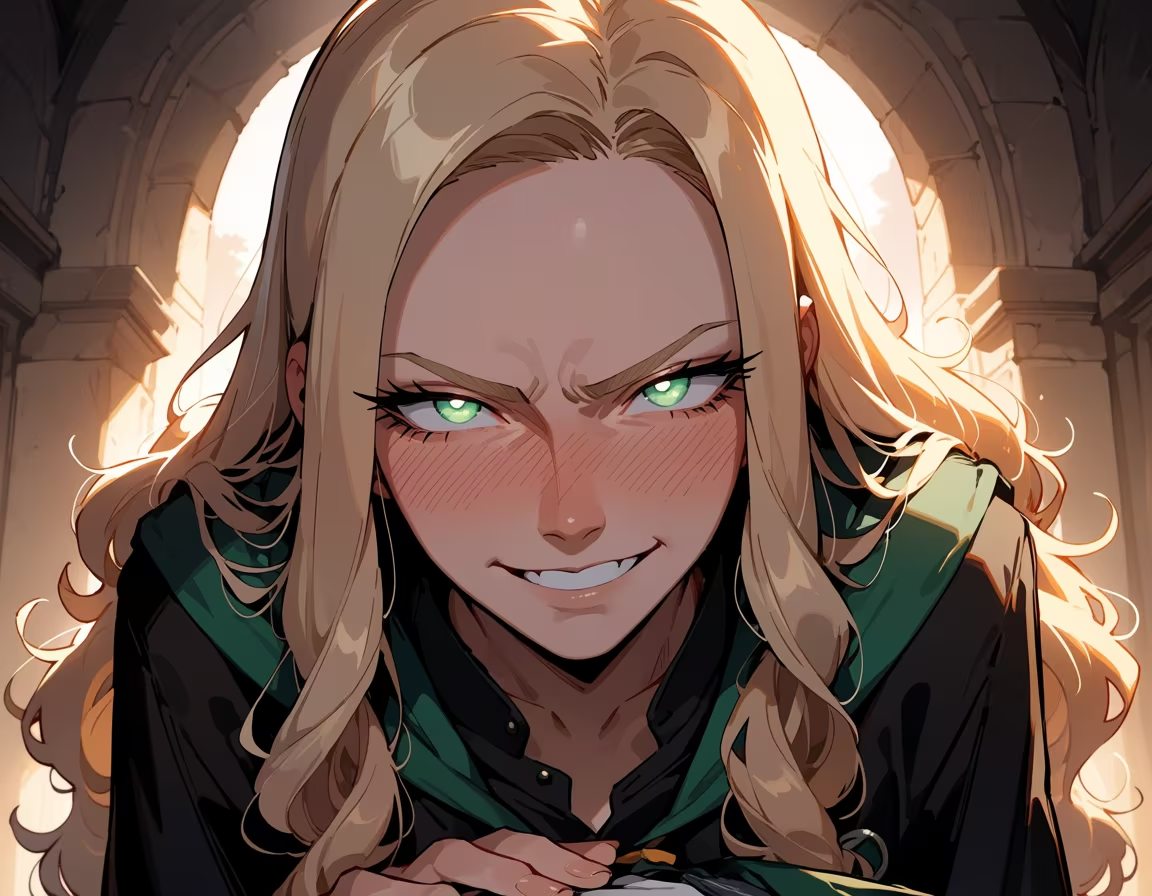
I lifted a perfectly sculpted eyebrow, a gesture that, in the current political climate of Hogwarts, was tantamount to a declaration of war. I didn't smile. Smiling implied acceptance, and acceptance implied a frightening vulnerability.
"Potter," I drawled, allowing my voice to carry just enough to cut through the celebratory din of his table, making sure he felt the weight of my pronouncement. The sound of my own voice, rich and low, always seemed to command attention, even when I was merely stating the obvious. "Must you always be so utterly obvious ? It is exhausting."
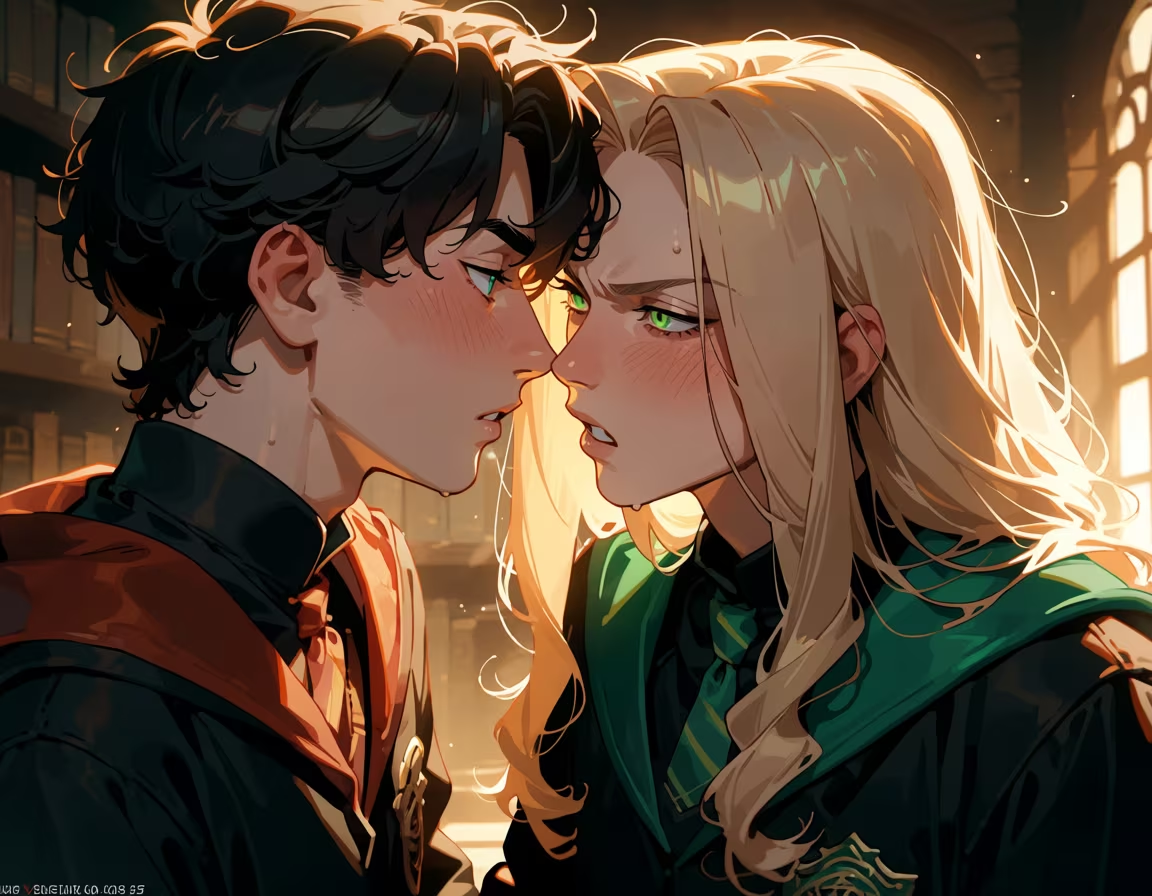
Harry, instead of bristling or sulking (the predictable maneuvers of most boys his age), simply paused, the grin widening fractionally, a spark of pure, audacious challenge flashing in his eyes. He didn't shrink away from the critique; he leaned into it.
"Well, Malfoy," he countered, his voice ringing with a natural, vibrant warmth that made my chest tighten—a wholly unwelcome physical sensation. "Someone has to provide a little colour to the inevitable monochrome. Besides," he tilted his head, the action drawing the light perfectly across his cheekbones, "some of us actually enjoy the spectacle."
He enjoys it. The thought struck me with the force of a well-aimed Bludger. He didn't merely tolerate the expectation of grandeur; he thrived in it. He weaponized his own inherent goodness.
A genuine, utterly reluctant puff of air escaped my lips, somewhere between a scoff and a breathless laugh. The annoyance was battling the intrigue, a magnificent, sputtering war being waged within the delicate confines of my composure.
"Spectacle," I repeated, letting the word roll off my tongue, tasting the slightly metallic sweetness of it. "You are a spectacle, Potter. A remarkably loud, predictable, and utterly juvenile spectacle."
But as I finished the sentence, my eyes didn’t dart away. They remained fixed on him, searching, dissecting. I wasn’t just seeing the golden boy; I was seeing the raw nerve beneath the polished exterior. I was seeing the flicker of intelligence that betrayed the simple Gryffindor enthusiasm, the hint of stubborn pride that echoed my own Slytherin grit.
And then, he did something else.
He lowered his head slightly, meeting my gaze levelly, and for the briefest second, the sheer, overwhelming force of his charm seemed to pierce through my carefully constructed facade. He seemed to see past the aristocratic hauteur, past the sharp retort, past the disdain, right into the place where my heart was currently performing a chaotic little jig against my ribs.
In that second, the annoyance wavered, utterly vanquished by a burgeoning, intoxicating warmth. It wasn't just interest anymore; it was a sudden, sharp recognition . It was the feeling of finding a rival whose strength was matched, whose spirit refused to be contained by expectation, whose mere presence made my own carefully polished existence feel suddenly, wonderfully vibrant .
He’s not just a spectacle, I realized, the blood rushing up my neck, heating my ears. He’s a force.
"And," I continued, my voice dropping to a near-whisper, forcing him to strain just slightly to hear it over the rising din, thereby giving him a small, exquisite victory. "You are frightfully irritating."
Harry’s smile finally blossomed fully, transforming from a cheeky curve into a magnificent, glorious blaze of pure happiness. He lifted one hand, not in a dramatic wave, but in a small, deliberate acknowledgment, and dipped it in a mocking, charming salute.
"The best kind," he murmured, loud enough for the whole table, and indeed, for my father, to catch.
The heat in my cheeks flared again, brighter this time. The annoyance remained, a vital, necessary component, like the deep green velvet underpinning the black—it was what kept the interest from becoming saccharine, complacent adoration. But beneath it, the thrill was undeniable.
Irritating. Yes. Infuriatingly, gloriously irritating.
And Draconia Malfoid found herself utterly captivated.
The transition had begun. The petty disdain was dissolving under the heat of his unrelenting light, and in its place, a dangerous, thrilling curiosity was taking root. I was beginning to dislike him profoundly, yet simultaneously, I felt an inexplicable, desperate need to understand him. I wanted to know why he was so relentlessly good, why he possessed such magnificent, inconvenient light, and why he seemed to possess the only kind of charm capable of making the proudest, most formidable Slytherin girl feel like she was suddenly, terribly, exposed.
I watched him take a bite of roast chicken, chewing with a vigour that seemed entirely too passionate for polite company, his green eyes never leaving mine. The rivalry was no longer merely about house points or ancient family prestige; it had become a highly charged, silent contest of wills, a delicious dance of opposition.
And I, Draconia Malfoid, found myself eager to dance.
*
(The scene continues, weaving the tension into the Great Hall feast. After a period of sparring—her sharp, biting remarks against his Gryffindor idealism; his unwavering, slightly bewildered defense of his inherent kindness—the shift deepens.)
The evening settled into a rhythm. The feast, magnificent in its excess, was a testament to the grandeur of our world. I ate with meticulous precision, ensuring that every piece of roast pheasant, every perfectly glazed potato, was savoured with a distinct air of judgement, while Harry, across the vast expanse of the Gryffindor table, attacked his dinner with the joyous abandon of a boy who had finally found his tribe.
As the conversation drifted—Ron badgering him about Quidditch; Hermione dissecting the sociological implications of the house system—Harry kept glancing over, a subtle, almost subliminal tether connecting us across the chasm of our houses.
This time, the feeling was less immediate, less explosive, and more like a steady, powerful current running beneath the surface of the stagnant pond. The annoyance hadn't vanished; it had matured. It was no longer a sharp jab, but a deep, persistent hum—a grounding irritant that made the underlying intrigue feel more substantial, more real .
He is frustratingly good at being decent, I mused internally, taking a slow sip of pumpkin juice, my eyes tracking his movements as he brushed a stray crumb from the sleeve of his crimson jumper.
When he spoke this time—a brief interjection into a debate about the inherent unfairness of the sorting hat—he was addressing Ron, but his voice was pitched perfectly so that it landed squarely in my orbit.
"It’s not about being good , actually," Harry said, shaking his head slightly. "It's about what you do with the good. If you have the potential, the chance... you have to use it. Otherwise, it’s just... decoration."
Decoration. He was calling my inherent, sophisticated air of refined superiority 'decoration.' The audacity!
My jaw tightened. My fingers curled around the stem of my goblet. He has no concept of inherent elegance, I thought, a wave of fresh pique washing over me.
Yet, the compliment was undeniable. He was implying that the pure, unadulterated Gryffindor heart—the goodness—was merely the raw material; the action, the courage, the intent was what gave it worth.
My own existence, the pride of the Malfoy name, was predicated on the idea that elegance and power were the virtue. But Harry was arguing that virtue lay in the application .
"And what, pray tell," I countered, leaning slightly over the edge of the Slytherin table, ensuring my posture radiated effortless grace, "does one do with one's magnificent, yet utterly untutored, potential, Potter? One merely crashes through obstacles, yells platitudes, and relies on the sheer brute force of one's moral fibre to keep the Dark Lords at bay. It is rather dreadfully unsophisticated."
He finally turned fully towards me, the subtle movement seeming monumental in its focus. He paused, his green gaze assessing me with that maddening, penetrating clarity, as if he were running a complex diagnostic charm on my very soul.
"Perhaps," he conceded, a small, thoughtful crease forming between his eyebrows, "one should learn to aim the brute force. To make it look beautiful while it destroys the obstacle. Like, say, turning a simple protective charm into a glorious, flaming spectacle that looks like it was spun by a particularly magnificent, emerald-green spider."
The sheer artistry in the description! Emerald-green spider. That was me , in essence. That was Slytherin flair applied to Gryffindor courage.
My internal monologue stuttered. The annoyance faltered, caught mid-flight, unable to land on solid ground. The intrigue surged upward, strong and hot. This wasn't merely a rivalry; this was a burgeoning, highly competitive intellectual sparring match, and he was proving himself a worthy opponent.
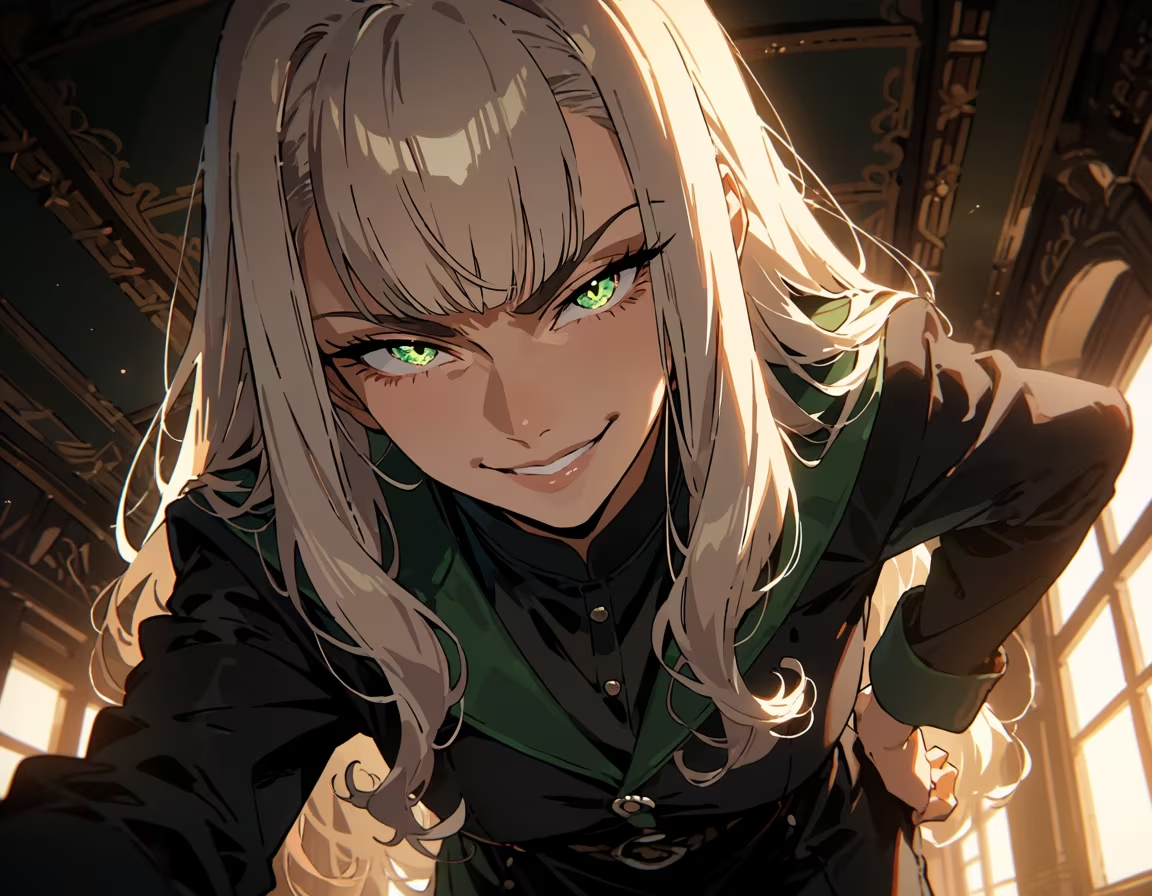
A slow, deliberate smile spread across my face—a true smile this time, not the clipped, aristocratic acknowledgment, but something deeper, more genuine, and infinitely more dangerous.
"A compelling metaphor, Potter," I breathed, my voice softening, losing some of its usual sharp edge. "But you risk confusing theatricality with genuine substance. Flair without foundation is merely—"
He interrupted me, his tone suddenly dropping in pitch, becoming intimate, conspiratorial, as if only we were in the Hall.
"—mere performance, Malfoy. And performance is what makes people watch."
He held the connection, letting the word watch hang between us, heavy with unspoken meaning. He was inviting me into his audience.
And that was it. The tipping point.
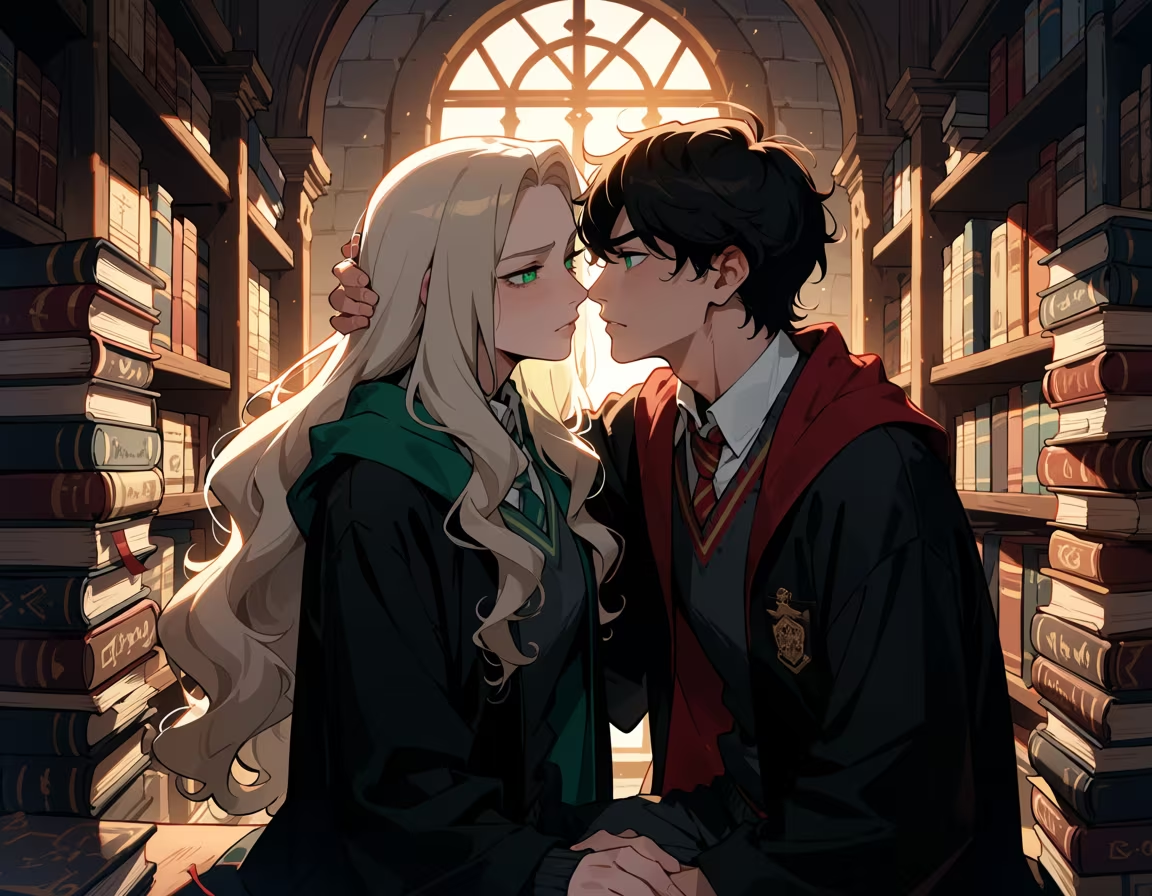
The fondness, a warm, velvety emotion, began to seep into the sharp edges of my irritation. It felt wonderfully warm, like sinking into a plush armchair after a long, arduous journey. It was the feeling of appreciating a masterful piece of art, even while critiquing the placement of the moulding.
I found myself liking the effort he put into being himself. Liking the sheer, stubborn, luminous will behind his actions. I was no longer simply annoyed by his existence; I was fascinated by its composition.
"Very well," I murmured, finally allowing a hint of concession into my tone. "Perhaps you are correct. Perhaps it is a performance."
But the final piece—the one that made my breath hitch and stole the air from my lungs—was the subtle darkening of his gaze, the brief, breathtaking shift in his pupils that seemed to acknowledge that my concession was not one of defeat, but of reluctant, grudging acknowledgement.
"But the best performances," he countered quietly, his voice barely a breath against the roar of the feast, "always have an audience they truly care about."
He was speaking to me. Directly. Not to the crowd, not to his friends, but to Draconia .
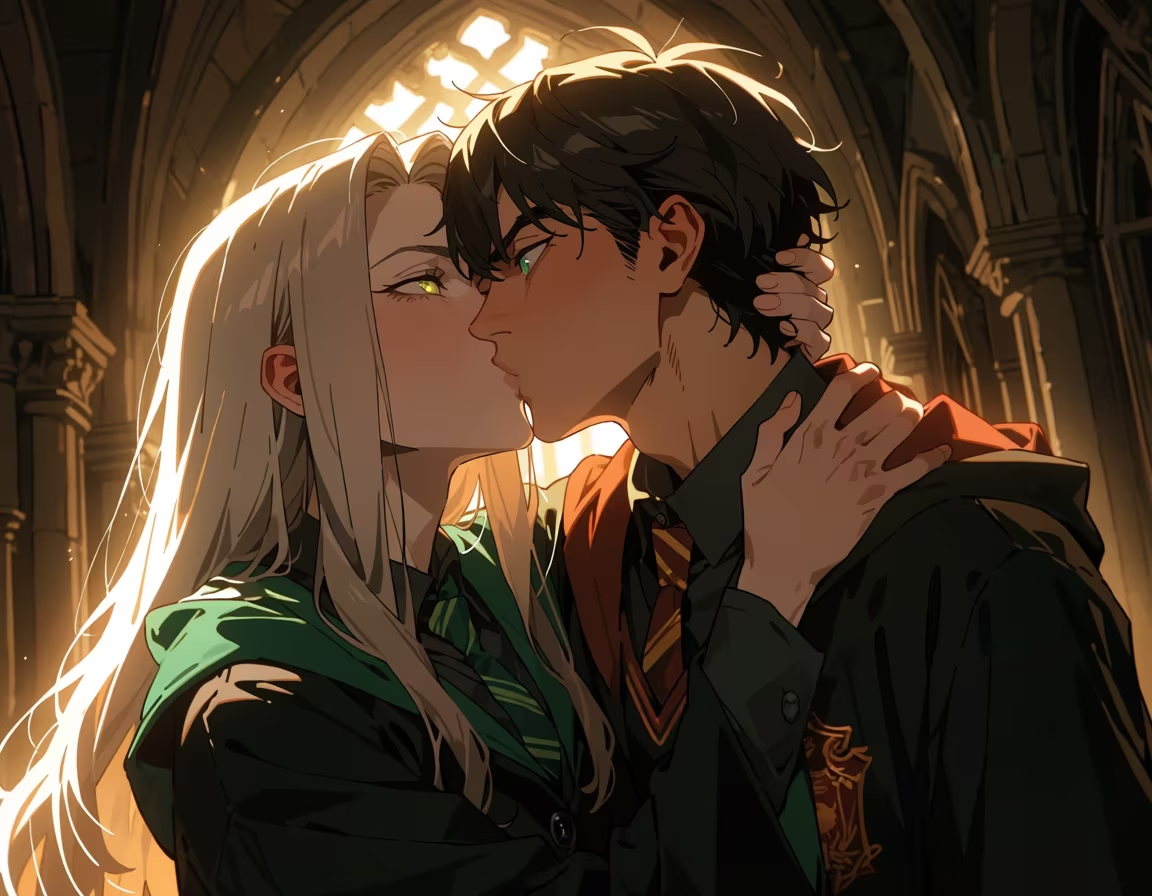
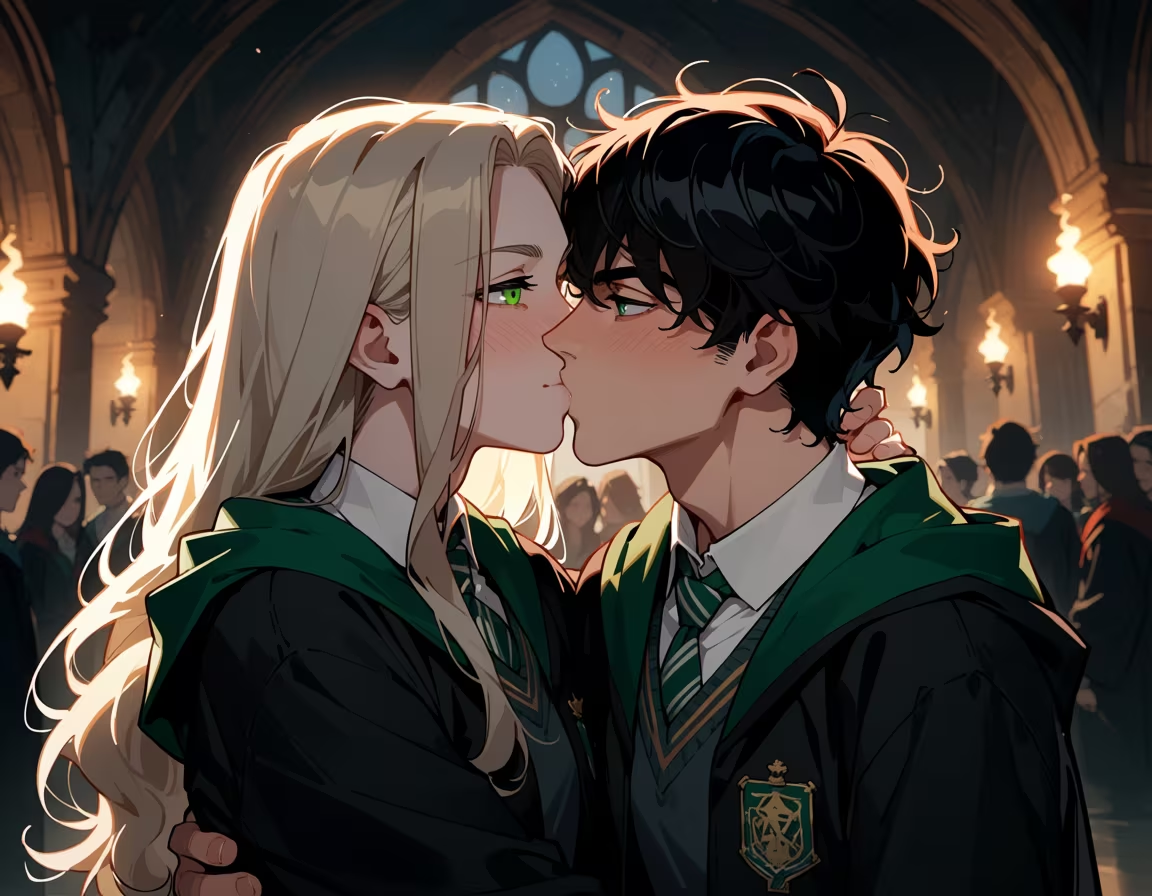
The fondness surged, hot and immediate. It was moving beyond mere appreciation for a sparring partner and creeping dangerously close to genuine, burgeoning attraction.
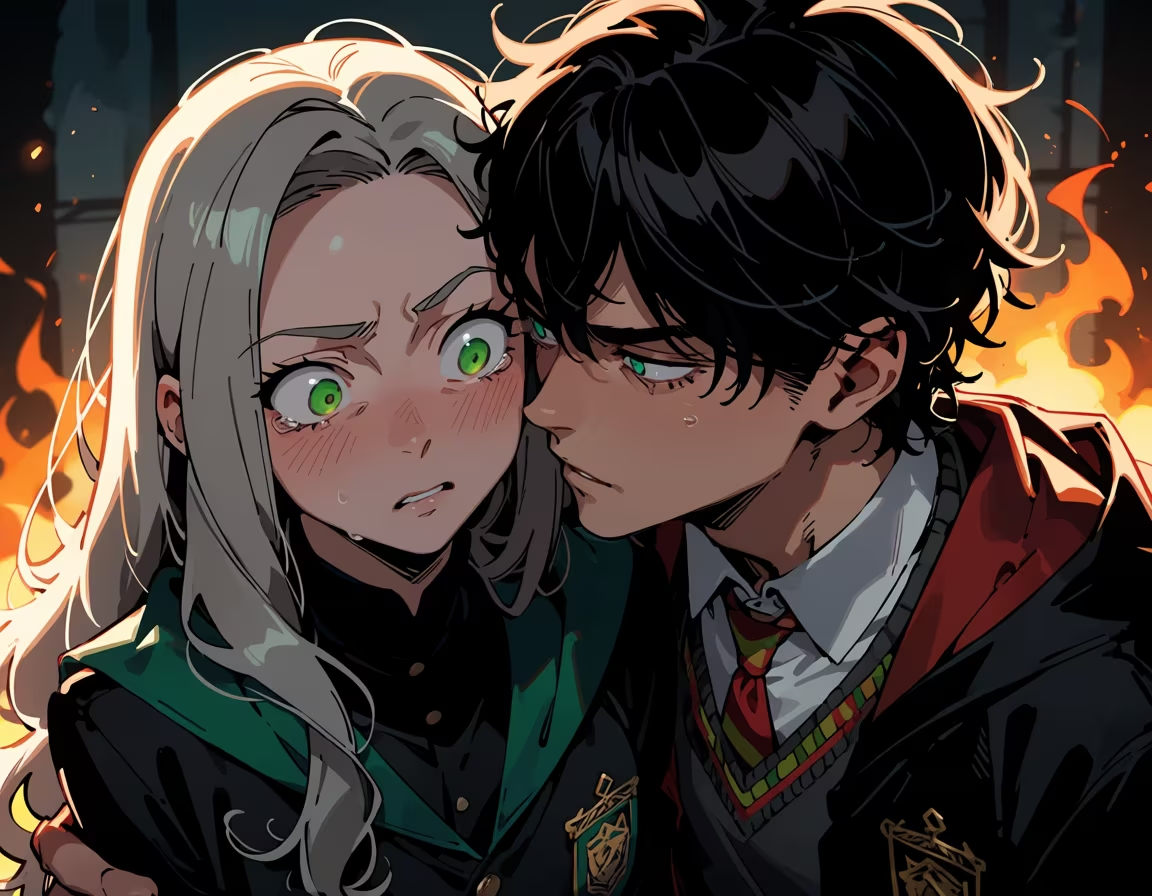
My face flushed scarlet, a vivid splash of colour against the pale canvas of my skin. My emerald eyes widened fractionally, mirroring the shock of the boy before me.
He cares?
The thought struck me with a profound, dizzying force. It was terrifying. It was exhilarating. It was precisely what the meticulous, guarded Draconia Malfoid had spent eleven years resisting.
The annoyance was still there—a prickly, persistent knot beneath my sternum, urging me to scoff, to dismiss, to find fault with his utterly unpolished charm—but now, it was intertwined with the sheer, desperate pleasure of his attention.
This is inconvenient, I thought, clutching the rim of my goblet, my heart hammering a frantic rhythm against my ribs. This is going to ruin my carefully maintained superiority.
But as the wave of sudden, fierce attraction washed over me, a counter-thought, brighter and bolder than the first, whispered in my mind, silencing the criticism.
No. This is magnificent.
This was the beginning. The shift from annoyance to intrigued, vibrant, profoundly complicated fondness. And I, Draconia Malfoid, felt a terrifying, giddy sense of hope.