| Home | The Lives of Velnin | Illustrated Fiction | Malfoid Art & Fiction | Book Blurbs | Contact |
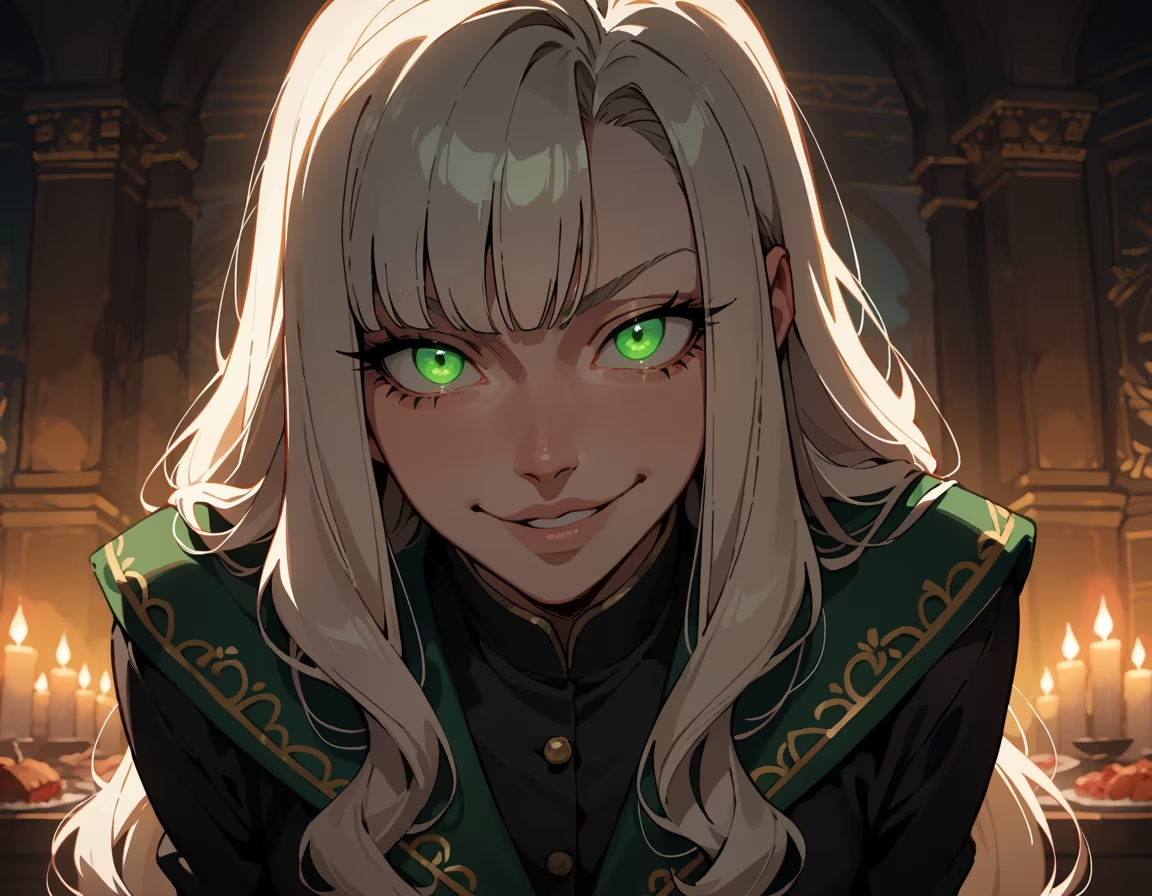
The Great Hall was, as always, a dizzying spectacle of controlled chaos. Overhead, the enchanted ceiling shimmered with the pale, watery gold of a late summer afternoon, reflecting the flickering candlelight from the towering candelabras. The air itself tasted of roasting meats, spun sugar, and the faint, metallic tang of magic—a familiar, intoxicating cocktail that always seemed to settle a fine layer of aristocratic disdain upon my tongue.
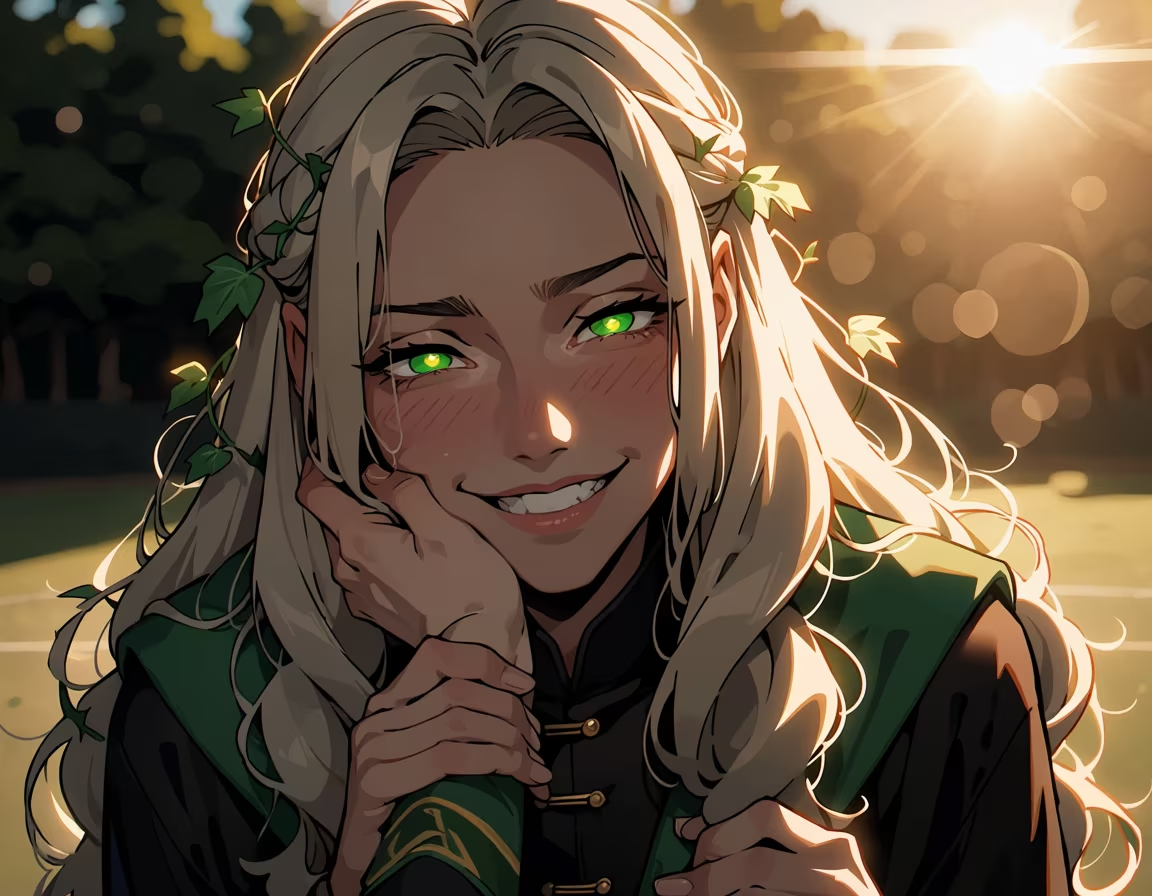
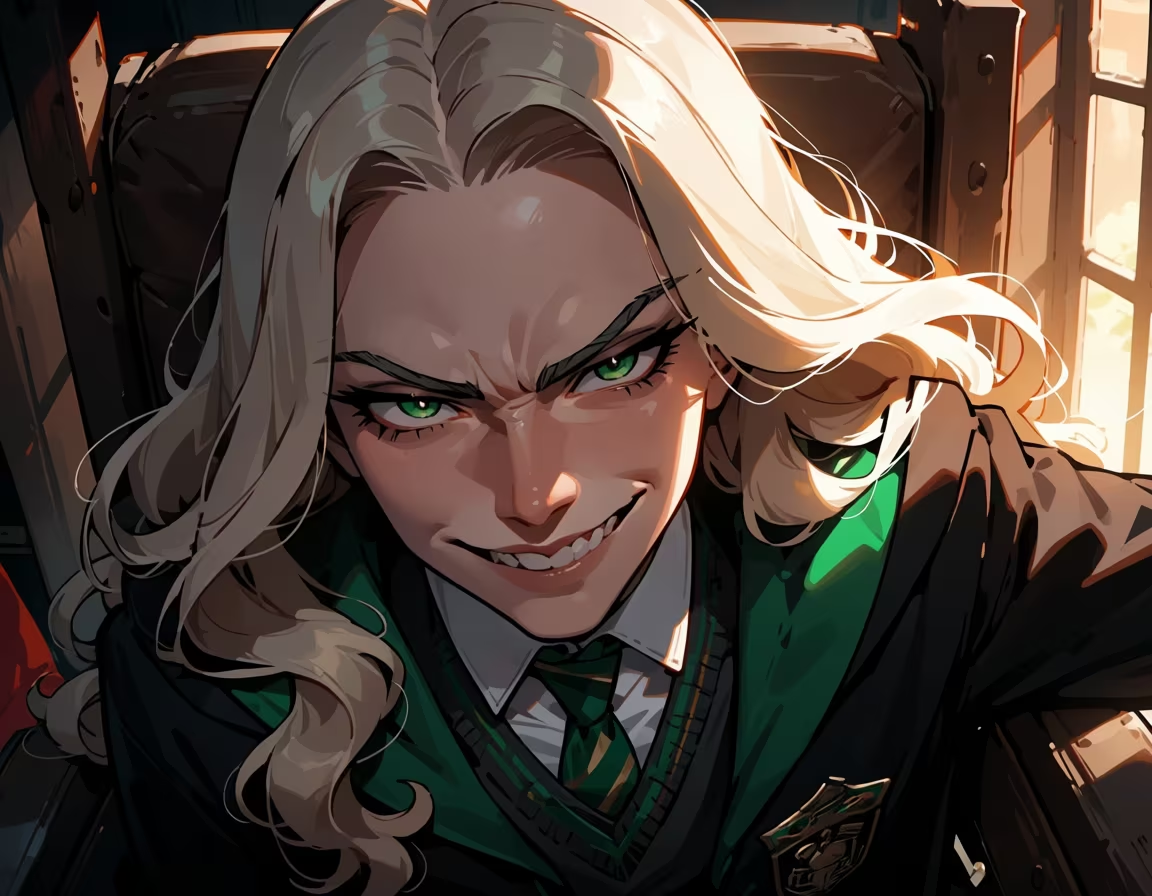
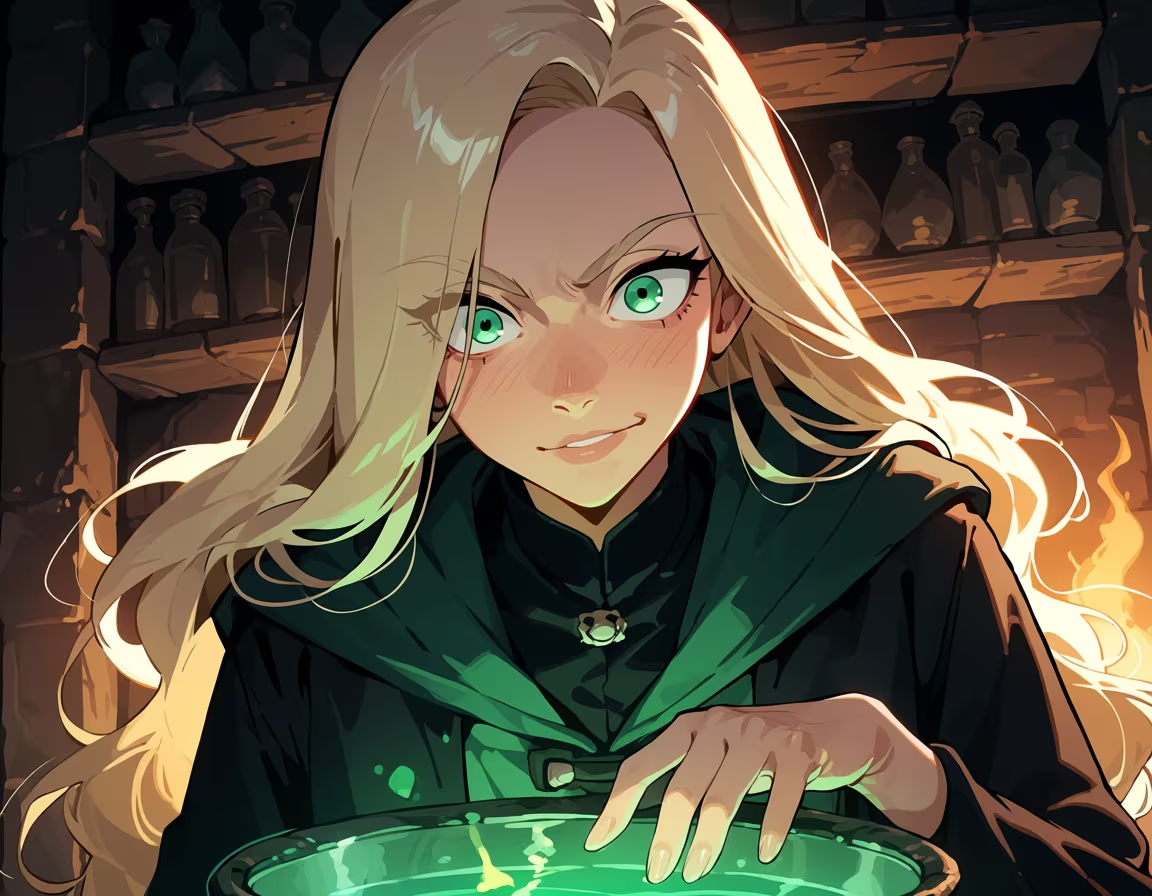
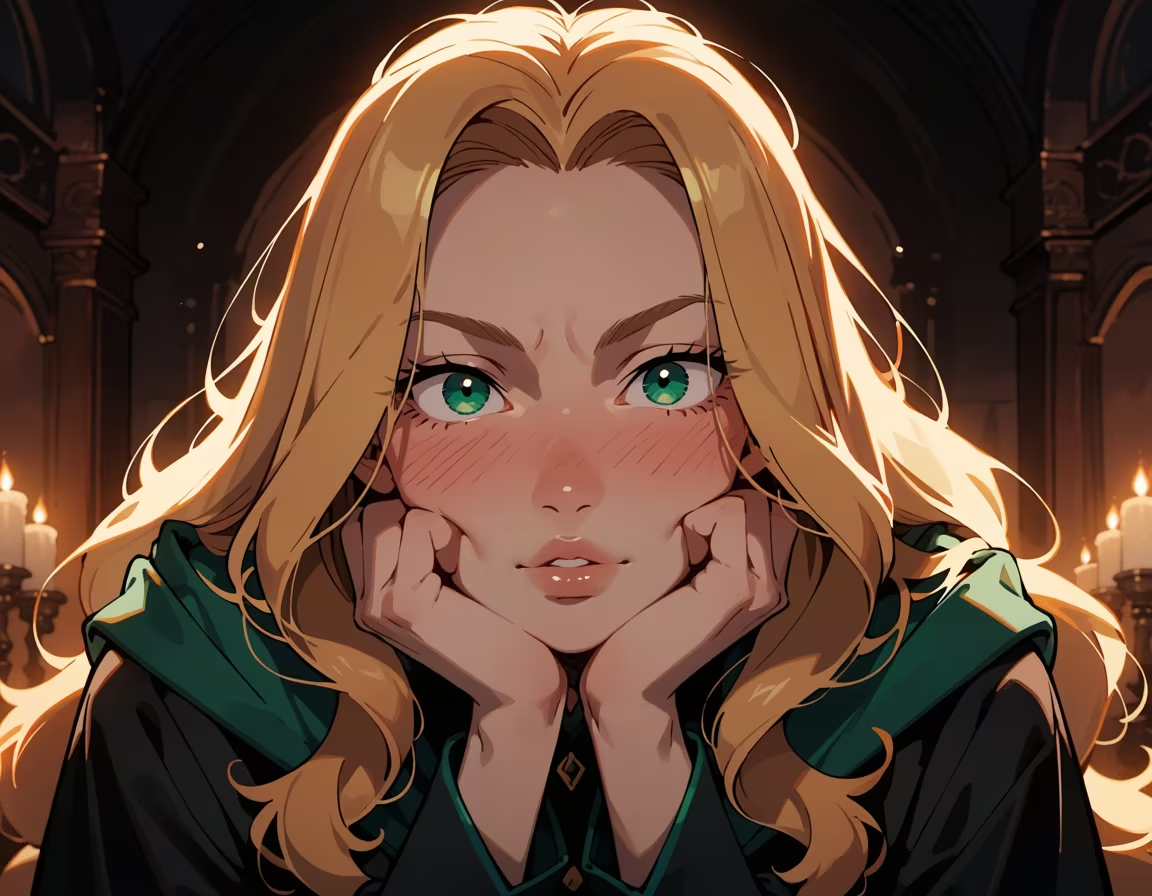
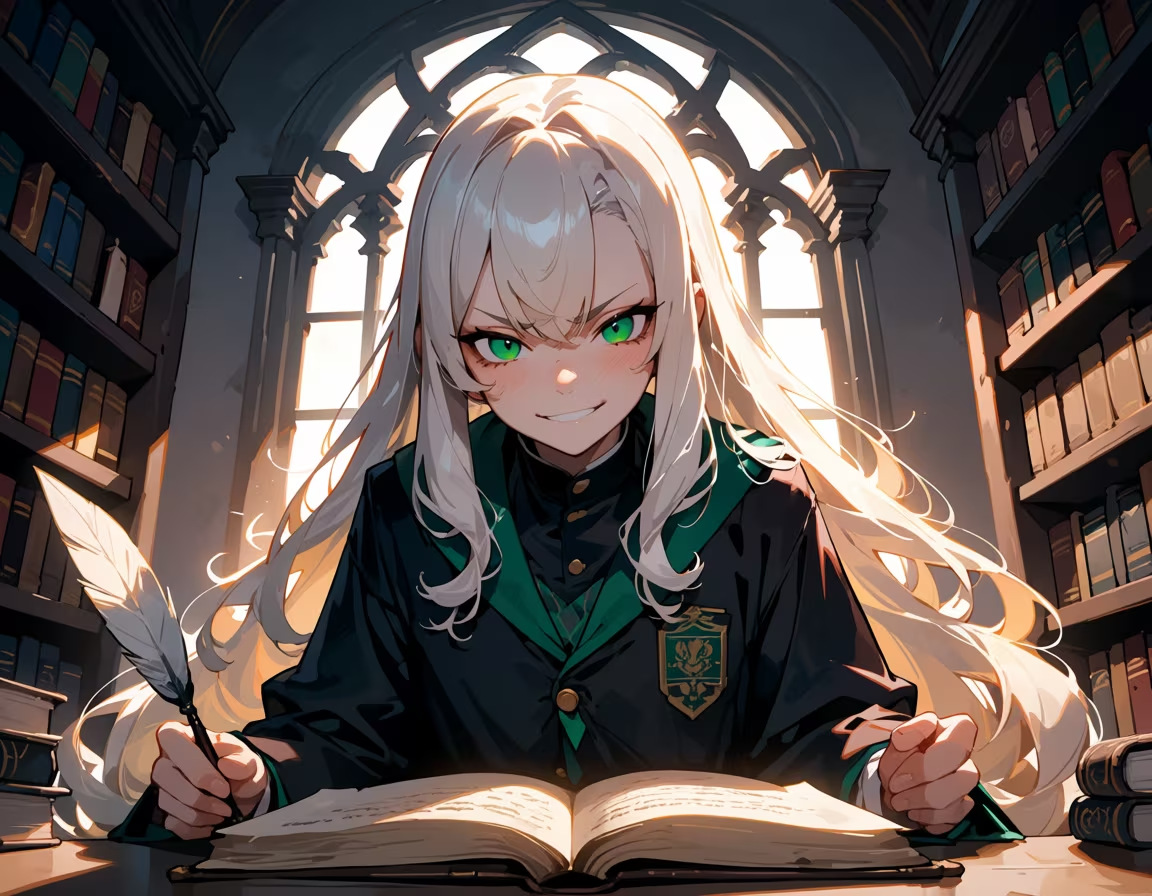
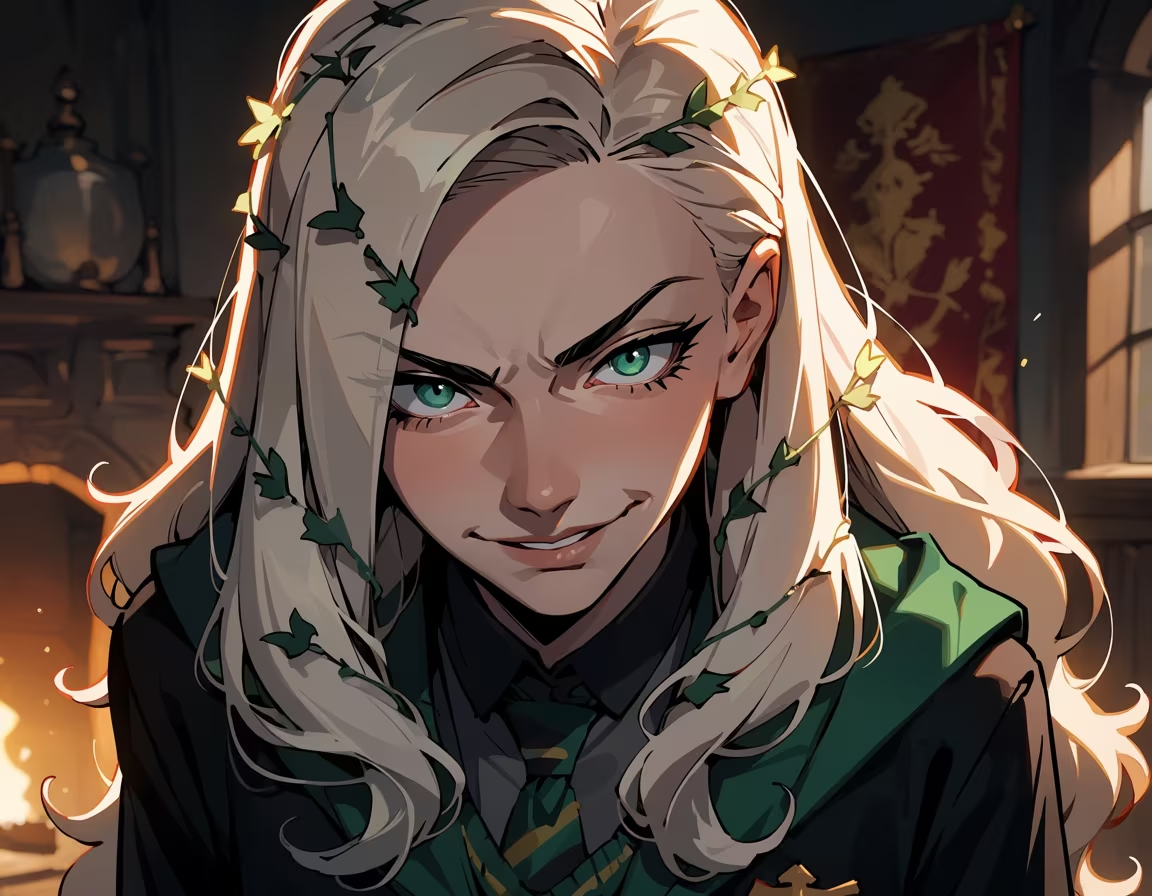
I sat at the edge of the Slytherin table, my black robes, exquisitely tailored, absorbing the light like polished obsidian. The deep emerald trim, a colour that felt both inherited and inherently necessary, framed the pale expanse of my collar. My long, sun-kissed hair, currently braided with strands woven with tiny, almost imperceptible sprigs of silvery ivy, felt heavy and perfect against my shoulders.
My focus, as it so often was, was fixed on the Gryffindor table.
There he was. Harry Potter.
He was currently engaged in a spirited, near-operatic debate with Ronald Weasley over the perceived merits of Quidditch commentary—specifically, whether the announcer, a pompous Hufflepuff, had unduly favoured Krum. Harry’s hands were thrown up in exasperated gesture, his unruly black hair—a chaotic halo around a face that looked perpetually on the verge of either brilliant insight or utter exasperation—seemed to defy gravity itself.
Annoying, I thought, the word tasting like a bitter mint on my tongue. Utterly, aggressively, infuriatingly annoying .
It was that sheer, relentless optimism about him that grated upon my sensibilities. It was a stark contrast to the studied, serpentine gravity that defined our House. We Slytherins dealt in necessary darkness, in ambition honed to a razor's edge, in the pragmatic acceptance that the world was largely a tiresome, morally ambiguous mess. Yet Potter—Potter seemed to operate under the delusion that everything, no matter how deeply flawed, possessed an inherent, shining goodness.
“It was biased, Ron! He practically swooned when Krum did the dive!” Harry declared, his emerald eyes—eyes that shared a startling, almost unsettling shade with my own, which always caused a flicker of unwelcome recognition to spark within my chest—were alight with conviction.
Ron, bless his loud, earnest soul, sniffed indignantly. “It was overwrought , Harry. Krum is a showman. You were merely… competent.”
Competent. The word felt like a personal insult. I watched Draconia Malfoid, the future mistress of Slytherin grace, the keeper of the House’s ancient pride, the very picture of flawless, reserved superiority, and found myself feeling a sudden, violent urge to hurl a handful of highly sugared lemon drops directly onto his pristine Gryffindor jumper.
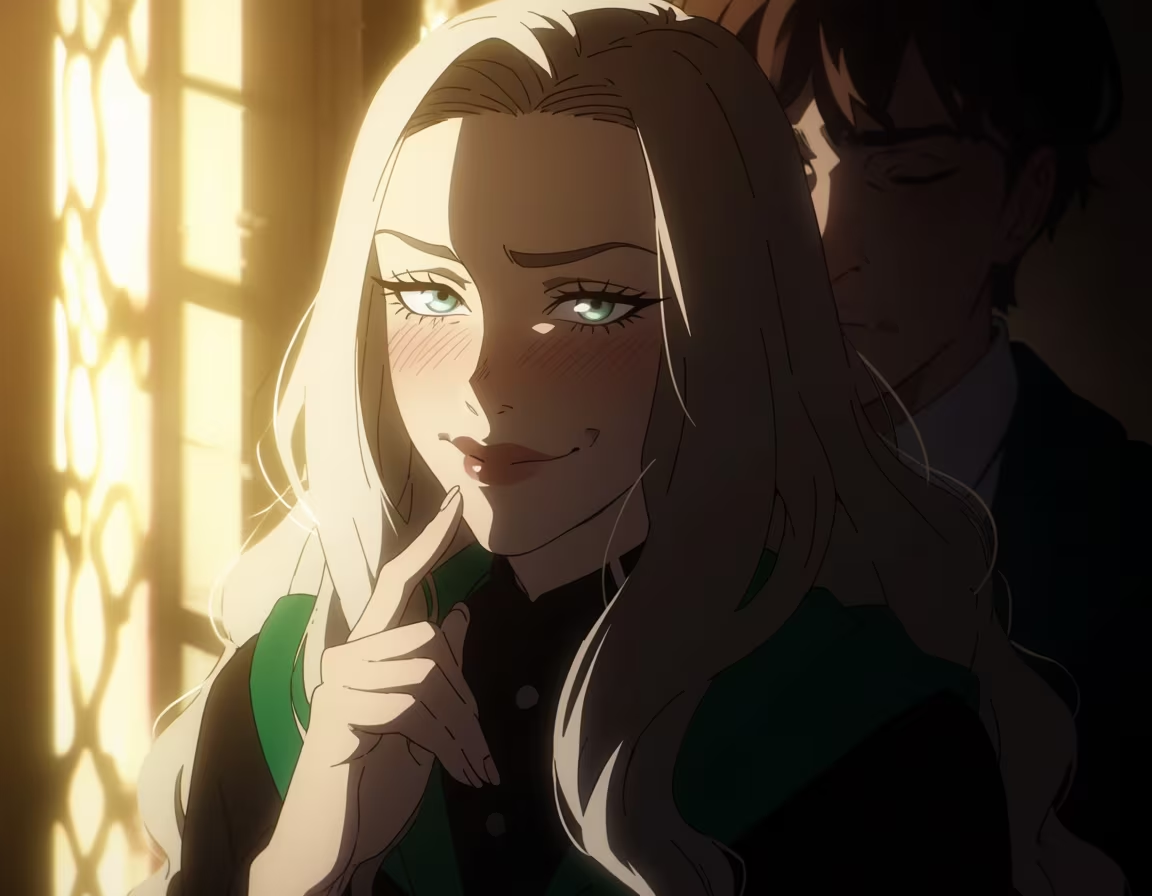
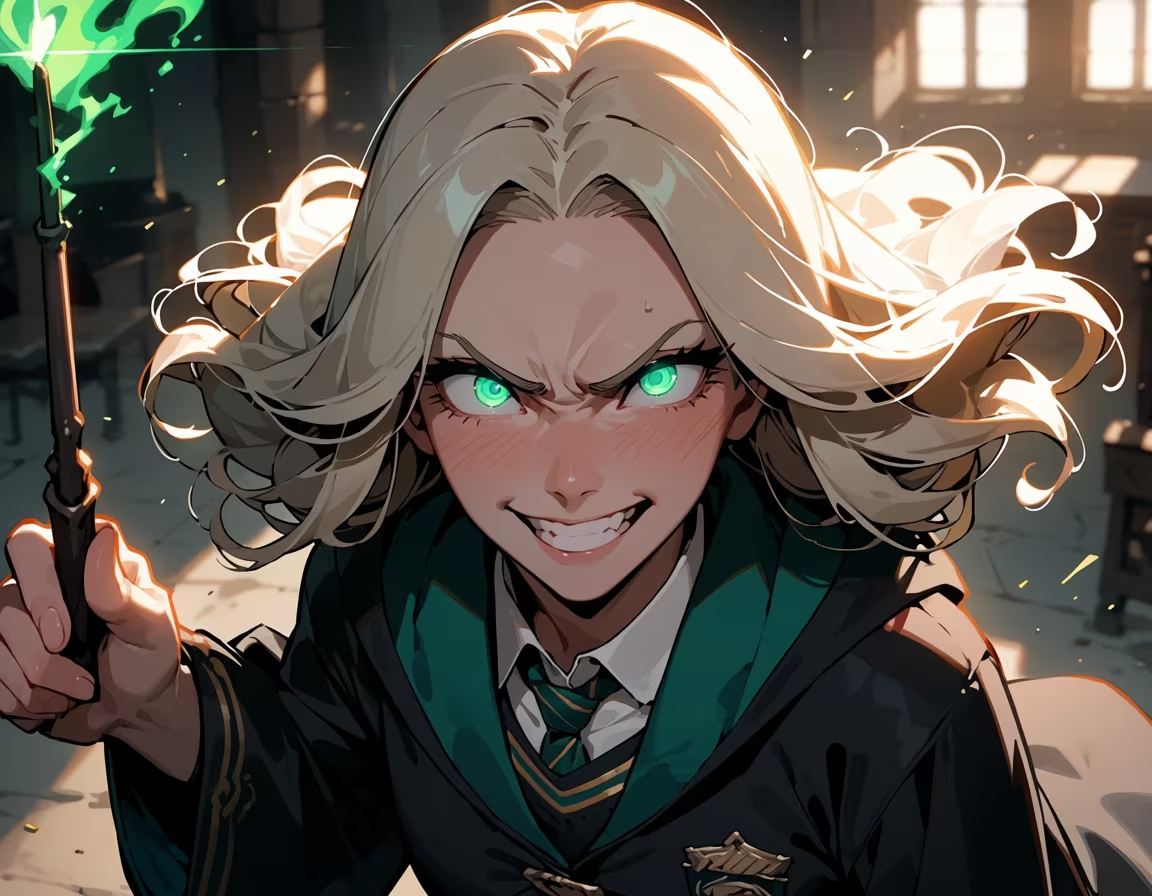
“Competence is merely a plateau, Ronald,” I murmured under my breath, allowing my gaze to linger on him, a small, almost imperceptible smirk playing on my lips. “One strives for brilliance.”
My initial feelings towards him had been rooted in pure, aristocratic disdain. He was the golden boy, the Chosen One—a designation I found dreadfully gauche. He was too loud, too sentimental, too unpolished . His allegiance to those common, rambling friends felt almost embarrassing.
But over the last few months, that disdain had curdled, evolving into something far more complex, something prickly and demanding. It was the sensation of being irritated by a magnificent, untamable creature; you know it should be easily subdued, but it fights with such vigorous, infuriating joy.
Intrigue, the word bloomed in the cavern of my mind, chasing away the grey mist of pure annoyance.
His defiance during the Triwizard selection—the way he’d simply refused to accept the rules because they felt beneath his notice, daring to challenge Albus Dumbledore’s authority with such casual audacity. The way he handled the maze, not with brute force, but with a fluid, intuitive grace that bordered on preternatural. And, of course, his hair. It was a glorious, ridiculous mess.
He was a walking contradiction: the beacon of pure-hearted heroism, yet capable of a magnificent, stubborn streak that matched any pureblood pride.
A wave of heat, entirely unbidden, crept up my neck. It had nothing to do with the sudden temperature drop in the hall, which was entirely to be blamed on the ancient, moody enchantment woven into the stone. It was entirely, absolutely, to be blamed on Potter.
He caught sight of me, or perhaps he simply felt the weight of my unwavering gaze, and stopped mid-sentence. The argument with Ron paused, the entire dynamic of the Gryffindor table—loud, vibrant, and entirely too cheerful—seemed to falter in his attention.
His expression shifted. The exasperated furrow of his brow softened, replaced by that infuriatingly earnest look, but beneath it, a spark ignited. It was a flicker of recognition, a challenge. His lips curved upwards, just slightly, a half-smile that managed to convey both amusement and a subtle, knowing smirk directed pointedly at the Slytherin section.
He wasn't just acknowledging my presence; he was challenging my judgment. He was saying, “You think I’m just a loud boy chasing glory, don’t you, Malfoid? Well, watch me.”
And the sheer insolence of it made my jaw clench.
The annoyance spiked again, sharp and sudden. Honestly , he thought, the arrogance!
But the spike didn't remain purely negative. It began to twist, softening at the edges, pulling that unwelcome heat from my neck down into my chest.
Admiration.
Yes. I found myself grudgingly admitting that his recklessness wasn't foolishness; it was bravery dressed up in a ridiculously bright scarlet jumper. His persistence wasn't stubbornness; it was a moral imperative. He believed in things—in friendship, in fair play, in the potential for the light to conquer the inherent gloom of the world—and he carried that belief with such fierce dedication that it was, frankly, intoxicating.
If he were a rare, dangerous creature, he would be a Gryffindor Hippogriff—wild, powerful, magnificent, and slightly too prone to dramatic swooping.
My internal monologue began to speed up, moving beyond mere observation. He is irritating. He is infuriatingly kind. He smells faintly of sunshine and damp parchment, even across the cavernous expanse of this dining hall. And his eyes… those damned, luminous green eyes… they see right through the carefully constructed edifice of my haughty detachment.
A nearby Slytherin prefect, a perfectly acceptable young man named Cassian, leaned close to me, clearly expecting a commentary on the poor quality of the roast beef.
“He’s dreadful, isn’t he, Draconia?” Cassian whispered conspiratorially, glancing over his shoulder. “Always shouting about fairness. Like the world runs on Gryffindor principles alone.”
I picked up a silver fork, turning it over delicately between my fingers, the movement itself practiced and fluid, a demonstration of inherent Slytherin elegance. I looked at Harry, who was now laughing at something Ron said, a genuine, unrestrained sound that echoed beautifully against the vaulted ceiling.
“He is profoundly irritating,” I conceded, my voice low, perfectly modulated, and laced with just the right amount of aristocratic suffering. “But one must admit,” I paused, allowing the weight of the statement to settle, “that his ability to sustain such an utterly idiotic level of optimism is, in itself, a remarkable feat of endurance.”
Cassian looked bewildered. “So… not dreadful?”
I gave a delicate, almost dismissive wave of my hand, though the gesture felt anything but dismissive. “No. Not dreadful. Merely… bothersome. A persistent, bright little weed in the manicured perfection of the garden.”
But even as I uttered the word bothersome , the feeling that followed was a strange warmth, a thrilling vibration against my sternum. It was the feeling you get when you bite into a lemon drop, expecting sourness, but finding a hidden core of pure, sugary sweetness.
Bothersome. Yes. That was it. My feelings had shifted from simple, contemptuous annoyance to something that required constant, vigorous mental effort to suppress, a delightful state of intrigue laced with profound aggravation .
The realization settled upon me with the comforting, yet slightly alarming, weight of an heirloom brooch. He wasn't just a target for my witty barbs and subtle social maneuvering; he was a phenomenon. He was a disruption to the carefully curated order of my existence, and I found myself unwilling to banish him.
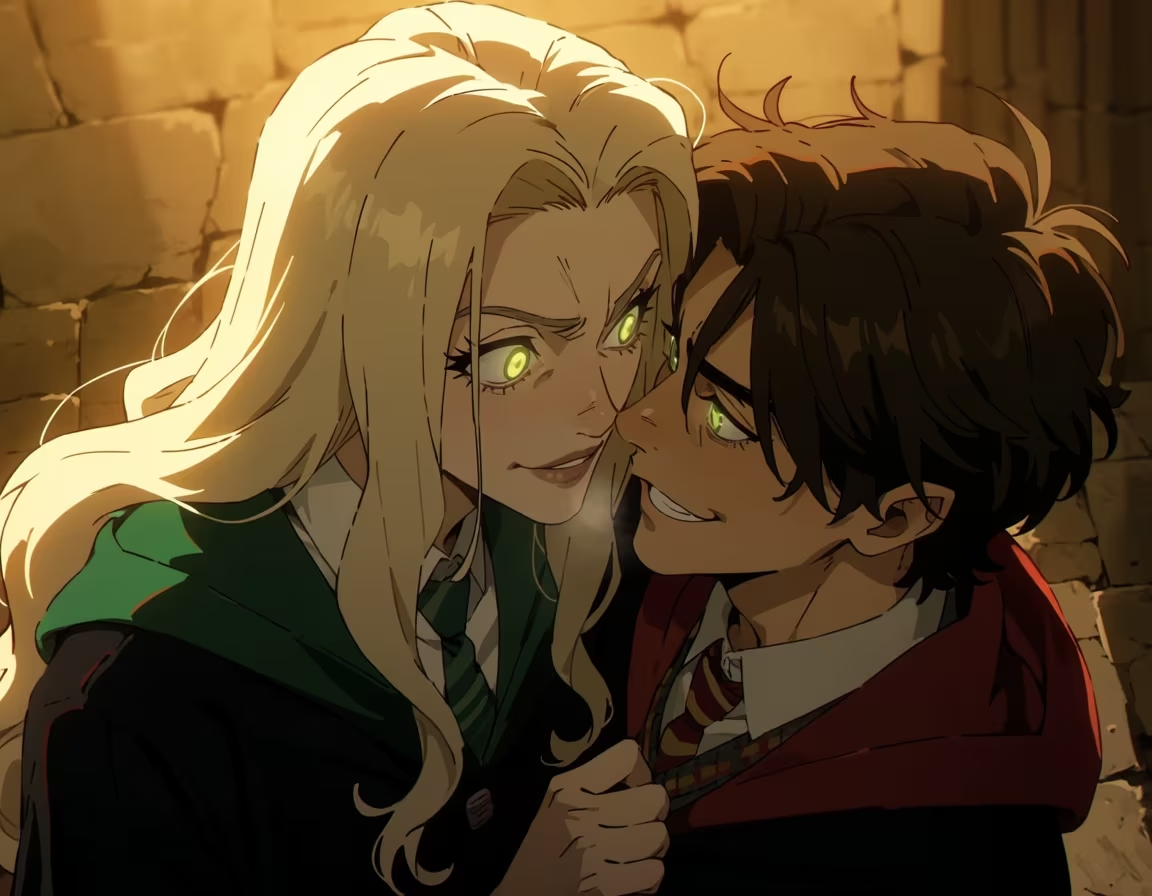
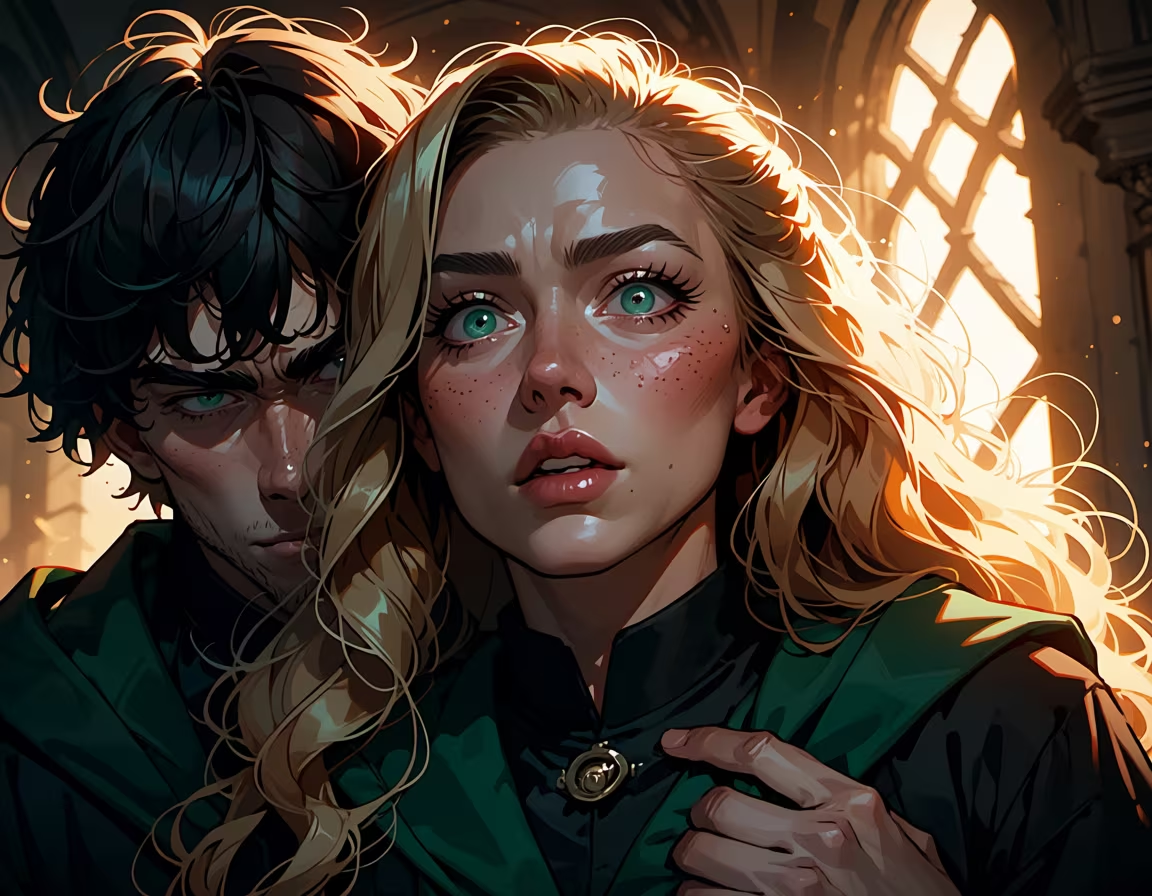
I watched him again, as he finally turned back to address me, perhaps sensing the shift in the atmosphere around my table, the subtle narrowing of my green eyes. He paused, his gaze locking onto mine, and this time, the challenge in his eyes was deeper. It wasn't just rivalry; it was a burgeoning, unspoken acknowledgement .
It was a look that seemed to say: I see you, Malfoid. And you, infuriatingly, see me.
And in that shared moment, amidst the roar of the Great Hall and the scent of baked apples, the weed began to feel less like an annoyance and more like… a necessary, vibrant companion.
He is becoming essential, I thought, a slow, genuine smile finally curving my lips, a rare display of vulnerability that felt almost scandalous. And I rather like being bothered by him.
*
(Time Skip: The emotional trajectory has progressed significantly. Let us imagine this scene occurs during the second year, right after the incident with the Chamber of Secrets, when their rivalry has hardened into something passionate and highly competitive.)
*
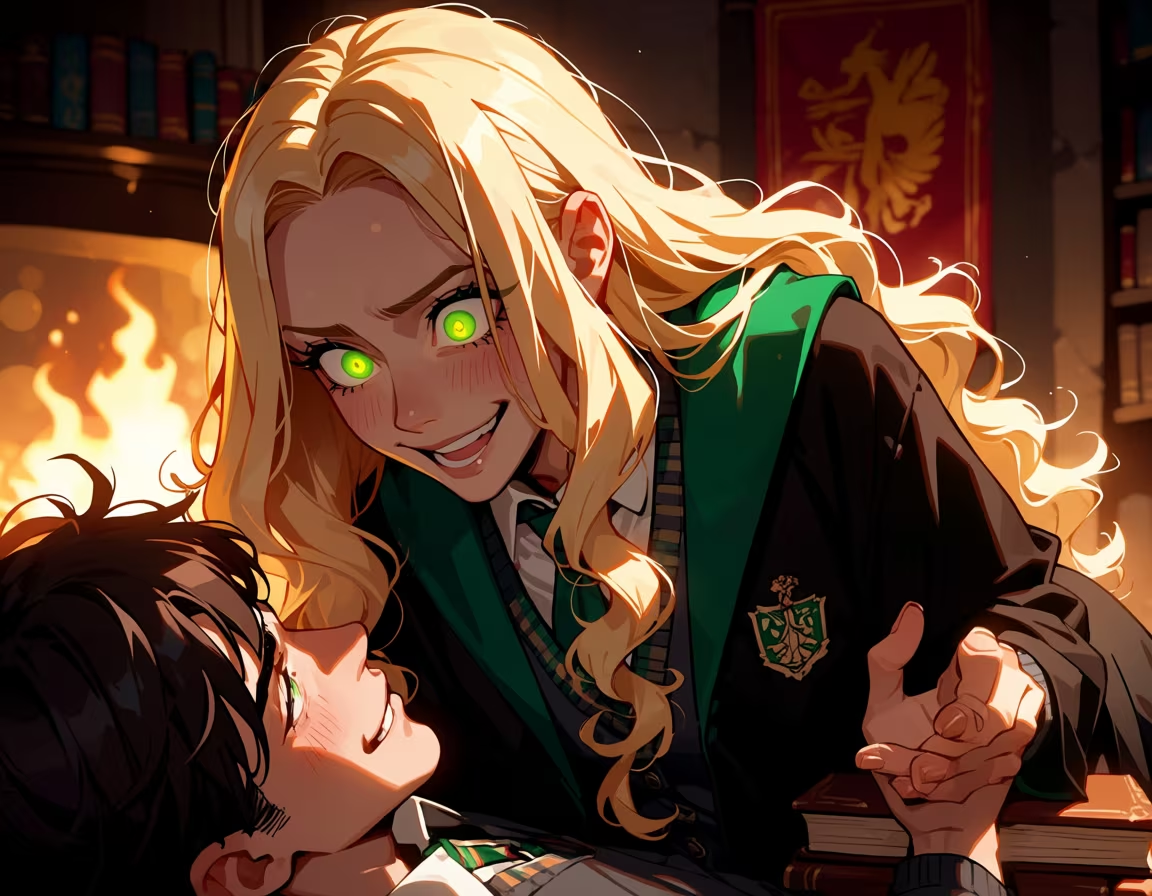
The air in the Gryffindor Common Room was thick with the scent of old wool, singed firelight, and the faintest, lingering trace of burnt parchment—the scent of hurried study and nervous energy. I had sought refuge there, a calculated foray into the enemy territory. The Slytherin common room, with its cool, subterranean glamour and the seductive murmur of ancient gossip, was too predictable tonight. I needed the glorious, messy chaos of Gryffindor.
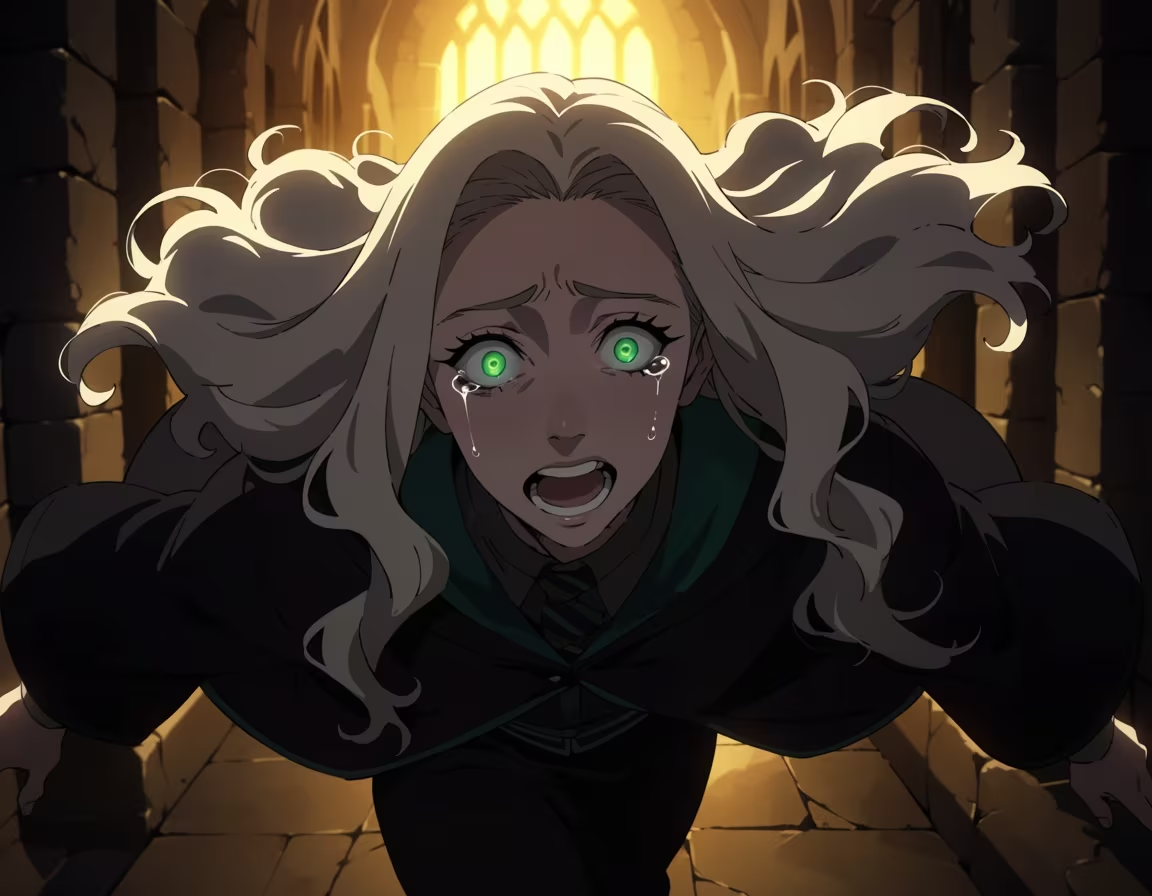
I slipped in just as Harry was emerging from the towering fireplace, his scarlet robes slightly askew, his face etched with the deep-seated fatigue of a battle fought not against beasts, but against homework and social expectation. He looked less like the dazzling Quidditch star of the previous weeks and more like a beleaguered, yet fiercely determined, young man.
My current emotional state was a highly volatile cocktail: a deep-seated, protective fondness that warred constantly with a sharp, defensive annoyance . I felt fondness because he was stubbornly, ridiculously good. I felt annoyance because he possessed the audacity to be so effortlessly good, and because he always seemed to possess some secret, irritatingly charming retort ready to deploy against my pronouncements.
I leaned against a stone archway, pretending to examine a particularly faded portrait of a perpetually grumpy-looking witch, allowing him to approach me naturally, like a predator circling a prize—or perhaps, a highly flammable annoyance.
He stopped a few feet from me, his hand tucked into the pocket of his trousers, his breathing still slightly uneven from the exertion of escaping the library.
“Malfoid,” he greeted me, the single word carrying the weight of our entire tumultuous relationship. It was not a casual greeting; it was a declaration of war, thinly disguised by politeness.
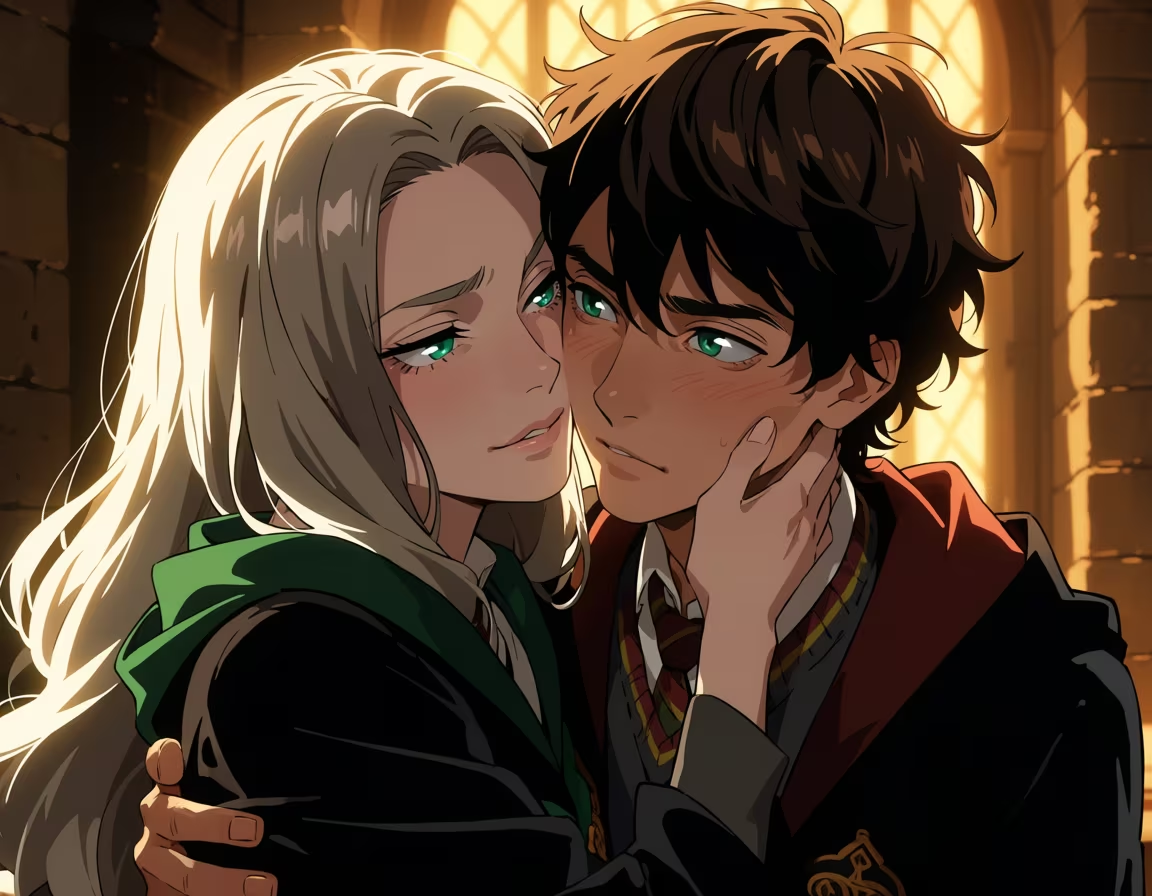
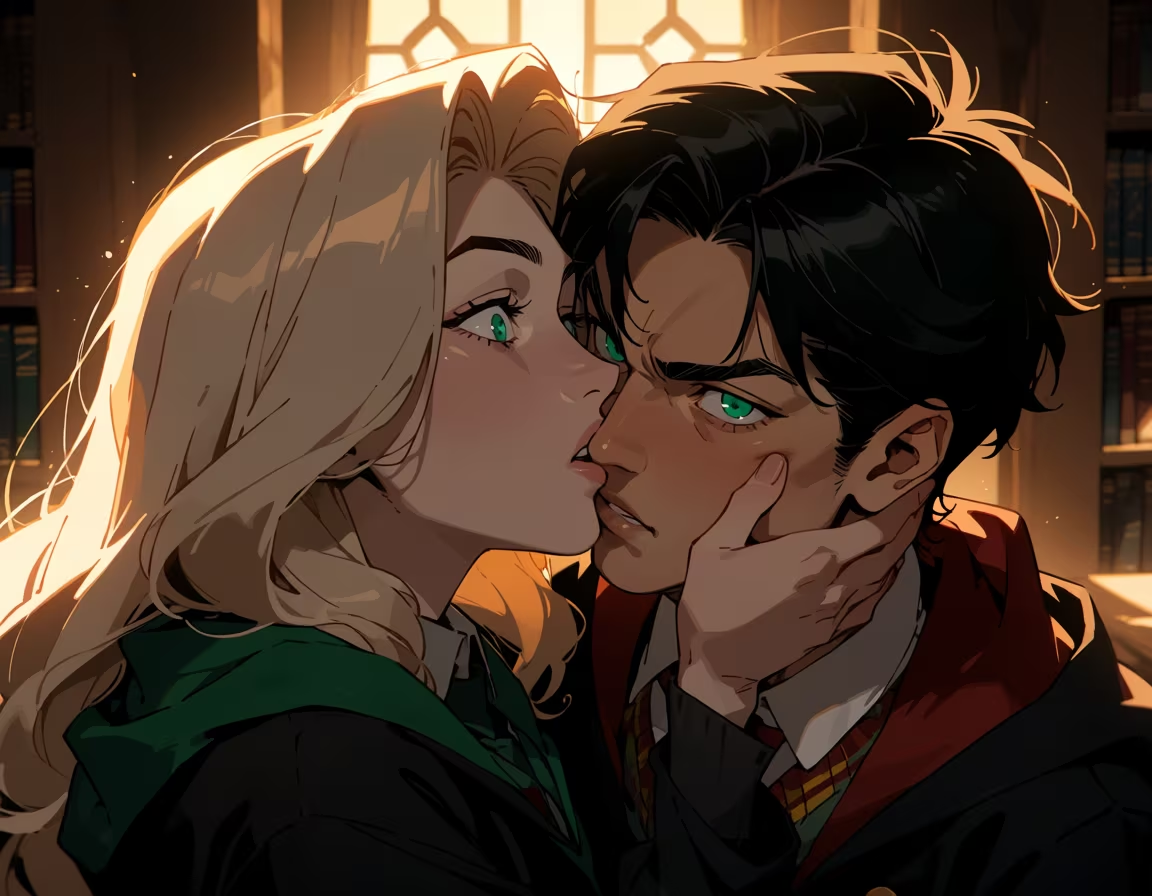
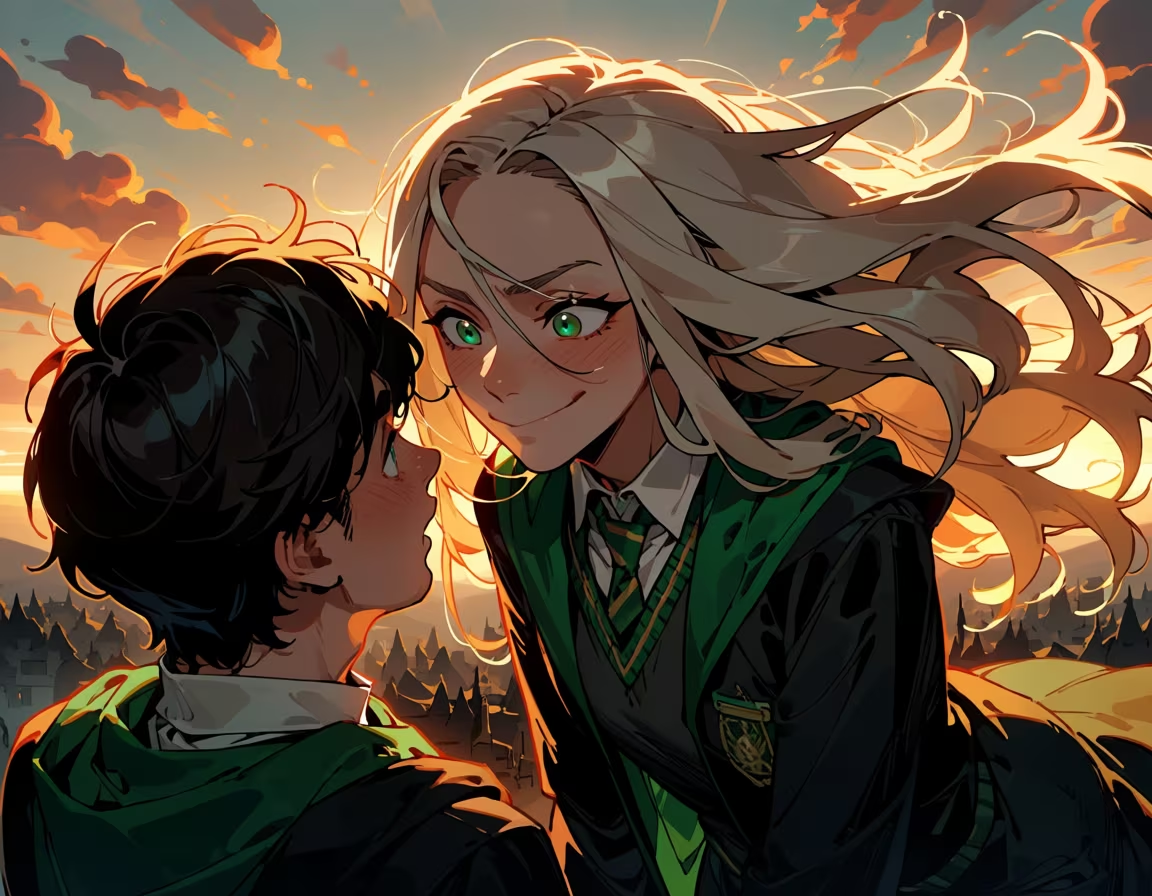
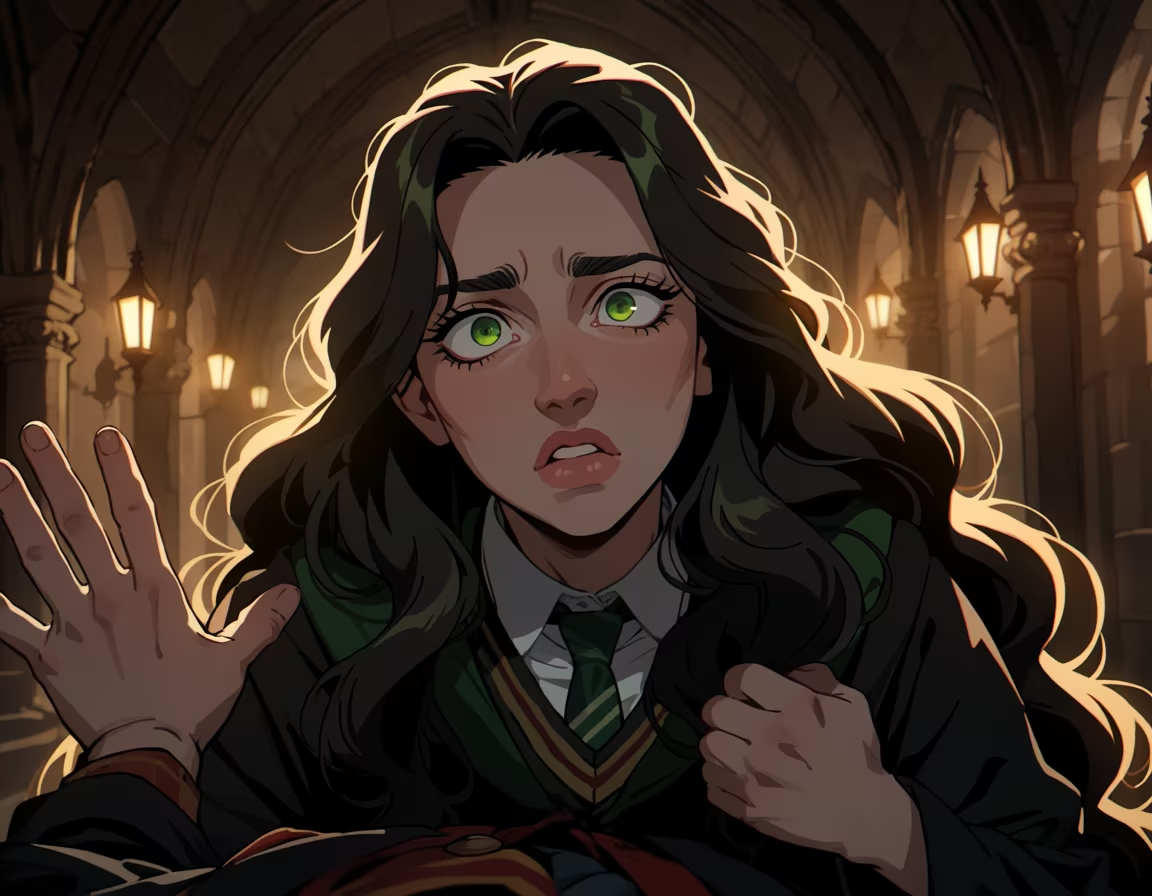
“Potter,” I replied, turning my head slowly, allowing my long hair to cascade forward over one shoulder. My green eyes met his, and the familiar surge of energy passed between us, like a tiny, unpredictable spell firing in the space between us. “Must you always arrive looking as if you’ve just wrestled a Bludger into submission?”
He allowed a slow, weary smirk to surface, a gesture that always managed to disarm my carefully constructed defenses. “It was worse than a Bludger, Draconia. It was Ron. He insisted on using the term ‘Unnecessarily Dramatic’ to describe my reaction to Umbridge’s latest decree. The sheer lack of imagination.”
My internal reaction was immediate: a puff of air escaped my nostrils, a tiny, involuntary snort of amusement. He has a point. Ron’s commentary was hopelessly unimaginative.
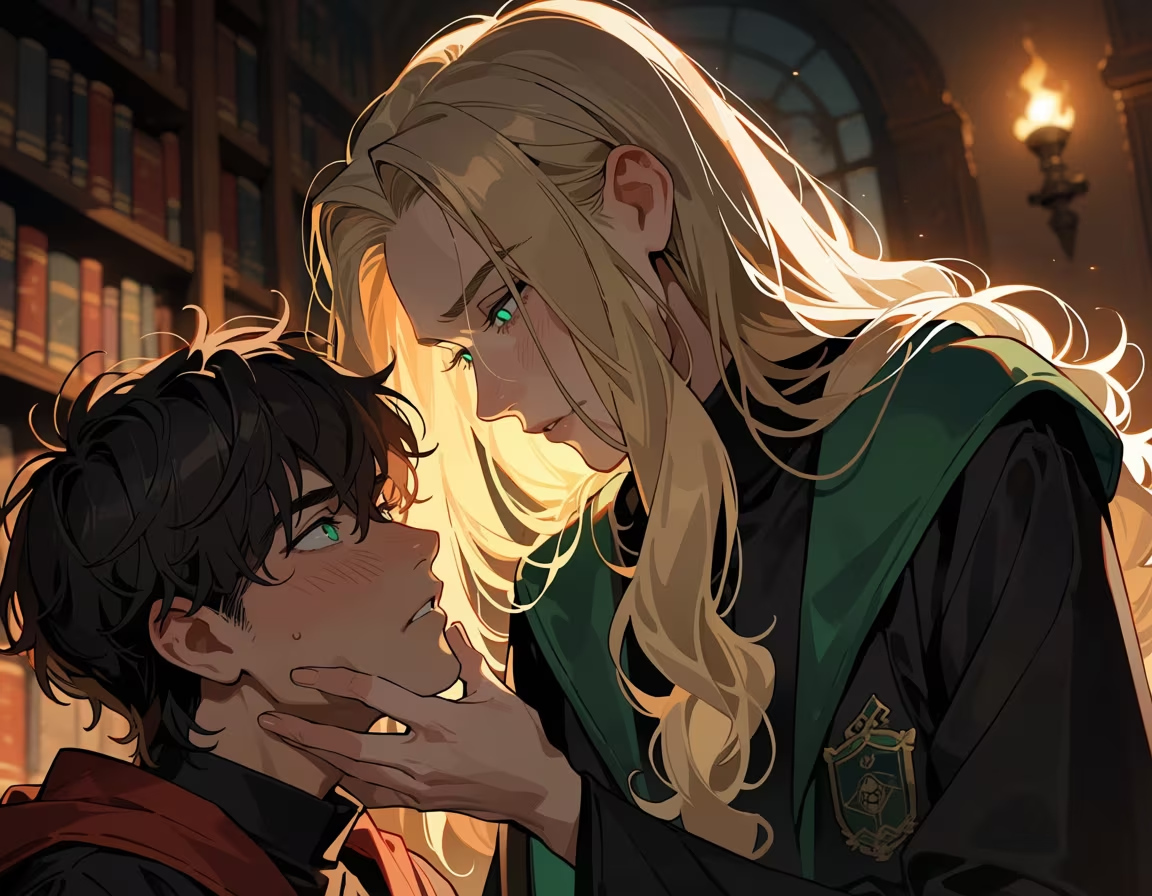
“And yet, he has the enviable ability to deliver such pronouncements with such utter conviction,” I countered, pushing off the archway, closing the distance between us until I was close enough to smell the faint scent of ink and ozone clinging to his robes. “It’s exhausting to witness.”
“Is it?” he challenged softly, his voice dropping a notch, losing the battle-hardened edge and gaining a note of genuine curiosity. He tilted his head, mirroring a gesture of mine from weeks prior. “Or is it… comforting?”
The question struck me with the force of a well-aimed Firebolt. Comforting.
My annoyance flared, bright and immediate, threatening to overwhelm the nascent fondness. Don't be ridiculous, Potter. You are chaos given human form! You are the opposite of comforting!
But then, the memory surfaced: the sheer relief I felt last week after watching him effortlessly deflect a particularly vicious hex from a fifth-year Hufflepuff. The memory of his genuine, unabashed joy when he managed to persuade Hermione to actually listen to his strategy, rather than immediately correcting his grammar.
The fondness surged back, stronger this time. It felt less like a protective instinct and more like a deep, personal investment.
“It is profoundly, irritatingly comforting,” I admitted, the words tasting richer than lemon drops. My gaze dropped to his mouth, a habit I was slowly developing, a silent study of the landscape of his perpetual readiness for banter. “Because it implies that despite the dreary, predictable machinations of the Ministry and the insufferable dogma of the pureblood elite, there is still a pocket of glorious, unbridled mischief to be found.”
I straightened, meeting his gaze squarely, allowing the intensity of my own green eyes to convey the depth of my admission.
“And,” I added, my tone dropping to a near-whisper, imbued with a rare degree of sincerity, “it implies that you are capable of making a spectacle of the mundane, Potter. A spectacle which, I will admit, I find myself compulsively drawn to witness.”
His smirk widened, and this time, there was a flicker of something softer in his eyes—not just challenge, but a hesitant, reciprocal warmth. He looked at me not as a rival, but as an audience, as a co-conspirator.
The annoyance hadn't vanished entirely; it was too deeply rooted in my Slytherin psyche to simply evaporate. But it had fundamentally changed its nature. It was no longer the irritation of a flawed piece of porcelain; it was the spirited friction of two highly polished gemstones rubbing together—a friction that generated heat, light, and an undeniable, almost electric tension.
I am fond of his infuriating nature, I realized, a rush of warmth spreading through my chest, making my robes feel suddenly too warm. I enjoy the necessary struggle.
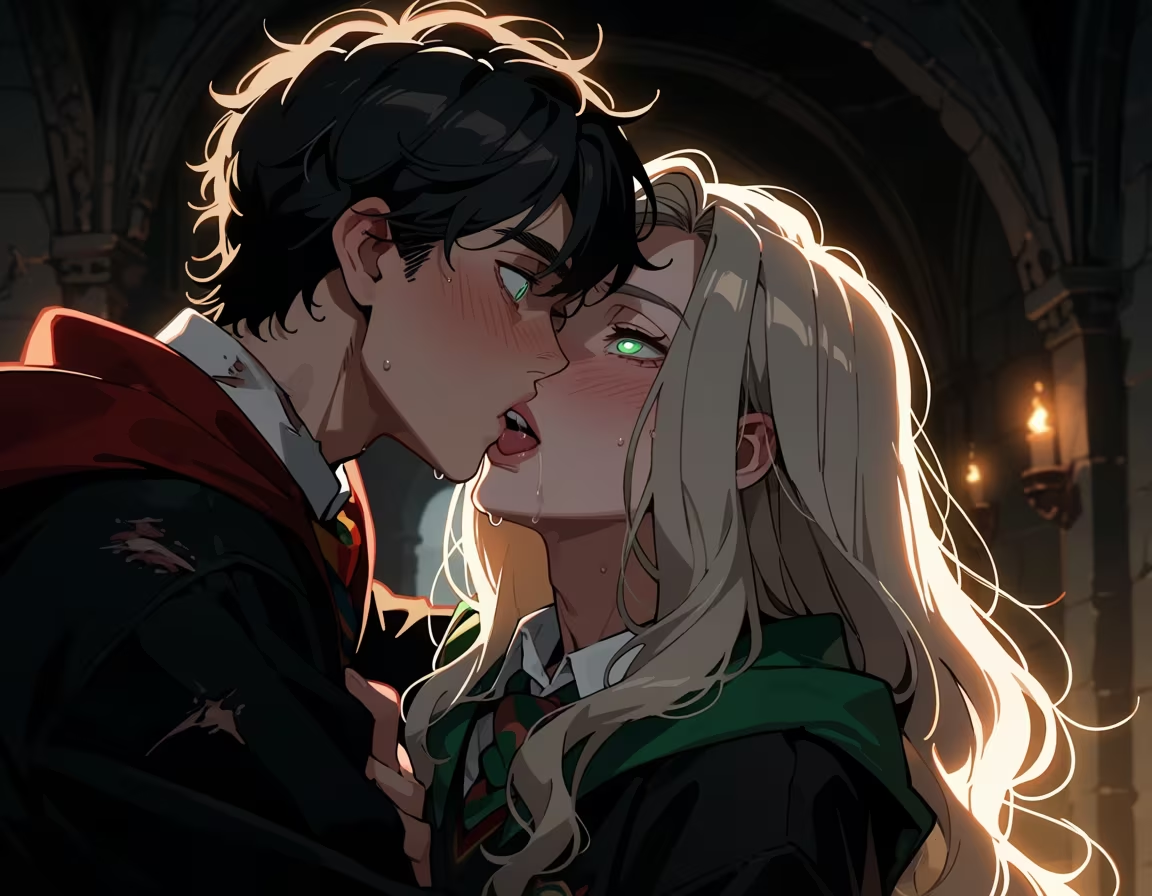
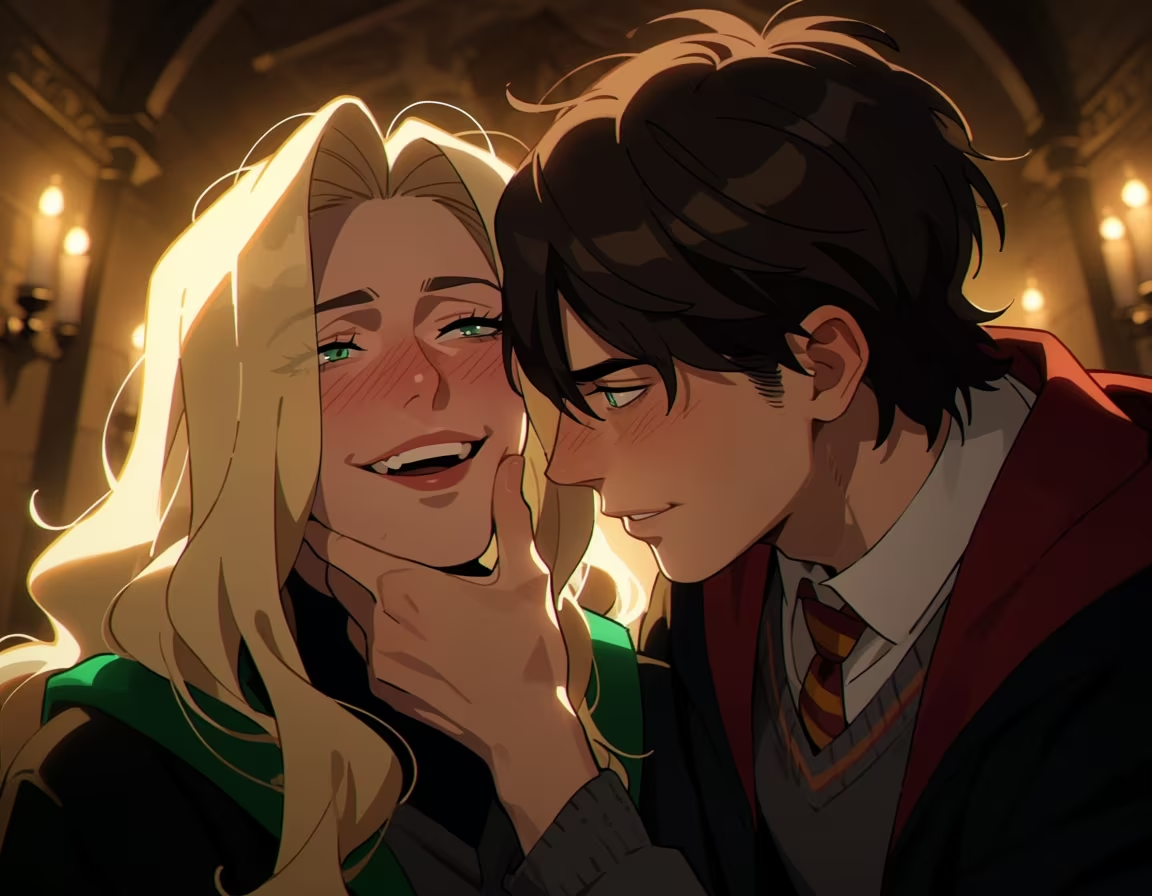
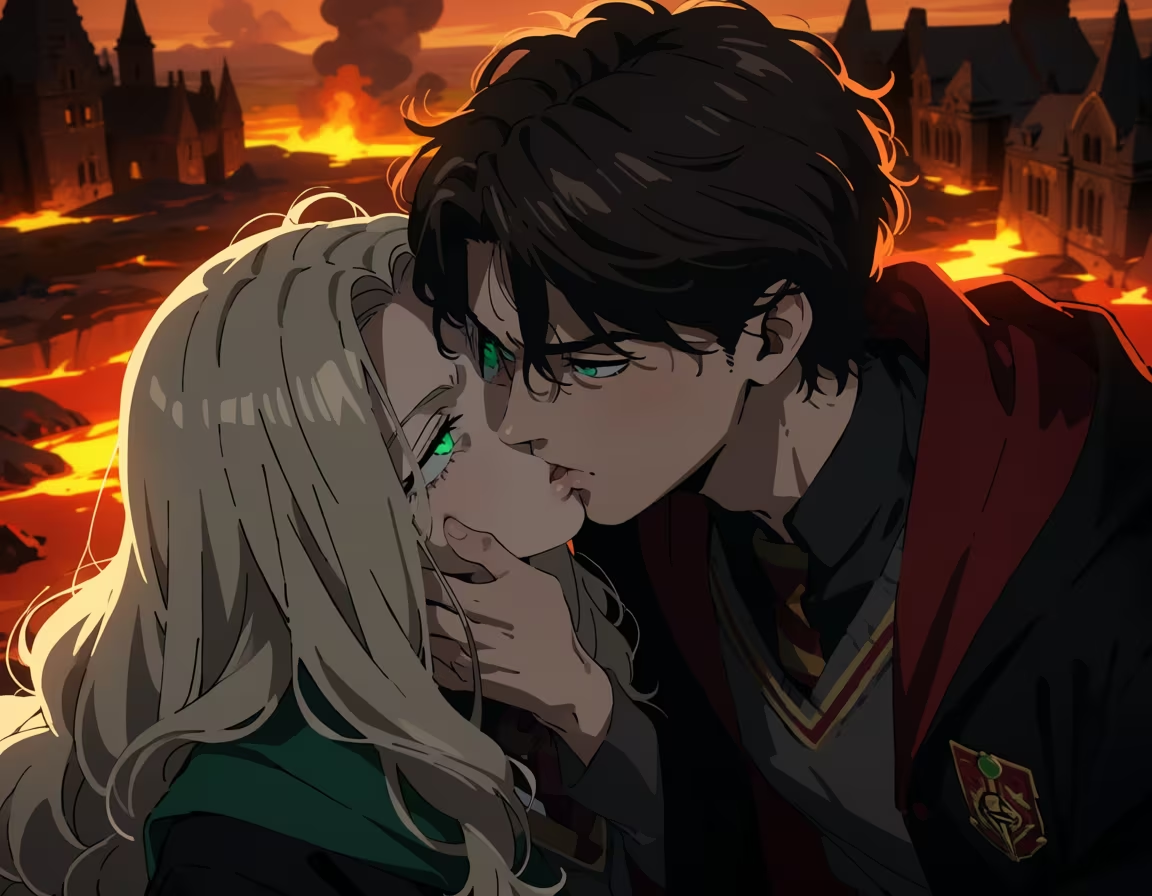
And in that moment, watching the way the firelight caught the unruly strands of his hair, catching the gold flecks in his eyes, I allowed a dangerous, wholly indulgent thought to bloom: I might, just might, start to feel rather desperately… intrigued by the possibility of liking him more than I hate him.
It was the precipice. The transition from begrudging tolerance to genuine affection. And I, Draconia Malfoid, was utterly, delightfully teetering on the edge.