| Home | The Lives of Velnin | Illustrated Fiction | Malfoid Art & Fiction | Book Blurbs | Contact |
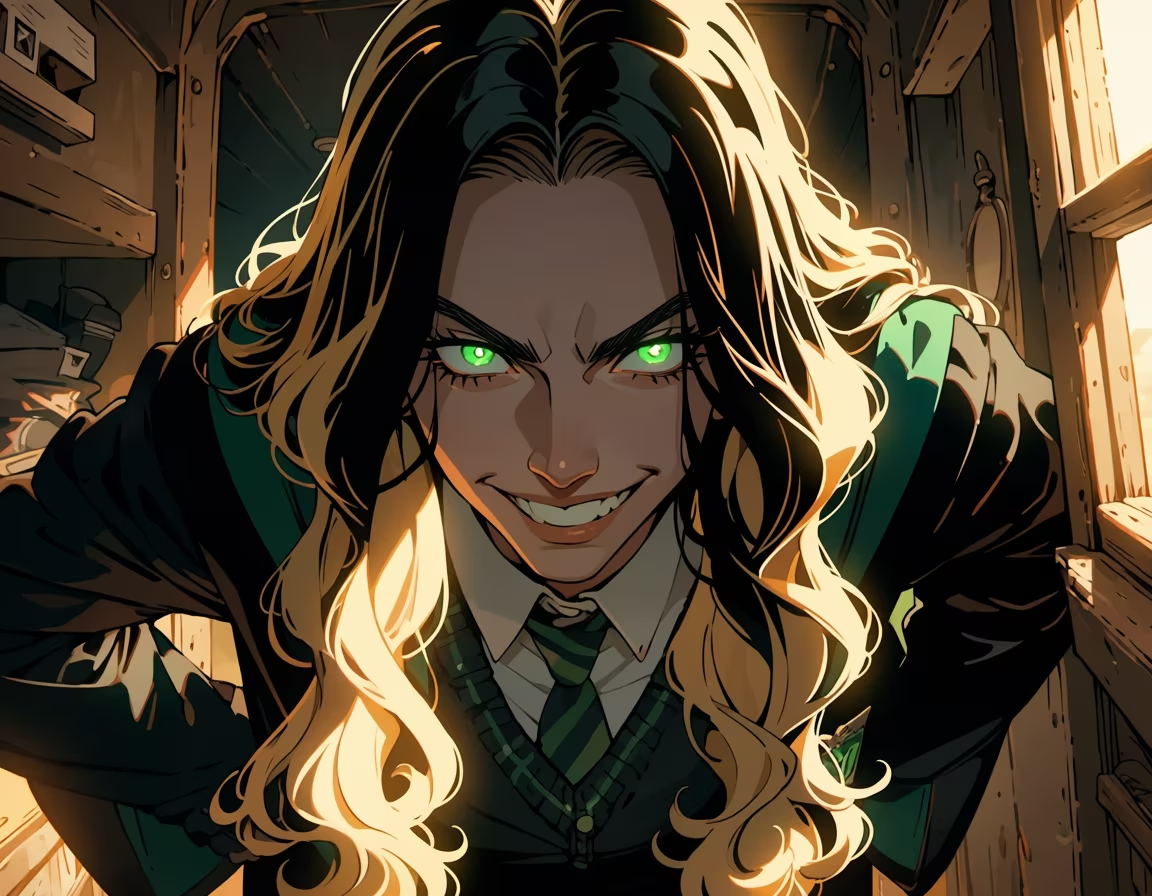
The rhythmic clatter of the Hogwarts Express wheels was, to my sensibilities, an offensively cheerful sound. It was a monotonous percussion that seemed determined to break the elegant silence of the compartment, drowning out the rustle of expensive parchment and the satisfying, hushed murmurs of the truly discerning passengers.
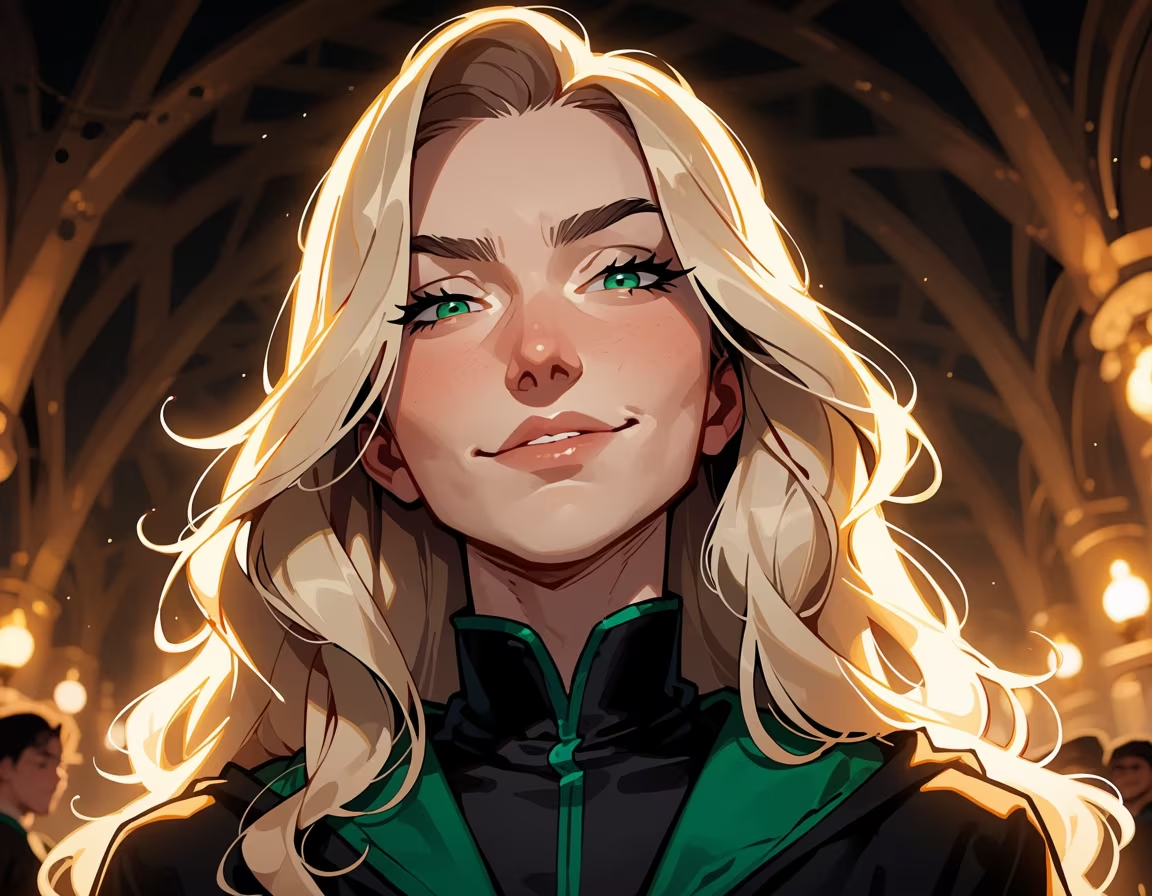
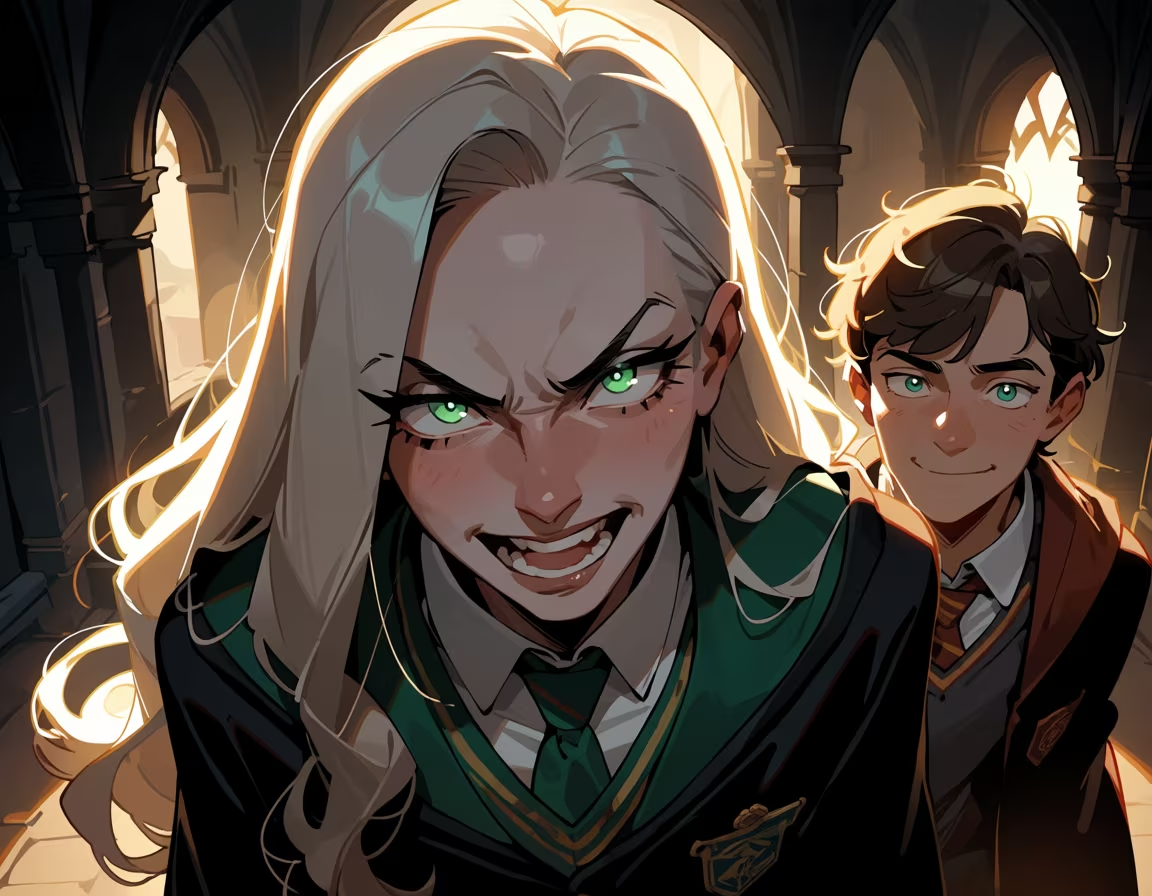
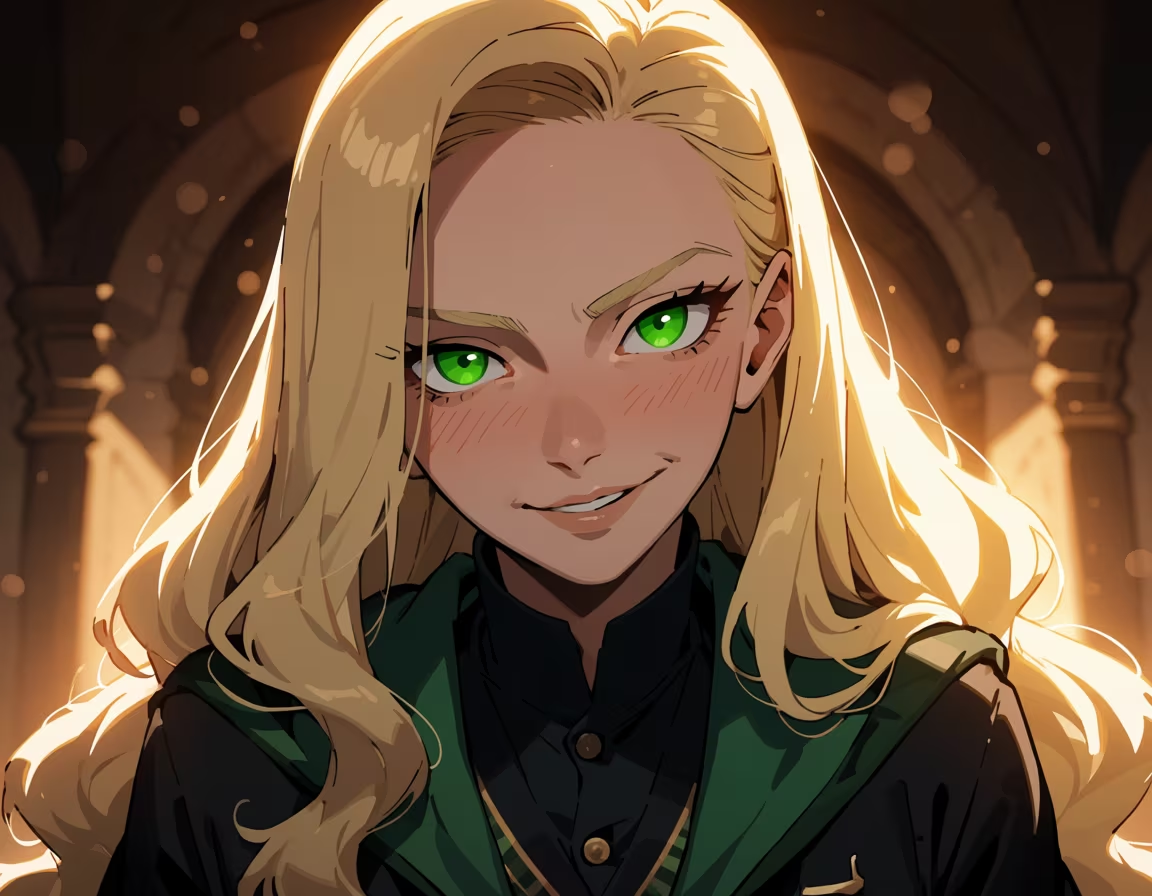
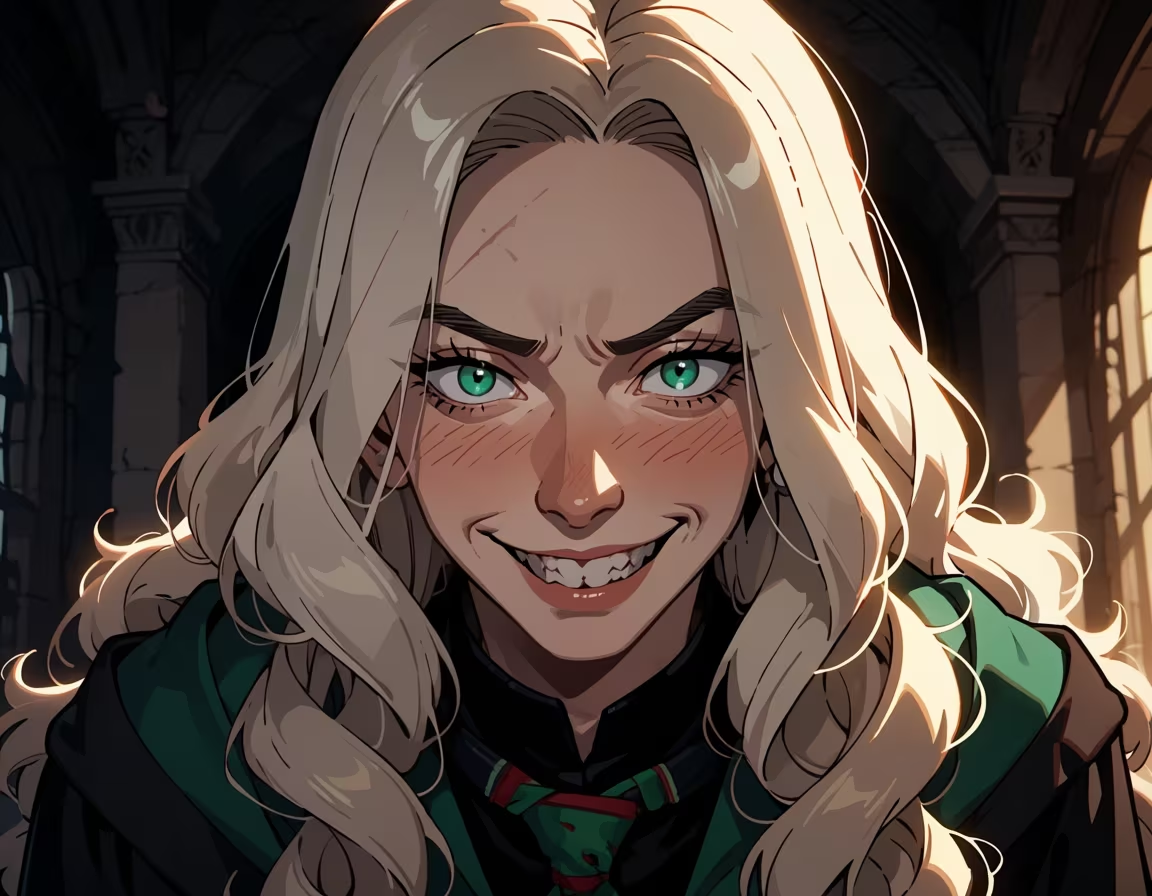
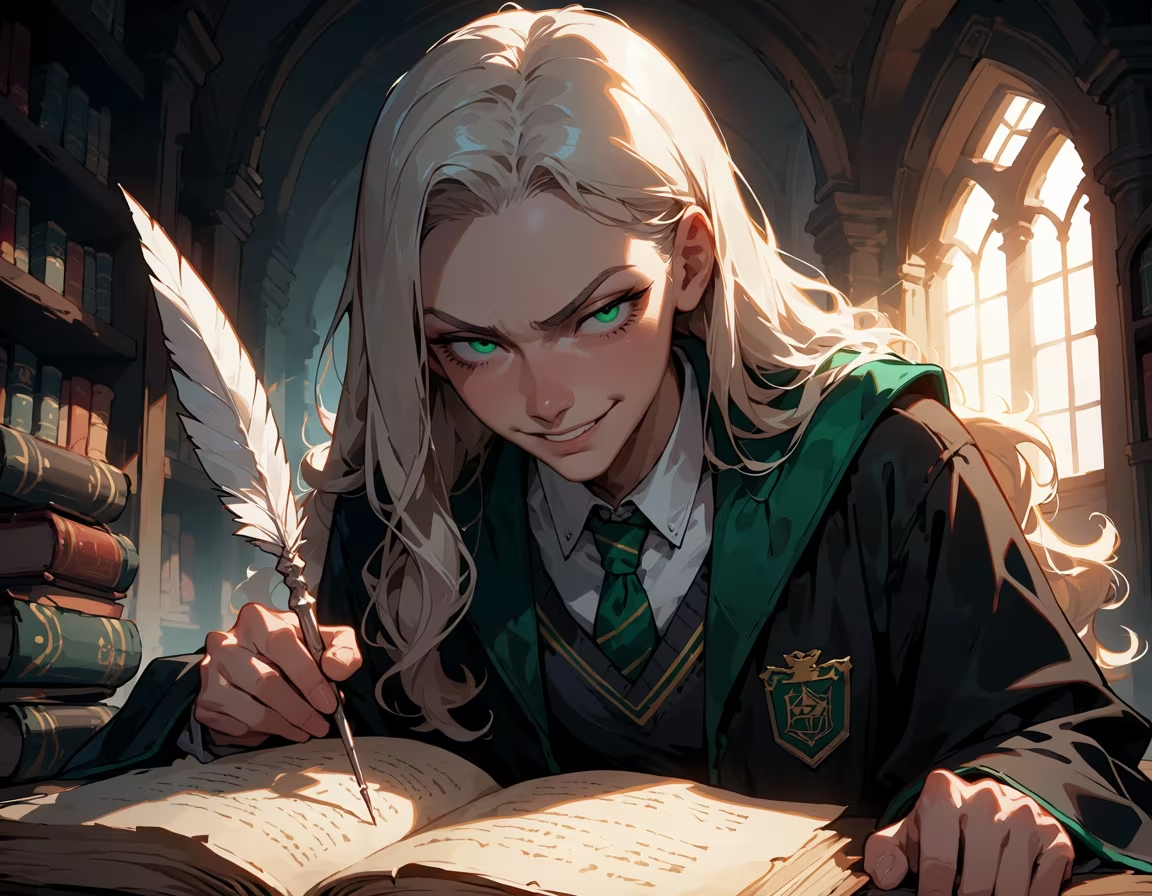
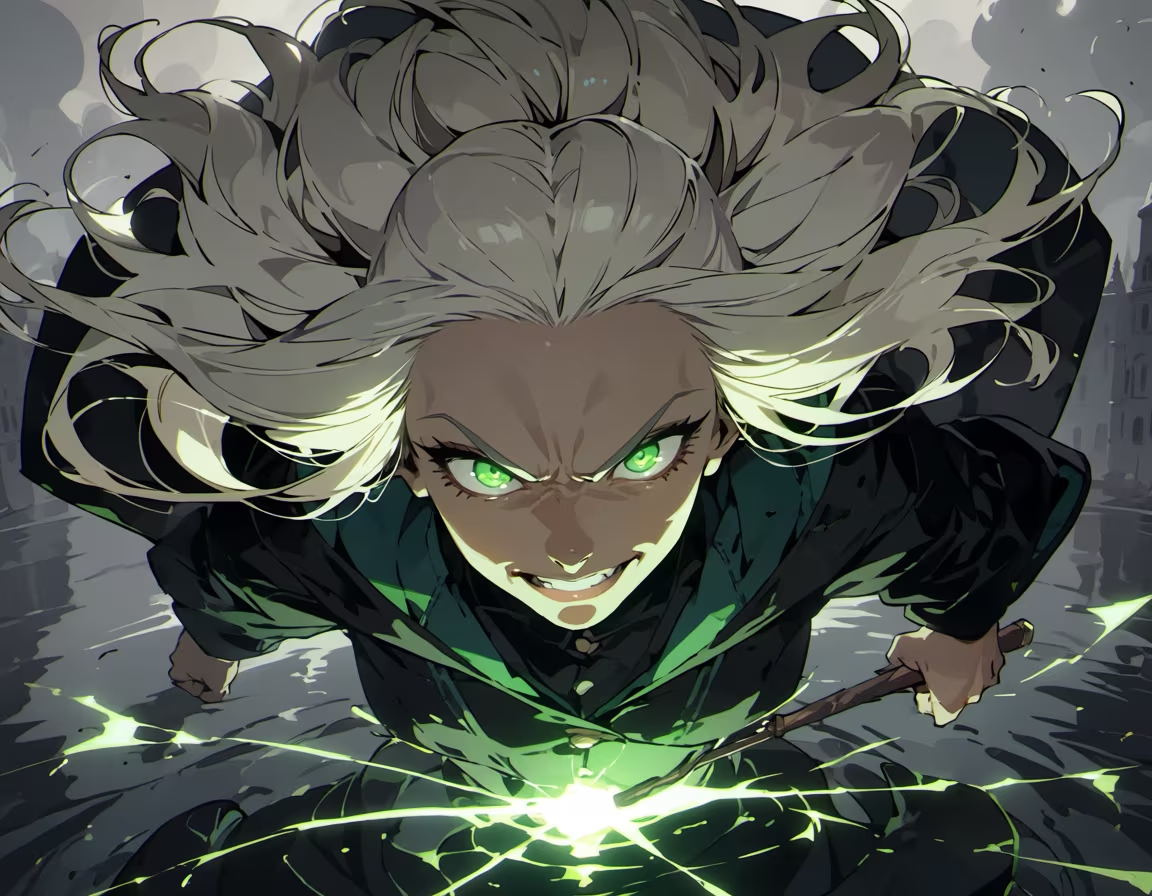
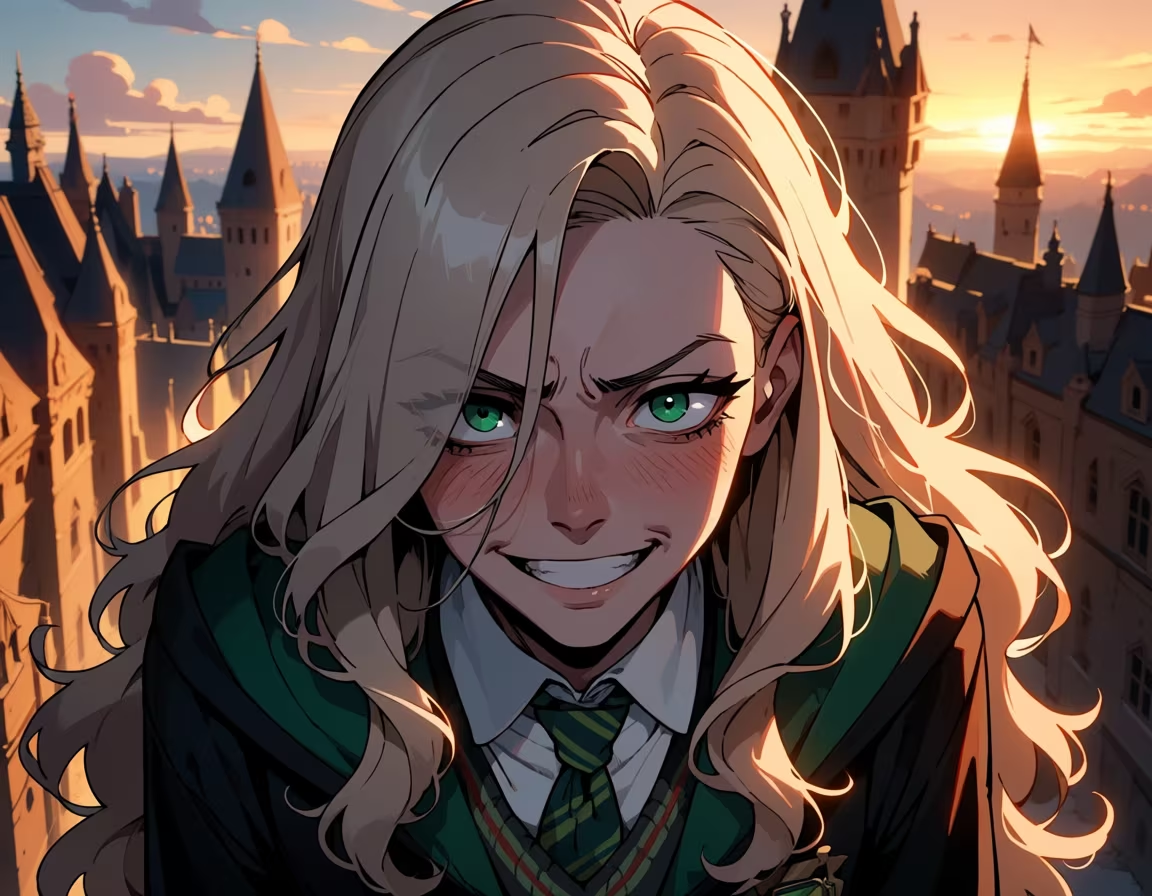
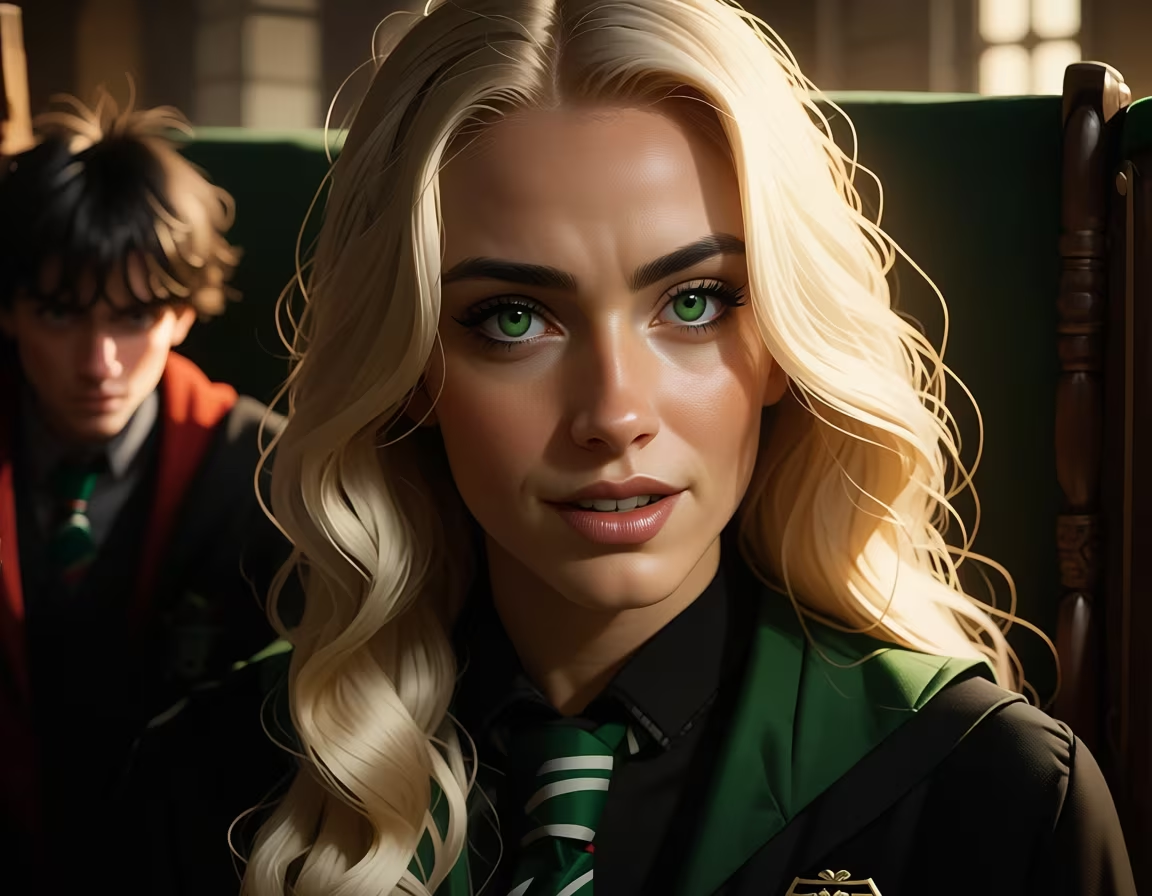
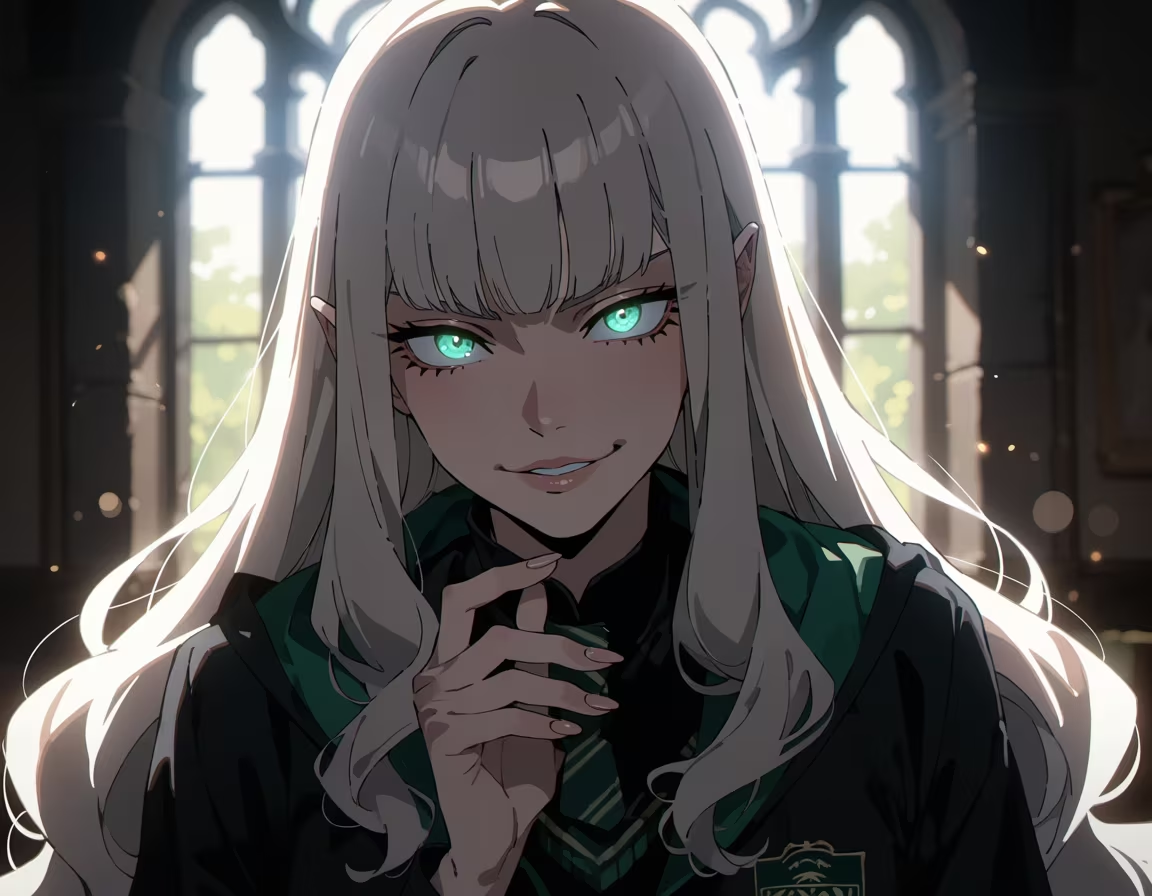
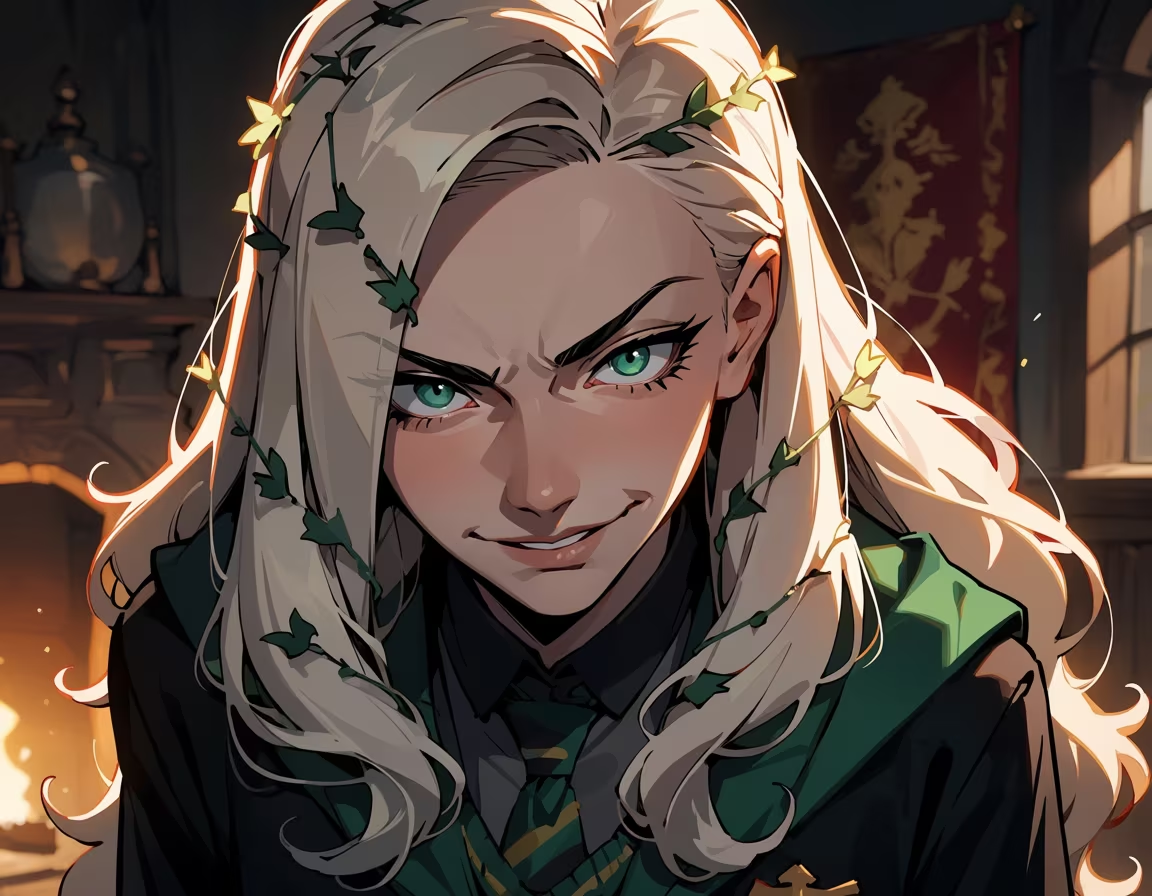
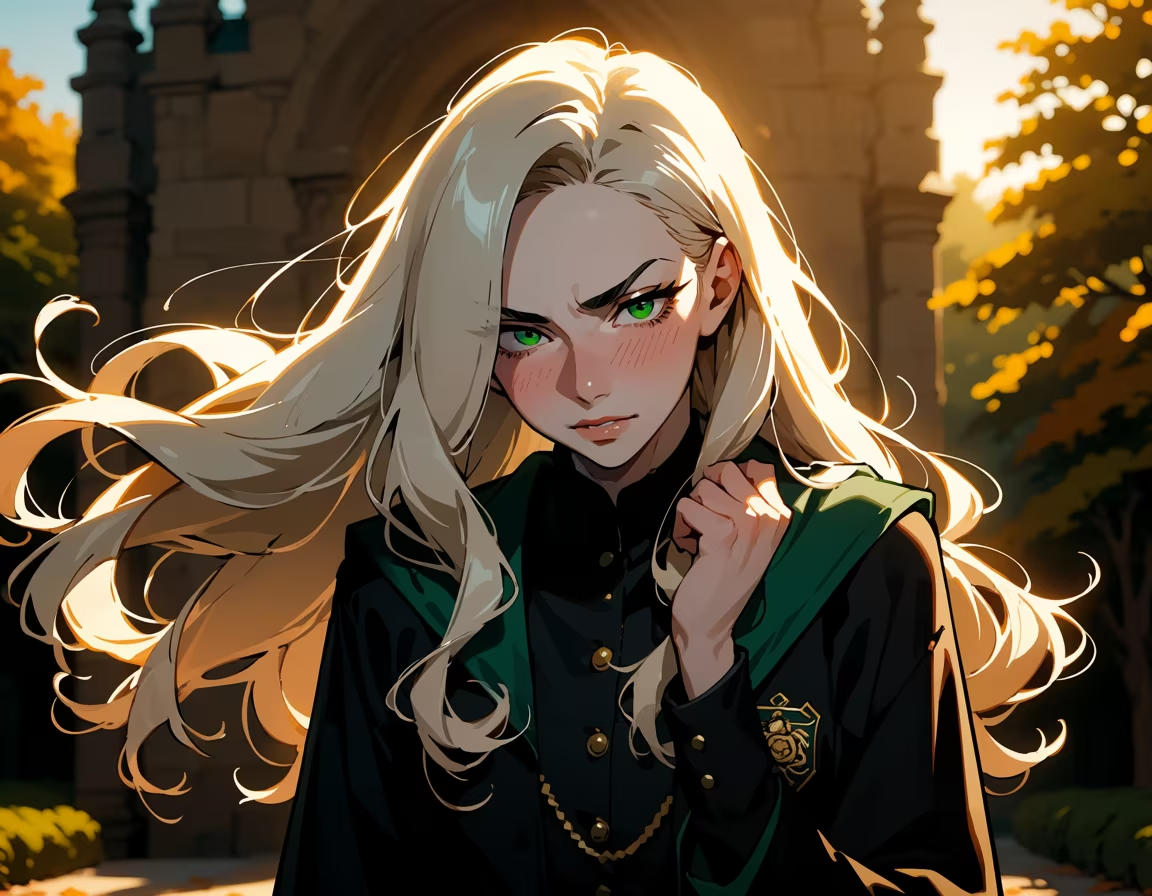
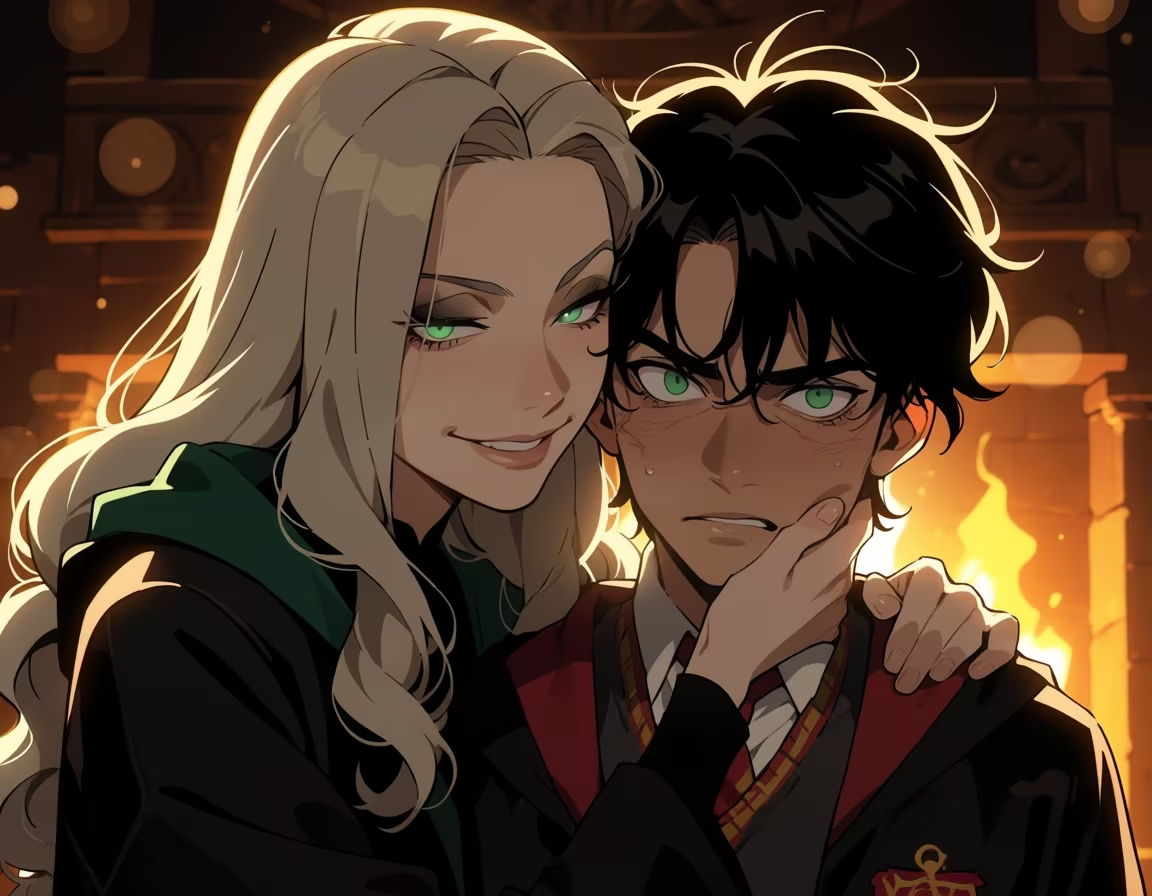
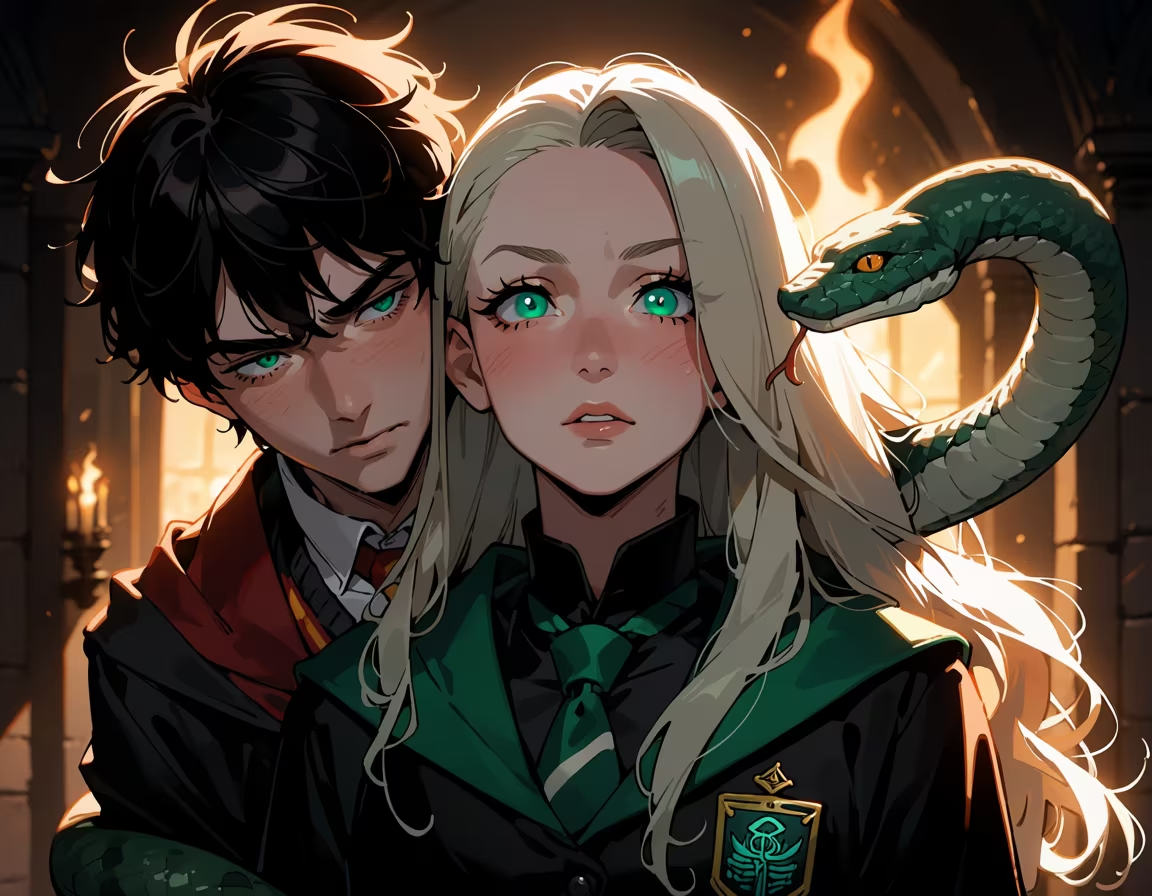
I was settled against the plush, dark green velvet cushioning, a small island of Slytherin sophistication in a sea of chaotic Gryffindor and boisterous Hufflepuff. My long, pale blond hair—a shade so perfectly cultivated that even I suspected it was an act of deliberate vanity—spilled over the shoulders of my black robes, the deep emerald trim catching the afternoon sunlight streaming through the compartment window like shards of rare jewels. My green eyes, currently narrowed to slits of exquisite judgment, were surveying the proceedings with the practiced hauteur of someone accustomed to being admired, envied, and occasionally, begrudgingly tolerated.
My focus was currently fixed upon the source of the most egregious noise pollution: a lanky, ruddy-haired boy—a Weasley, judging by the aggressively primary colours of his tartan scarf—who was attempting to balance a precarious tower of pumpkin juice cups on his knee. Beside him, a girl with hair the colour of a well-kept copper penny was attempting to read a hefty tome, occasionally glancing up with a look of exasperated patience.
Honestly, I thought, a faint, almost imperceptible curl lifting the corner of my mouth. The sheer lack of innate decorum.
The Weasley boy, in a magnificent display of competitive clumsiness, managed to send the entire tower cascading onto the floor with a wet splat .
“Blimey, Draconia! You’ve been staring at us like we’re a particularly stubborn stain on a Persian rug,” the ginger boy announced, wiping a splash of crimson juice from his chin.
I didn't deign to look at him immediately. Instead, I allowed my gaze to drift past his messy curls, past the worn tweed of his jacket, and land upon a new arrival.
He was standing just outside the compartment doorway, having seemingly been drawn in by the sudden eruption of Weasley-induced pandemonium.
And then, the noise of the train seemed to diminish, pulled taut by the sudden, magnetic force of his presence.
He was… unexpected.
He was not polished, like myself. He was not impeccably neat, like the other Slytherin prefects who had already taken their assigned seats. He was a glorious, vibrant mess. His hair was a wild thatch of jet black, defying any attempt at aristocratic combing, and it seemed perpetually windswept, even though we were perfectly still within the carriage. He wore his Gryffindor uniform with a certain defiant slouch that suggested he found the concept of 'proper posture' to be a bourgeois constraint.
But it was his face.
The face was striking in its stark simplicity. It held a raw, startling beauty—a sort of untamed potential that made my internal critic stumble momentarily. And there. Right above the bridge of his nose, a faint, pale lightning-shaped scar—a mark too dramatic, too evocative, to simply be a childhood mishap. It looked as if fate itself had decided to etch a narrative onto his skin.
My annoyance, which had been a steady, simmering broth within my chest, paused, wobbled, and then, with a delightful little pop , morphed into something far more intriguing. It wasn’t immediate fondness, heavens no. It was sharp, critical curiosity, laced with a powerful, undeniable interest .
He was offensively ordinary in many ways, but the scar, the startling blue-green of his eyes—eyes that seemed to hold a defiant, intelligent fire—they elevated him instantly above the Weasley tide. He possessed a certain glorious, stubborn intensity .
He stepped fully into the compartment, pausing, seeming to gauge the atmosphere—the scent of damp wool, old leather, and overly sweet pumpkin juice—before allowing his gaze to finally sweep across the compartment. It caught mine.
The moment our eyes met, the world seemed to compress. The clatter of the wheels, the bleating of a nearby pig, the scent of ginger—all faded. There was only the piercing contact between his bright, turbulent eyes and my own steady, emerald gaze.
For a split second, he looked utterly surprised, as if he had expected the compartment to be filled with drab, beige mediocrity. He looked slightly guarded, perhaps a fraction wary of the Slytherin judgment radiating off me, but his posture held firm.
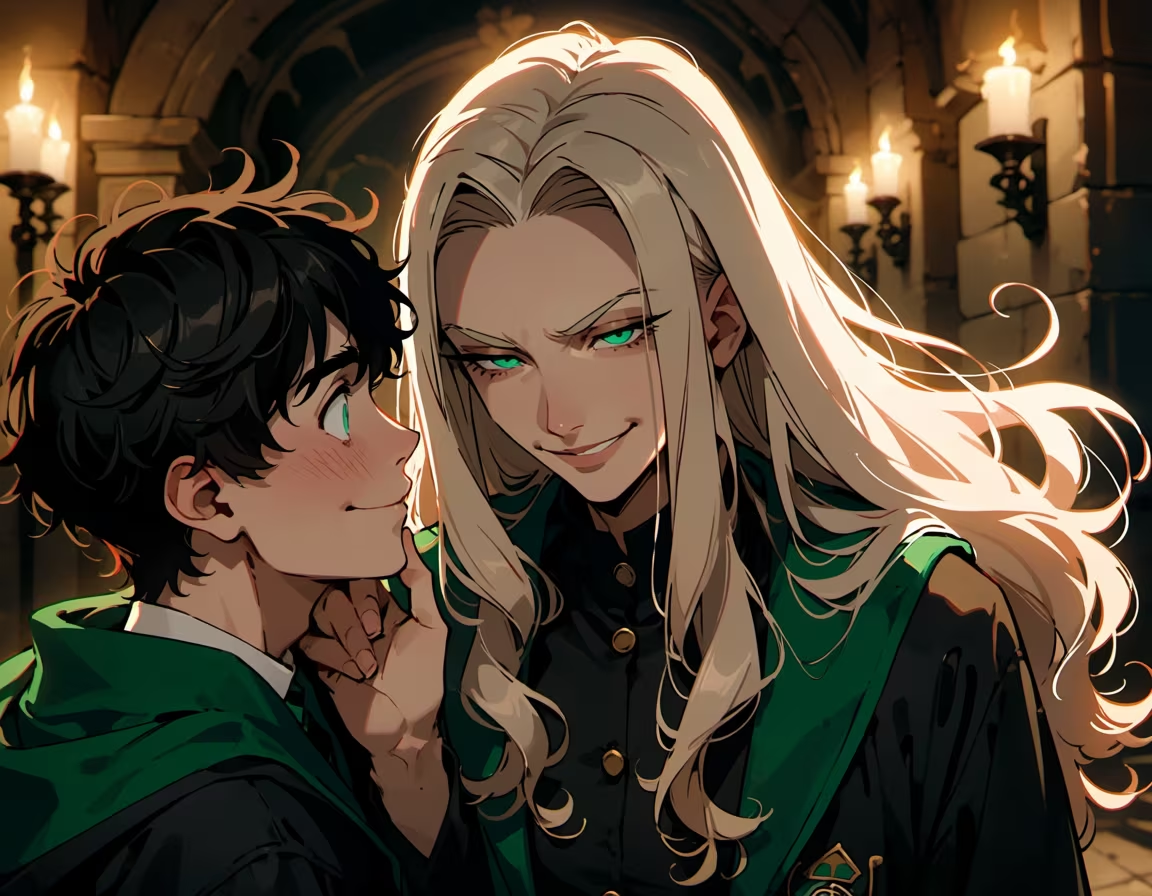
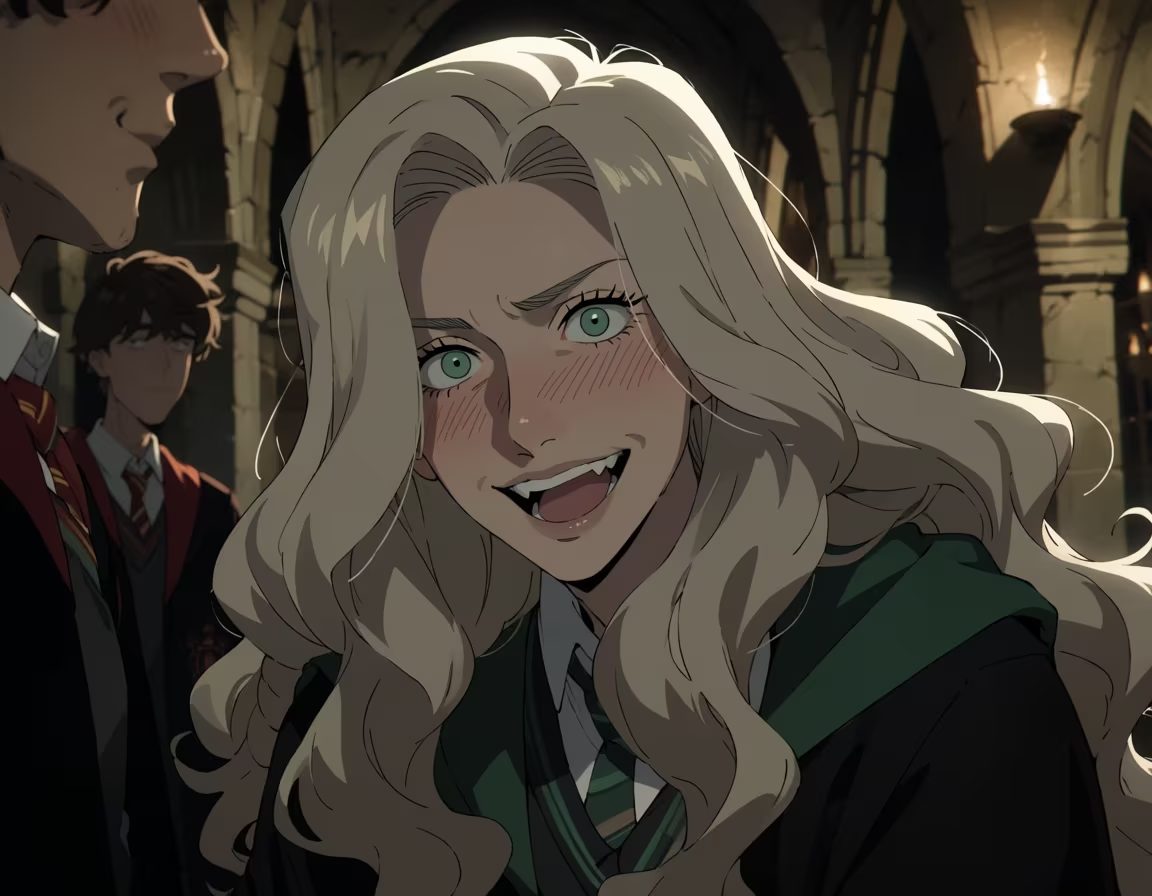
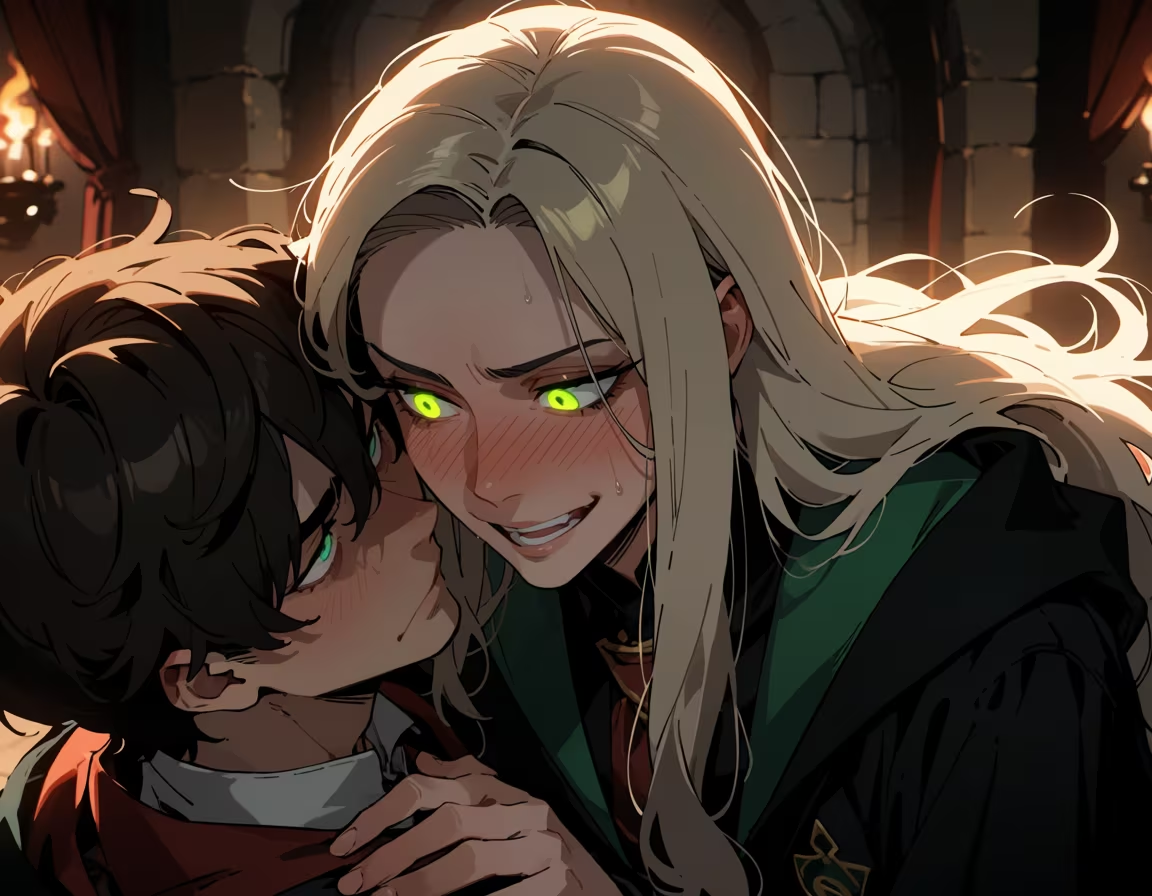
I held his gaze, refusing to blink first. A small, almost predatory smirk touched my lips.
Oh, I thought, the internal monologue accelerating into a rapid, delightful drumbeat. You have spirit. A commendable, infuriatingly bright spirit.
He didn't flinch. He didn't look away, though a faint flush was beginning to rise up his neck, a tell-tale sign of his own internal battle against my scrutiny.
I decided, then, that one direct, devastatingly cutting observation was necessary to establish the appropriate hierarchy.
"Well," I said, my voice smooth, pitched just low enough that the Weasleys had to strain slightly to catch it, but perfectly clear for the boy. "You are… startling. For a Gryffindor."
His eyebrow arched infinitesimally, a small, masterful gesture of resistance. He seemed to be weighing whether to dismiss the comment as simple, petty Malfoy condescension, or to engage with the inherent compliment.
"And you," he countered, his voice surprisingly deep, lacking the youthful squeak of most boys my age, "are offensively polished. Are you always this… perfectly curated?"
The slight, involuntary tightening of my jaw was the most visible sign of my internal reaction. Offensively polished. He had the audacity. But the way he said it—that hint of playful challenge beneath the critique—sent a tiny thrill down my spine, a delicious counter-irritant to my initial annoyance.
I allowed the smirk to widen, turning the critique into a weapon. "One strives for excellence, Potter. Something most of your lot seems to actively avoid. You, however, possess a certain je ne sais quoi ... a dramatic untidiness that suggests you might actually be worth tolerating."
He blinked once, a slow, deliberate movement, as if absorbing the complex mixture of insult and praise. He took a small step closer, his posture shifting from defensive to challenging.
"Tolerating me," he repeated, the words tasting wonderfully dry on his tongue. "That is a high compliment coming from the reigning queen of Slytherin self-regard. I shall endeavor not to be too taxing, Malfoid."
Malfoid. He had used my surname. Not the full, grand title, but the clipped, dismissive form. A deliberate slight.
This was magnificent.
My initial irritation flared back up, sharp and bright, but this time it was mingled with a powerful rush of pleasure. It was the feeling of being perfectly provoked. He wasn't meek; he wasn't shy; he was active .
"Don't strain yourself," I purred, leaning back slightly, regaining my elegant composure. "It takes considerable effort to maintain such a state of perpetual, vibrant disarray."
Before he could launch a counter-barb, the ginger Weasley—Ron, as he had been called—interjected with the desperate enthusiasm of a boy seeking validation.
"You’re the one who’s worth tolerating, Harry! You’re way more interesting than half the slimy Slytherins," Ron declared, puffing out his chest.
I glanced at Ron, offering him a look that could curdle milk, before pivoting back to Harry.
"And yet," I murmured, my tone softening marginally, the annoyance yielding to a more sophisticated, intrigued amusement. "You are currently being championed by the most aggressively earnest specimen of Gryffindor mediocrity. One must wonder if you have a baseline standard of tolerable company, or if you simply find all of us inherently amusing targets."
Harry’s gaze flickered to Ron, a barely perceptible flicker of something that might have been weary exasperation, before snapping back to me.
"I think," he said, his voice dropping just a fraction, becoming more intimate, more resonant, "that the people who are most amusing are the ones who are the hardest to read."
The air in the compartment seemed to thicken instantly. Ron looked utterly baffled, the pumpkin juice residue forgotten.
Hardest to read.
That struck a chord deep within the meticulously guarded architecture of my inner self. He had seen past the flawless presentation, past the ingrained aristocratic sheen, and recognized the subtle shifts in my expression, the practiced aloofness that was merely a defensive shell.
My annoyance, the prickly desire to dismiss him as another over-hyped Gryffindor nuisance, dissolved completely. In its place bloomed the first fragile, exciting tendril of interest . He wasn't merely handsome or defiant; he was perceptive.
A true threat to my established superiority. And I adored it.
I met his gaze again, and this time, the smirk was slower, deeper, imbued with a genuine spark of acknowledgement.
"A bold claim," I whispered, allowing a touch of genuine awe—a dangerous emotion—to colour my voice. "Very well, Potter. Let us see if your perception can withstand sustained exposure to my particular brand of perfectly crafted inscrutability."
Ron, sensing the seismic shift in the atmosphere, finally seemed to understand the gravity of the exchange. He looked from Harry to me, his jaw slightly slack, and then seemed to gulp.
The tension was a delightful, humming thing. It vibrated between us, a silent declaration of war and mutual fascination. We were two perfectly honed instruments, suddenly placed side-by-side, ready to see which of us could play the more magnificent, devastating melody.
This, I thought, leaning in just a fraction more, allowing the scent of expensive, faintly spiced lavender clinging to my robes to drift towards him, this is going to be wonderfully tedious.
My annoyance had been supplanted by a profound, heady intrigue. He was going to be the most infuriating, glorious, captivating distraction of my eleven years at Hogwarts. And I, Draconia Malfoid, was entirely prepared to be obsessed.
*
(Years passed in a blur of challenging glances, subtle sabotage, and grudging acknowledgments of talent. The initial annoyance never truly left, but it softened, like hard winter ice melting under a relentless spring sun. The intrigue deepened into a glorious, thorny admiration. I began to notice the way his brow furrowed when he was deeply focused on a Charms lesson, the slight crinkle beside his eyes when he laughed at something utterly ridiculous said by Hermione, and the way his hand instinctively went to that lightning scar when he felt stressed. I started to want him to mess up, to defy expectations, just to prove he was truly worthy of my attention.)
*
(Book 4: The Triwizard Tournament)
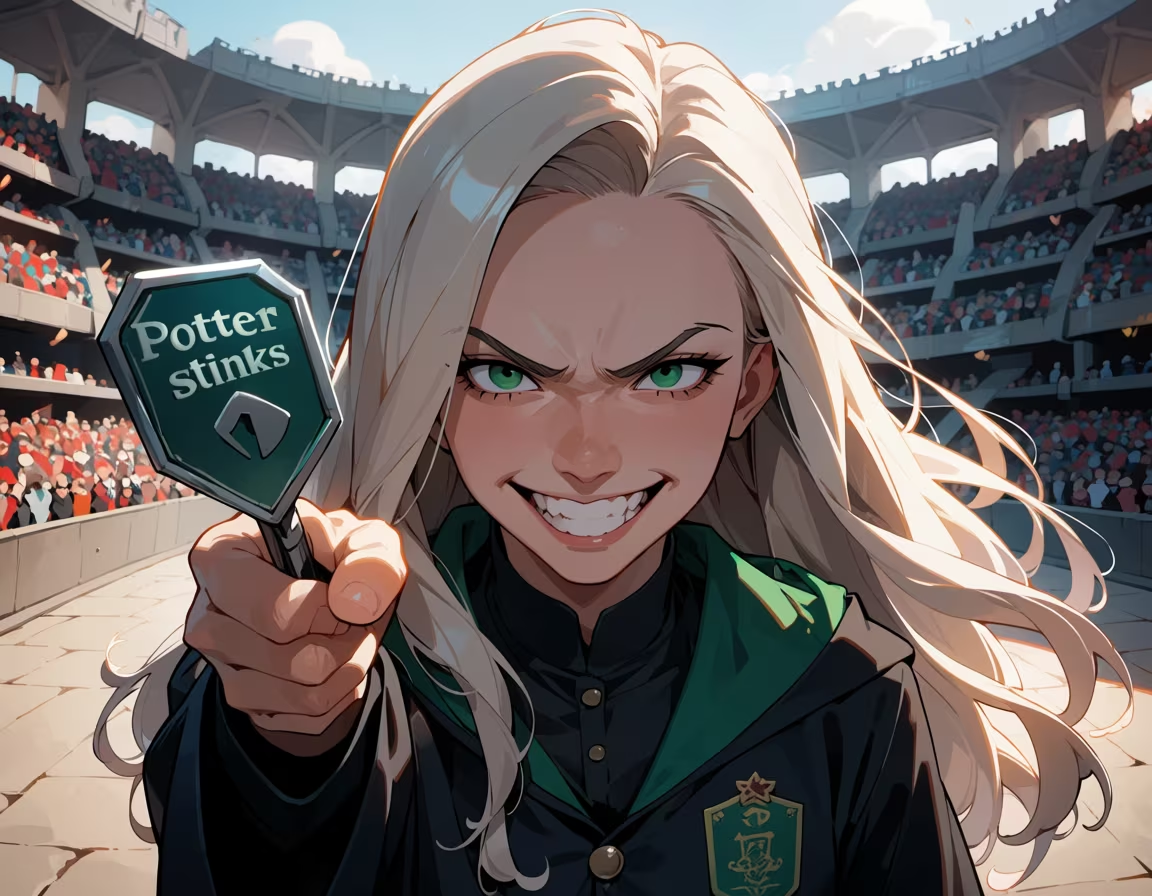
The spectacle of the Tournament had been irritating, predictably so. The Beauxbatons girls were suitably elegant, the Durmstrang boys suitably brooding, and Cedric Diggory was offensively earnest in his handsome simplicity. But Harry Potter, standing before the roaring crowd at the edge of the Great Hall, looked entirely too much like the focal point of all the world's attention.
My initial reaction upon seeing him arrive for the second task—the perilous lake—was a sharp, proprietary wave of irritation. He gets to be the hero? He gets the dramatic entrance? It was deeply unfair to my own perfectly structured existence.
"Look at him," Daphne Greengrass whispered to me, her own eyes tracking Harry with a mixture of envy and mild professional assessment. "He looks like he’s been dipped in moonlight and recklessness."
"He looks like a poorly executed piece of melodrama," I corrected her smoothly, allowing my gaze to sweep over the muddy robes and the determined set of his jaw. "But... the lighting catches the slight dampness in his hair rather well. It almost looks purposeful."
My internal assessment was already shifting. The annoyance was softening, edged with a thrilling sense of admiration . He wasn't just surviving; he was thriving in the chaos.
Then, the moment came. The task. The dragons.
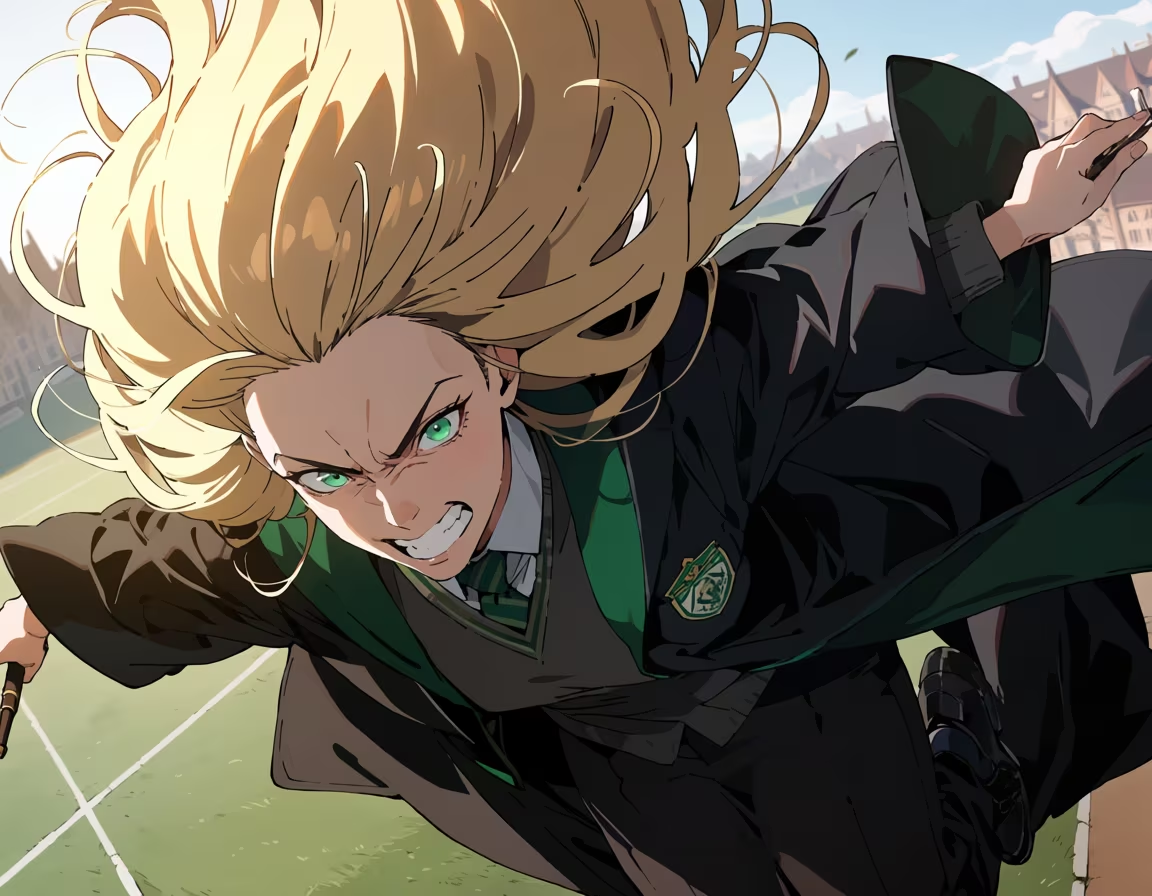
Cedric had managed a respectable, if somewhat conventional, victory. Harry, predictably, had been caught in a whirlwind of adrenaline and sheer bloody-mindedness. He hadn’t tried to be elegant or clever; he had simply charged .
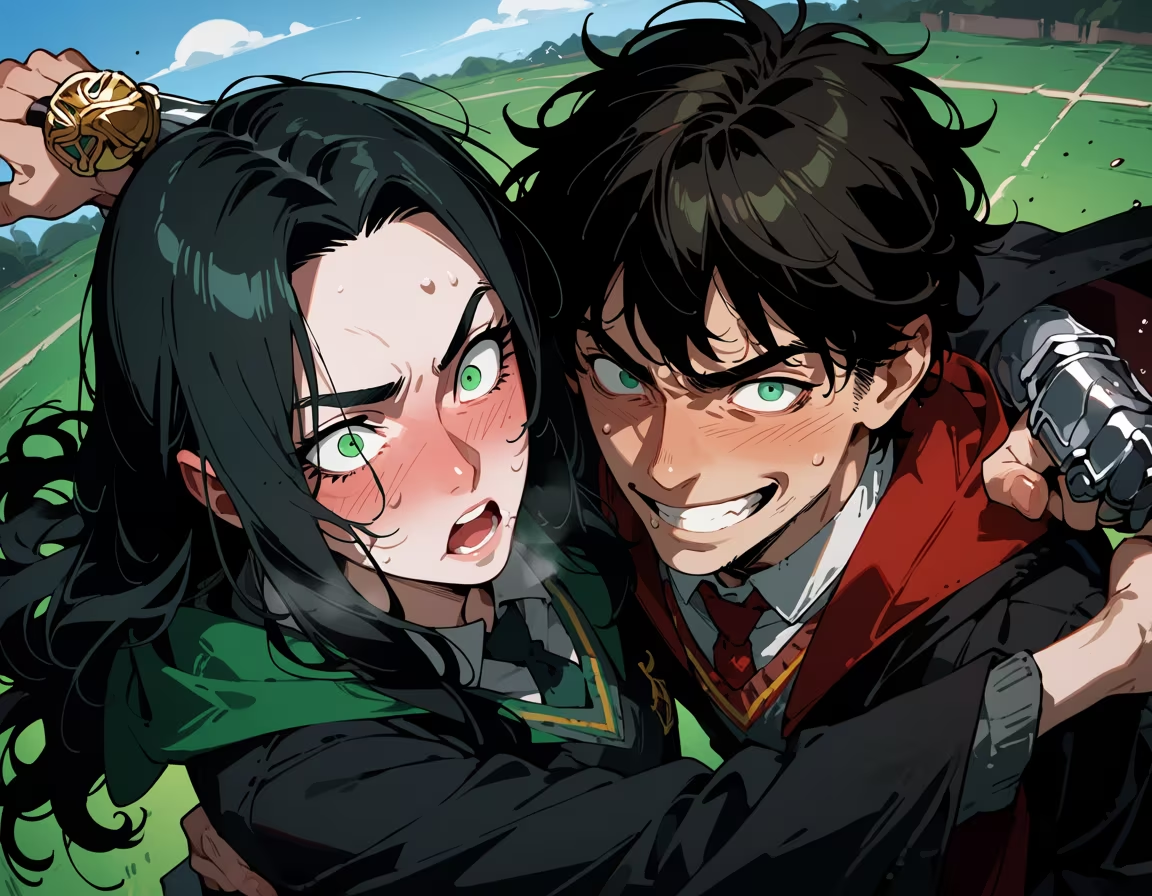
When the massive, emerald-scaled beast snapped at him, Harry didn't retreat in panic. He plunged forward, using the momentum to drive his wand into the creature's wing joint. The sheer, reckless commitment of the action sent a jolt of pure, sharp energy through my chest.
A small, involuntary sound escaped my throat—a soft, breathy noise that sounded suspiciously like a gasp of appreciation.
There he is, I thought, staring at the scene unfold. The magnificent brute. The walking disaster zone of heroic proportions.
"Did you see that?" Blaise Zabini murmured next to me, a genuine smile gracing his lips. "He didn't calculate the trajectory; he just decided to be there."
"Precisely," I agreed, my voice firmer than usual. I found myself mentally filing away this trait: Decisive Momentum . It was entirely too Gryffindor, entirely too reckless, and yet, it was utterly intoxicating.
When he finally stood before the Hufflepuff banner, slightly scorched, utterly victorious, and breathing heavily, the crowd erupted. Harry, blinking against the sudden brilliance of the cheers, seemed momentarily bewildered by his own success.
And when his eyes lifted, searching the stands, they found mine.
The connection was immediate, electric. He wasn't looking at the Slytherin crowd—the usual sycophantic mob waiting to praise his bravery. He was looking at me .
He didn't smirk. He didn't bow in exaggerated thanks. He simply looked, a look of weary defiance mixed with profound relief, as if saying, ‘Right. I did it. Now what?’
In that moment, my feeling curdled slightly, pushing the pure admiration into a volatile mix of admiration and dislike .
He had earned the right to be admired. He had earned the right to be celebrated. But he had done it so effortlessly, so loudly, so loudly , that it was terribly, wonderfully irritating. He was a shining, obnoxious beacon, and he was aimed squarely at my exquisitely controlled orbit.
"He is insufferable," I murmured, leaning slightly towards Daphne, "the sheer audacity of that boy."
But my internal voice countered with a whisper, softer, warmer, infinitely more insistent: But oh, how terribly beautiful the audacity is.
I didn't hate him, not truly. I merely resented his ability to effortlessly occupy the space that should, by right of birth and impeccable lineage, belong to someone like myself. He was a glittering, inconvenient sun, and I was a finely wrought, perfectly shaded moon, and we were destined to orbit each other in a glorious state of mutual aggravation.
*
(Book 5: The Order of the Phoenix)
The atmosphere during this year was poisonous, thick with the oppressive weight of Voldemort’s return and the ceaseless, baffling presence of Umbridge. My initial feeling regarding Harry during the Ministry skirmishes was a weary fondness tempered by utter annoyance . He was too emotional, too prone to melodrama, too quick to jump to conclusions about the injustices inflicted upon him.
Yet, when the Ministry skirmish was over, and the dust settled, revealing the bruised and weary lines around his eyes, the irritation softened into a more indulgent warmth. He was vulnerable. And vulnerability, I had discovered, was the most intriguing state of being.
The climax of this emotional evolution arrived during the infamous confrontation in the Ministry Atrium. Harry was bruised, his robes slightly singed, and he was standing there, radiating a furious, defensive energy that was entirely too potent for a boy who hadn't slept properly in weeks.
I found myself hovering near the edge of the fray, watching him exchange pointed barbs with Fudge and Umbridge, my own voice ready to inject a perfectly placed, cutting remark to bolster his case.
"He is being completely ridiculous," I muttered to a passing Crabbe (who, despite his lack of intellectual acuity, possessed the necessary brutish presence to be a useful sounding board). "He is behaving as if his life were the singular, most important event in the history of wizarding Britain, rather than a rather tedious Tuesday."
But then, Umbridge sneered at him—a sickly, saccharine little sound of derision—and Harry’s eyes flashed, darkening from cerulean to a stormy, volatile blue-green.
"You," he ground out, pointing a wandless finger at her, "have no idea what it’s like."
And in that instant, the fond irritation snapped. It became a fierce, protective fondness . It was the realization that beneath the dramatic façade, he possessed a core of profound, unyielding conviction. He cared . Fiercely. Recklessly.
Seeing that flash of genuine, righteous anger, my own defenses crumbled a fraction. My carefully constructed annoyance dissolved into a protective warmth.
He is not just amusing; he is necessary, I realized with a startling jolt of certainty.
As the scene shifted, and the tension settled into a tense standoff, I found myself instinctively wanting to be on his side, wanting to offer him the elegant, sharp reassurance that he deserved. I wanted to tell him that his defiance was not ridiculous; it was magnificent .
When the Ministry delegation finally began to disperse, Harry paused, turning back toward the area where the Slytherin contingent stood, his gaze sweeping over us. It lingered on me.
He seemed to be searching for something—perhaps validation, perhaps an ally, perhaps just a moment of quiet recognition from someone who understood the burden of his fame.
When his eyes met mine, the familiar spark returned, but this time, it was less challenging and more questioning. A plea.
And I gave him the smallest, most private smile—a small concession that was purely for him. It was a gesture of shared understanding that bypassed all the pomp and circumstance of the Ministry. It said, I see the exhaustion. I see the anger. And I find it terribly beautiful.
In that quiet exchange, the fondness solidified into something deeper, something akin to burgeoning crush . It was the dizzying realization that my feelings for this Gryffindor mess were not purely intellectual; they were visceral.
*
(Epilogue: Order of the Phoenix - Seeing off the children)
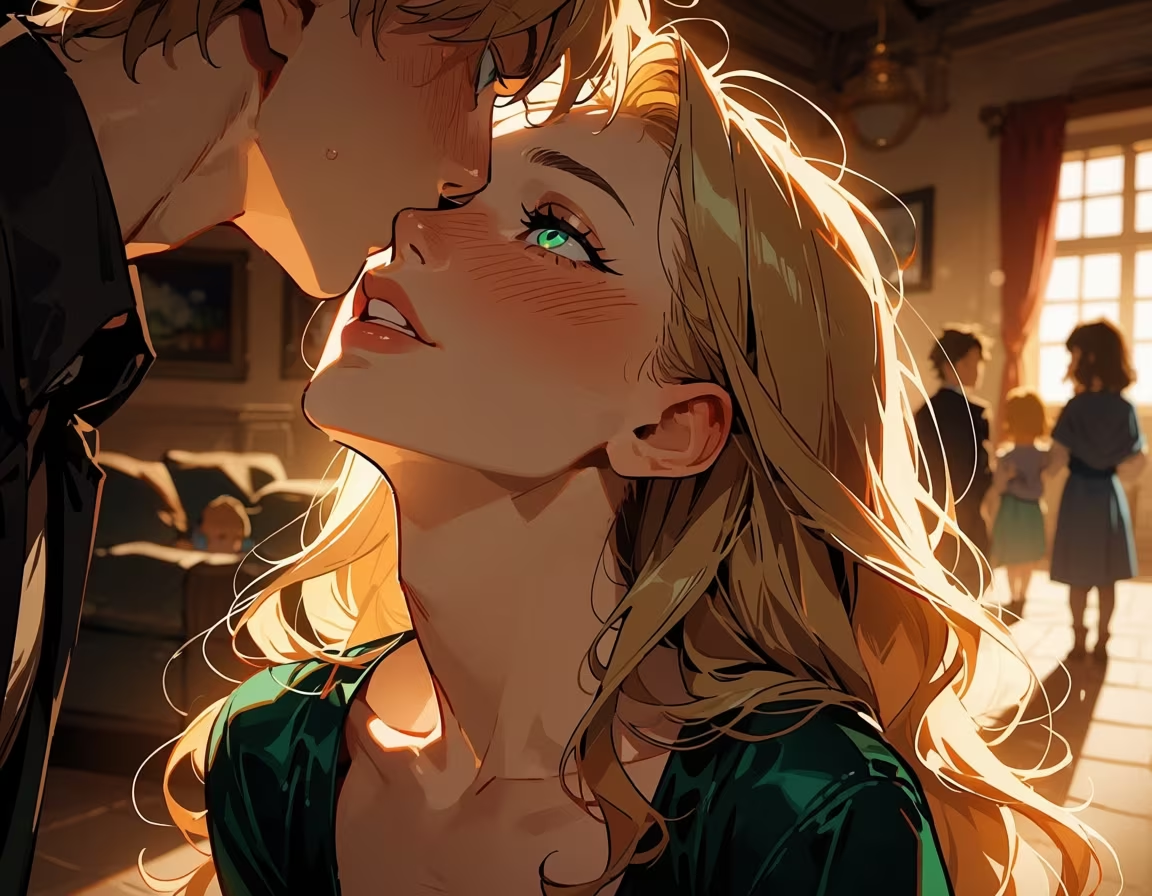
The finality of the journey was almost painful. The war was won, Voldemort was vanquished, and the weight of that monumental victory felt too large to contain gracefully. We were all gathered near the edge of the grounds, waving farewell to the younger generation—the proof that the impossible was, in fact, true.
And there he was, standing beside his mother, Ginny, looking impossibly grown-up, impossibly relieved, yet still bearing the ghost of that familiar, weary determination. Harry.
My own heart performed that ridiculous, traitorous flutter, the one that still managed to happen even when I was wearing robes that were decidedly less perfect than they had been in my first year.
My feeling now was a deep, settled, consuming infatuation . It was no longer the giddy, sharp sting of a crush, but a constant, comforting pressure behind my ribs—a sense of belonging. He was my counterpoint to my own inherent Slytherin need for order; he was the glorious, chaotic force that made my order feel meaningful.
As the children began to arrive, a joyous, chaotic procession, I felt a profound sense of destiny settle over me.
Severus, with his intense, slightly severe gaze; Lucius, already adopting the aristocratic disdain of our family; Albus, a miniature, perpetually questioning replica of his father; and Bellatrix, who possessed a startling, fiery curliness and an almost manic energy. They were all him.
Harry looked down at them, a profound tenderness softening the lines around his mouth—a sight that nearly knocked the breath from my lungs.
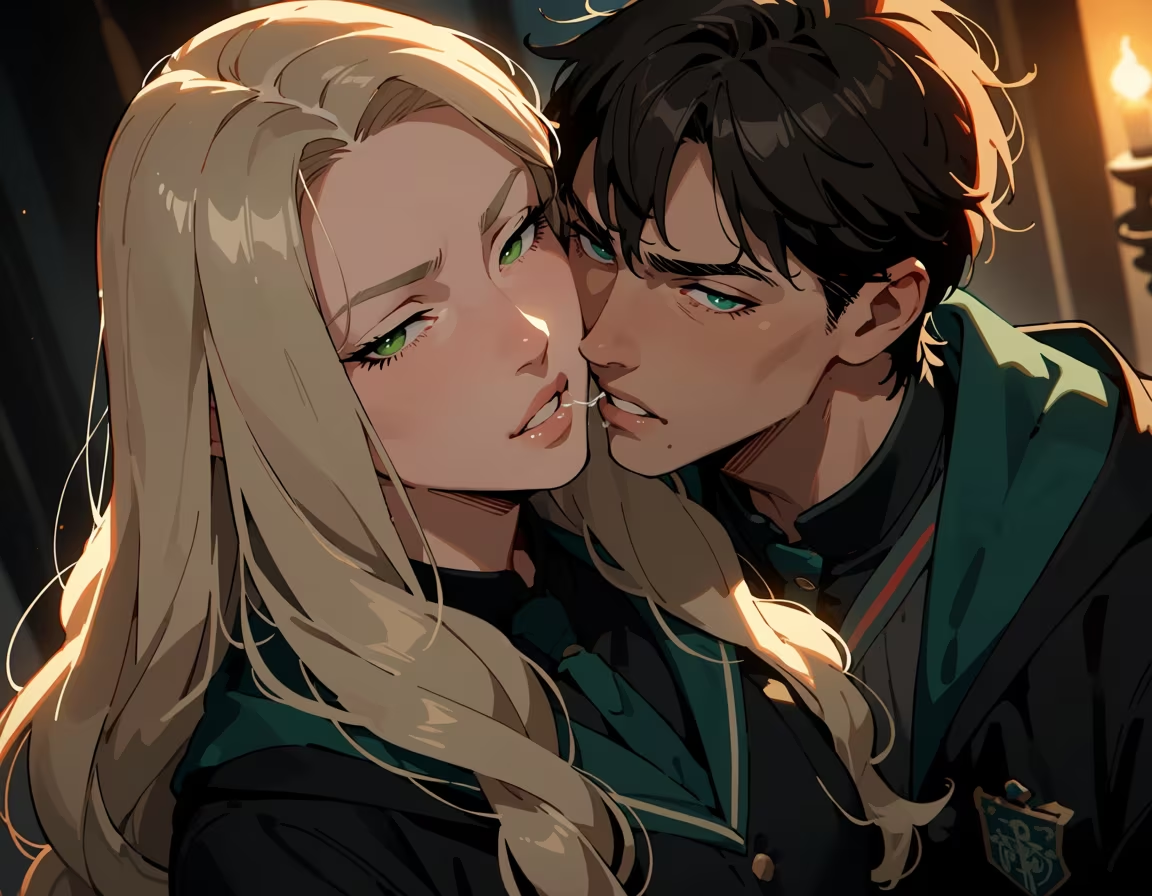
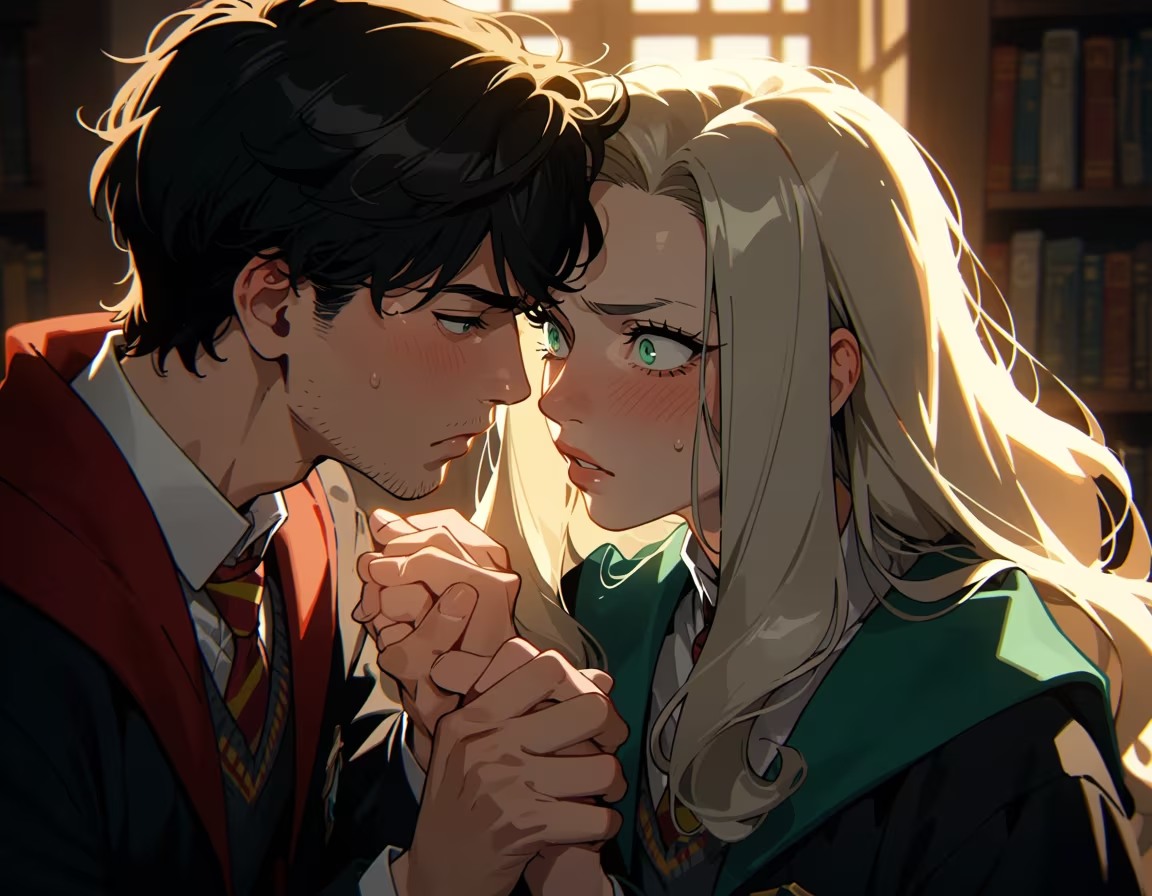
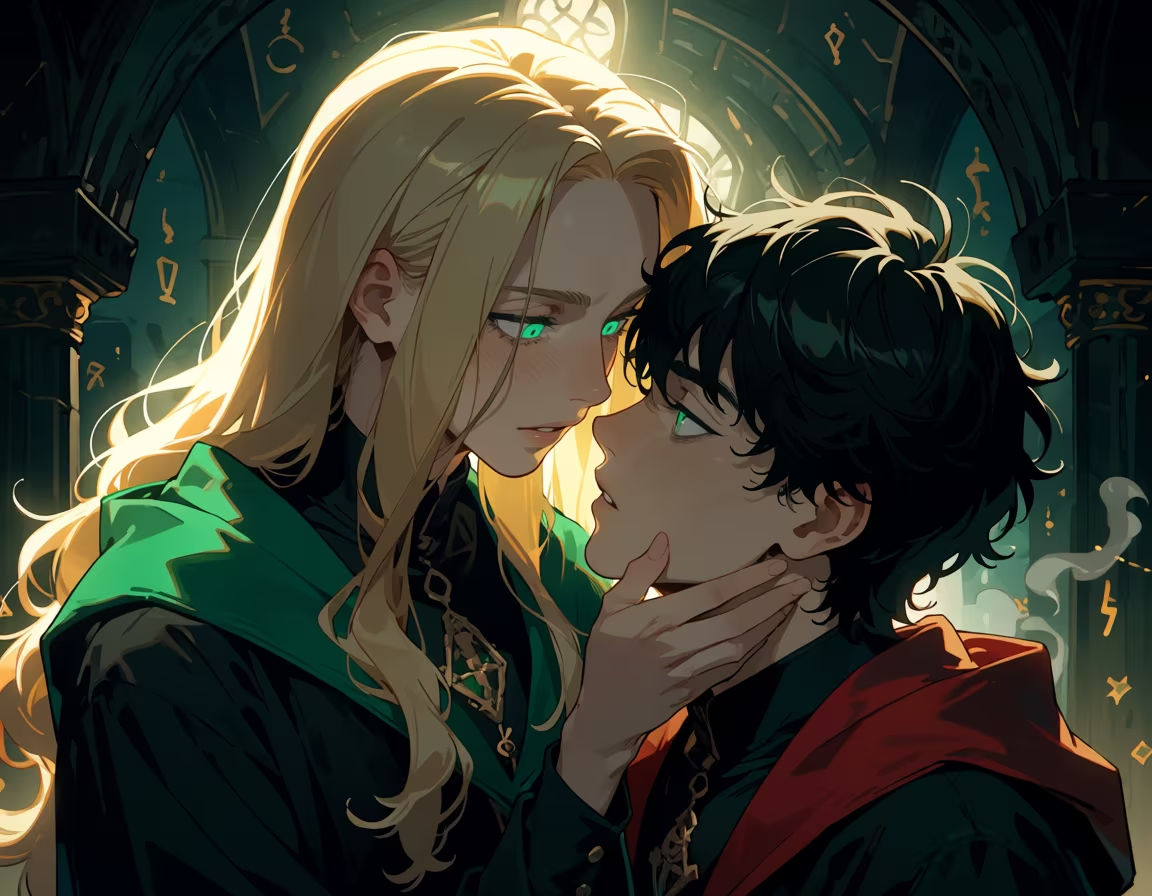
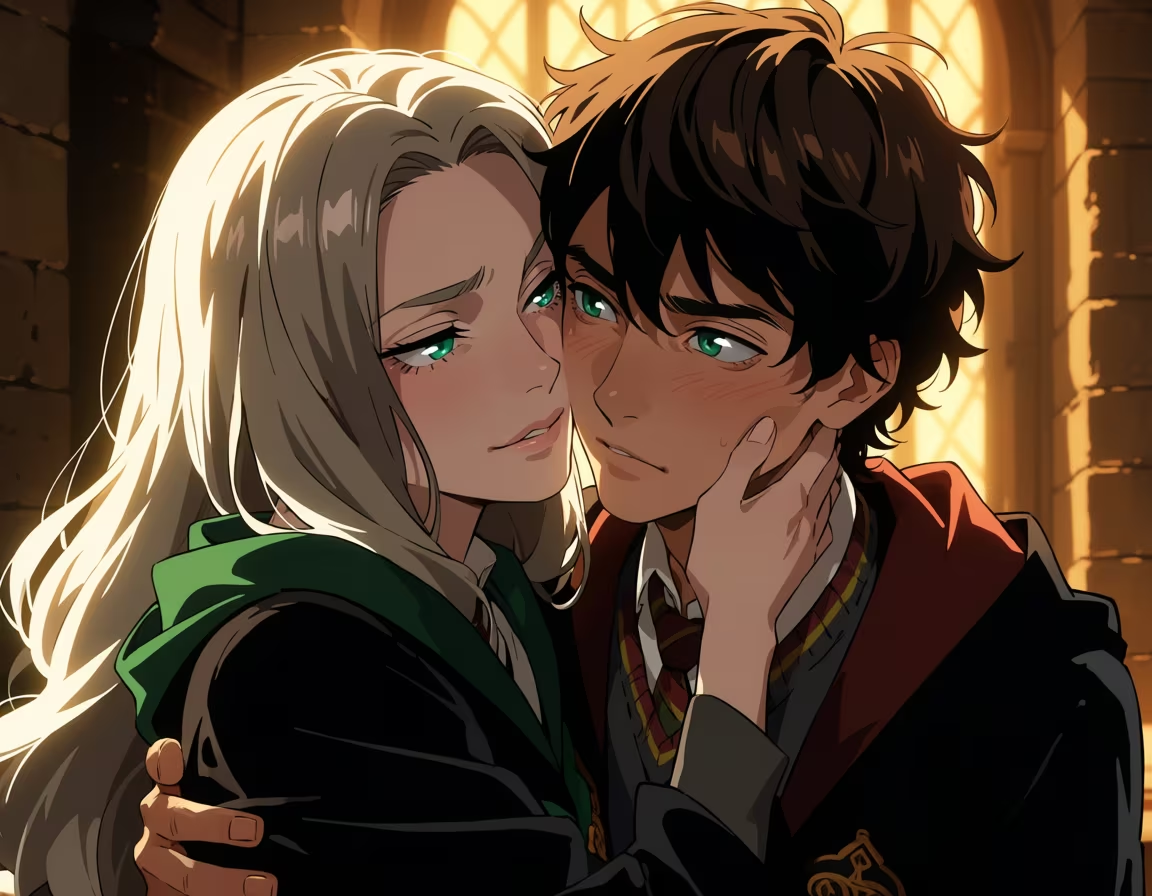
"Draconia," he murmured, turning to me as he finally reached us, brushing a stray piece of blond hair from my cheek. The touch, light as it was, felt devastatingly possessive. "You should come properly. You shouldn't just hover."
His eyes, those magnificent, turbulent pools of blue-green, locked onto mine again. This time, the question was gone. It was a statement of fact.
"I don't think I can," I whispered, my voice catching. The word felt inadequate for the weight of the emotion.
He smiled then, a full, genuine, blinding smile that reached those startling eyes. It was the most beautiful thing I had ever seen, surpassing the grandeur of the Great Hall, the spectacle of the Triwizard Tournament, and the sheer force of his dragon-riding bravery.
"Why not?" he challenged gently.
The annoyance was gone. The slight, nagging feeling that he was too much—too bright, too loud, too perfect—had been entirely eclipsed by a surging, magnificent sense of love . It was not the sudden, dramatic explosion of the first year; it was the steady, undeniable warmth of the hearth.
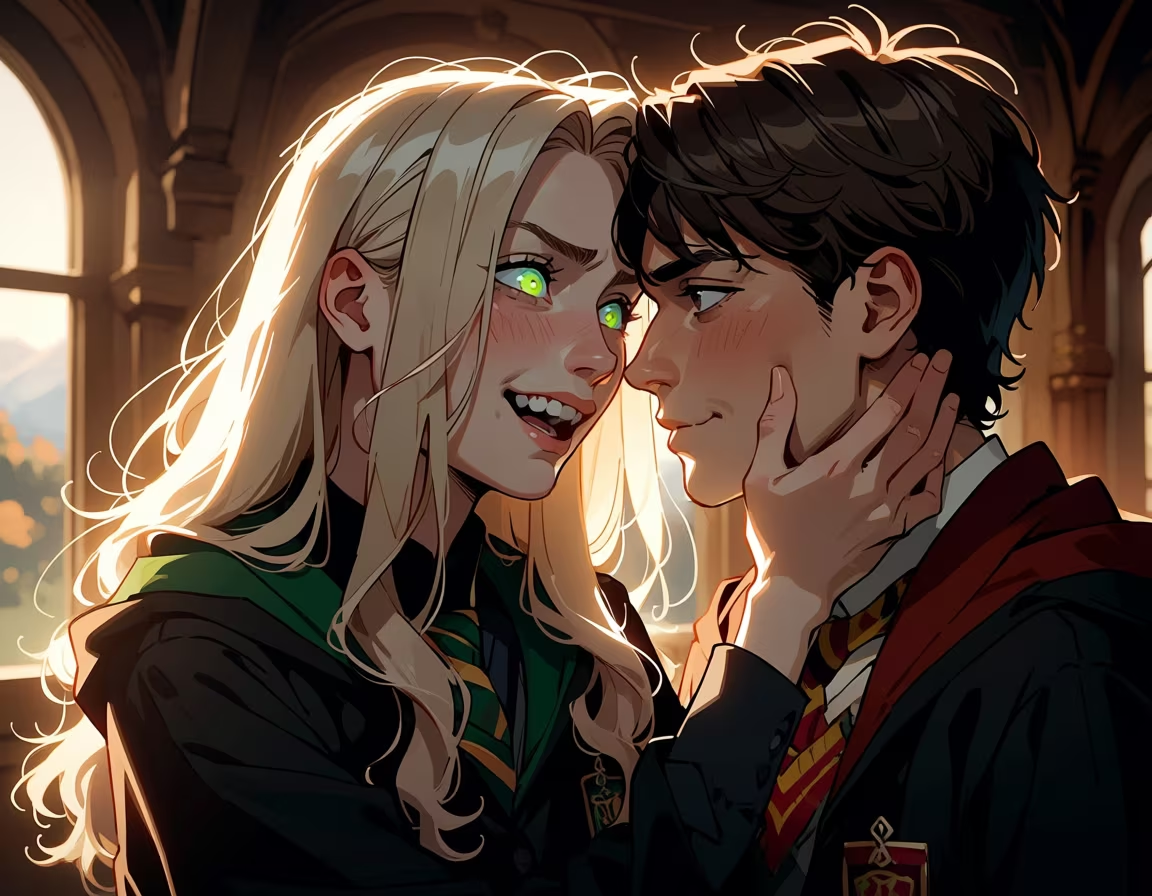
"Because," I managed, lifting my hand to cover his where it rested on my cheek, tracing the line of his thumb, "I think I am far too busy trying to decipher what you are capable of next."
He chuckled, a warm, rumbling sound that sent shivers through me.
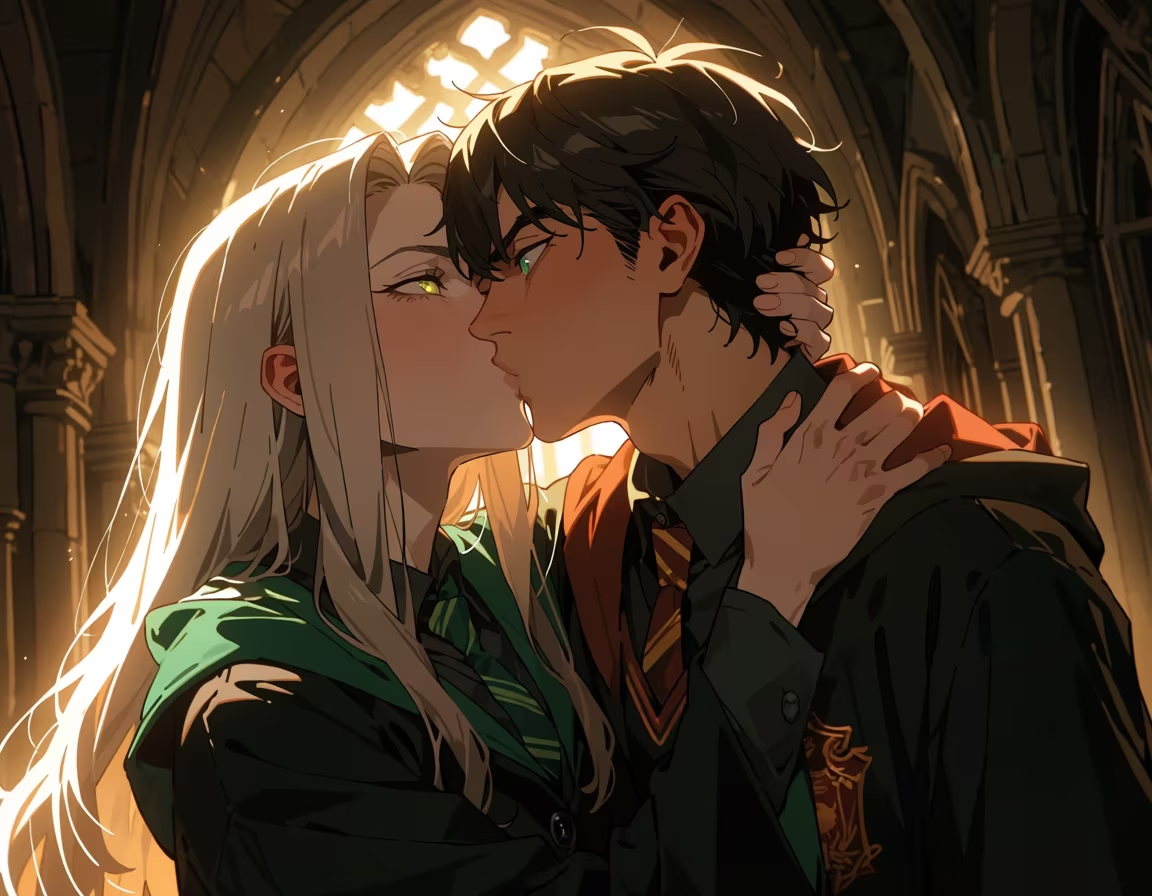
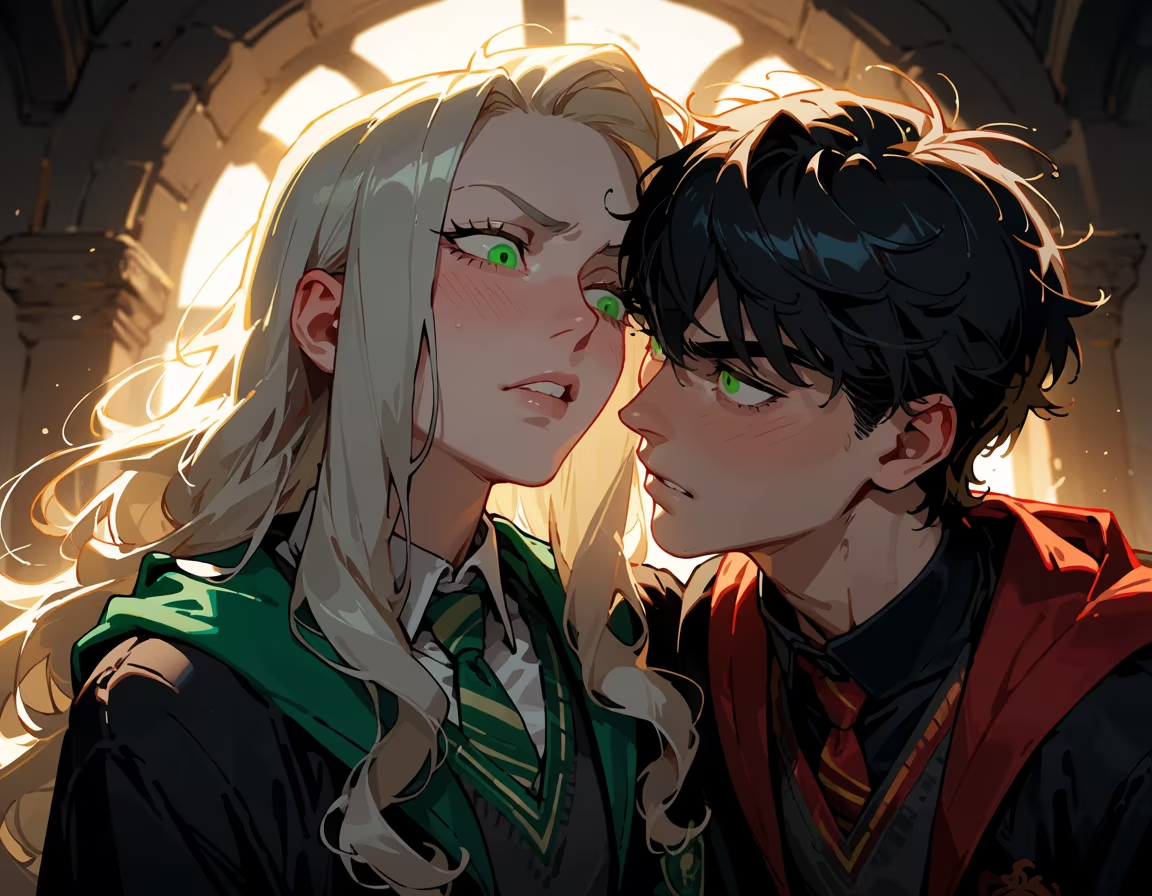
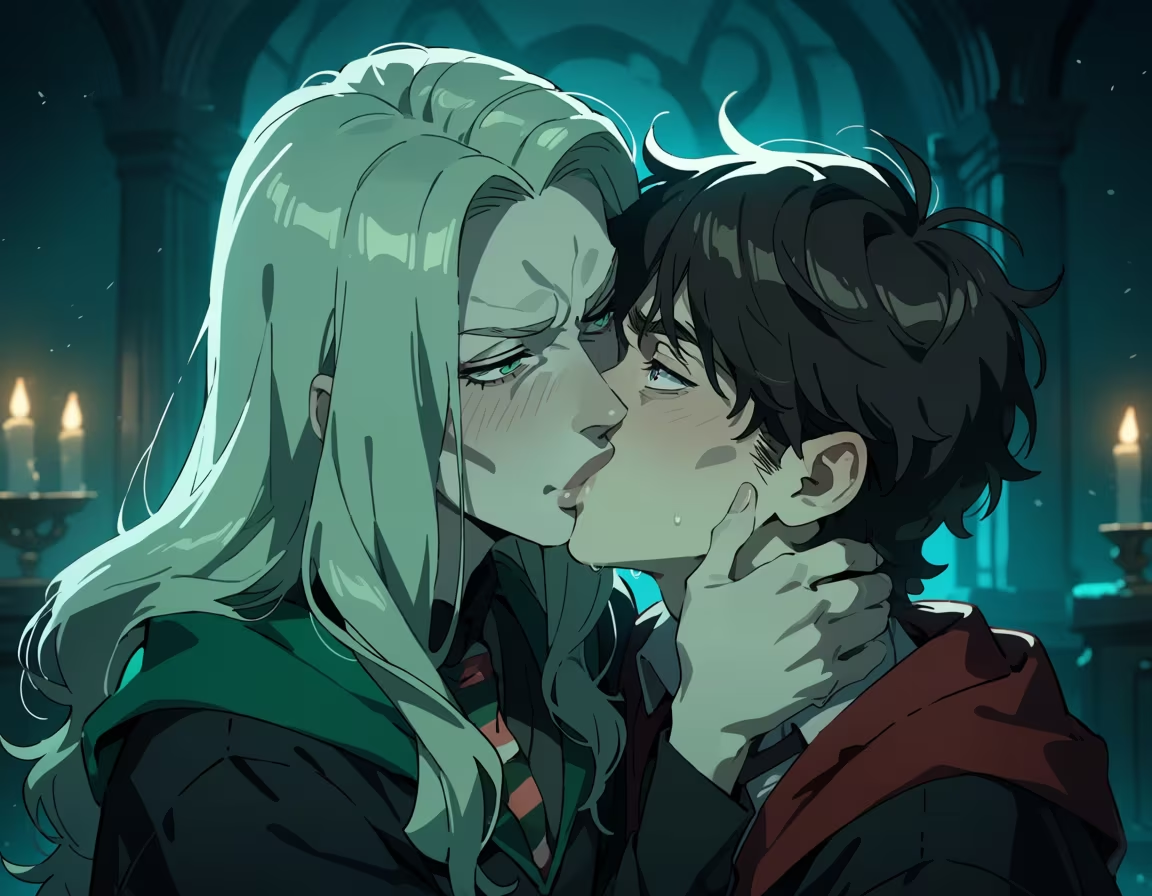
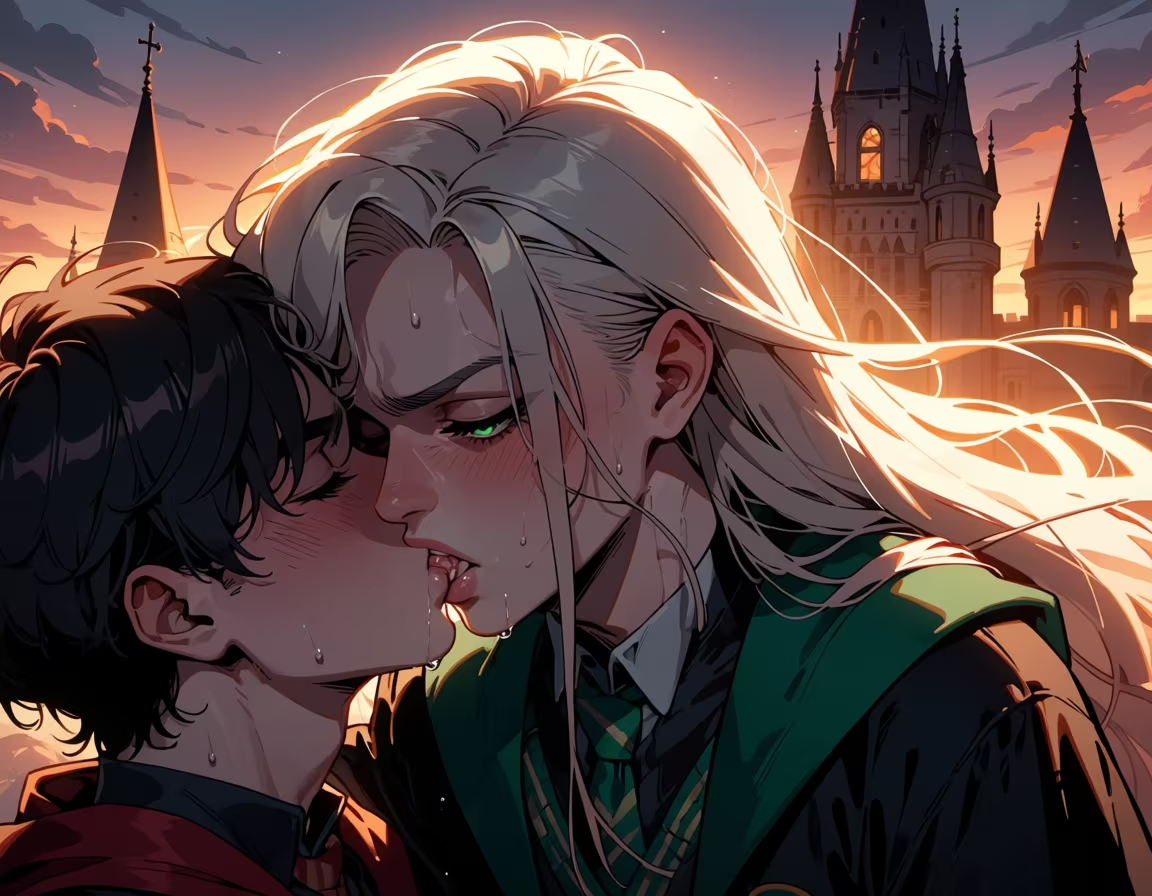
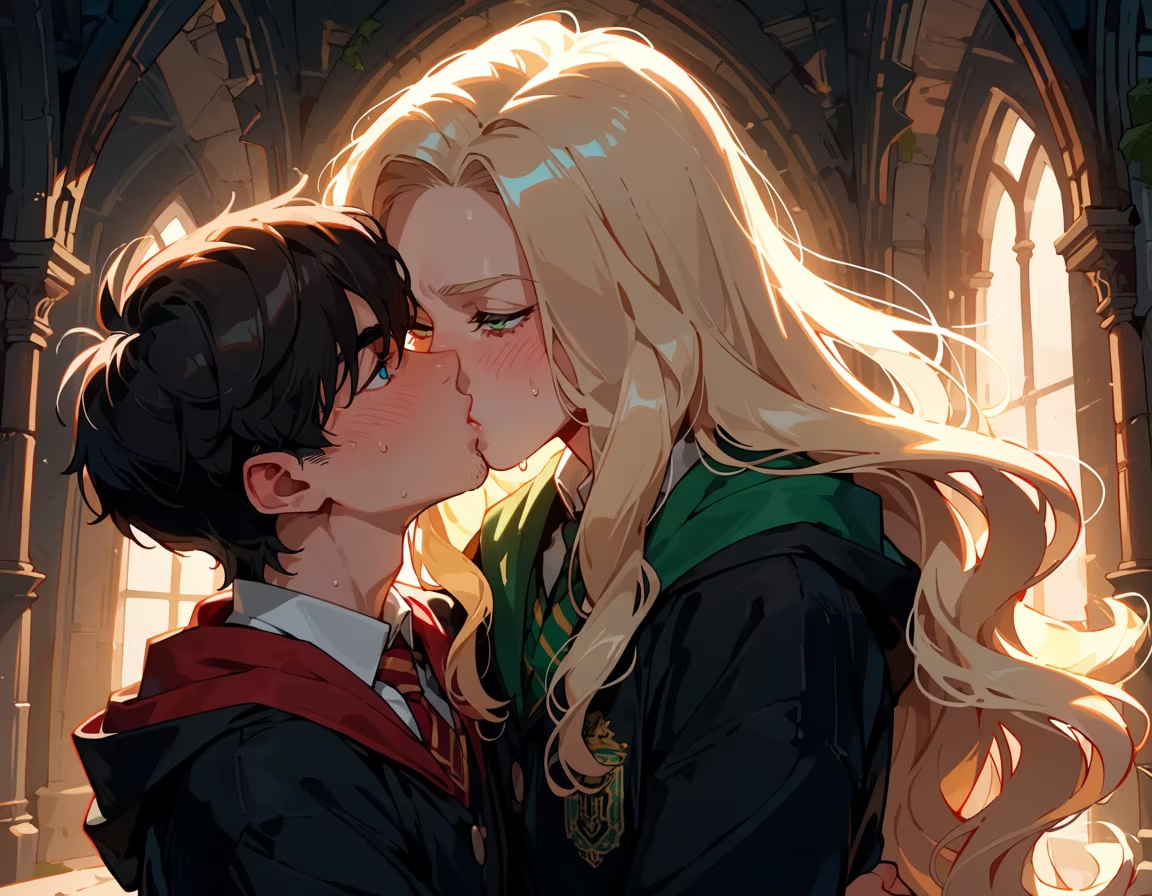
"And I, my darling Draconia," he countered, leaning down until his forehead rested against mine, his breath smelling faintly of lemon drops and victory, "think you are entirely too magnificent to be left to mere deciphering."
In that moment, surrounded by the evidence of our shared survival—the noisy, beautiful, messy proof of our love—I knew. The irritation, the fascination, the grudging respect, the crushing infatuation—it had all coalesced into this singular, perfect feeling.
He was mine. And I was, irrevocably, his.