| Home | The Lives of Velnin | Illustrated Fiction | Malfoid Art & Fiction | Book Blurbs | Contact |
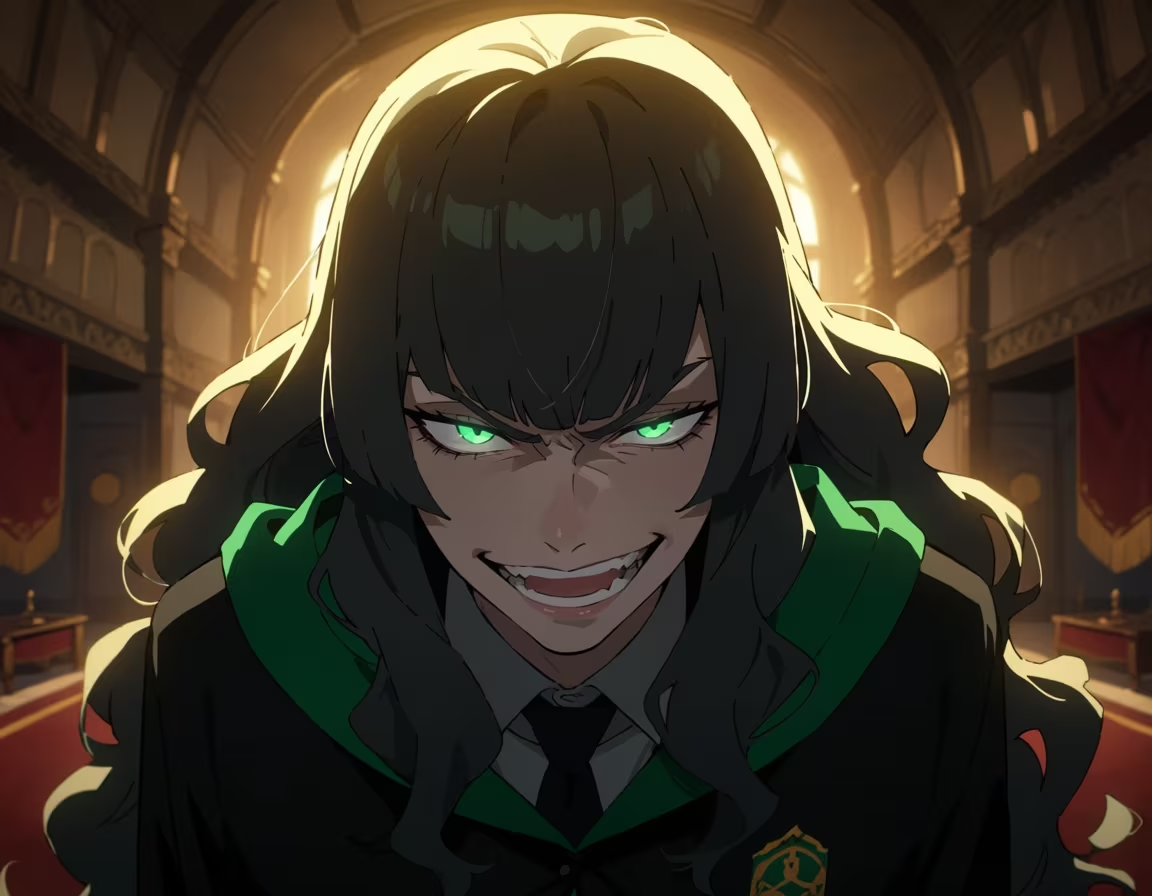
The Great Hall, in the early autumn of the first term, was a spectacle of dizzying, ancient beauty. Sunlight, fractured by the high, arched windows, streamed down onto the polished stone floor, illuminating motes of dust dancing above the heads of newly arrived students. It was a glorious, overwhelming chaos—the scent of roasting meats mingled with beeswax and the faint, sharp smell of magic itself.
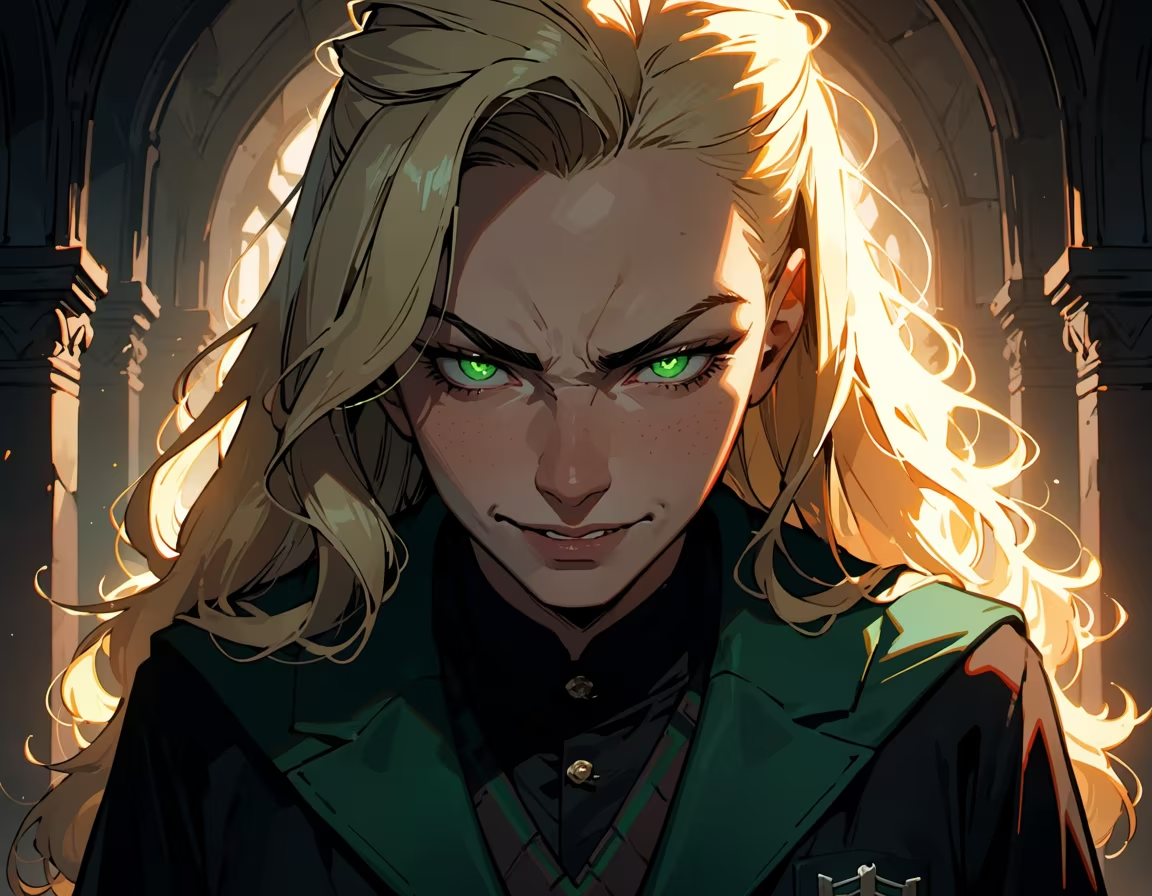
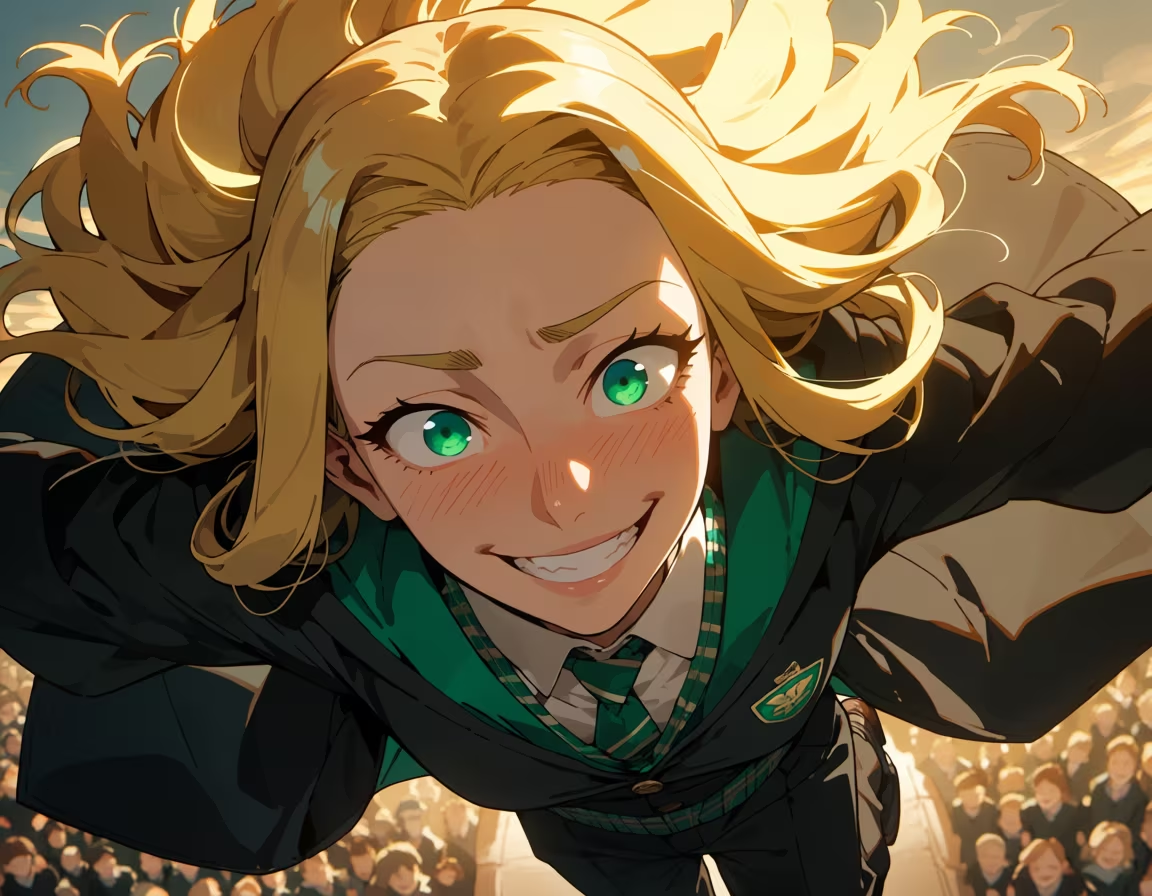
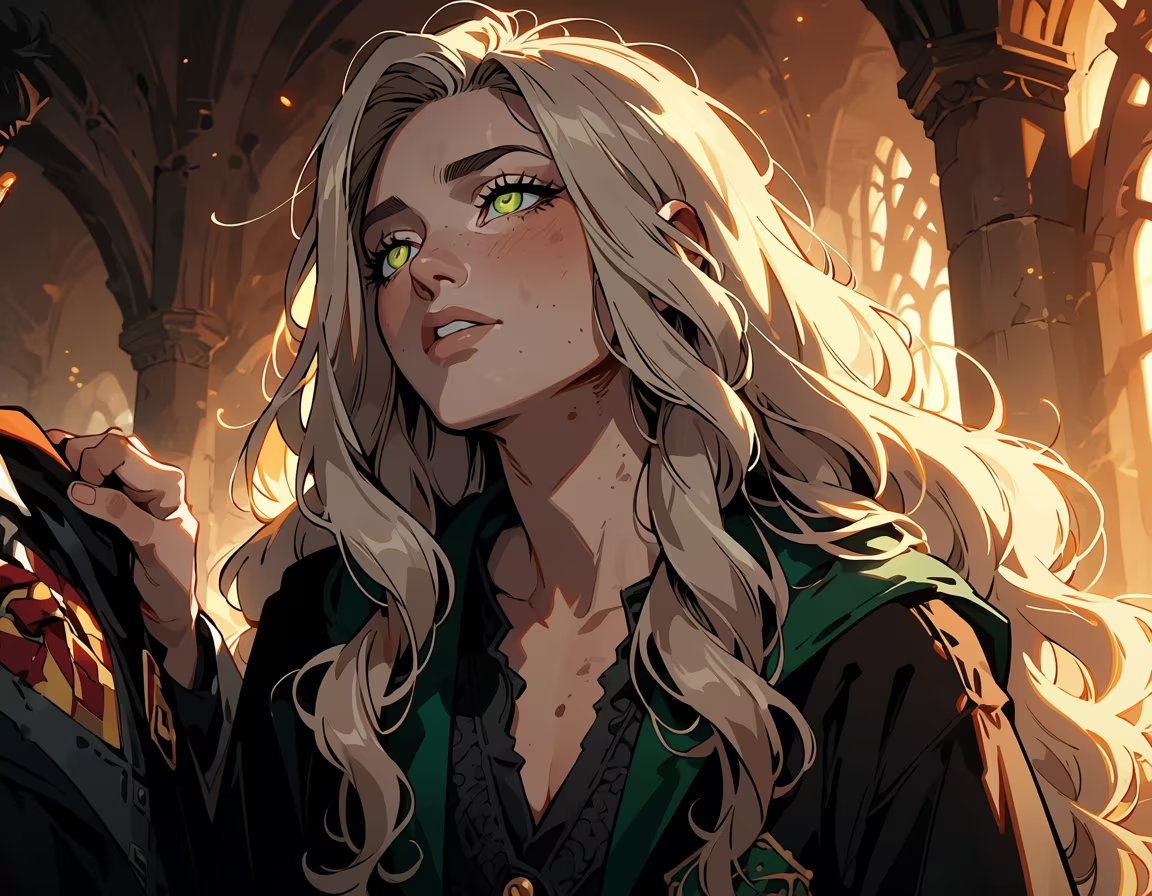
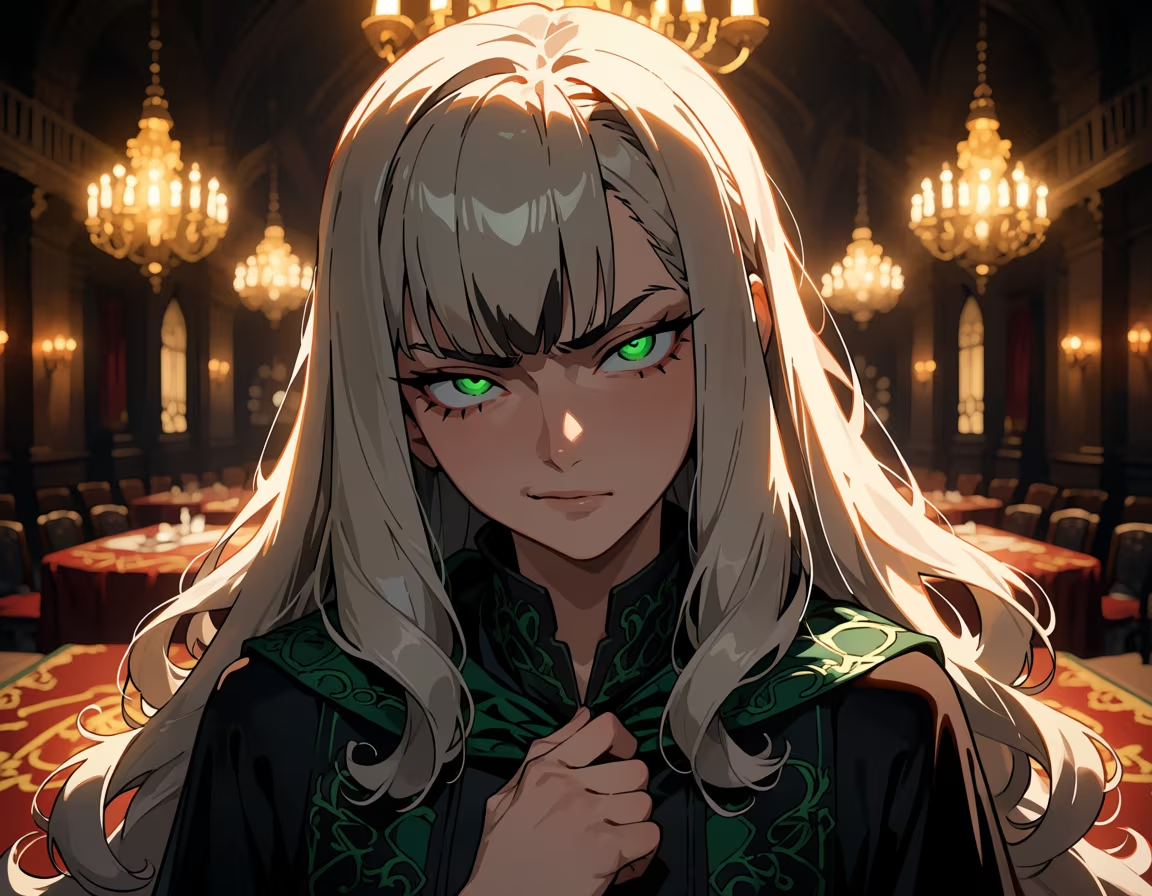
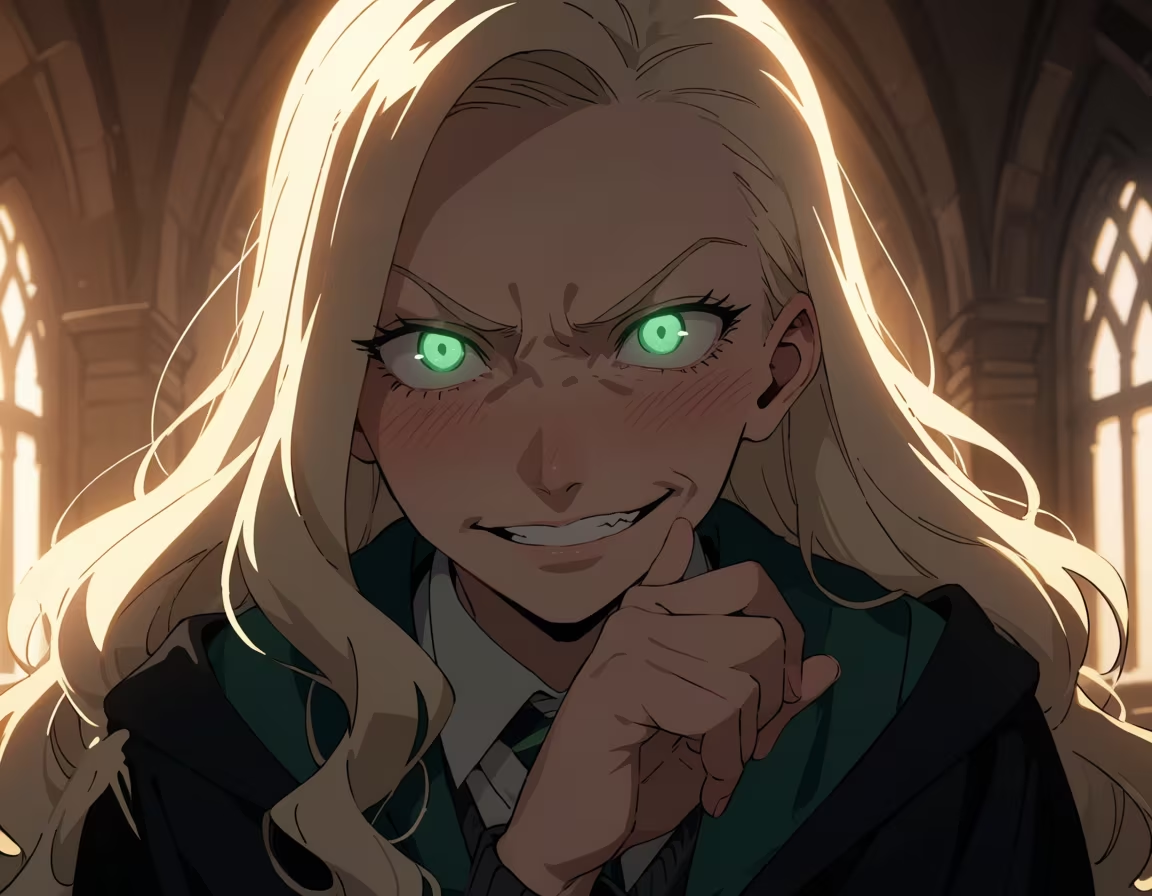
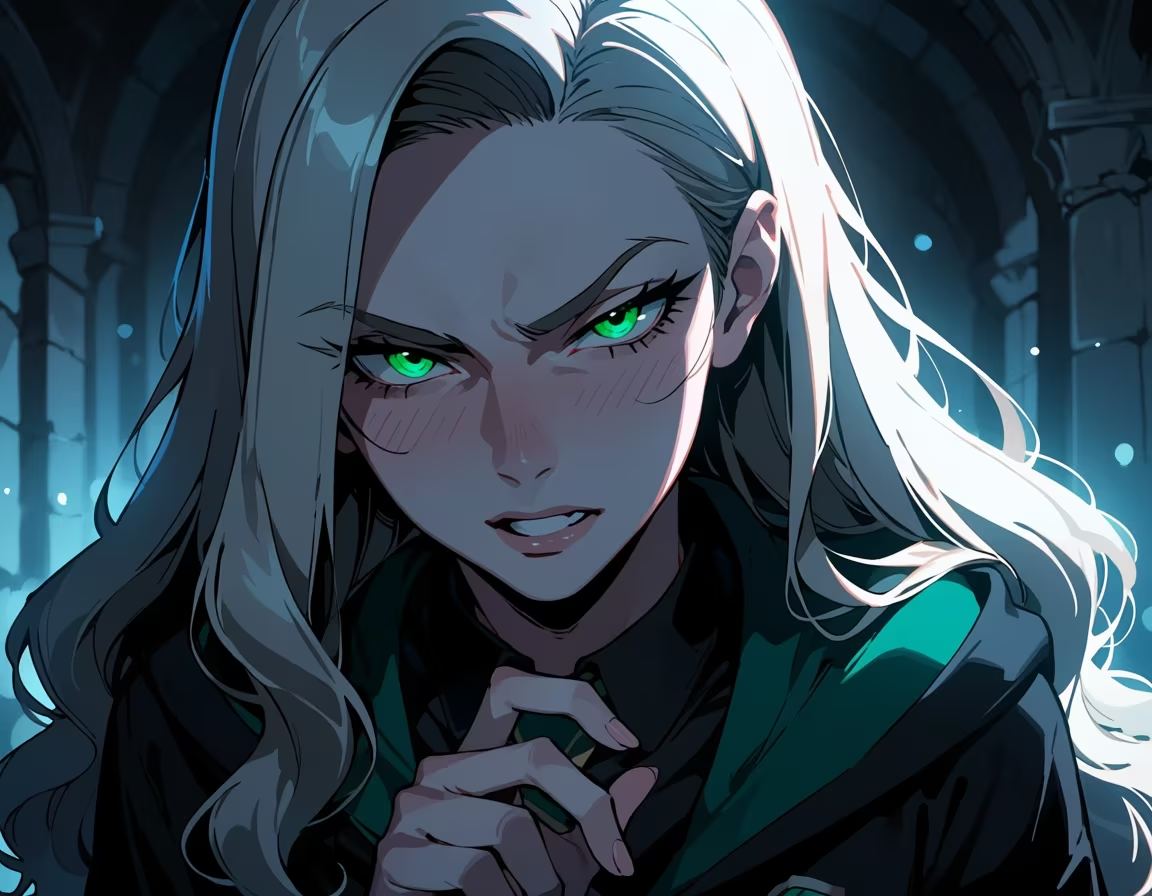
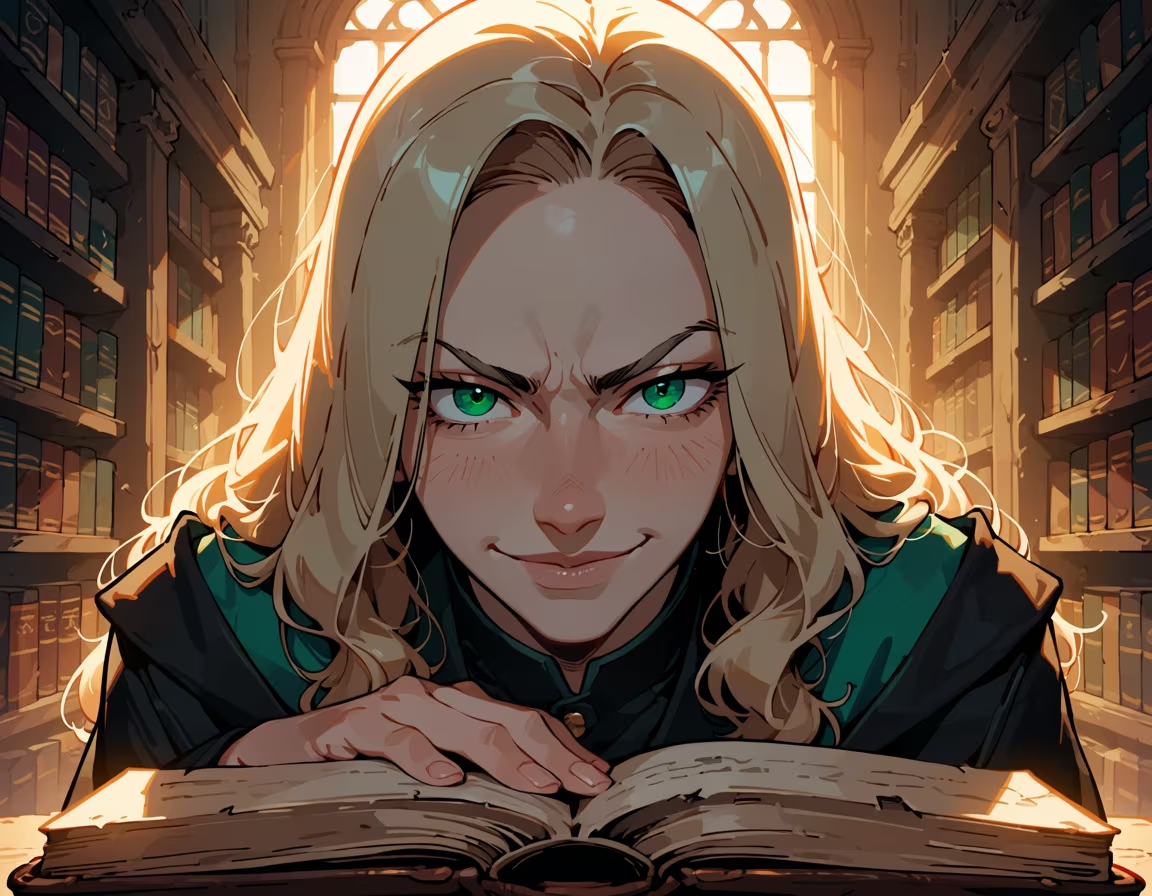
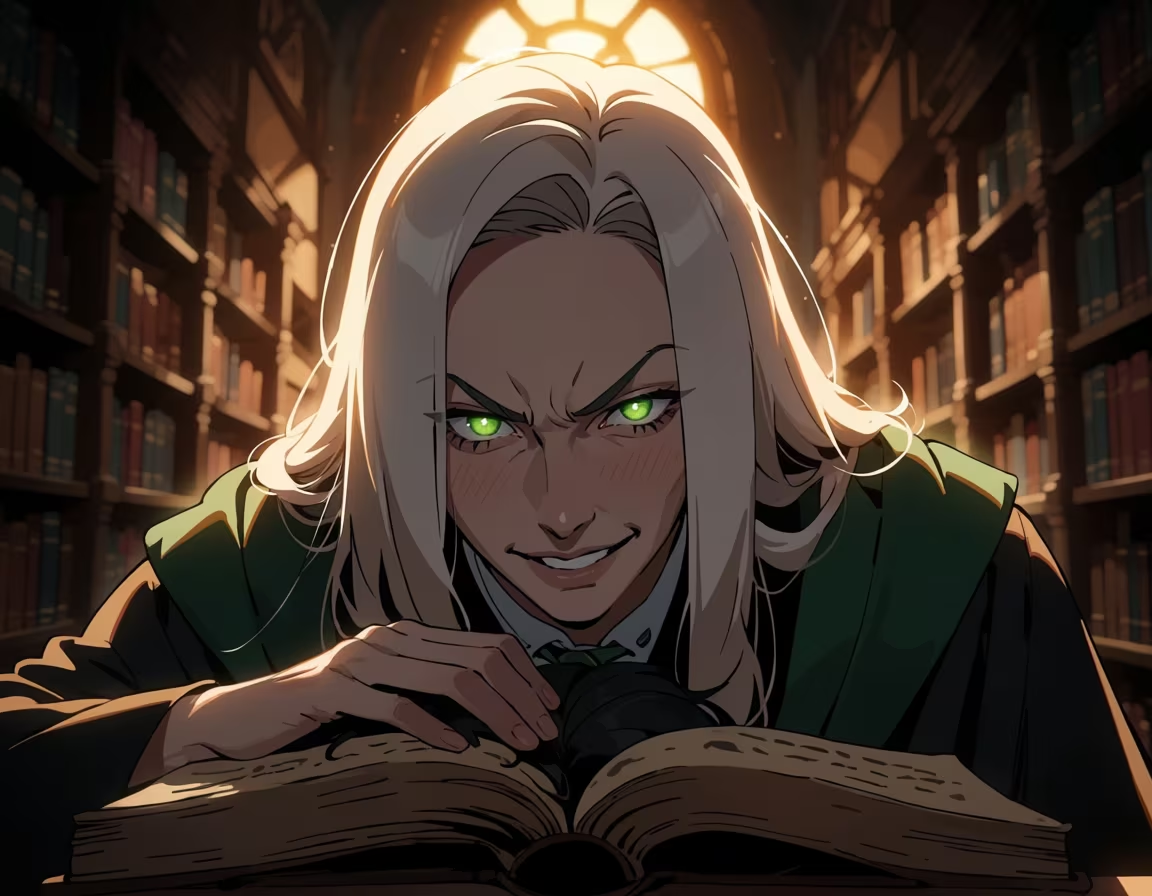
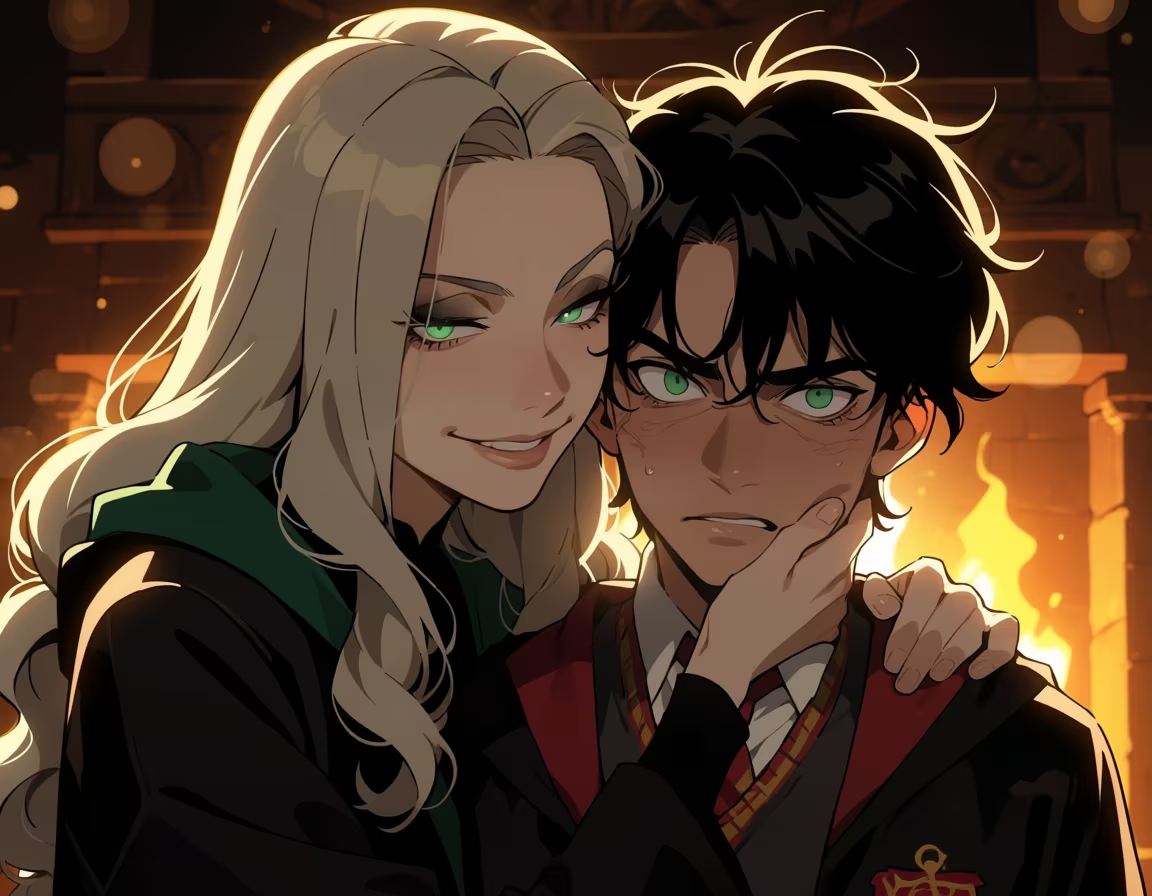
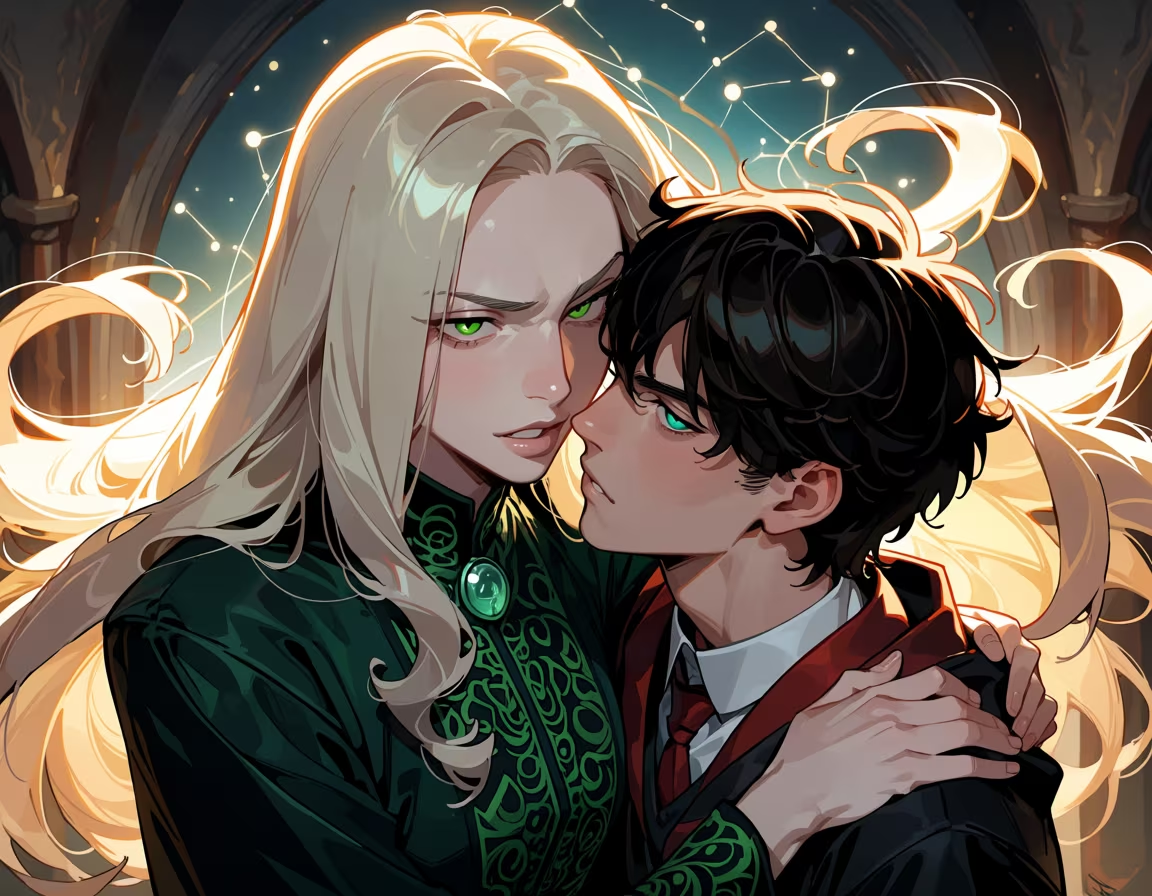
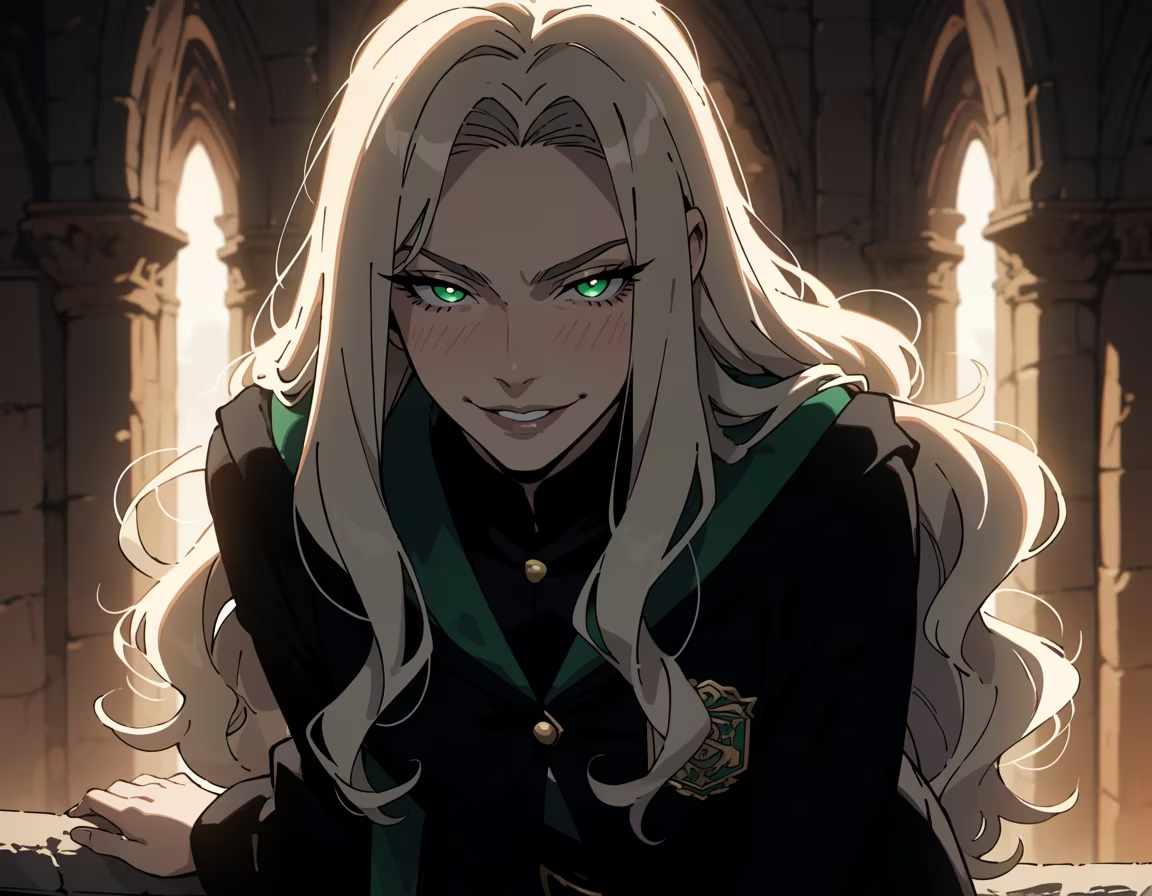
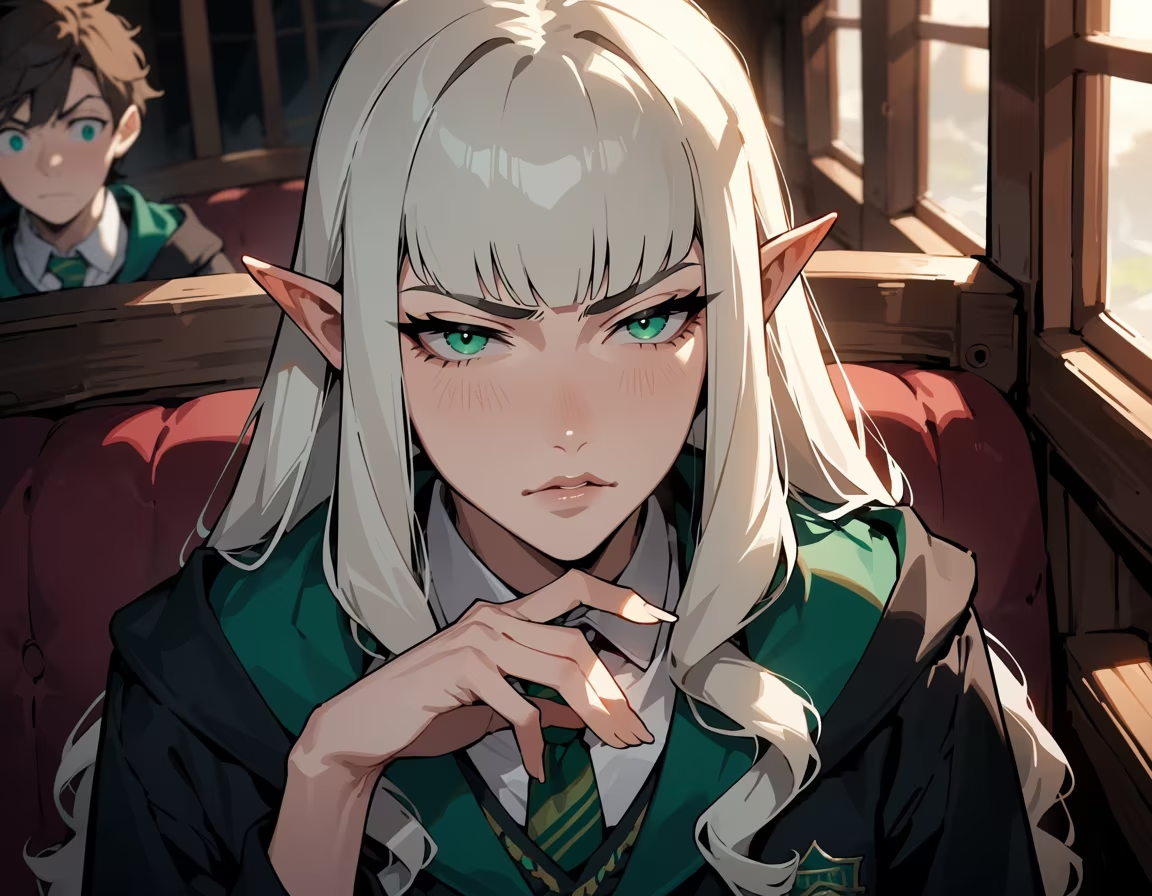
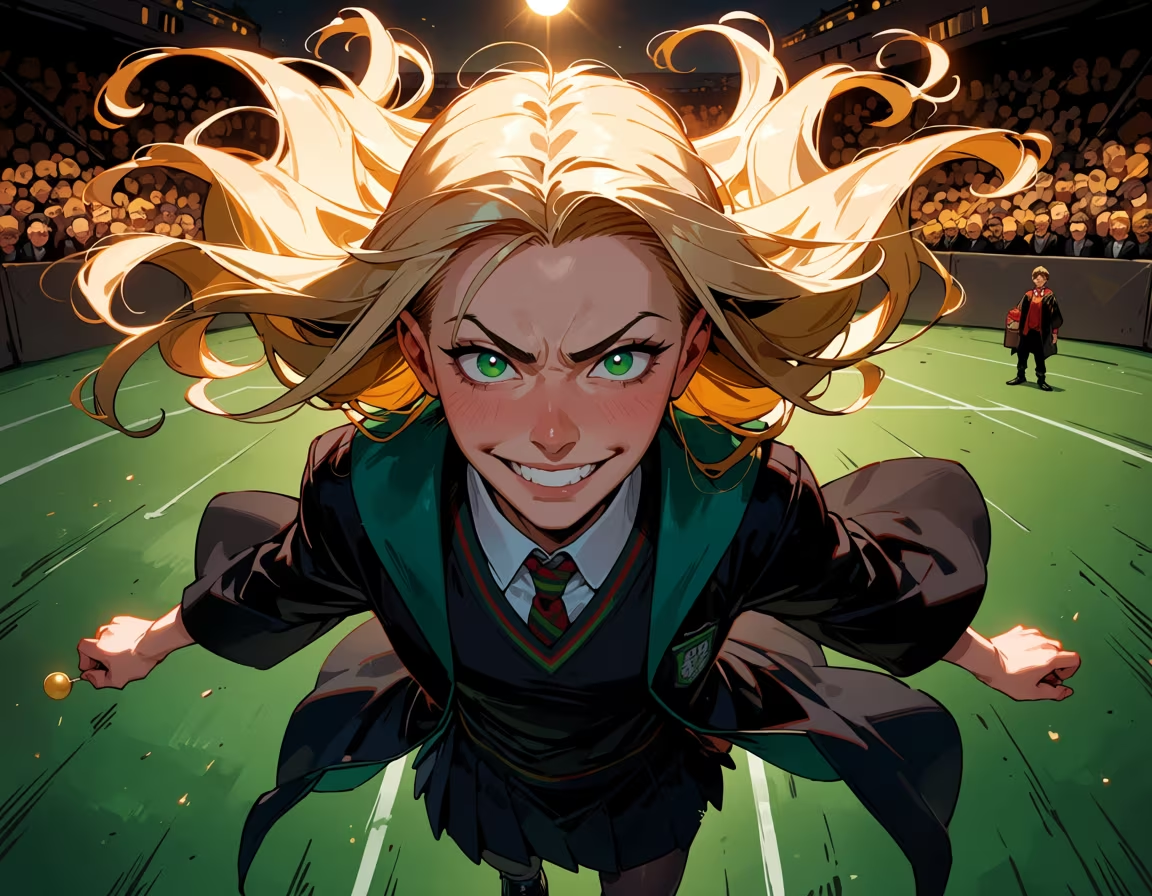
Draconia Malfoid stood near the entrance of the Slytherin table, perfectly poised, a flawless sculpture carved from pale marble and Slytherin arrogance. Her long, flaxen hair, catching the light like spun gold, flowed down the black silk of her robes, the emerald trim appearing richer and more vital against the dark fabric. She had mastered the art of looking perpetually unimpressed, a skill she felt was genetically gifted, inherited directly from the illustrious lineage of the Malfoy name.
The initial wave of Gryffindors had been tolerable—a collection of loud, slightly disheveled youths whose scarlet and gold uniforms seemed a touch too bright, a touch too earnest. But then, the Potter boy entered.
He was a magnet for chaos, even in his sheer presence. Round-faced, perpetually windswept, with hair that looked as if a rogue blast of wind had decided to give it a dramatic, unruly fringe. He was accompanied by a boy whose freckles seemed to have been applied with enthusiastic abandon (Weasley, she supposed, based on the fiery colour of his hair) and a slightly taller, bookish-looking boy who seemed determined to look profound despite wearing a rather crumpled Gryffindor crest.
Draconia felt a familiar, sharp spike of irritation deep in her chest. It wasn't just the Potter boy, though he was the primary source of the aggravation; it was the sheer luminosity of him. He seemed to glow, annoyingly so, against the deep, muted greens and blacks of the Slytherin side.
Honestly, she thought, allowing a slow, deliberate sigh to escape her lips, barely audible over the roaring of the enchanted ceiling. Must everything be so dreadfully… visible?
She had expected a timid creature, a nervous, gawking Gryffindor whose bravery would be easily shattered by the weight of Malfoy expectation. Instead, this Potter boy strode—or rather, swaggered —with a determined, almost aggressive lack of self-consciousness.
Her annoyance, however, began to transmute. It was less a simple, flat irritation, and more a complex, simmering brew of annoyance mixed with a nascent, unwelcome spark of interest . He was a poorly rendered painting, yet the brushstrokes—the unruly hair, the startling blue of his eyes, the sheer stubborn set of his jaw—were undeniably captivating.
As the Head Table settled, and the murmurs died down into a hum of anticipation, Draconia found herself watching him, not with the disdain reserved for a mediocre house-elf, but with the intense scrutiny one reserves for a particularly vexing piece of art.
"Look at him, Draconia," Blaise Zabini whispered beside her, leaning in with a smirk that was entirely too self-satisfied. "Potter. The Saviour of... what now? The Boy Who Lived?"
"A loud, offensively bright Boy Who Lived," she corrected, allowing her gaze to drift back to Harry. "And he wears that dreadful, ill-fitting scarlet as if it were a crown, rather than merely a uniform."
"But you're watching him," Theodore Nott noted, his voice soft, observant. "Your expression suggests you've decided he is either a fascinating insect or a poorly bred ferret."
"Precisely," she hissed back, a tiny, triumphant curl playing on her lip. "But I find the ferocity in his stance rather… diverting. He seems determined to make the Gryffindor badge look less like a crest and more like a battle banner."
Diverting. The word tasted metallic on her tongue, a strange mixture of distaste and fascination. She hated that she was noticing him. She hated that her internal narrative, usually so pristine and tightly controlled, was being hijacked by the image of his slightly too-big robes.
The real confrontation, however, happened shortly after supper, during a chaotic passage between the Great Hall and the Transfiguration classroom.
Draconia, having been escorted by her father, Lucius, and flanked by her usual entourage, was marching with the necessary, stiff gait of someone accustomed to being adored (or at least, feared). She was gliding through the throng, her head held high, when Harry, having evidently separated from Ron and the bookish Potter, was approaching them from the opposite direction.
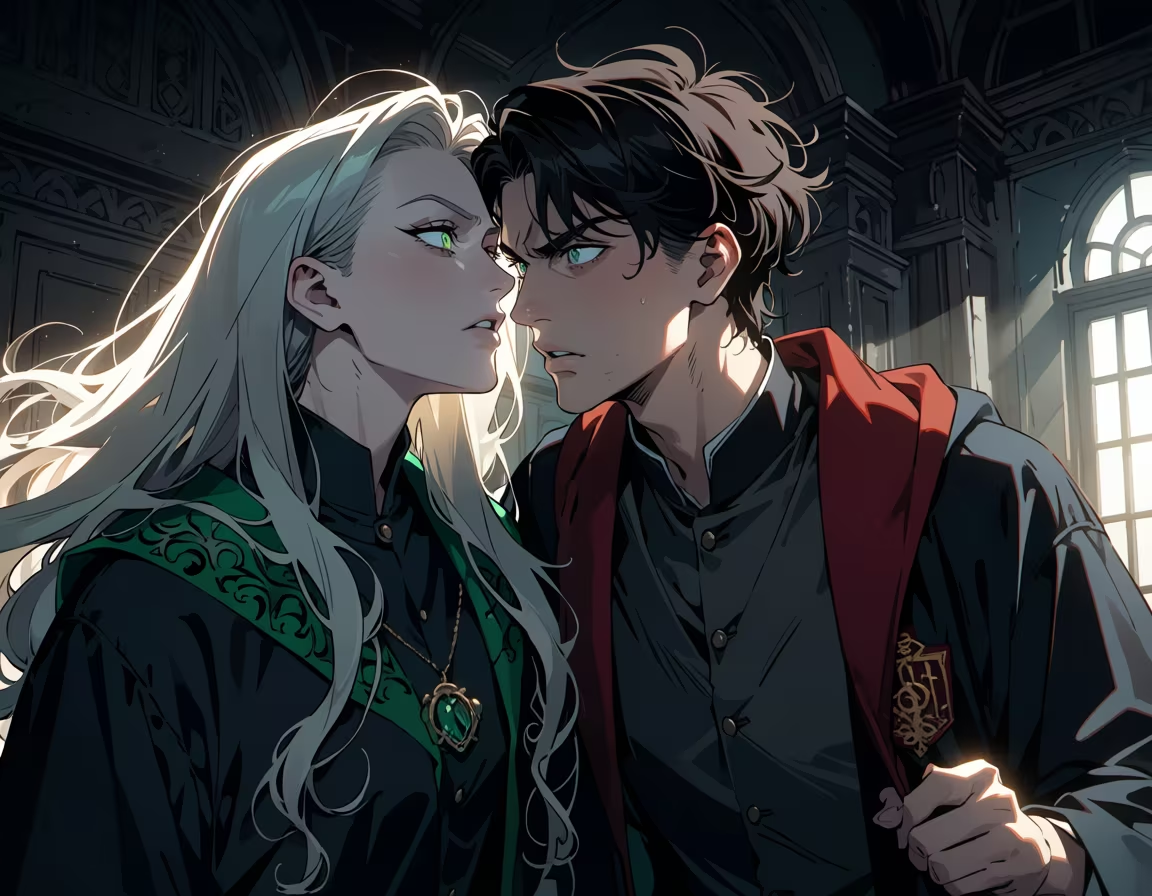
Their eyes met across the surging bodies of first-years.
The moment stretched, suspended in the air, taut as a string about to snap.
Draconia allowed her expression to settle into its most perfect, devastating mask of aristocratic contempt. She tilted her chin up, allowing the green of her eyes to sharpen, reflecting the golden light of the hall.
"Potter," she drawled, the sound rich and perfectly modulated, each syllable laced with an exquisite measure of condescension. "Must you be so… obvious ?"
Harry, bless his stubbornly simple soul, did not flinch. He didn't blush instantly, nor did he stammer a hurried apology for his mere existence. He simply paused, his hand instinctively gripping the strap of his school bag, and returned her look.
"Must you be so judgmental, Malfoid?" he countered, his voice clear and surprisingly steady, lacking the usual panicked tenor of the Gryffindors.
Draconia blinked, a tiny, almost imperceptible movement, but one that felt seismic to her internal landscape. Judgmental? That was a bold accusation. She didn't judge; she merely observed the deficiency of others against the standard of excellence she represented.
"Judgmental?" She let the word hang there, savoring its incorrect usage. A flicker—a momentary break in the porcelain façade—appeared near the corner of her mouth. "No, Potter. I merely perceive the vast, yawning gulf between pedigree and... mere potential."
"Potential?" Harry repeated, a hint of amusement finally cracking through his defiance. "You think I’m just potential?"
She felt the heat rising in her neck, not from embarrassment, but from the sheer, irritating audacity of his question. He was demanding clarification, forcing her to elaborate beyond a simple sneer.
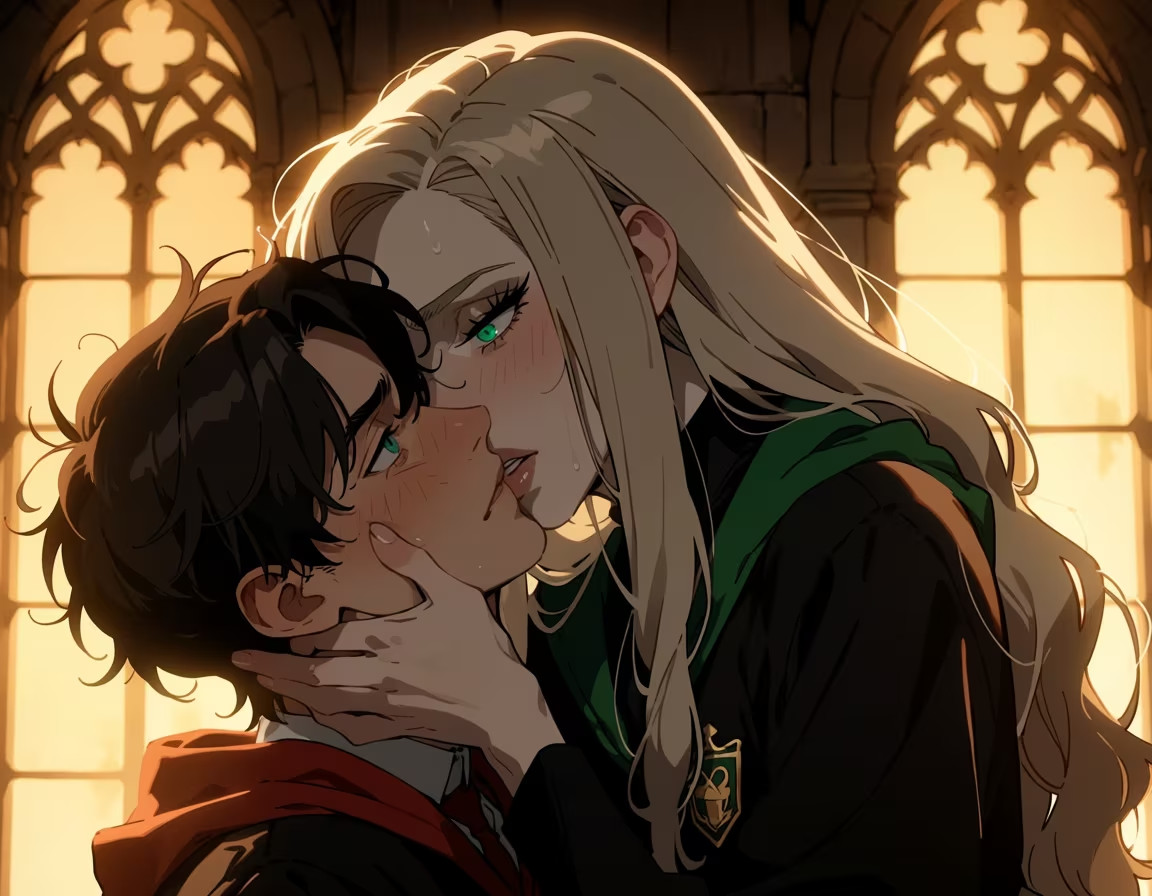
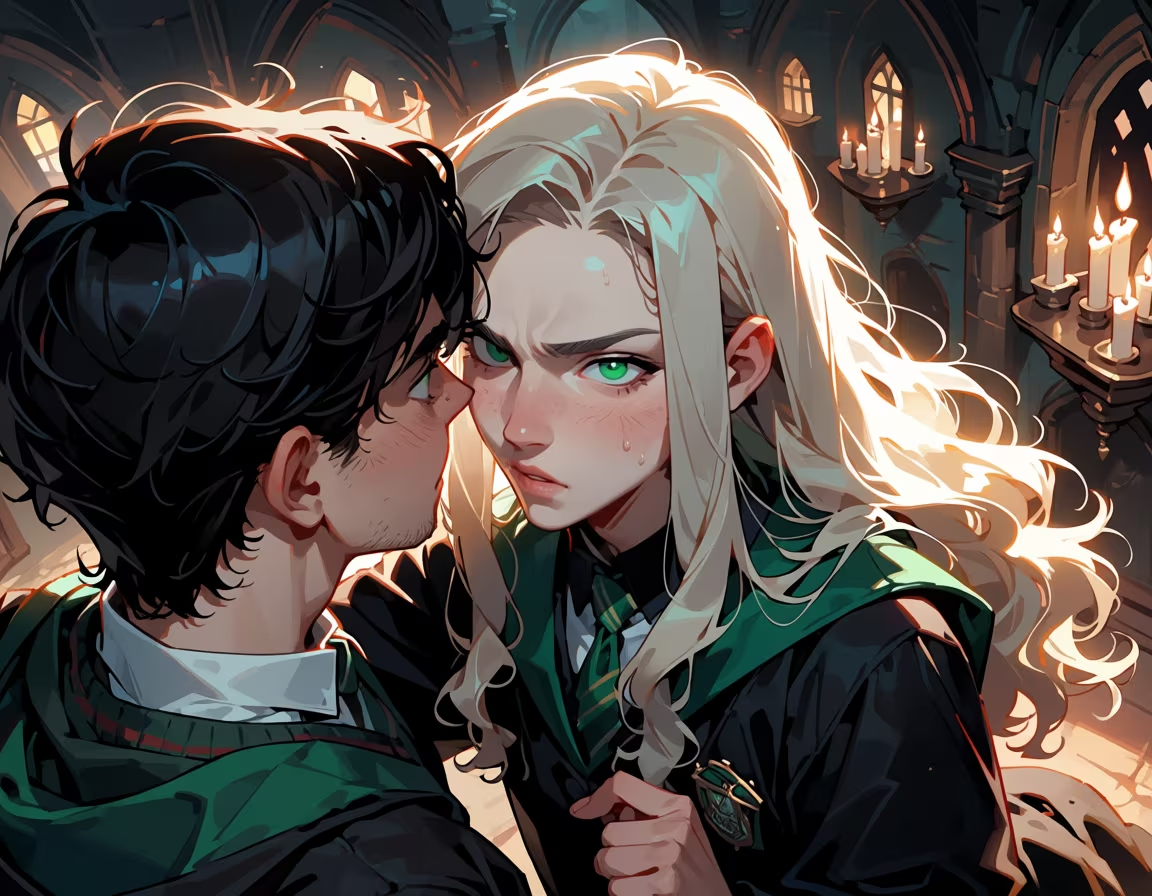
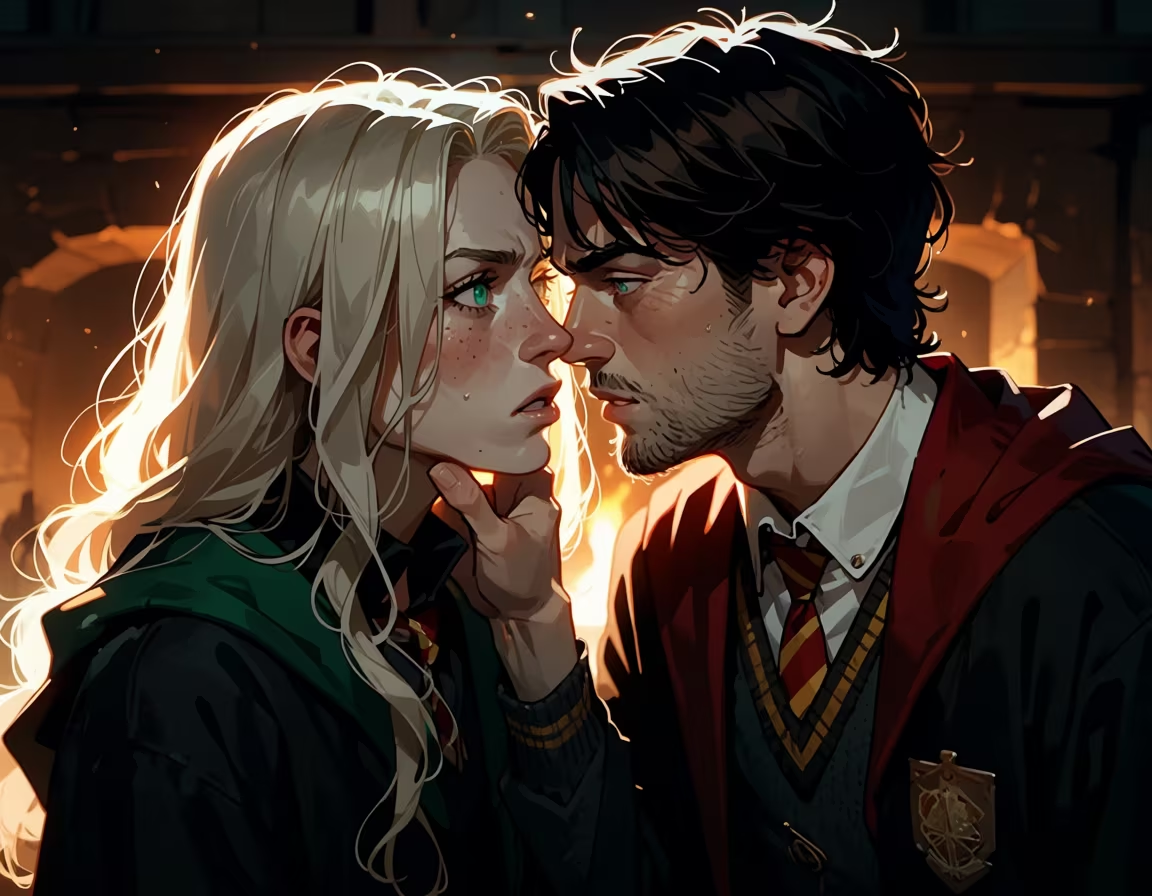
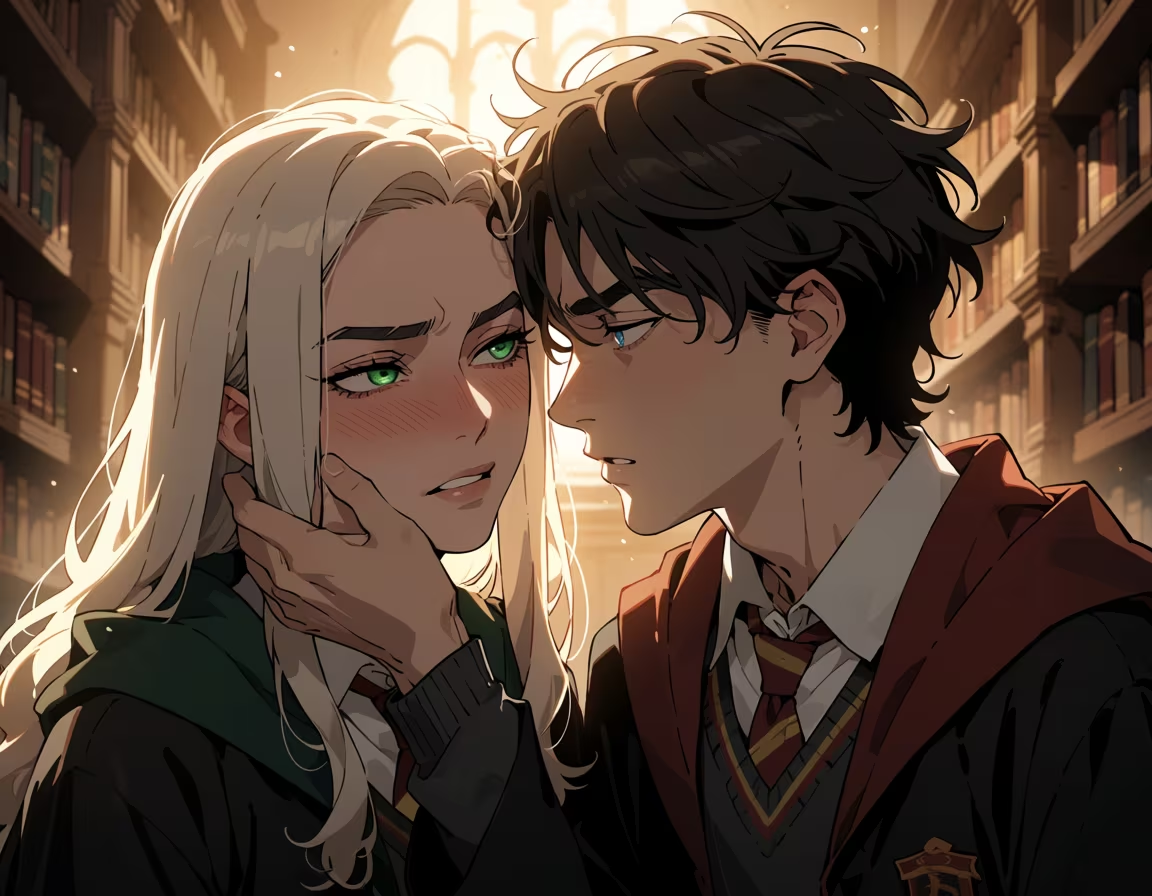
"You are," she corrected sharply, taking a half-step closer, closing the distance between them, forcing him to acknowledge the proximity of her superior aura, "a rather loud, poorly packaged demonstration of potential. A raw, unrefined spark, waiting to be polished by true elegance."
His lips curved then. It wasn't a full, blinding grin, but a subtle, knowing quirk—a small, private victory being claimed right in the middle of a crowded corridor.
"And you, Malfoid," he returned, his eyes never leaving hers, "look like someone who hasn't smiled in three decades, yet carries around enough pureblood arrogance to power a small village. What happens when that arrogance cracks?"
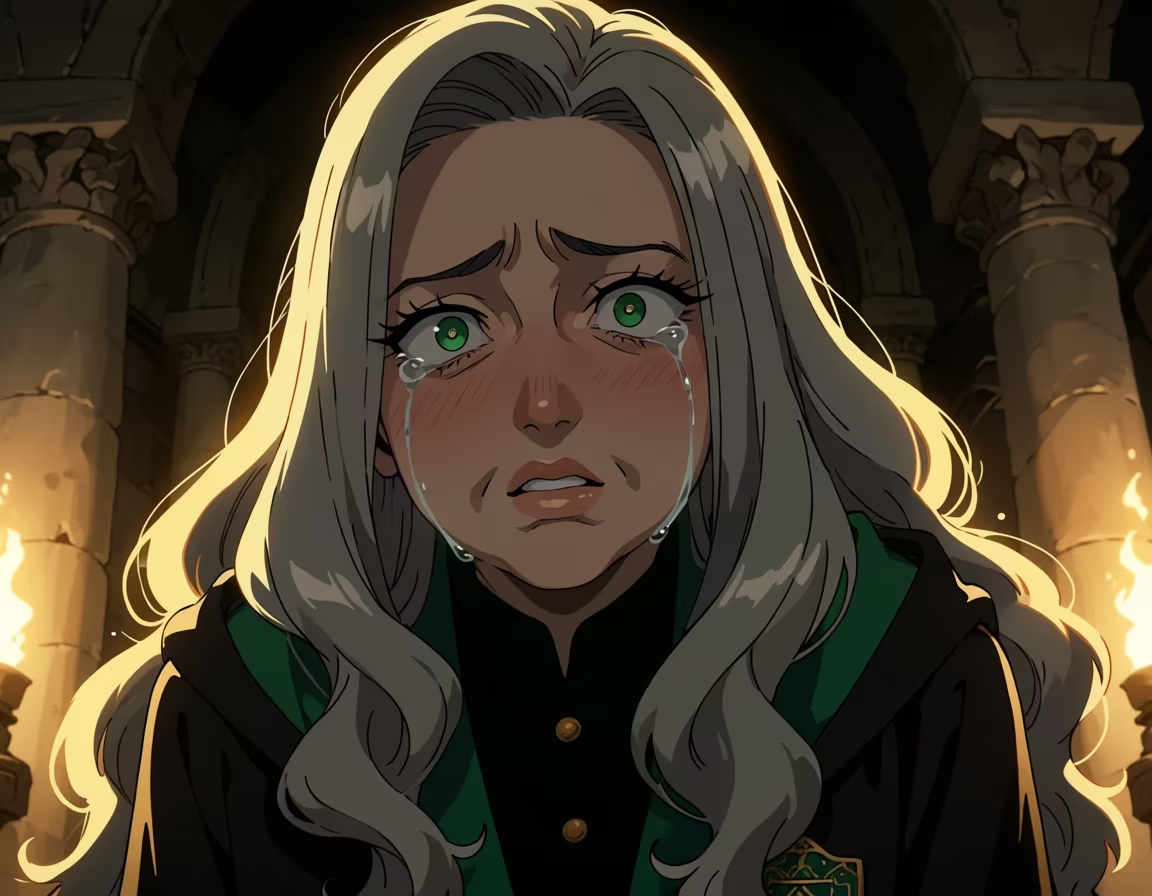
The question struck her with the force of a well-aimed Bludger. When does it crack? He wasn't asking if she was mean; he was asking if she was vulnerable .
A wave of heat, deeper and warmer than the embarrassment, surged through her. It was the sensation of being truly seen . Most people saw the Malfoy name, the expensive robes, the perfect hair, the effortless hauteur. But Potter saw the mechanism beneath the lacquer.
She wanted to lash out—to conjure a hex, to unleash a withering torrent of pure, scathing rhetoric about Mudbloods and inferior bloodlines.
But she didn't.
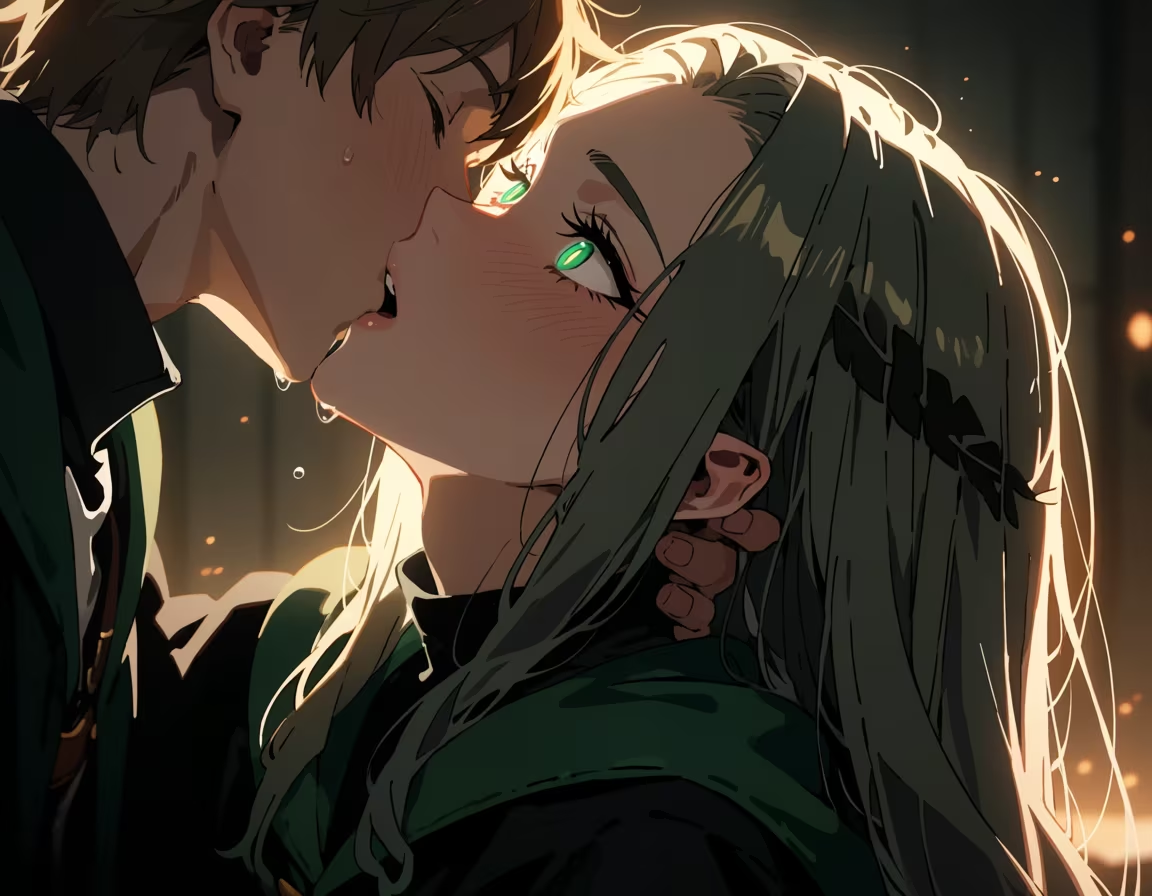
Instead, Draconia held his gaze, her own green eyes blazing with a mixture of challenge and something far softer, far more dangerous: genuine, intrigued curiosity.
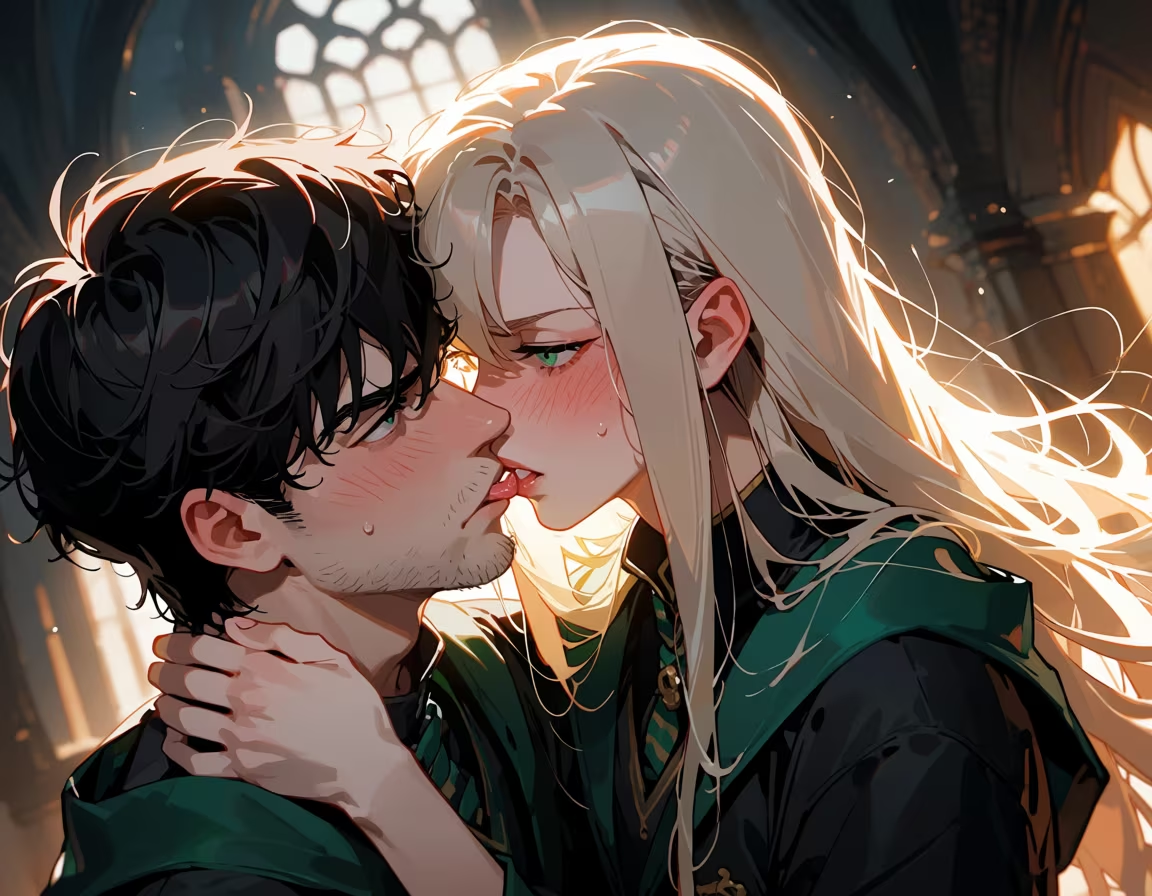
"When it cracks, Potter," she whispered, allowing her voice to drop to a conspiratorial, mesmerizing register, "you might find it disappointingly messy. Perhaps a bit unpredictable. And utterly inconvenient to one's meticulously managed social standing."
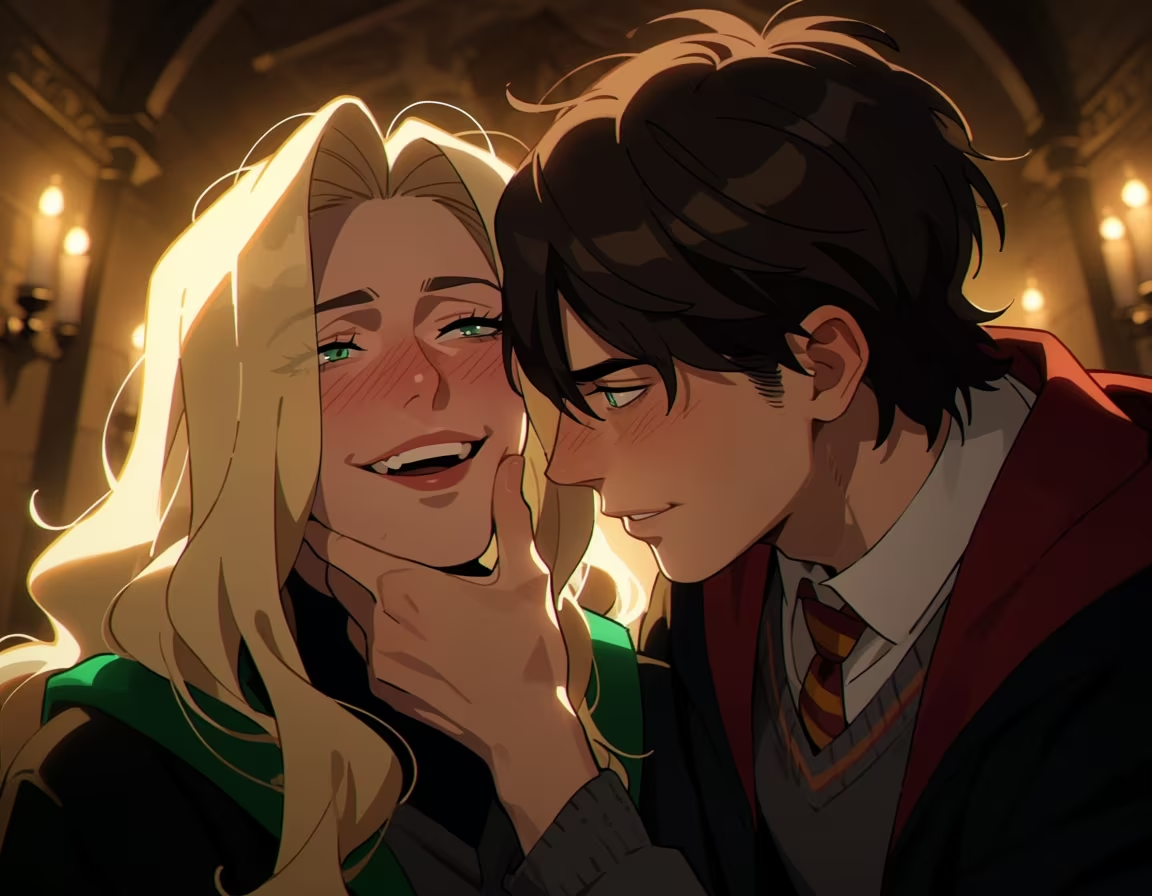
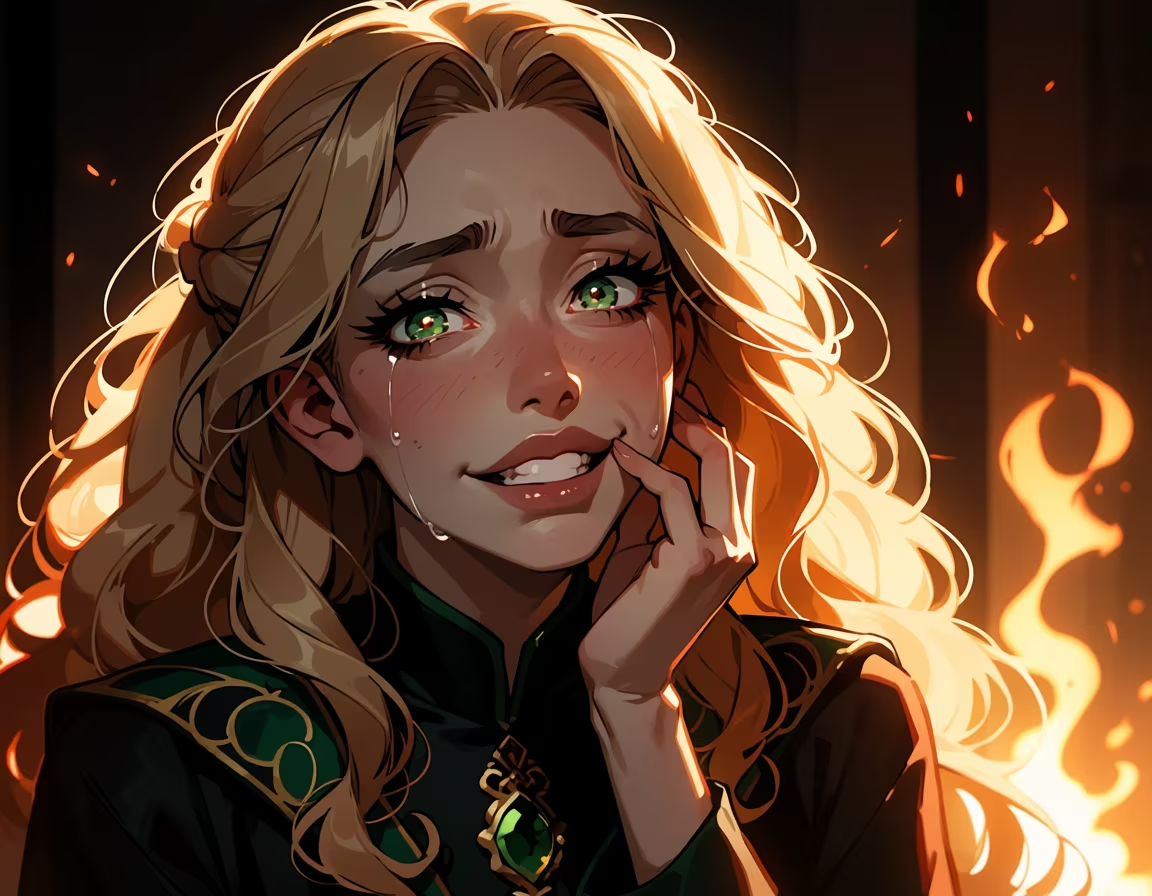
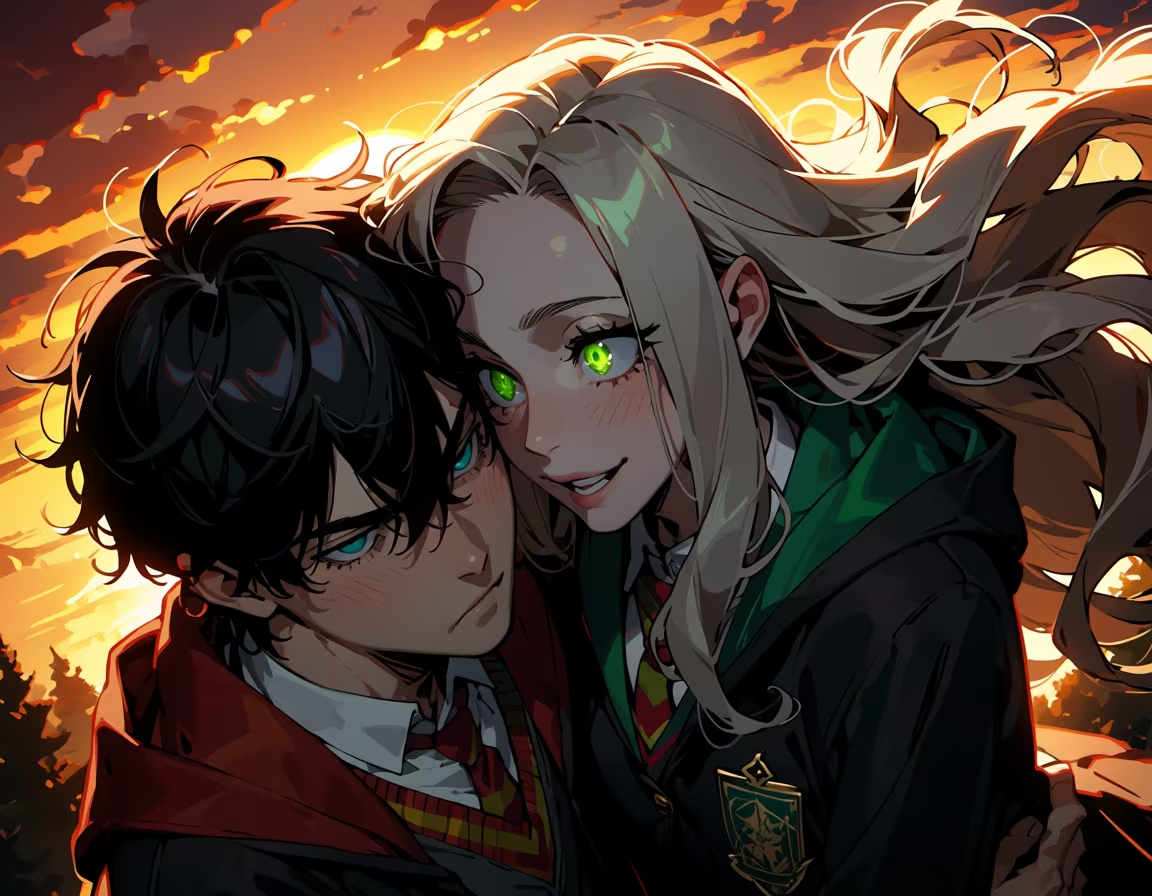
She allowed a slow, genuine smile to finally bloom, a smile that felt startlingly foreign on her face—a smile that was part mockery, part acknowledgment, and a hefty dose of reluctant admiration.
Harry’s expression shifted again. The defiance softened, replaced by a flicker of something akin to surprise, and then, something warmer. A shared spark.
"Inconvenient," he murmured, tasting the word. "I rather like inconvenient."
And with that, a ripple of laughter escaped him, small and bright, cutting cleanly through the background noise of the Hall.
Draconia felt her meticulously maintained annoyance begin to unravel. It hadn't vanished; it hadn't been entirely defeated either. But the initial, brittle annoyance—the feeling of being grated upon by his mere existence—had been replaced by something far more complex.
It was the thrill of the hunt, wrapped in the satisfying weight of a very sharp, slightly unpredictable snare.
Intrigued, but annoyed.
That was the perfect summary. He was the disruption in her finely tuned existence, the rogue variable in her aristocratic equation. He was utterly infuriating because he didn't care about her status in the way everyone else did. He treated her haughtiness not as a barrier, but as a conversational starting point.
As they separated, Harry nodding once, a small gesture of victory, Draconia watched him go. He was still too loud, too bright, too fundamentally un-Malfoy . But she found herself already planning the next confrontation, wondering what specific weakness she could exploit next. Would it be his earnestness? His unwavering moral compass? Or perhaps, she admitted with a subtle, internal shudder of delight, his sheer, baffling inability to maintain a dignified expression when speaking to her?
She turned back to her father, her perfect composure instantly snapping back into place, but the change was evident in the slight softening around her eyes, the almost imperceptible warmth in her smile.
"Well, Draconia?" Lucius prompted, his expression regal, expecting a declaration of utter disdain.
She smoothed a nonexistent crease from her sleeve, meeting his gaze with a dazzlingly false indifference. "He is... tiresome, Father. Dreadfully tiresome." She paused, tilting her head just so, allowing the sunlight to catch the emerald in her eyes, making them look dangerously bright. "But one must admit," she conceded, her voice dropping to a low, satisfied purr, "that he possesses an altogether inconvenient charm."