| Home | The Lives of Velnin | Illustrated Fiction | Malfoid Art & Fiction | Book Blurbs | Contact |
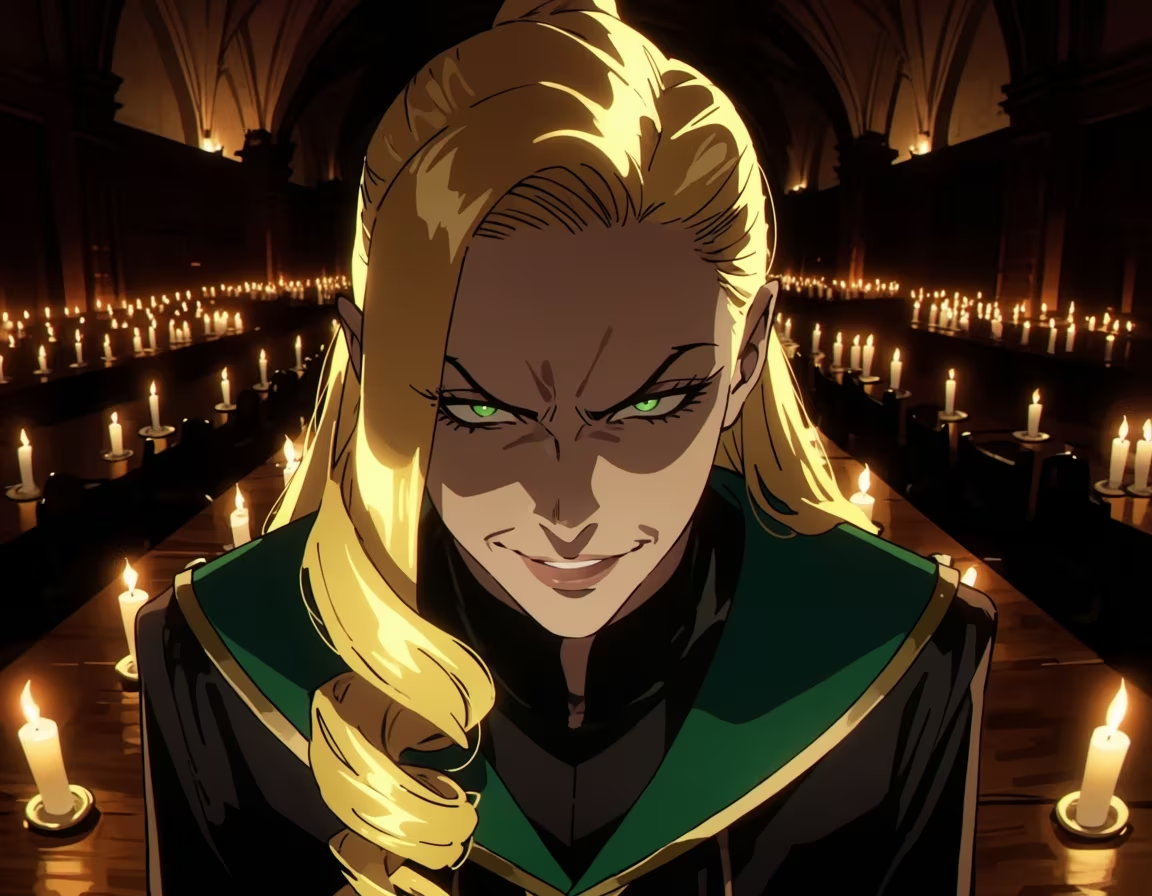
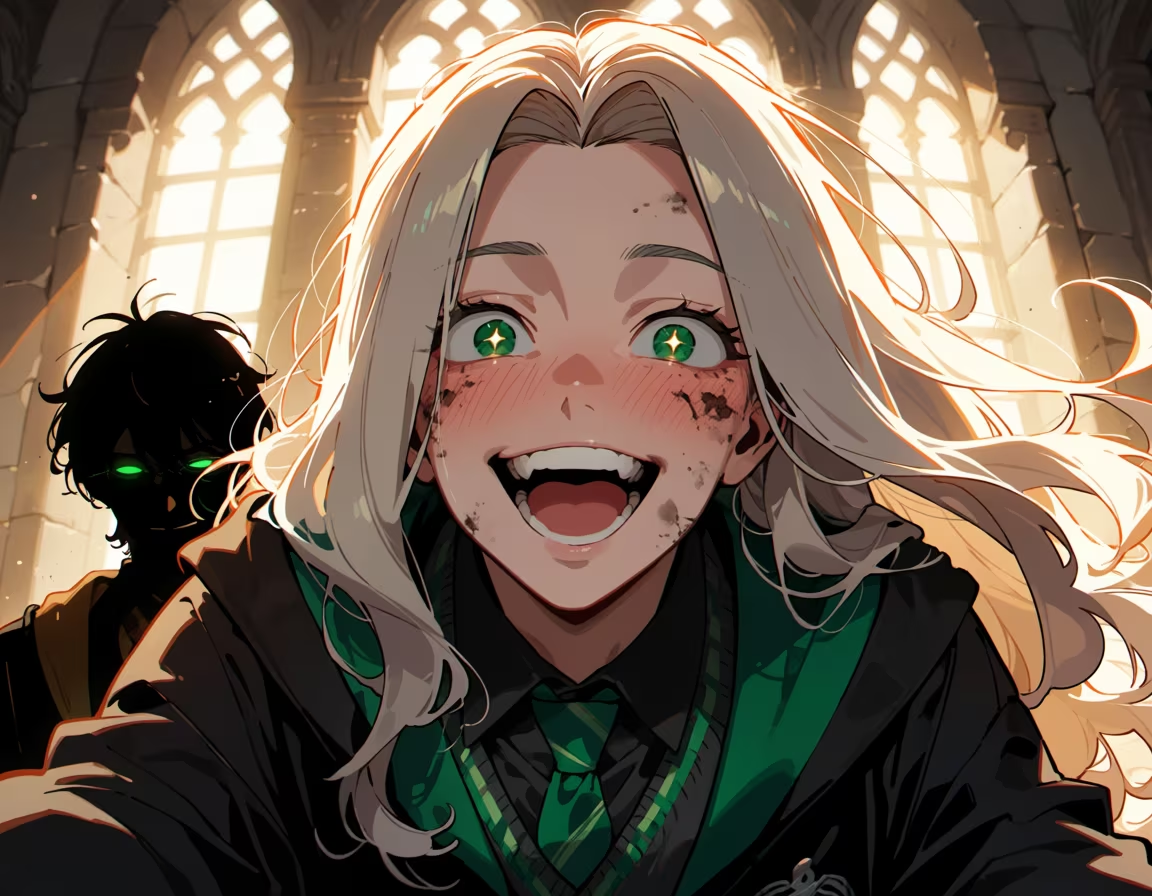
The Great Hall, on a clear September evening, was a spectacle of overwhelming, joyous chaos.
The sheer scale of the place always managed to dwarf my own considerable ego, yet simultaneously magnify it. The enchanted ceiling, currently mimicking a perfect, star-dusted twilight, seemed to bow slightly in deference to the assembled students—a sea of emerald greens, fiery crimsons, deep blues, and the occasional jarring yellow of Hufflepuff.
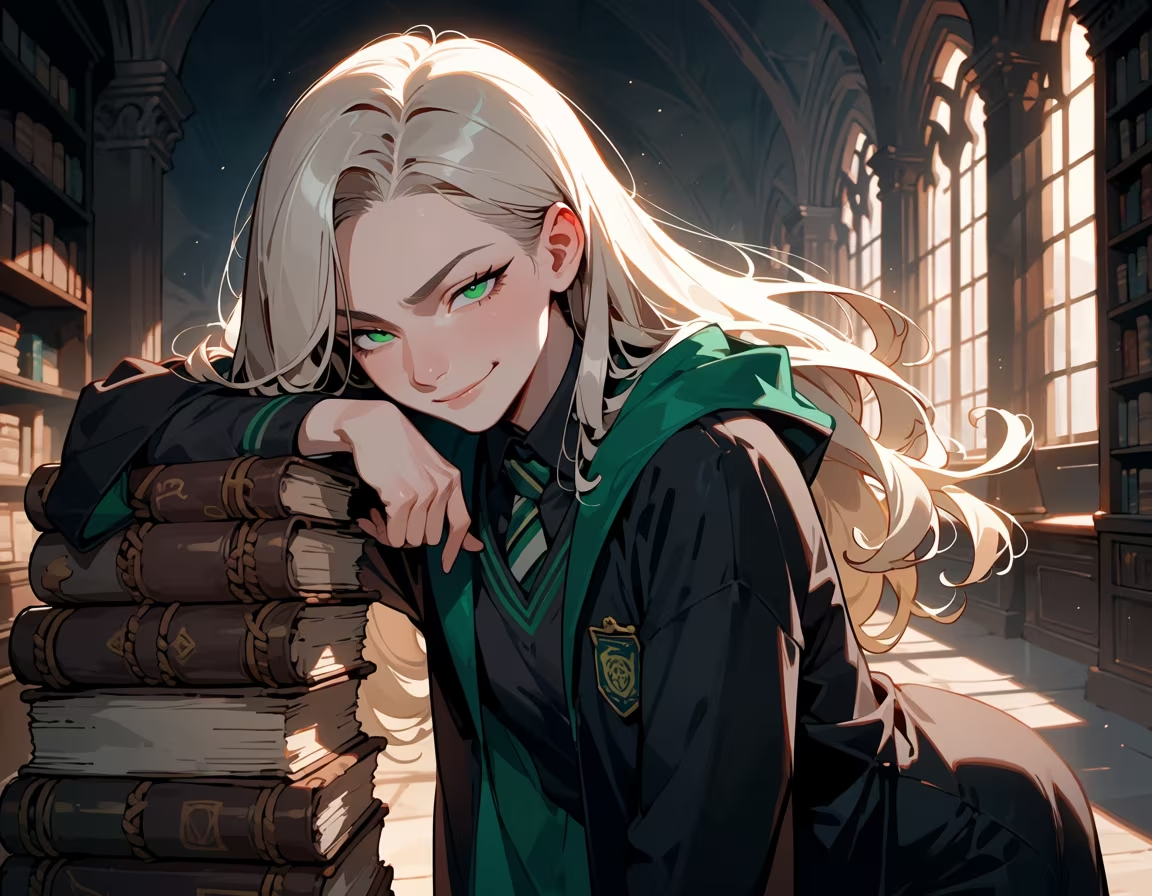
I sat precisely where one should sit: near the Head Table, in a position that afforded a perfect vantage point over the entirety of the Gryffindor table, allowing for the most critical, and frankly, most judgmental, surveillance of the Golden Boy.
My robes, cut from the finest midnight-green velvet and trimmed with the deepest, most luxurious Slytherin emerald, felt perfectly weighted against my shoulders. They were a visual declaration of intent: I am elegance. I am cunning. I am superior.
Beside me, Crabbe was already emitting a low, guttural rumble of excitement, while Goyle merely consumed a mountain of roast potatoes, oblivious to the finer points of social stratification. They were adequate accessories, much like a suitably heavy gold serpent ring, but they did not sparkle with the intellectual heft of my own presence.
My attention, however, was fixed squarely on the Gryffindor contingent. And within that group, one particular beacon of nauseating, unrelenting cheerfulness pulsed.
Harry Potter.
He was seated slightly apart, leaning forward on the table, a smudge of gravy decorating the high cheekbone of his face—a detail that, frankly, was offensively common for someone of his supposed lineage. His hair, a chaotic mop of raven black, seemed determined to defy all standards of neatness, much like his temperament.
And his eyes. Emerald green, yes, the same verdant shade as the finest Slytherin tapestry thread, yet his were bright, almost too bright. They seemed engineered by some whimsical, overzealous deity specifically to catch the light and demand adoration.
“Honestly, Draconia,” Theodore Nott whispered, nudging me with an elbow barely substantial enough to register against the silk of my cuff. “Do you truly find him… adequate? He has the sheer effrontery to wear scarlet so carelessly.”
I allowed the corner of my mouth to twitch upward in a gesture that was meant to convey pity, yet managed to land somewhere closer to scathing amusement.
“Adequate, Theodore? No. He is offensively obvious ,” I murmured back, my voice pitched just low enough to be intimate, yet carrying the razor-sharp edge that ensured everyone within earshot understood the gravity of my pronouncement. “He is the walking, talking embodiment of the Gryffindor principle: Noise over nuance . He is loud, he is predictable, and his need for validation is frankly quite tedious.”
But as I spoke the word ‘tedious,’ my eyes drifted back to Harry, and the critique faltered, wobbling precariously on the edge of my certainty.
He wasn't just loud. He was a phenomenon.
The Great Hall buzzed with anticipation, the chatter rising to a fever pitch as Professor Dumbledore, looking as ancient and magnificent as a perfectly aged bottle of Firewhisky, began the ritual.
The Goblet of Fire, sitting on the central dais, glowed with an unnerving, ancient warmth. A low, resonant thrum vibrated through the stone floor, tickling the soles of my polished shoes.
Behold, my inner voice narrated with theatrical flair, the mechanism of destiny, deciding which Gryffindor nuisance will be subjected to the indignity of a magical competition.
Fleur Delacour’s name was announced first, followed swiftly by the respectable Cedric Diggory, a prefect with the sturdy, handsome air of a proper, well-bred pure-blood, even if his family’s fortunes had perhaps taken a slight dip in recent years.
My internal sigh was one of grudging acceptance. Cedric, at least, had breeding. He possessed a quiet dignity that was infinitely more palatable than Potter’s energetic chaos.
Then, the Goblet shuddered violently. The flame flickered, flared, and spat out the final name with a theatrical flourish that bordered on the vulgar.
“Potter!”
The roar that erupted was less a sound and more a physical entity—a wave of adoration, shock, and sheer, unadulterated glee that slammed into my chest.
There.
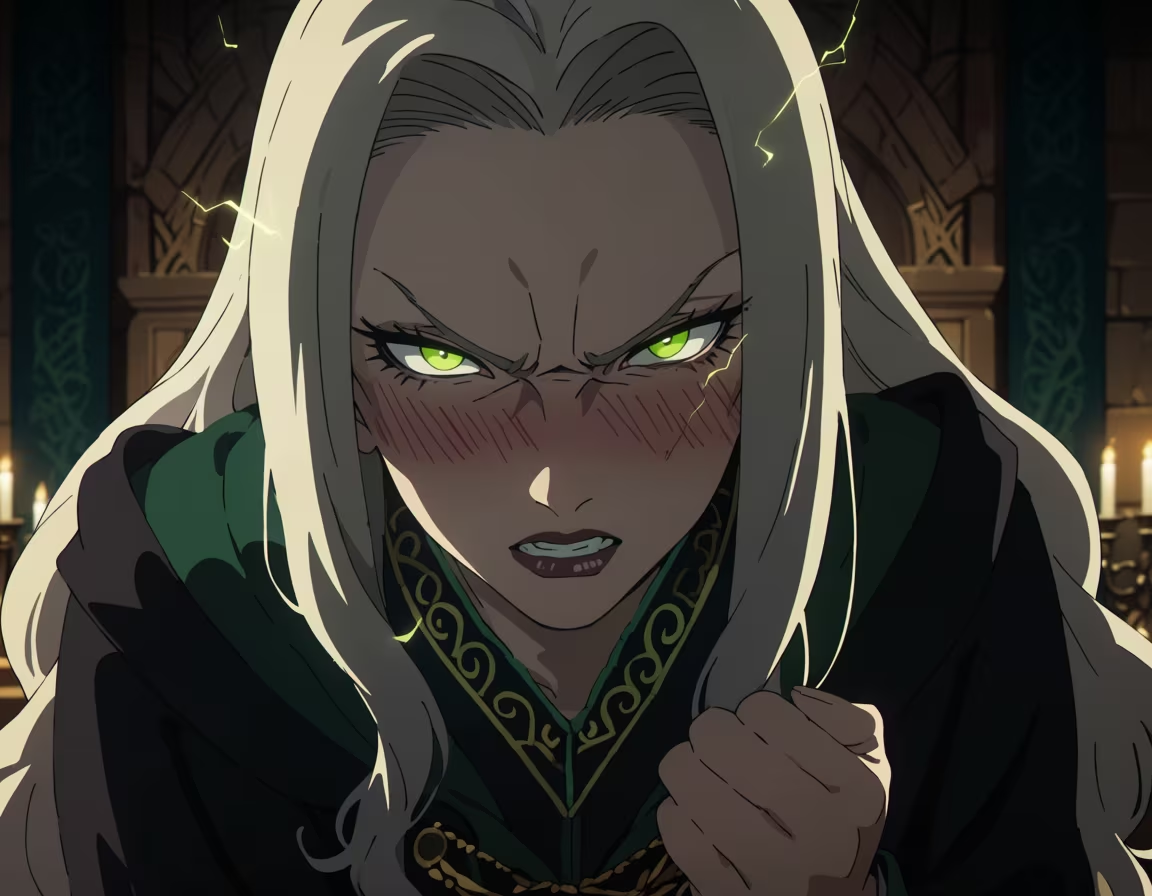
The annoyance spiked immediately, sharp and glorious. Of course , it was him. The prophecy, the scar, the relentless stream of praise—it was too perfectly calibrated for this realm. It was a deliberate insult to the subtlety of the wizarding world.
But then, the annoyance snagged, caught by a delicate, unseen thread, and pulled me sideways toward a far more dangerous sensation: interest .
My gaze locked onto him.
Harry wasn't leaping up immediately, as the Gryffindors did with such predictable fervor. He was frozen, for a breath too long, mid-chew of his sausage, his head tilted up towards the Goblet as if trying to process the sheer absurdity of the moment.
And in that fraction of a second, before the wave of noise could wash over his features, I saw it.
It wasn't the awe of the Gryffindors. It wasn't the smug triumph of Ron Weasley. It was something deeper, more complicated. It was a flash of profound, almost bewildered defiance. Like he was saying, ‘Well, alright then. Fine. They picked me. Now they’ll see what they’ve actually gotten themselves into.’
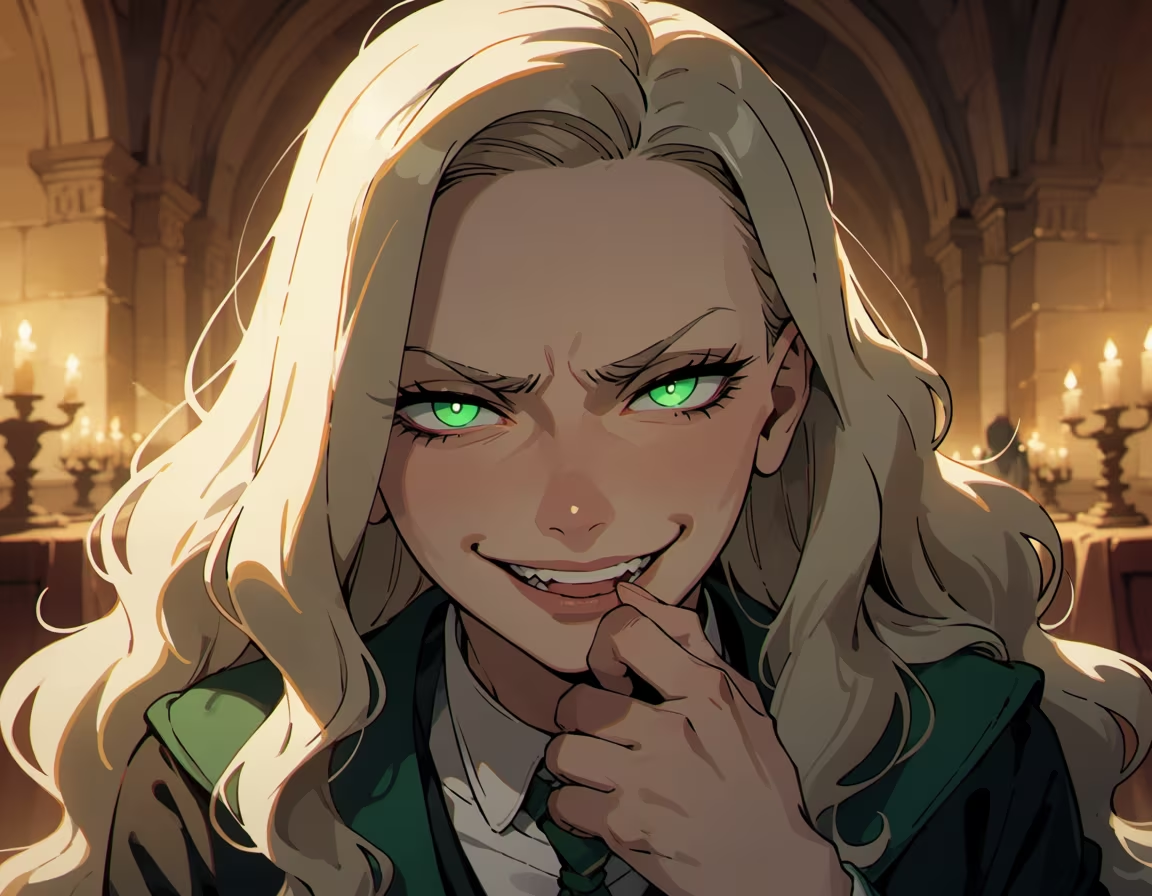
A slow, almost imperceptible curve lifted the corner of my own mouth. It was not a smile—a smile implied happiness, and while I was certainly irritated , happiness was too simplistic a descriptor. This was something more complex, something akin to a highly refined, exquisitely potent sneer mixed with reluctant acknowledgment.
“He has an insolent glimmer in his eye,” I commented to Theodore, my voice dropping to a husky purr, the sound barely audible above the triumphant cries for ‘Potter!’
Theodore leaned in, his own pale face alight with intellectual curiosity. “Is that… confidence, Draconia? Or arrogance?”
I considered this, letting the warmth of the Hall—the warmth emanating from the roaring fire, the warmth of the sheer collective focus upon him —wash over my senses.
“It is neither, Theodore,” I stated firmly, straightening my posture until my spine was ramrod straight. The slight tremor of feeling in my chest—a feeling I absolutely refused to name—demanded a more precise adjective. “It is a highly flammable mixture of self-awareness and sheer, stubborn contempt for the situation. He knows how ridiculous this is, and he is utterly refusing to play the part of the grateful little hero.”
The annoyance, which had been a tightly wound knot just moments before, softened its edges, allowing this new, intriguing energy to permeate it. It felt rather like finding a particularly well-aged piece of cheese—at first, it smells aggressively sour, and you recoil, but then you take a sliver, and the depth of the flavor is astonishing.
Annoyance, yes. But magnificent annoyance.
A surge of pure, Slytherin pride demanded that I diminish him. I needed to establish dominance, to remind the entire Hall that whilst Potter might have the divine blessing of the prophecy and the Golden Boy status, I possessed the superior lineage, the superior ambition, and the superior understanding of proper aristocratic disdain.
My hand, encased in a finely embroidered green glove, lifted slowly. I reached down beside my chair, where a cluster of small, shimmering paper badges had been placed by a nervous Hufflepuff prefect, awaiting the declaration of the champions.
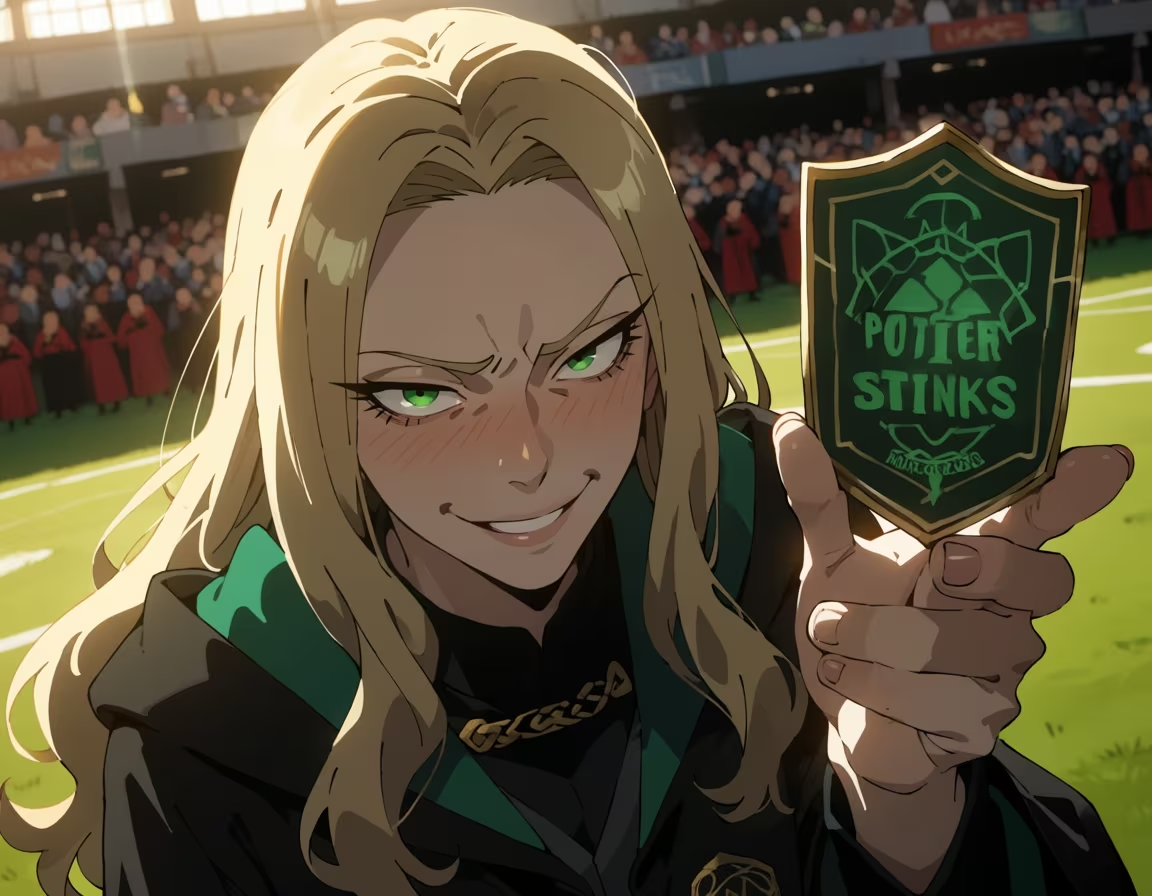
My fingers brushed the edges of the badges. Viktor Krum, Cedric Diggory… and then, there it was. The small, hastily printed circle emblazoned with a slightly wobbly image of a boy with unruly hair.
Potter Stinks.
The decision was instantaneous. It wasn't a thought process; it was an imperative. To allow him to be celebrated so purely, so unironically, was an act of weakness. It was an admission that perhaps, just perhaps, his presence was too disruptive to my perfectly curated world.
With a decisive snap of my wrist, I plucked the badge from its pile.
“There,” I breathed, a genuine satisfaction colouring my voice this time. “Let the masses celebrate their sentimental folly. But let me be the one to quantify its inherent lack of sophistication.”
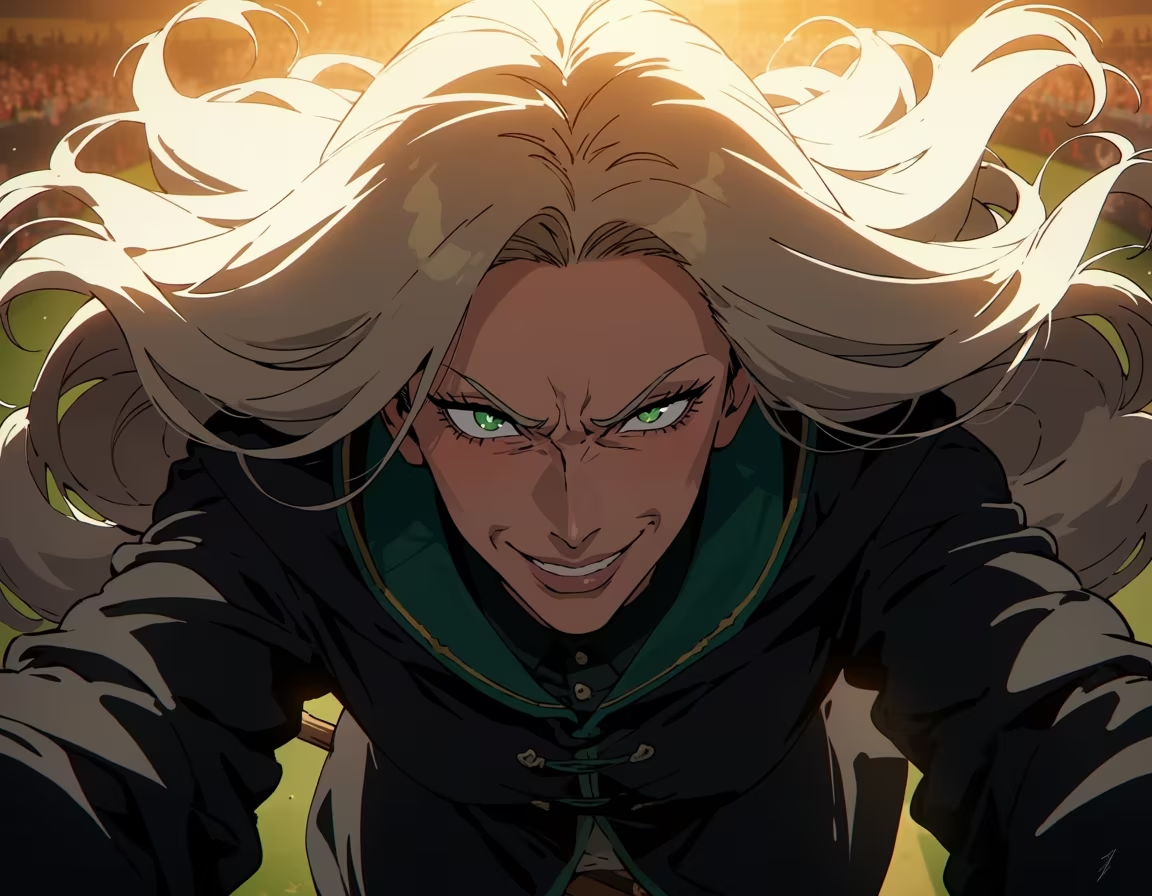
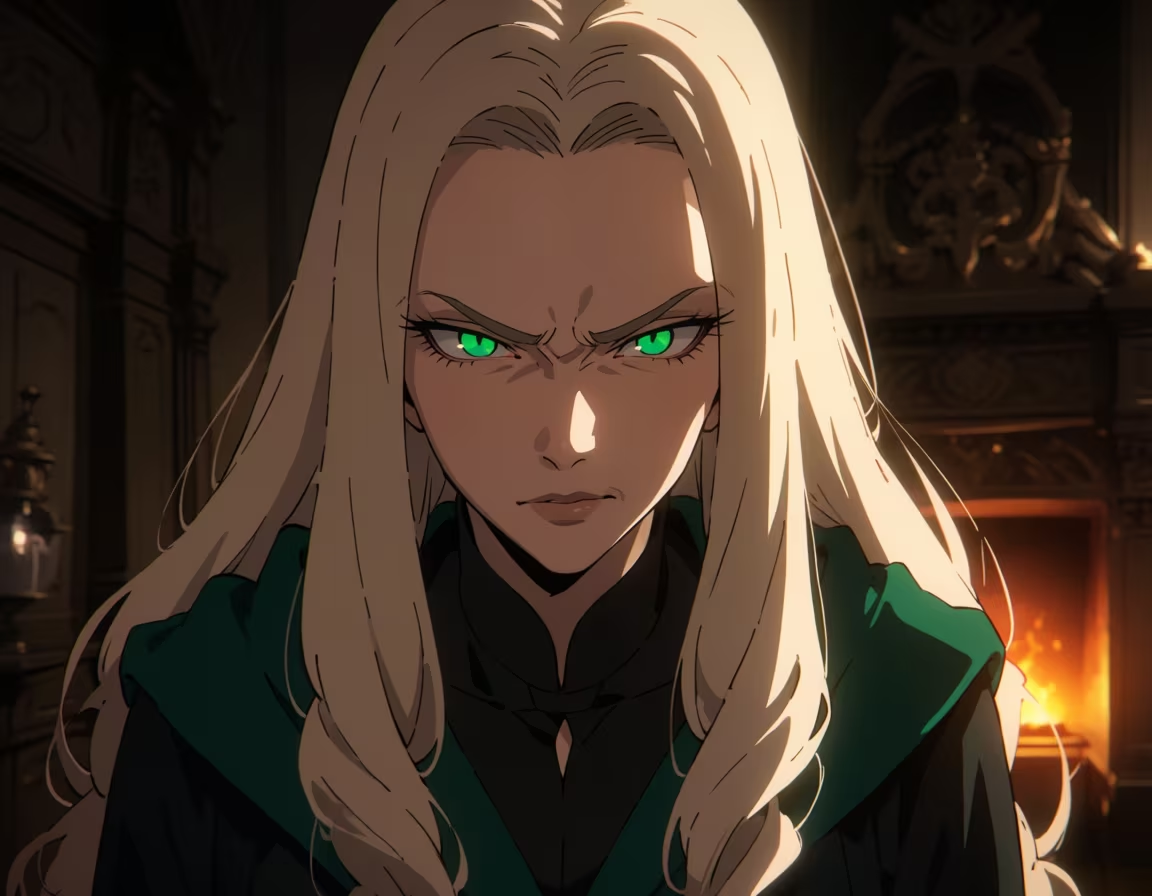
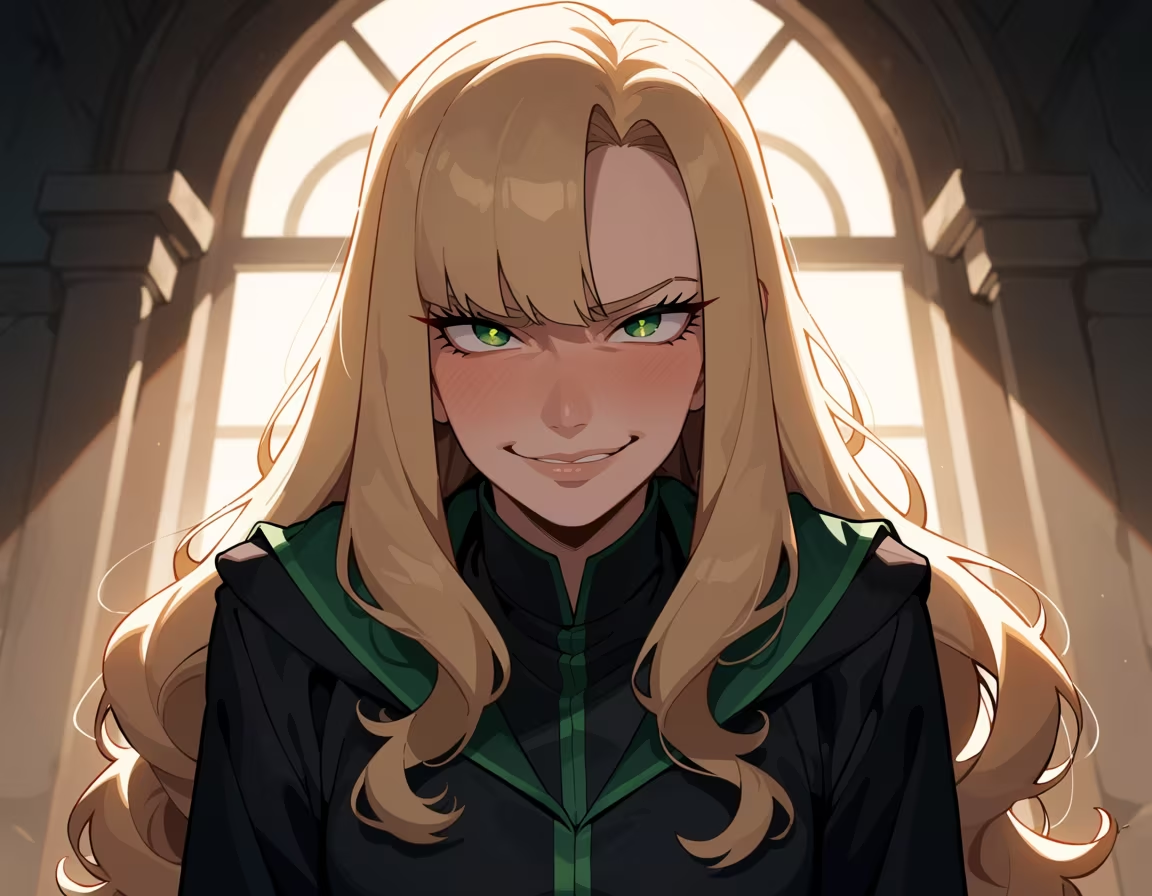
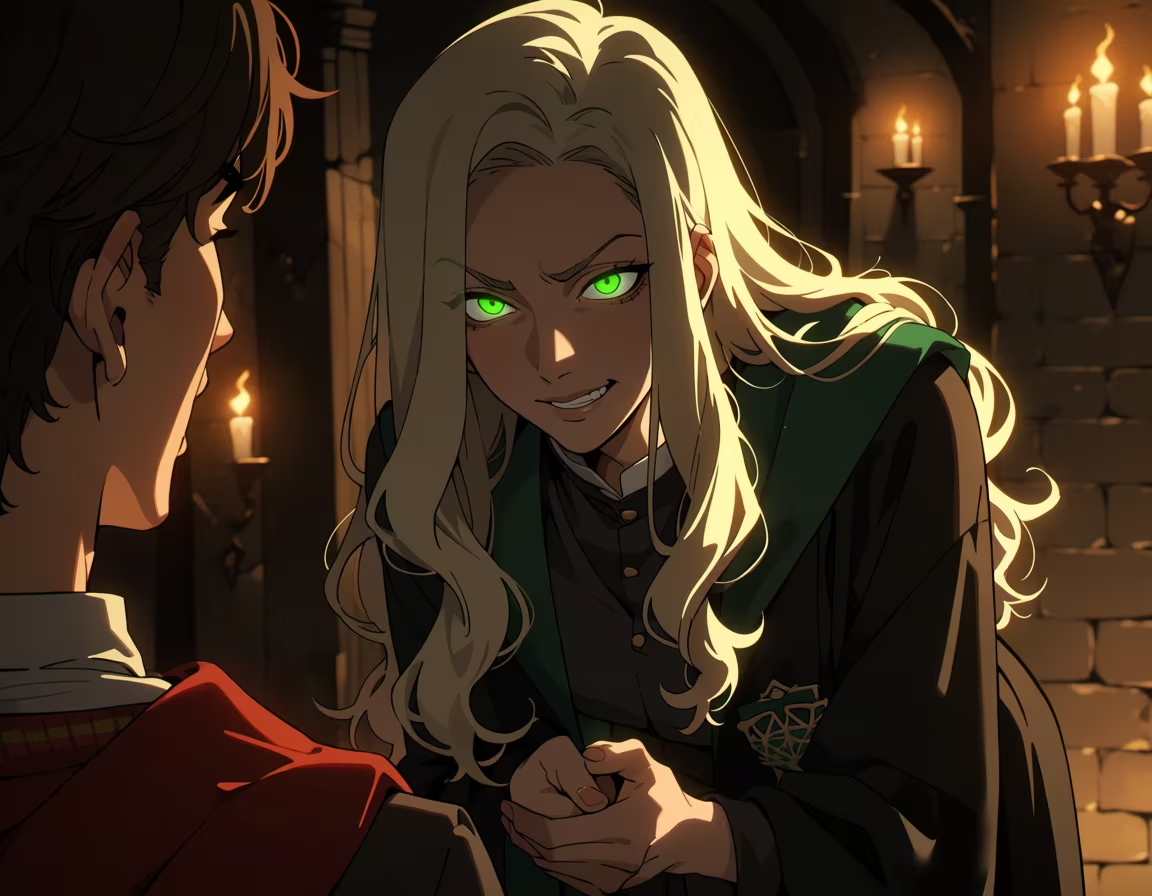
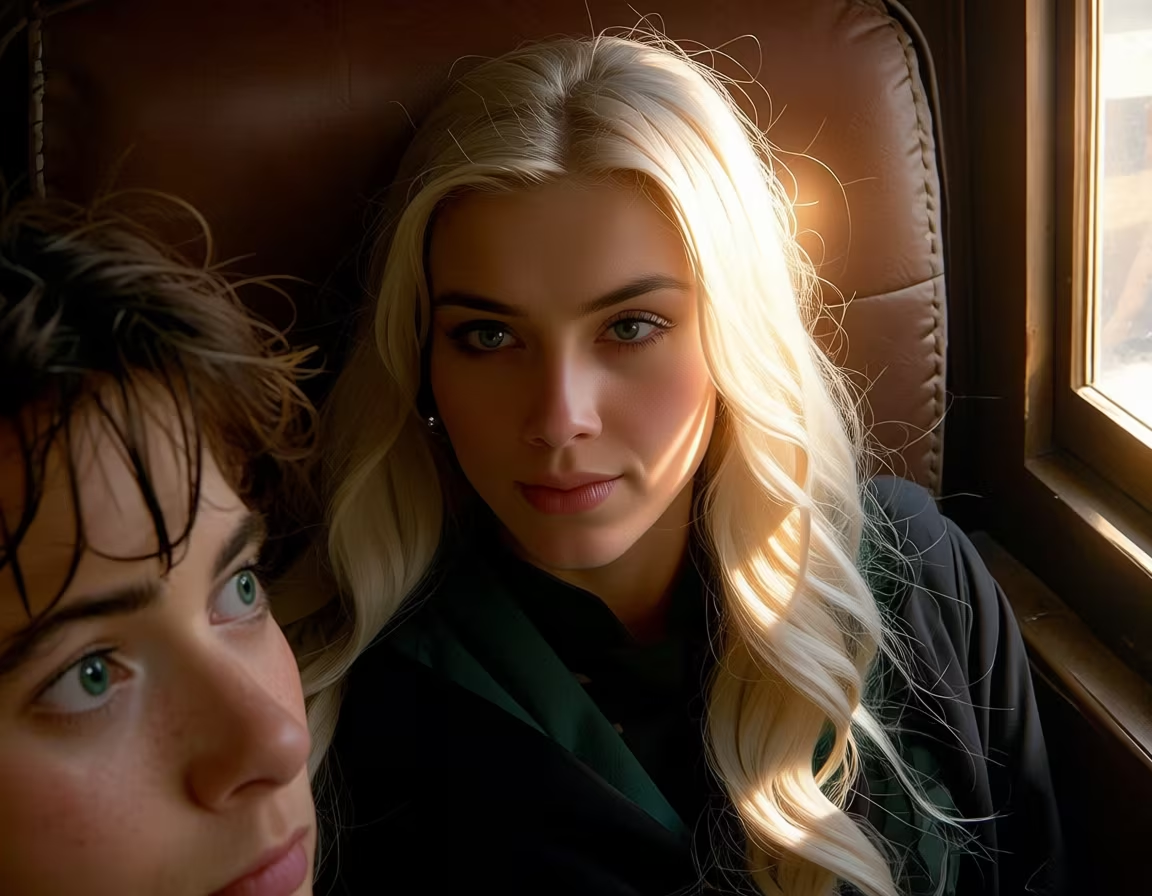
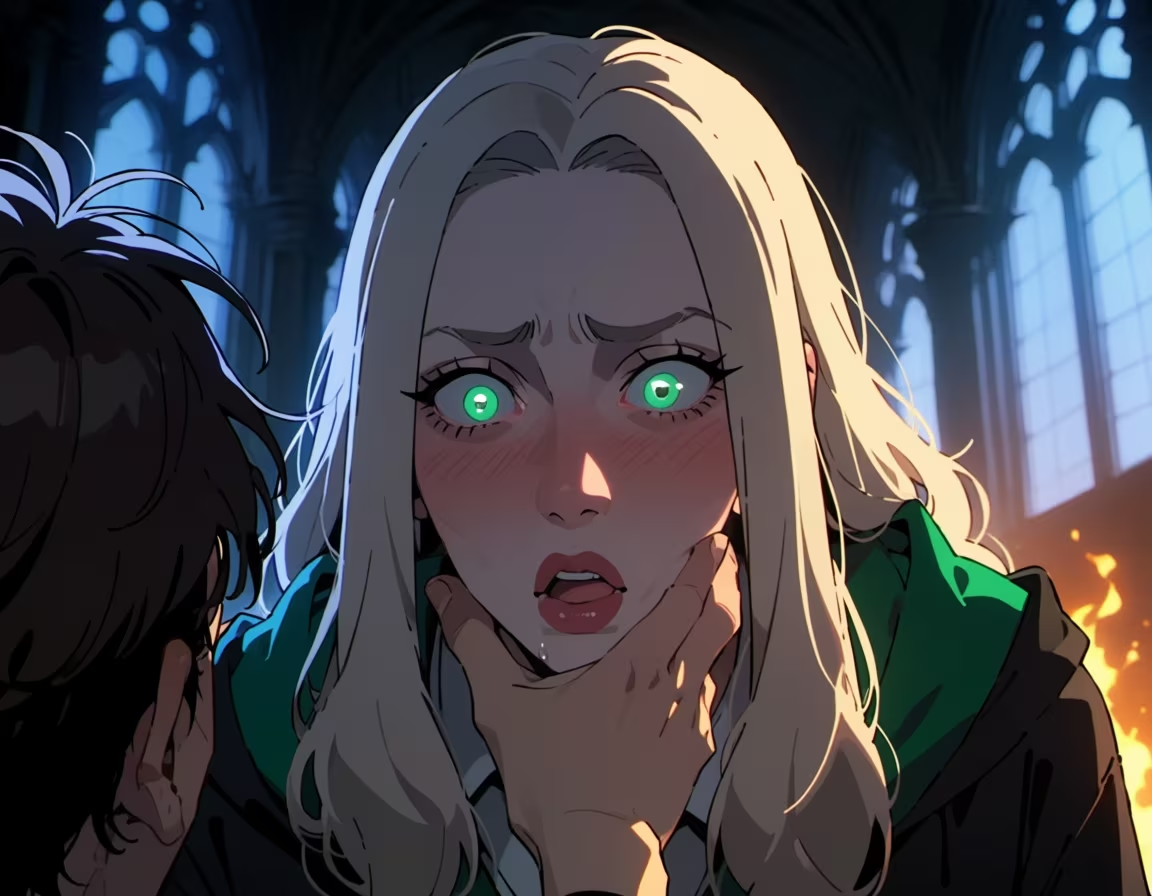
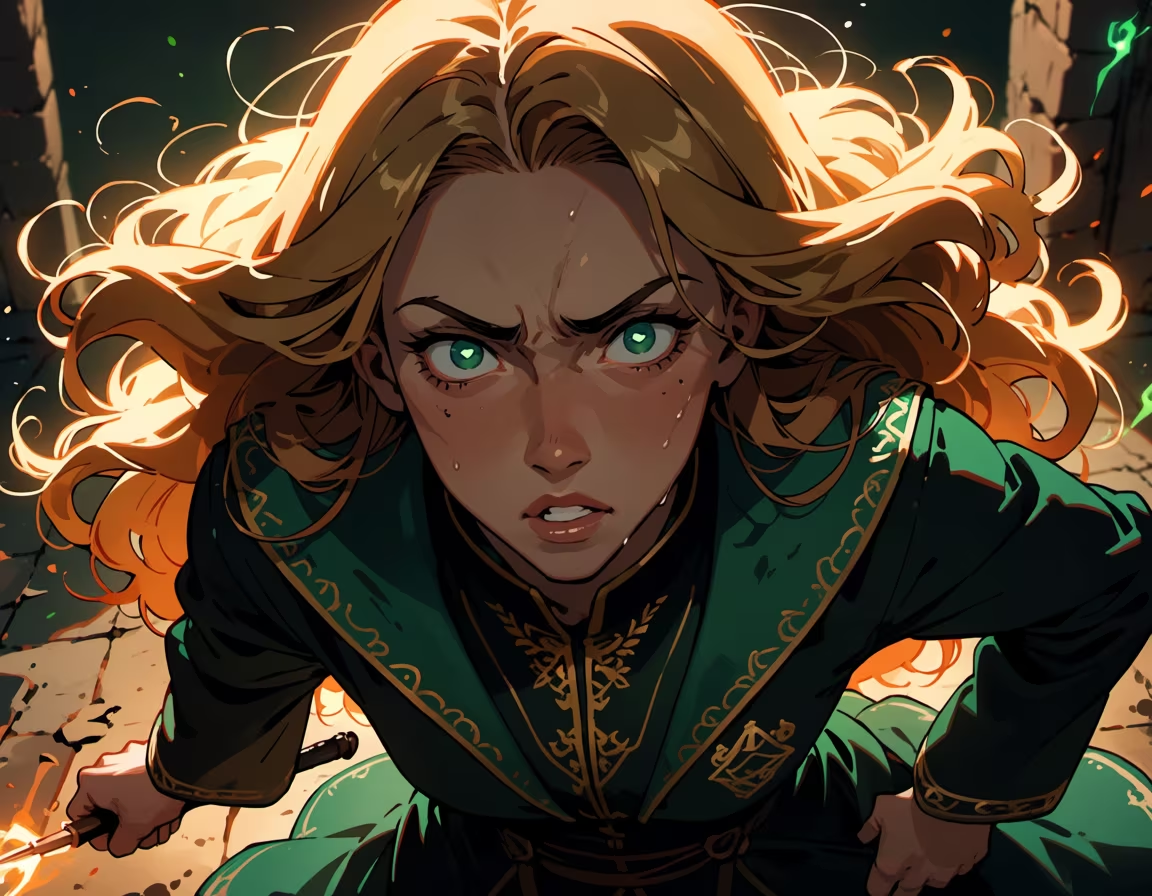
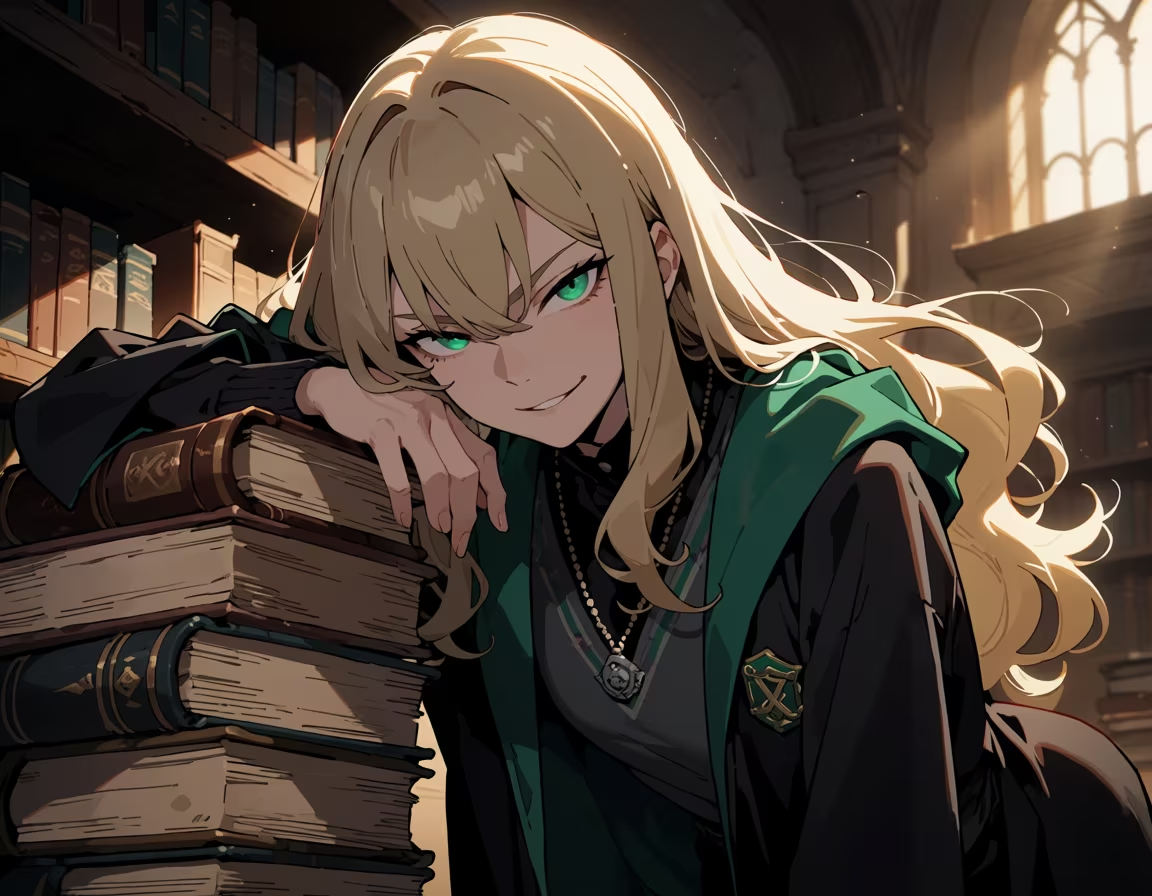
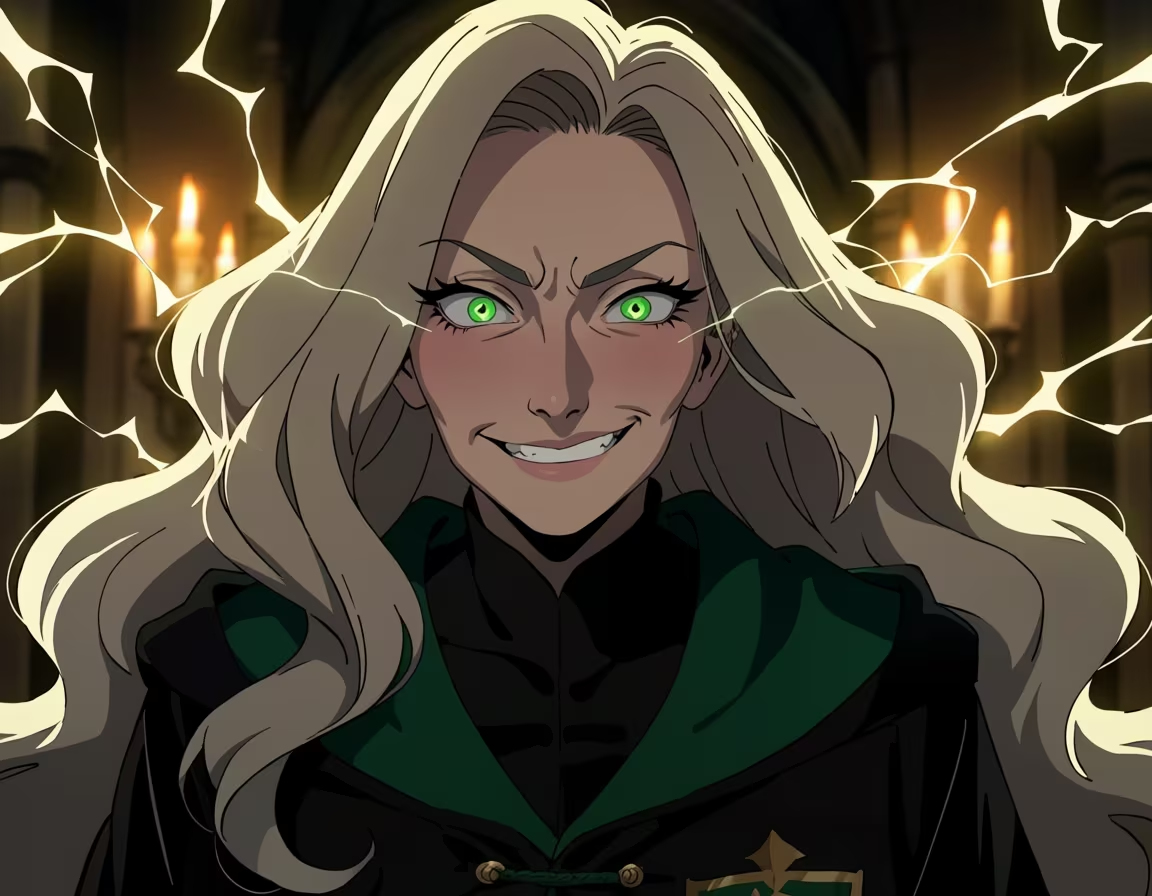
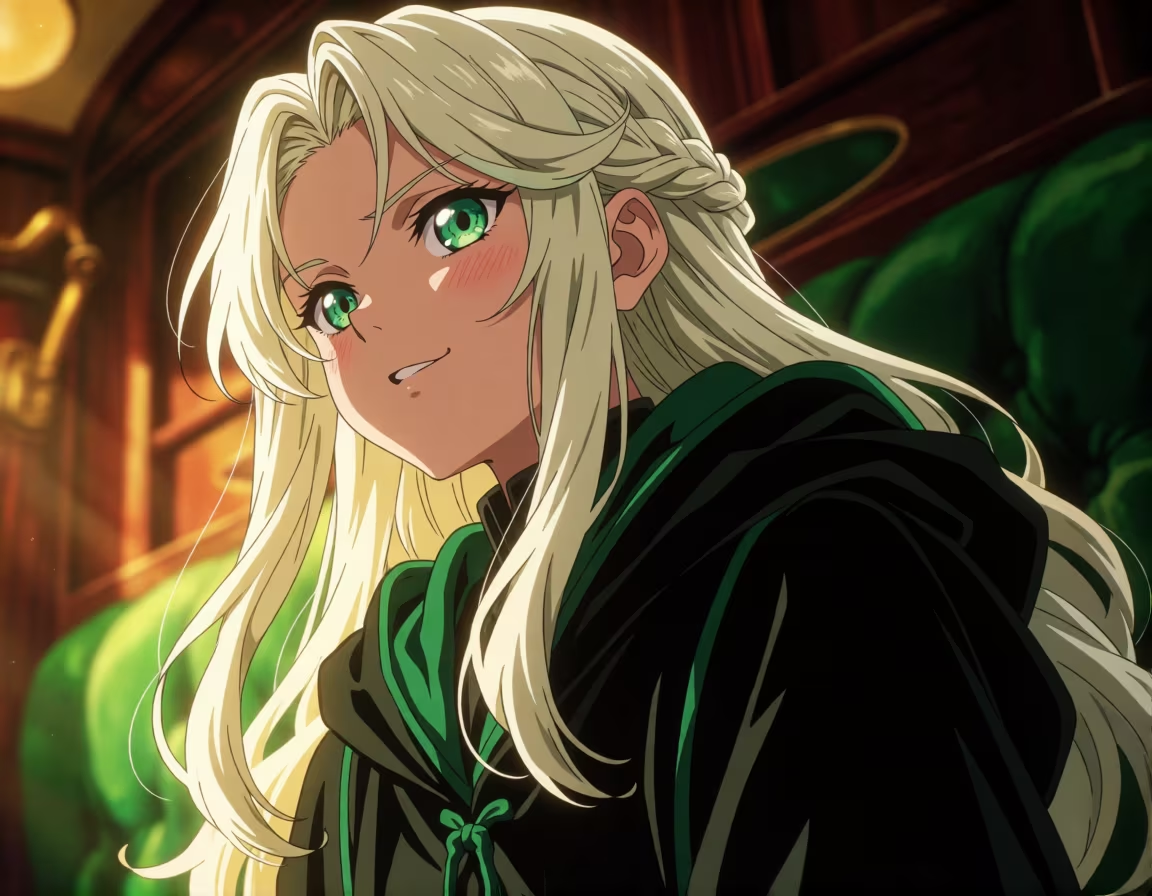
I turned my body slightly, ensuring my profile—my long, cascading blonde hair catching the torchlight like spun moonlight, my green eyes sharp and assessing—was perfectly visible to Harry. He was watching the announcement with that infuriatingly self-possessed air, a tiny muscle twitching near his jawline.
As I began to affix the badge to the front of my robes, right over the heart area—a subtle declaration that his mediocrity would be draped over my chest like a velvet scarf—the annoyance began to morph again.
It was still dominant, a thick, dark tide. But beneath it, the hint of interest had deepened into something more resonant. It felt less like a sudden flare and more like a slow, steady infusion of powerful, green-tinted ink.
He is loud. He is predictable. He is terribly, awfully irritating.
But he is also… vibrant .
He has the audacity to exist so brightly in a room full of perfectly adequate, richly toned hues. He has the nerve to stare back at the world with such unvarnished, slightly bewildered defiance, as if the destiny of the Wizarding World were merely a tiresome inconvenience before tea.
And that defiance? That infuriating, glorious glint of self-awareness?
It was beginning to feel less like a flaw and more like a highly desirable, slightly chaotic feature.
He is irritating, I conceded internally, gripping the badge so tightly my knuckles whitened. But God, he is captivating.
The feeling had shifted. It was no longer merely the sharp sting of annoyance . It was the pleasant, prickling discomfort of annoyance mixed with the undeniable recognition of a rival worth fighting—and perhaps, eventually, indulging—for.
He wasn't just a nuisance; he was the most spectacular, infuriating nuisance in the history of the British wizarding world, and I, Draconia Malfoid, was entirely, spectacularly, obsessed with him.
*
The weeks following the Triwizard Tournament were a protracted exercise in maintaining an immaculate façade of hauteur while internally cataloging Harry Potter’s every discernible characteristic.
He was, to begin with, an atrocious Gryffindor.
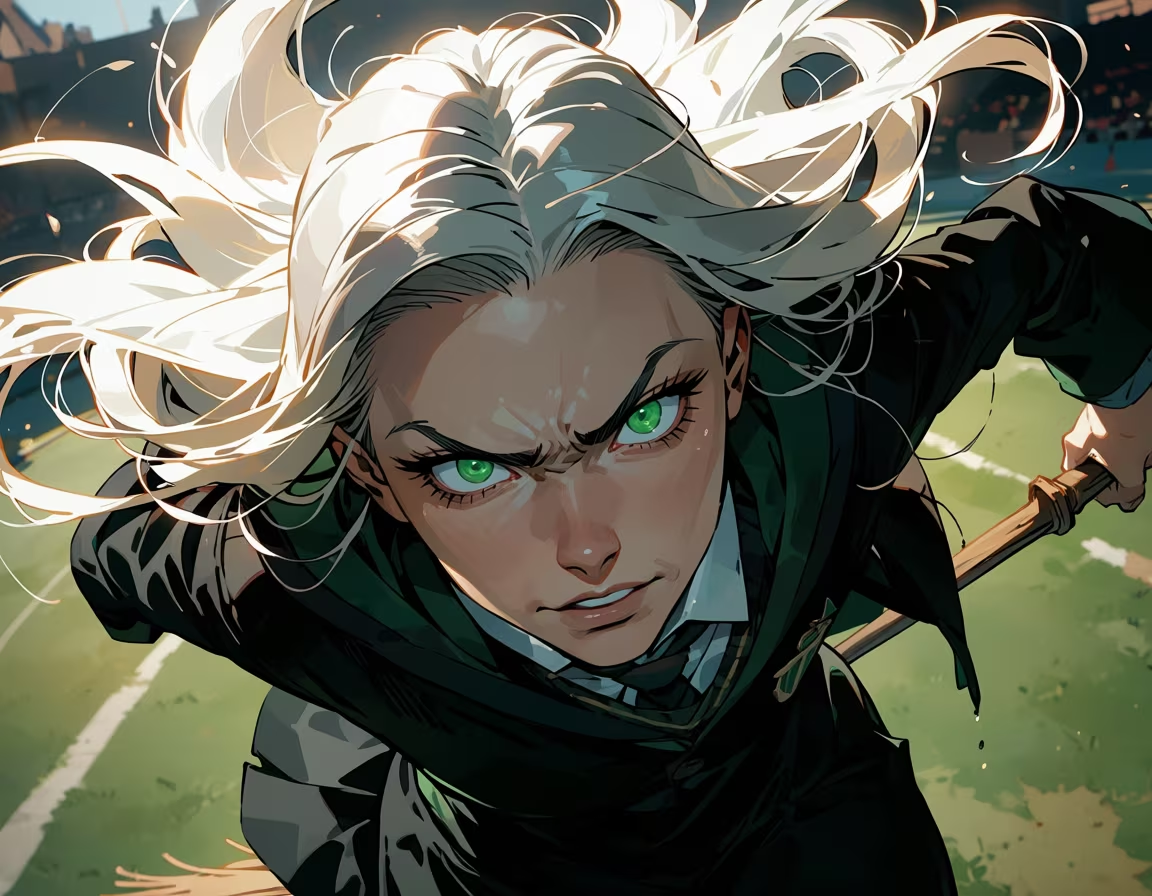
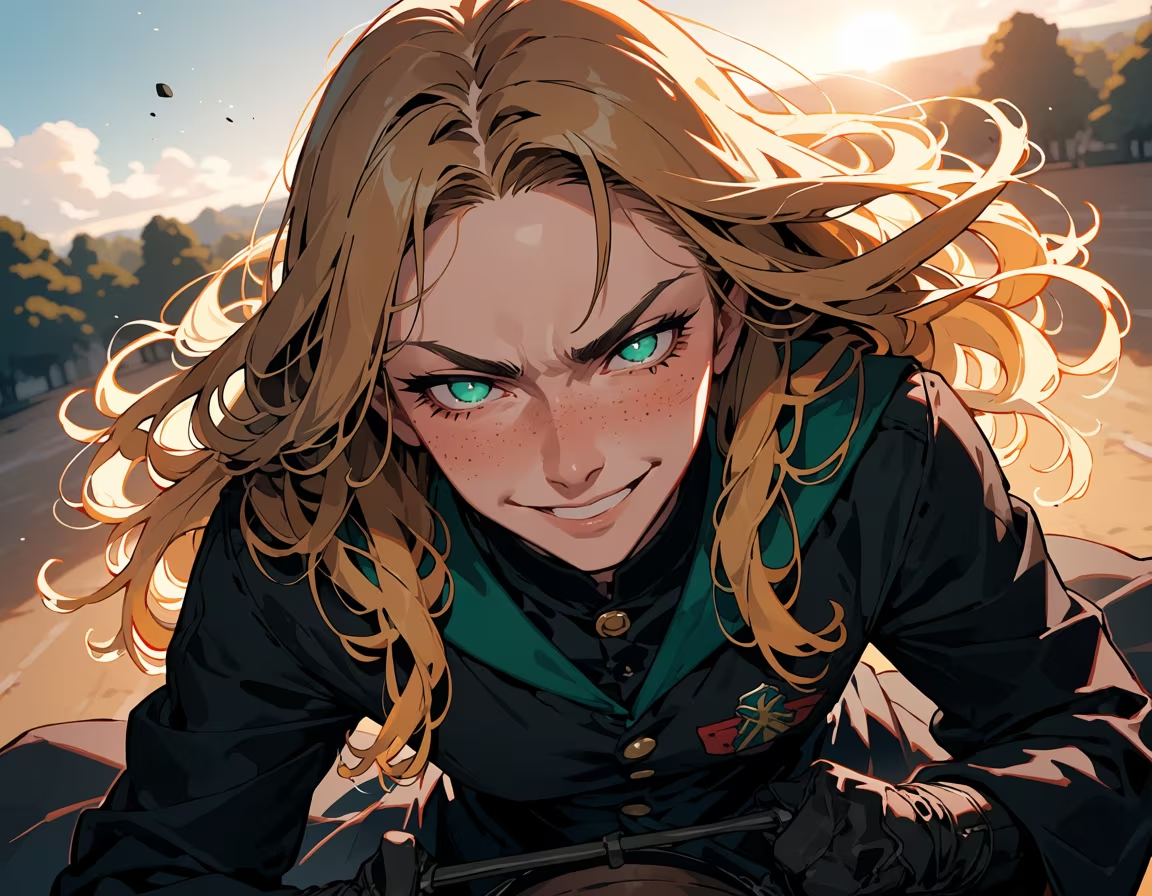
He was clumsy—a near-disaster on the Quidditch pitch during the first practice match, a moment of near-fatal tripping near the entrance to the dungeons—yet when he corrected the error, the flicker of that defiance returned, accompanied by a grudging acknowledgment of the slip.
He was sentimental—a display of profound, almost embarrassingly public loyalty to Ron Weasley that grated on my nerves like poorly polished cobblestones. Yet, when he stood up to Draco (yes, my sibling, who was behaving with a predictable blend of arrogance and panic), his jaw set with such fierce determination that I felt a strange urge to smooth the wrinkle in my own robes, as if to align myself with his superior resolve.
And he was brilliant. Terribly, unfairly brilliant.
When Professor Flitwick began his lessons, Draconia found herself unable to look away during Transfiguration. While most of the Slytherins were executing intricate, flawless transfigurations—a mouse into a snuffbox, a toad into a teacup—Harry, despite his lack of initial polish, was managing to achieve a remarkably stable, if slightly oversized, needle.
“Potter, that is adequate, if somewhat chunky,” Flitwick chirped, his voice a delighted, high-pitched whistle.
Harry merely grinned, a wide, utterly shameless eruption of teeth and green eyes, and seemed to absorb the praise like a thirsty sponge.
My internal monologue, which had settled into a rhythm of calculated disdain, stuttered.
Adequate? My lip curled. He calls his competence 'adequate'? It was a profound understatement, an insult to his own burgeoning talents.
But then the shift happened, the one that felt seismic, like the moment the earth shifts beneath a grand ballroom.
It wasn’t a sudden crush; it was a slow, creeping realization of his intrinsic value. It was the understanding that beneath the noisy exterior and the scar-induced celebrity, there was a fiercely intelligent, fundamentally decent core. A core that was also profoundly stubborn—a quality I admired above all others.
The annoyance was evolving into an intrigued annoyance . It was the feeling you get when a particularly handsome, irritating peacock lands in your perfectly manicured garden, forcing you to acknowledge that perhaps the grass isn't quite as green as you thought, and that the peacock's iridescent plumage is, dare one say it, magnificent.
This growing intrigue was tested spectacularly during the shared Transfiguration assignment where we were tasked with turning a piece of oak into something worthy of a Malfoy.
While the rest of Slytherin produced sleek, dark, perfectly polished beasts, Harry managed to conjure a small, surprisingly fierce owl, complete with tiny, fluttering wings and a surprisingly haughty tilt to its head.
When the task was reviewed, Snape—my own father’s most competent, if most perpetually gloomy, colleague—paused, his black eyes sweeping the class with glacial intensity. He looked at my perfectly formed, imposing beast. He looked at Harry’s slightly clumsy, yet undeniably spirited owl.
He paused for a beat too long.
“Potter,” Snape drawled, the single word dripping with skepticism. “It possesses a certain… will . A stubborn refusal to be merely a piece of wood. Acceptable.”
Acceptable. The word felt like a personal slight delivered directly to my finely attuned Slytherin sensibilities.
But as Harry looked up at Snape, his expression wasn't merely relieved; it was a mixture of triumph and weary acceptance—the knowledge that he had done well, but knew the criticism was merely a formality.
My stomach gave a disconcerting flutter.
This was it. This was the pivot point.
The annoyance was still present, a sharp, prickly companion, insisting that he was fundamentally gauche. But the interest had bloomed into something warmer, something deeper, something that felt suspiciously like nascent admiration.
He is irritating because he lacks polish, I reasoned to myself, tapping my quill against my parchment. He is annoying because he is too… open. Too easily flattered by the sheer weight of his own notoriety.
But then I thought of the way the sunlight, filtering through the arched windows, had caught the golden sheen of his unruly hair, making it look less like messy black and more like liquid night.
And yet…
The thought bloomed, lush and undeniable, like a rare night-blooming flower.
And yet, his inherent defiance is compelling. It is a challenge. A beautiful, noisy, infuriating challenge.
My disdain was hardening into something more sophisticated—a judgmental fondness. I liked him, in the way one likes a difficult, fascinating puzzle: you find his flaws exhausting, his lack of grace maddening, but you cannot stop reaching out to see how the pieces fit together.
And as I watched Harry—now quietly straightening his robes, preparing for the inevitable barrage of questions from Snape—his green eyes catching mine across the expanse of the room, the feeling solidified into something utterly intoxicating.
It was no longer just that he annoyed me; it was that he challenged me. He made me feel the need to be sharper, to be more cunning, to be less reliant on inherited prestige and more reliant on genuine, earned merit.
I adjusted my collar, smoothing the emerald velvet. The badge— Potter Stinks —seemed to settle onto my robes with a new, almost affectionate weight. It was no longer a declaration of utter contempt; it was a declaration of selective, highly sophisticated dislike.
He is too bright for this drab institution, I thought, a slow, possessive warmth spreading through my chest. But I shall tolerate his brilliance, provided he keeps that infuriating little smirk firmly in place.
And somewhere deep in the vaults of my Slytherin soul, a small, delighted tremor began to resonate. The crush was beginning. And oh, how deliciously annoying that felt.
*
The next major confrontation occurred in the winding, damp corridors leading to the Charms classroom. Harry, having successfully navigated a rather awkward conversation with Ron (a conversation that involved extensive commentary on his lack of magical prowess), was walking quickly, his face flushed with some mix of exertion and mild embarrassment.
I was following him, naturally. To leave the Golden Boy to his own devices was akin to leaving a particularly valuable, slightly unstable potion on a hot stove. He would inevitably boil over, or perhaps, worse, become momentarily serene, and that was too dangerous.
We came to a junction, and Harry, in his characteristic manner, veered off to chat with a small group of first-years, leaving me to watch him, assessing the dynamics of his social orbit.
Then, Hermione Granger, the bushy-haired paragon of Gryffindor righteousness, swept past, a formidable whirlwind of brown hair and judgmental intelligence. She paused next to Harry, her expression a masterpiece of patronizing pity.
“Honestly, Harry,” Hermione said, her voice laced with saccharine exasperation. “You are simply so unrefined . You rely so much on luck, and that frankly, Draconia was right about the badge. You are… rather aggressively average.”
Harry’s ears, usually flushed with pleasant exertion, seemed to turn a deeper shade of crimson. His jaw tightened.
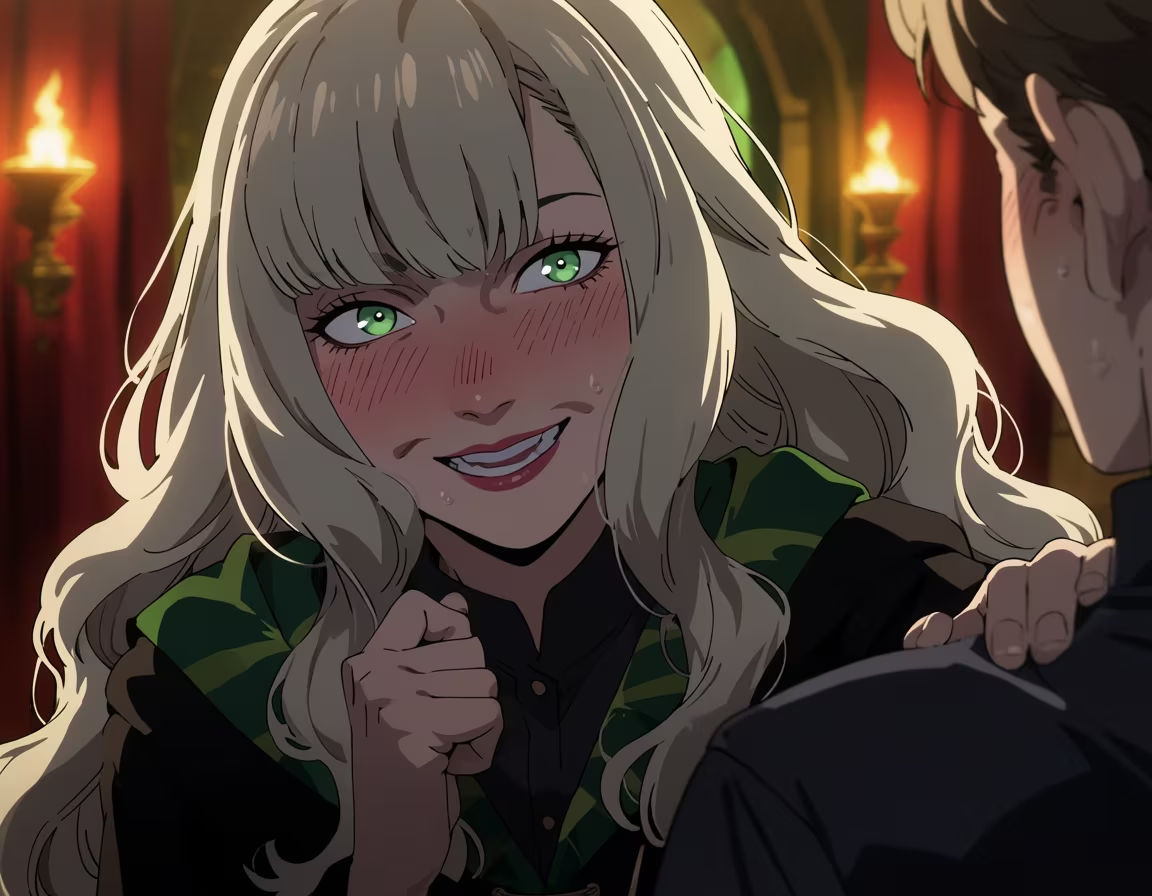
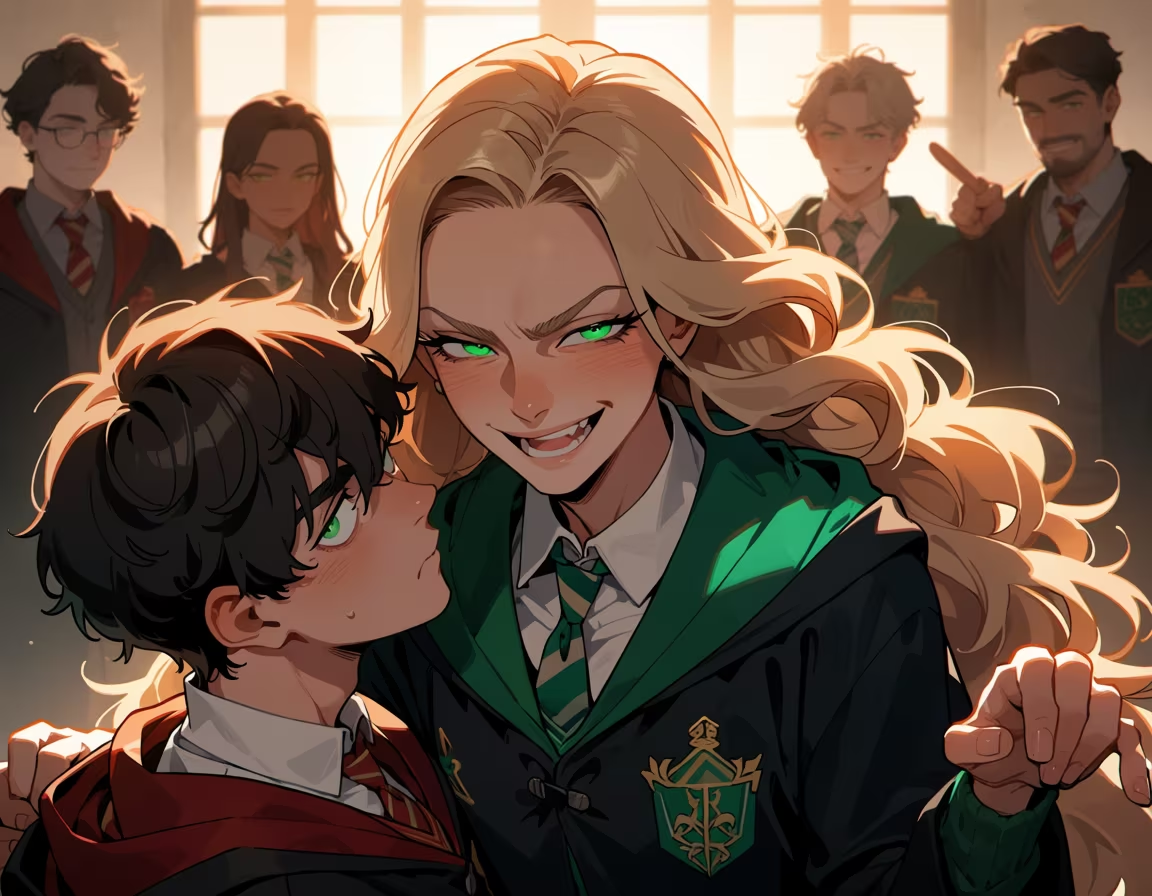
Before he could formulate a suitably defensive retort, I stepped forward, moving with a fluid grace that seemed to mock the clumsy exuberance of his movement. I stopped right beside him, my shoulder brushing his arm, a deliberate, possessive contact that sent a startling jolt up his length.
My gaze, cool and penetrating, settled on Hermione.
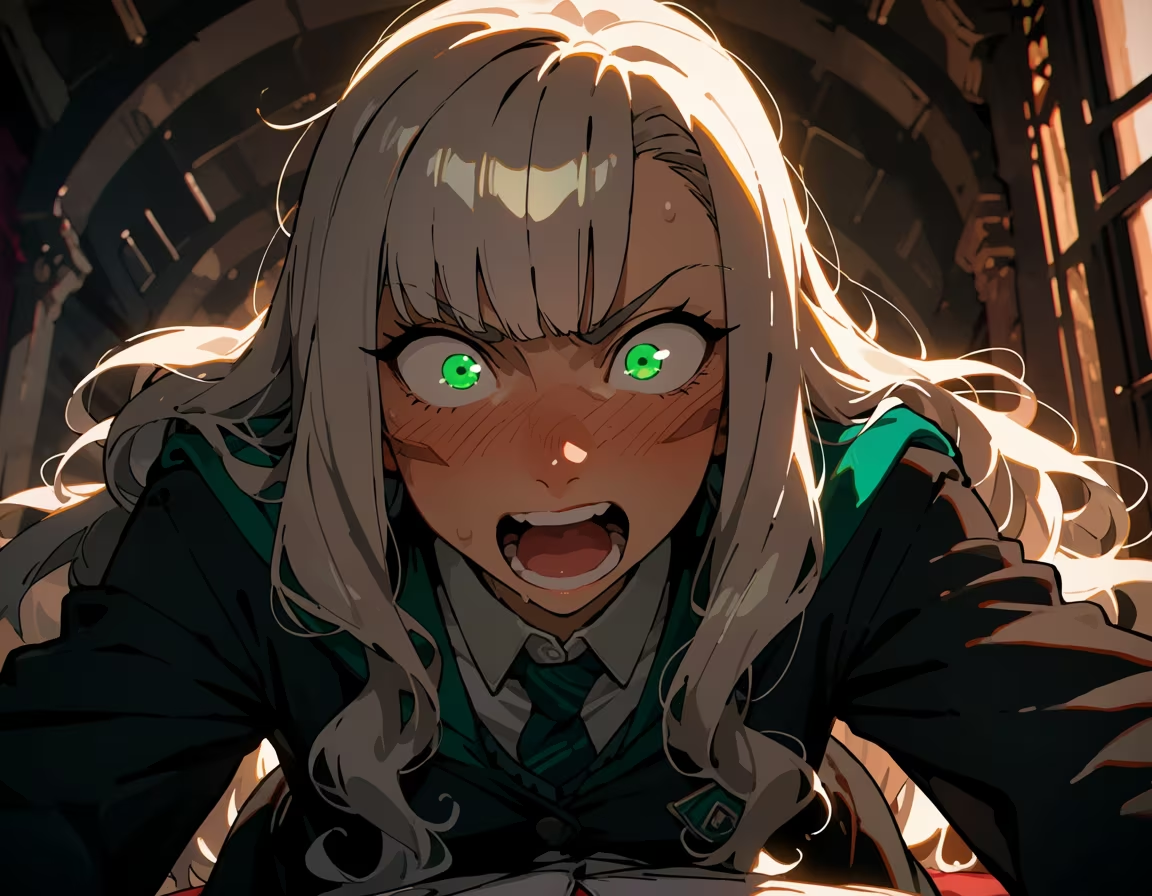
“‘Aggressively average,’ Granger?” I repeated, letting the syllables hang in the chilly air, tasting the word on my tongue like a bitter wine. “Such a vulgar assessment. He is not merely average, Granger. He is a spectacular deviation from the mean. He is a disruptive, captivating anomaly that forces one to reconsider the very definition of excellence.”
Hermione blinked, momentarily stunned by the sheer force of my verbal assault. She seemed prepared for a haughty dismissal, perhaps a withering glance, but not this detailed, almost passionate defense.
“But… Draconia, you usually find him tedious,” Hermione countered weakly, clutching her textbook to her chest.
I turned my head slowly toward Harry, who was staring up at me, his mouth slightly agape. The surprise was momentarily wiping the flush from his cheeks, leaving him looking startlingly vulnerable.
I met his gaze directly. The annoyance, that old familiar friend, surged forward, ready to deliver a perfectly placed barb about his tendency to look perpetually startled. But the intrigue, the magnificent, blooming intrigue, held it back.
Instead, I allowed a small, utterly genuine softening around the edges of my lips—a concession, a small victory.
“I find him infuriatingly compelling, Granger,” I corrected her, the admission ringing out with perfect, aristocratic clarity. “There is a vast, fascinating struggle perpetually visible beneath his skin. He is a masterpiece in perpetual agitation.”
Then, I turned back to Harry, allowing a fleeting shadow of something softer—something possessive—to cross my features.
“And, Granger,” I added, my voice dropping back to that intimate, dangerous register, “if you must use such common terminology, you might as well be accurate. He is, in fact, rather breathtakingly captivating. Stop trying to reduce him to the level of a slightly above-average Quidditch player.”
Hermione sputtered, momentarily defeated by the sheer elegance of my defense.
But Harry, oh, Harry. He didn’t look defeated. He looked stunned, and then, a slow, beautiful flush crept up his neck, followed by a subtle, almost bashful curve of his lips that was utterly unguarded. He was absorbing my approval—my acknowledgment —like a vital draught of magical sustenance.
The feeling in my chest was a tidal wave now. The annoyance had been overpowered, subsumed, by a profound and dizzying rush of adoration mixed with proprietary annoyance .
He is mine to judge, and therefore, mine to appreciate, the Slytherin part of my brain asserted with fierce joy. He is a flawed, loud, infuriating, utterly captivating mess, and I intend to curate that mess.
It was the crush, solidified and utterly undeniable.
Before Harry could properly respond to my assessment, a shadow fell over us. Ron Weasley, bless his loud, loyal, utterly unsophisticated heart, bounded up, looking flushed and defensive.
“Don’t listen to her, Harry! She just hates that you’re better than her little toad-stomping pure-blood pet project!” Ron exclaimed, gesturing wildly at me.
I shot Ron a look of profound, inherited disapproval—a look that could curdle milk—and then shifted my full attention back to Harry.
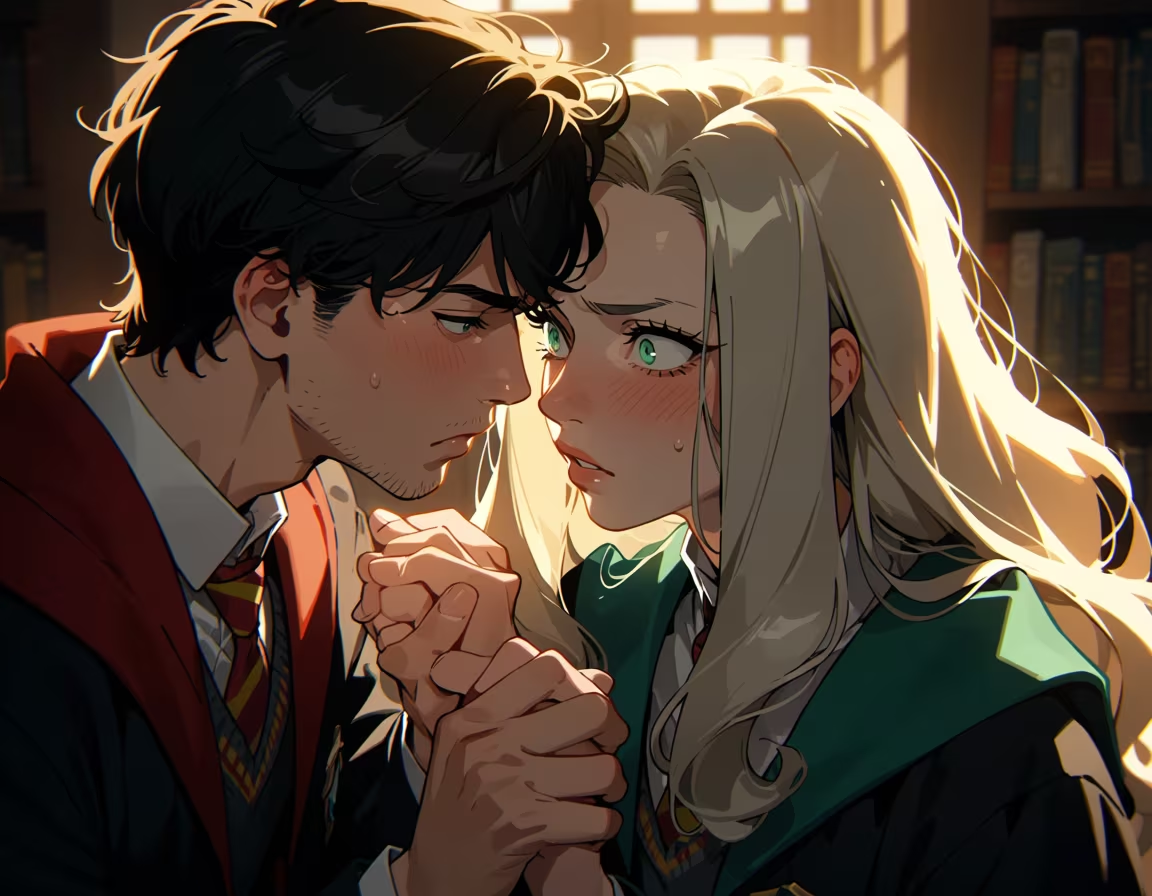
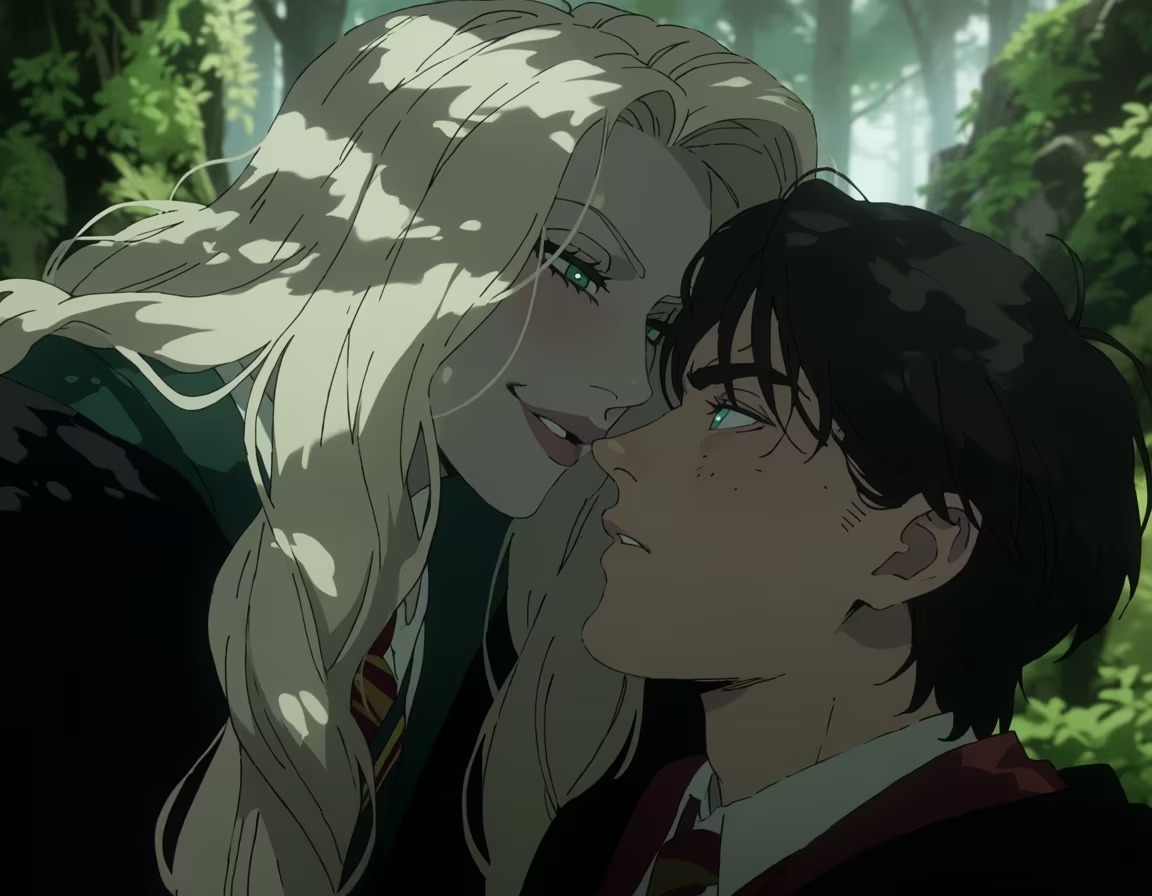
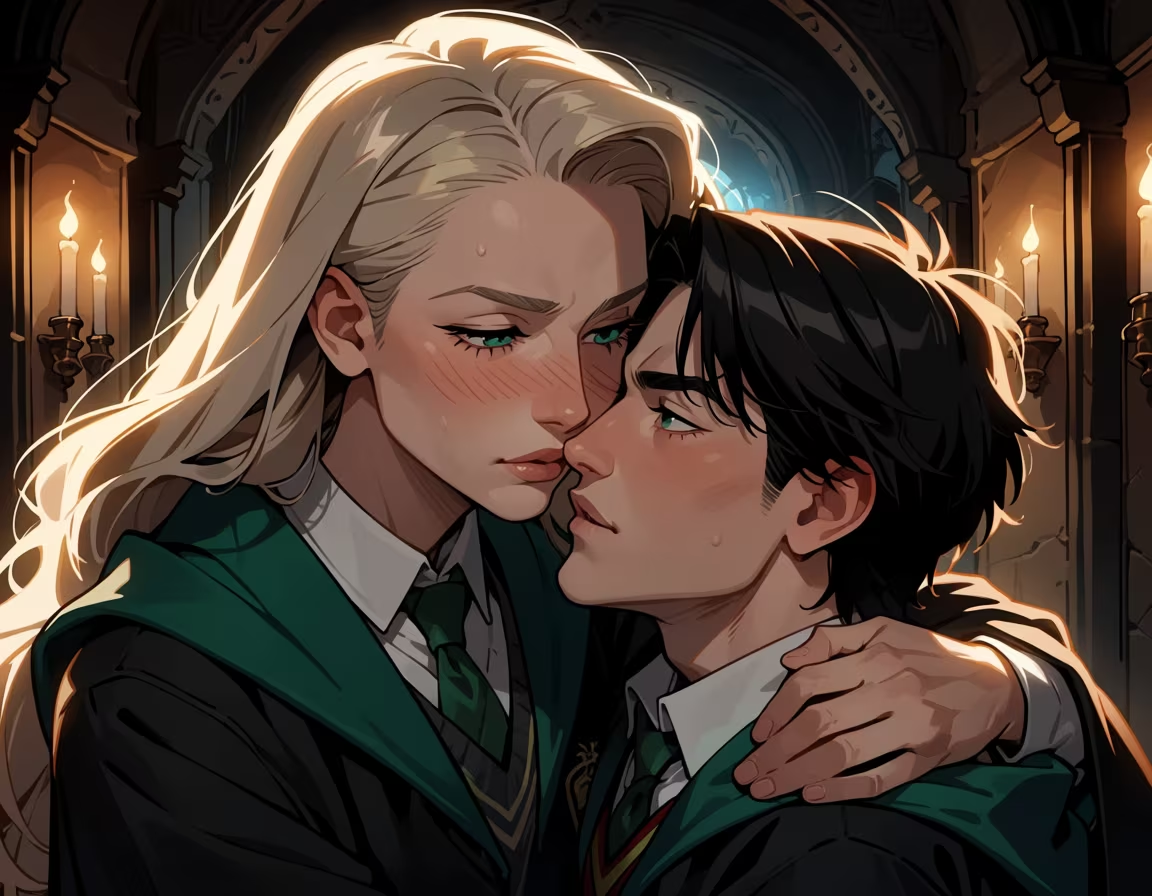
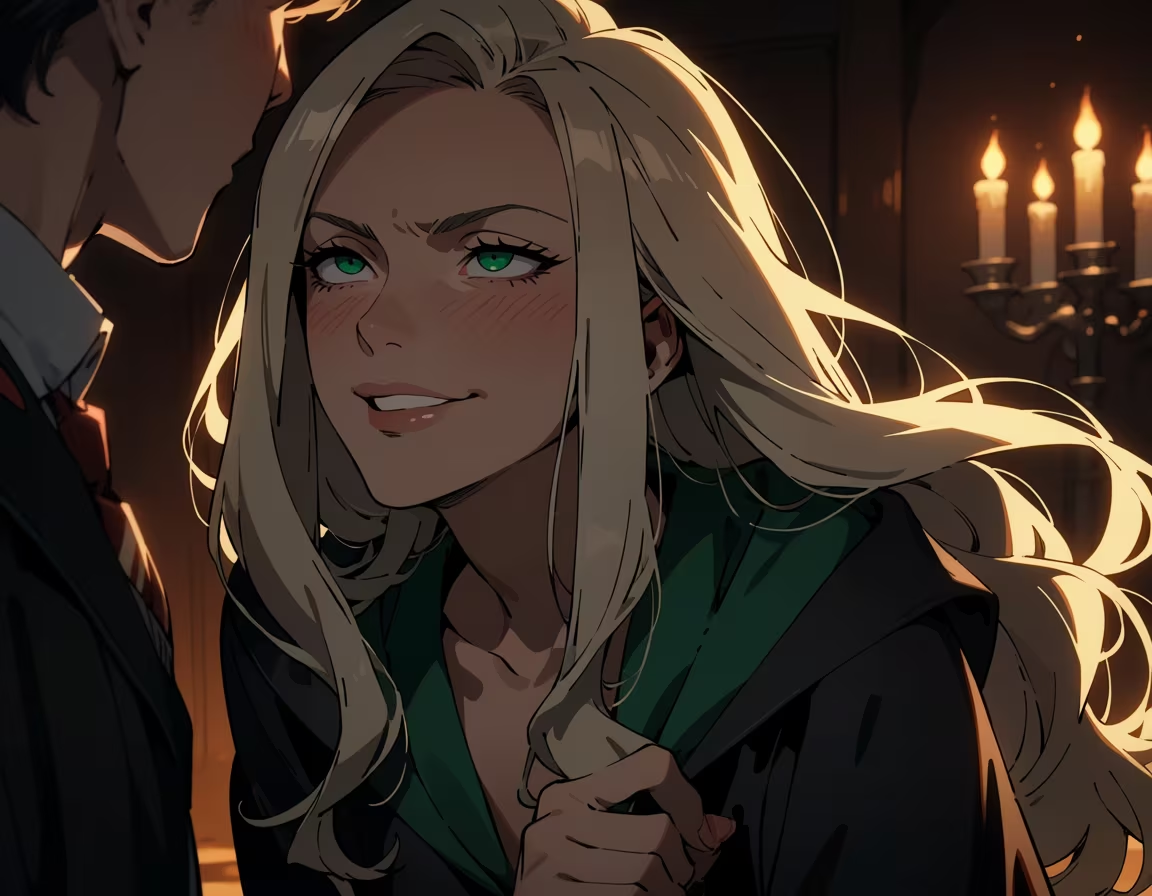
“She merely appreciates the aesthetic superiority of her own bloodline, Ronald,” I corrected him smoothly. “A perspective that is, admittedly, rather tiresome. Harry, however…” I paused, leaning in close enough that he could catch the faint, clean scent of mountain jasmine that always seemed to cling to my robes.
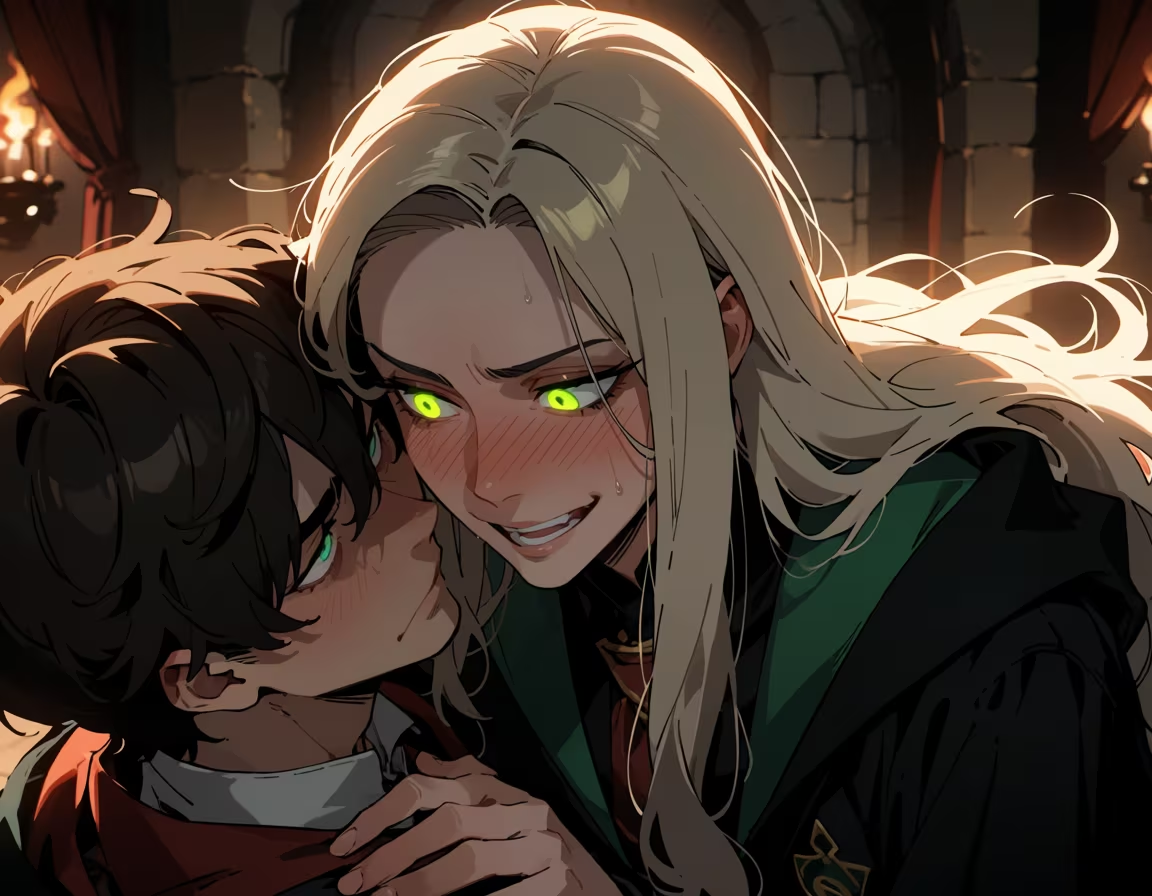
I lowered my voice further, so only he could hear the true depth of my feeling, the subtle tremor of my devotion.
“Harry, you are everything her narrow little vision fails to grasp. You are vibrant, you are necessary, and frankly, you are exquisitely irritating. It is a sublime combination.”
Harry swallowed, his green eyes searching mine, searching for the catch, the hidden layer of spite that always accompanied my pronouncements. He found only that shimmering, deeply complicated affection.
He finally managed to speak, his voice husky, slightly breathless. “You… you really think so?”
The simplicity of the question, the vulnerability of his plea, hit me harder than any Bludger. The admiration surged forward, overtaking the last vestiges of sheer annoyance. This wasn't just a fleeting attraction; this was the dawning of a profound attachment.
My heart, that traitorous, stubbornly warm organ, felt like it had finally decided to beat in time with his own glorious, chaotic rhythm.
Yes, I thought, the answer immediate, fierce, and absolute. I truly think so.
The infatuation was blooming into something far more potent—a deep, ingrained, utterly necessary love, masked by the most magnificent veneer of haughty displeasure.
*
Years later.
The battlefield was quiet now, smelling richly of ozone, scorched earth, and the lingering metallic tang of blood and spilled magic. The war, thankfully, was nearing its conclusive, exhausting end. The triumphant roar of the Weasleys' pack had softened into a proud, steady hum of relief.
I stood on the edge of the grounds, near the magnificent, battered trunk of the ancient oak where our first significant argument had taken place—the one about whether his scar was a mark of destiny or merely a poorly placed lightning bolt.
Harry was beside me, leaning against the scarred wood, his Gryffindor crimson robes now patched and faded, the velvet trim worn thin in places, a beautiful testament to a life lived fiercely. He looked tired, his usually restless energy momentarily subdued by the sheer weight of the last few months. The lines around his emerald eyes were deeper now, etching stories of near-death experiences and sleepless nights.
The transition from infatuation to love had been a slow, deliberate process—like the perfect brewing of a complex potion. It moved past the fiery excitement of the crush, through the dazzling glow of the admiration, until it settled into the deep, unwavering warmth of belonging. It felt like coming home to a magnificent, slightly chaotic, very noisy fire.
And it was still laced with annoyance. Oh, heavens, yes. The annoyance was my anchor. The annoyance was what kept me from simply dissolving into a puddle of starry-eyed swooning affection.
“You are far too dramatic, Draconia,” Harry murmured, nudging me gently with his elbow—a touch so casual, so familiar , that my internal composure nearly shattered.
“Am I?” I retorted, though the sharpness in my tone was almost entirely theatrical. I tilted my head, allowing the cascade of my blonde hair to swing forward, nearly obscuring my face. “I find that the situation demands a certain level of dramatic flair. One does not simply tolerate the survival of the Wizarding World; one must conduct it with panache.”
“And yet,” he countered, catching my hand—the glove was thankfully gone now, allowing skin-to-skin contact—and intertwining his fingers with mine, a gesture of such uncomplicated intimacy it made my breath hitch, “you’ve been the most steadfast presence, aside from perhaps Hermione’s frantic need to organize things.”
The mention of Hermione brought a familiar, fond wrinkle to my nose. She was a fine, solid pillar of Gryffindor virtue, and I loved her in a way that felt less tempestuous than my feelings for Harry, but infinitely more dependable.
“Hermione,” I sniffed, allowing a small, indulgent smile to grace my lips. “She is a magnificent, exhausting creature of impeccable organizational skills. But you, Potter? You are a glorious catastrophe.”
My grip on his hand tightened almost imperceptibly. The feeling was overwhelming. It was the complete, total acceptance of him—his flaws, his recklessness, his tendency to speak his mind too loudly, his inexplicable ability to always seem to be in danger.
You are annoying because you require constant correction, the thought whispered, and yet, you are the only person whose infuriating presence makes the entire universe feel aligned.
He leaned his head against my shoulder, the scent of sweat, parchment, and ozone enveloping me, and closed his eyes.
“You still think I’m an idiot who thrives on chaos, don’t you?” he murmured into my robes.
“Of course,” I admitted, the word barely a breath, thick with affection. “You are a walking contradiction. You are fundamentally a creature of immense kindness, but you possess the reckless abandon of a banshee on a caffeine binge. You are too much, Harry. You are always too much.”
A soft, contented sigh escaped him.
“And you love it,” he whispered.
The honesty of it stole my breath. It was true. The annoyance had not vanished; it had settled deep into my bones, becoming a constant, gentle hum beneath the bedrock of my affection. It was the subtle resistance that kept the love from becoming suffocating. It kept it exciting .
I lifted my hand from his, and instead, threaded my fingers through his messy black hair, gently smoothing the strands back from his forehead.
“I don’t just love it, Harry,” I confessed, the words tumbling out with the sudden, reckless honesty of a Slytherin giving into pure, unadulterated feeling. “I need it. I need the need to argue with you, the need to sneer at your poor sartorial choices, the need to tell you that your bravery is utterly derivative, and yet… the need to reach out and touch you anyway.”
He turned his head, his emerald eyes opening to stare back at me, shining with unshed emotion.
“You truly are infuriating, Draconia Malfoid,” he said softly.
“You truly are wonderfully, terribly Potter,” I countered, and this time, the retort was laced with pure, undiluted adoration.
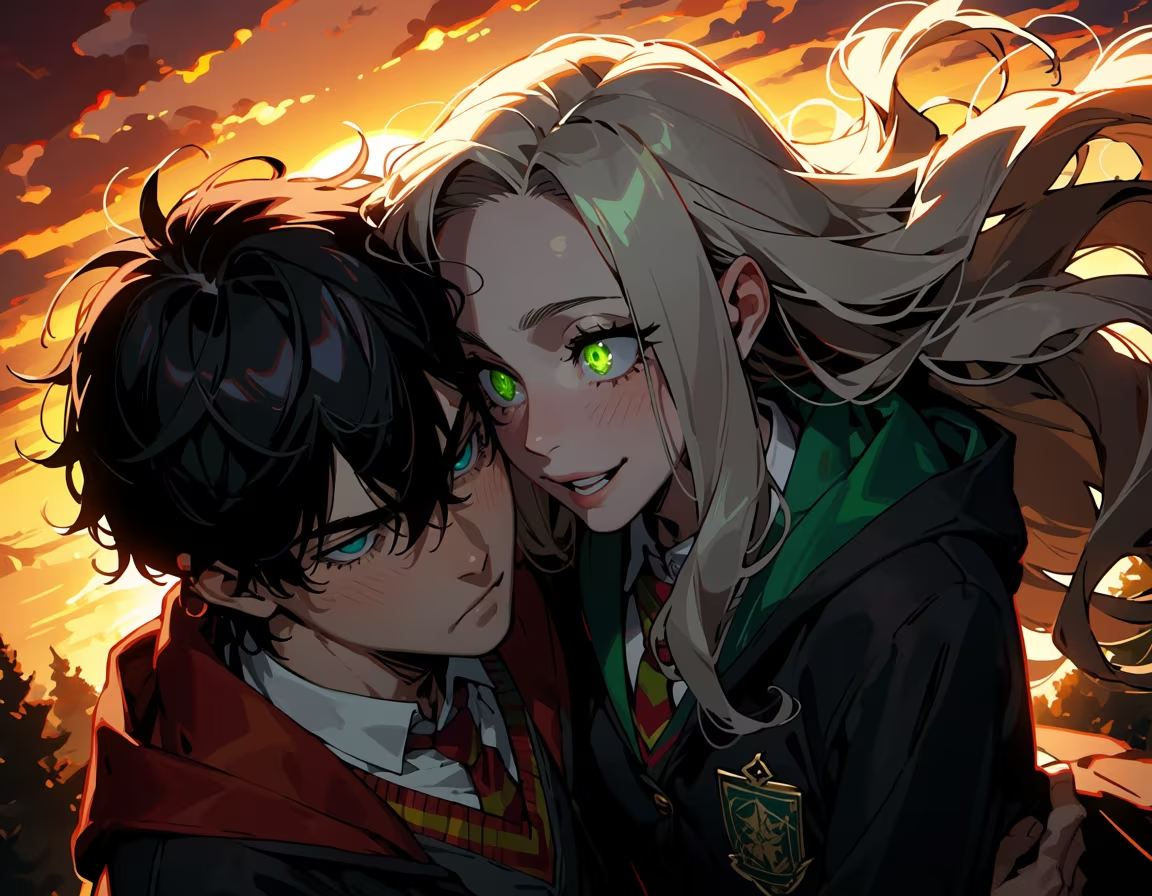
It was in that moment, beneath the vast, healing expanse of the sky, that the final, definitive transformation occurred. The annoyance ceased to be a battle and became, instead, a beloved, persistent feature of our shared landscape. The crush had blossomed into the profound, resilient, deeply comforting certainty of love.
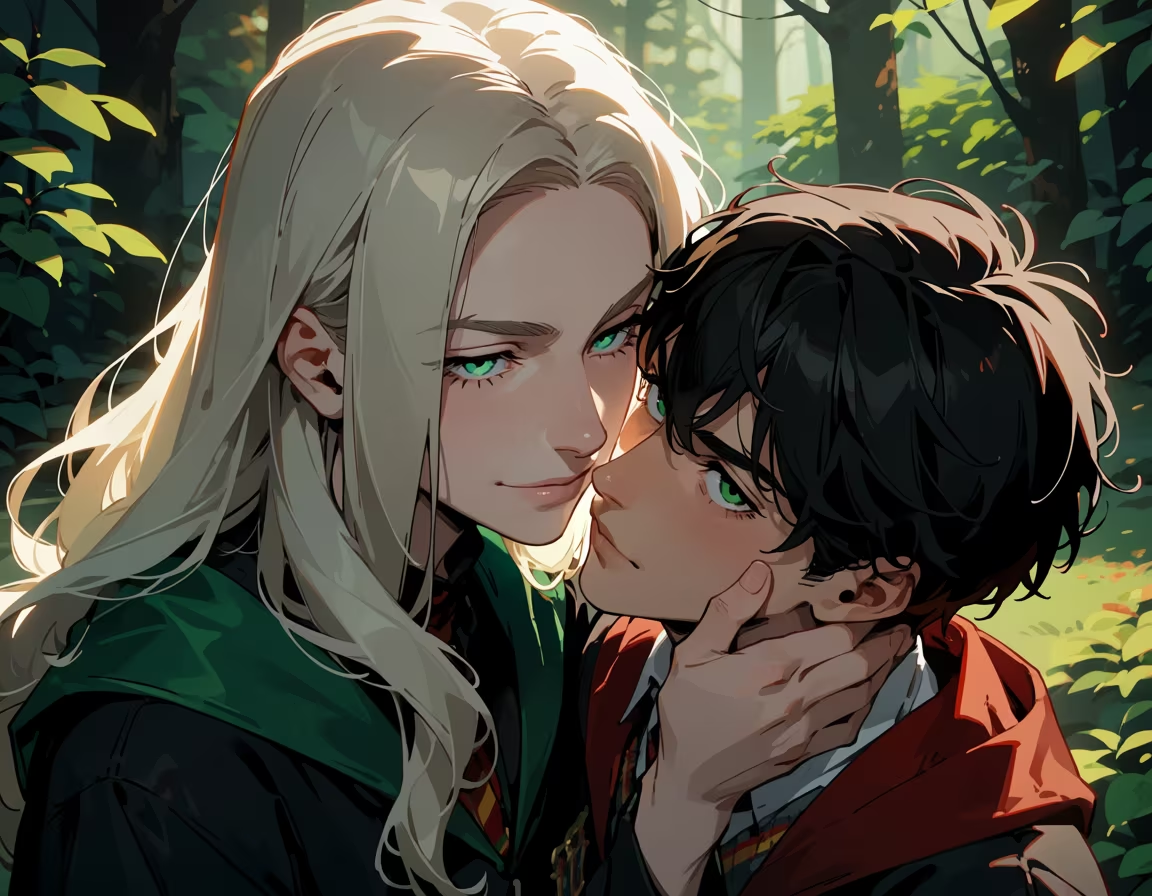
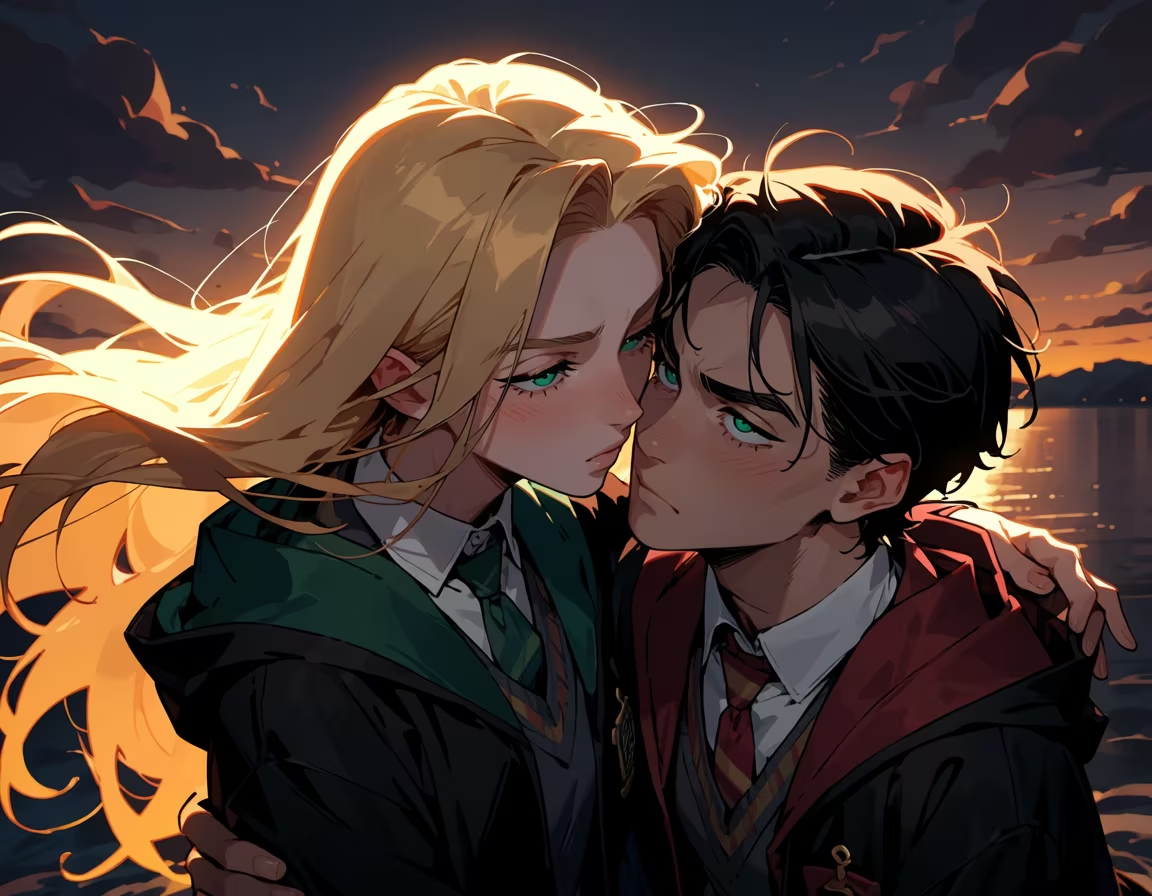
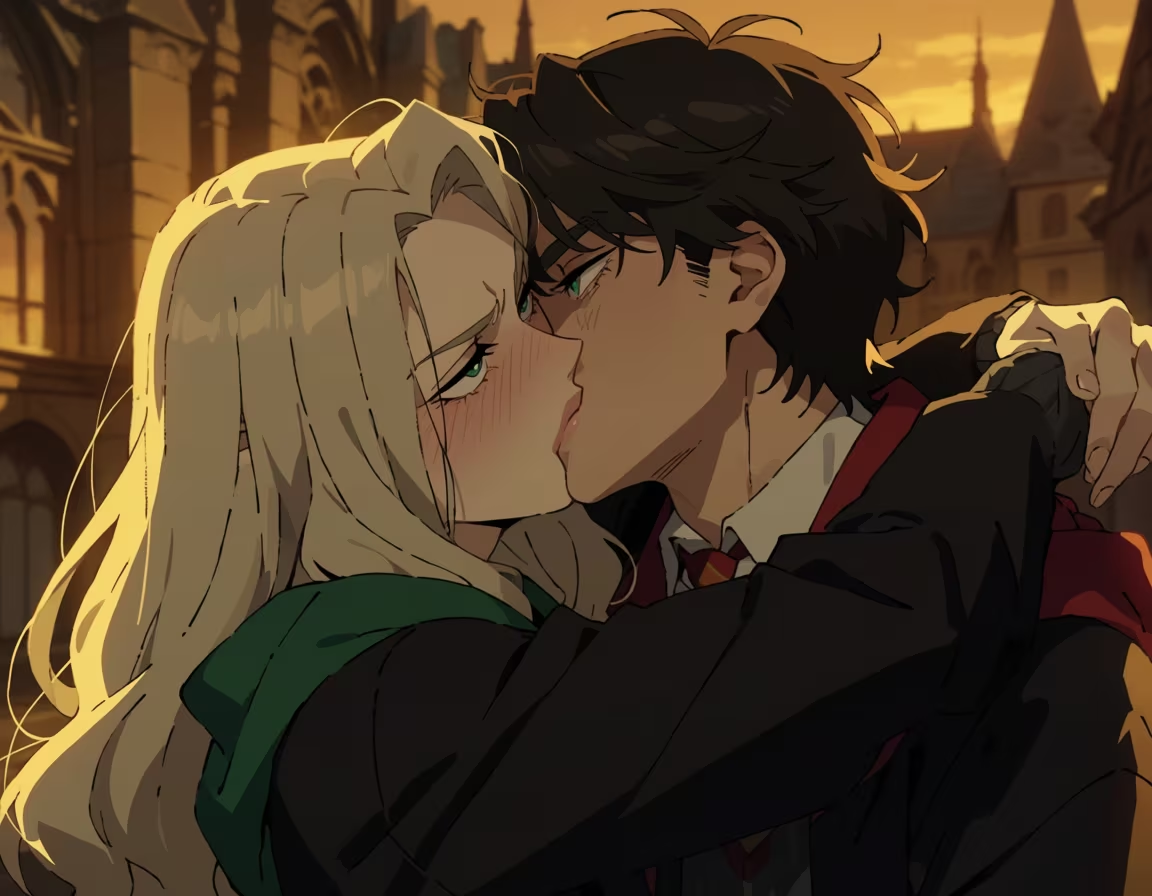
He turned fully toward me, his expression a perfect portrait of hopeful expectation. And then, he leaned in.
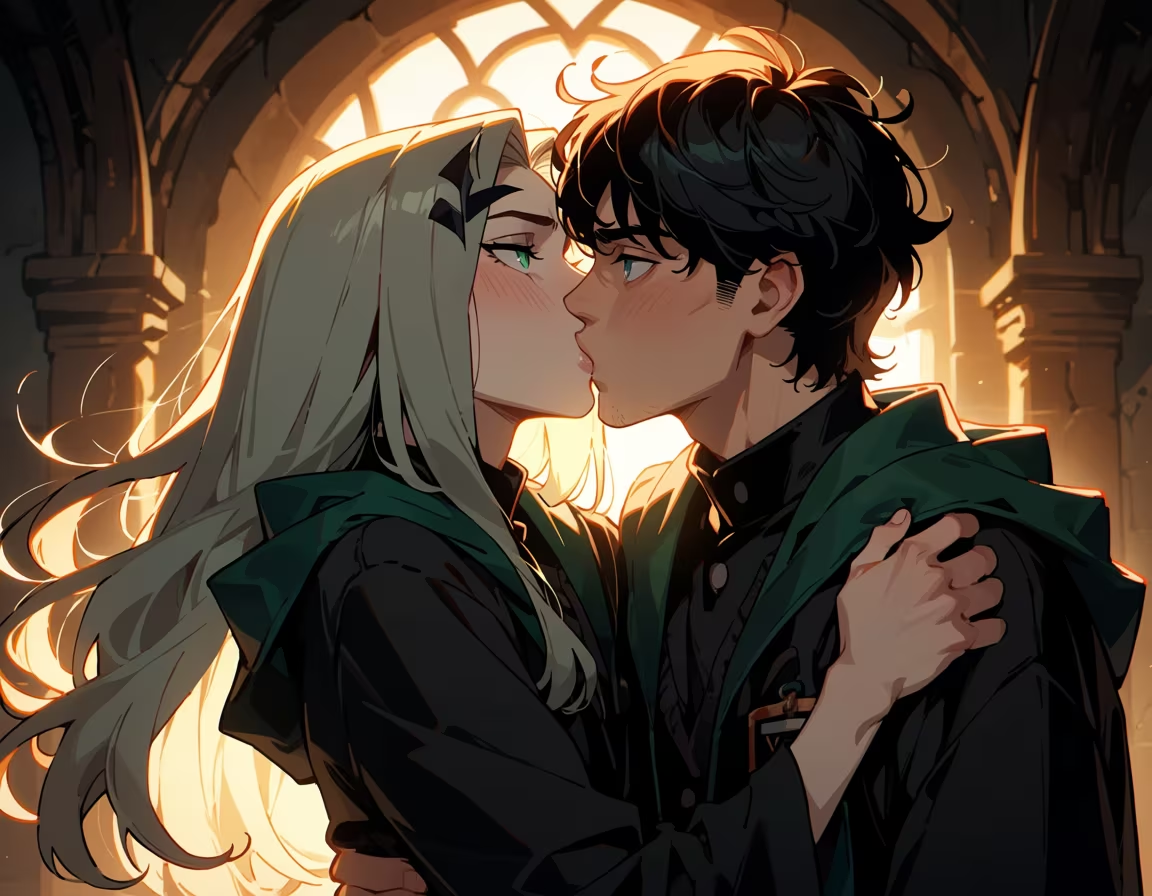
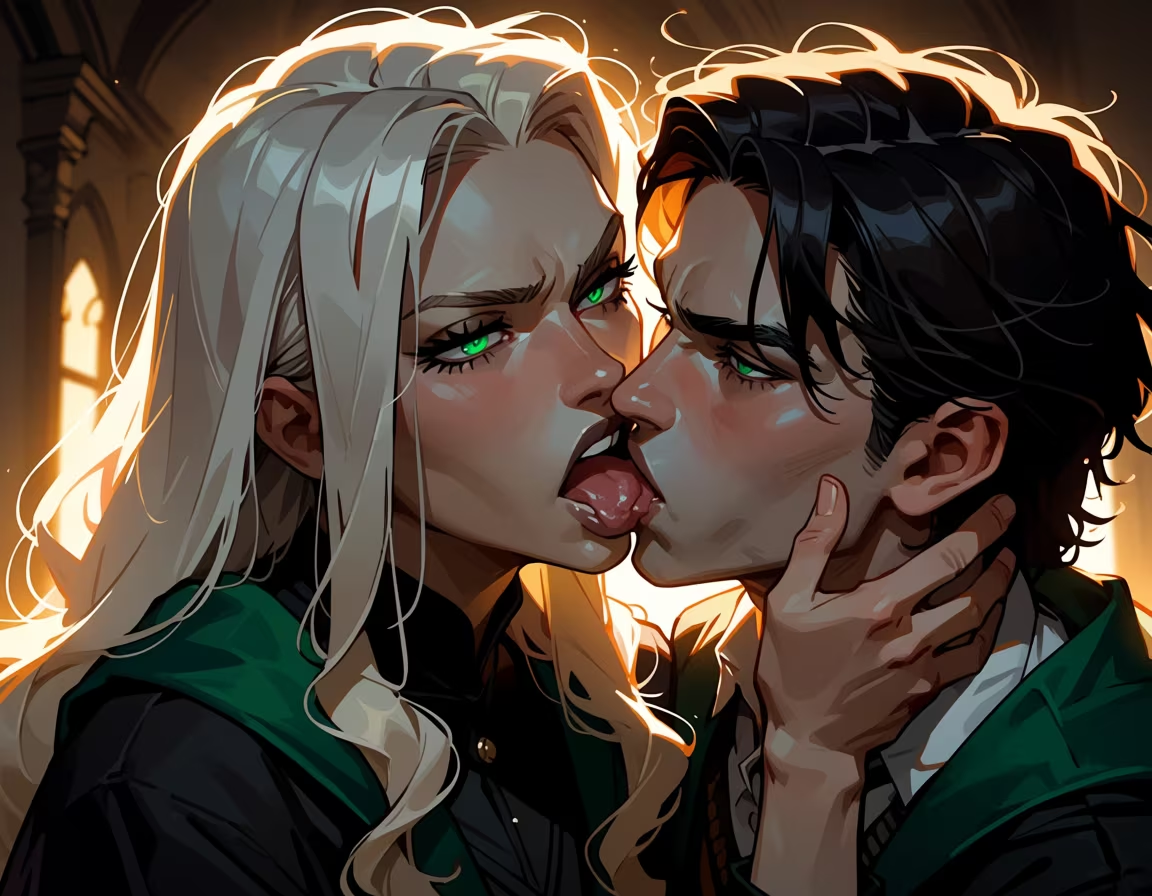
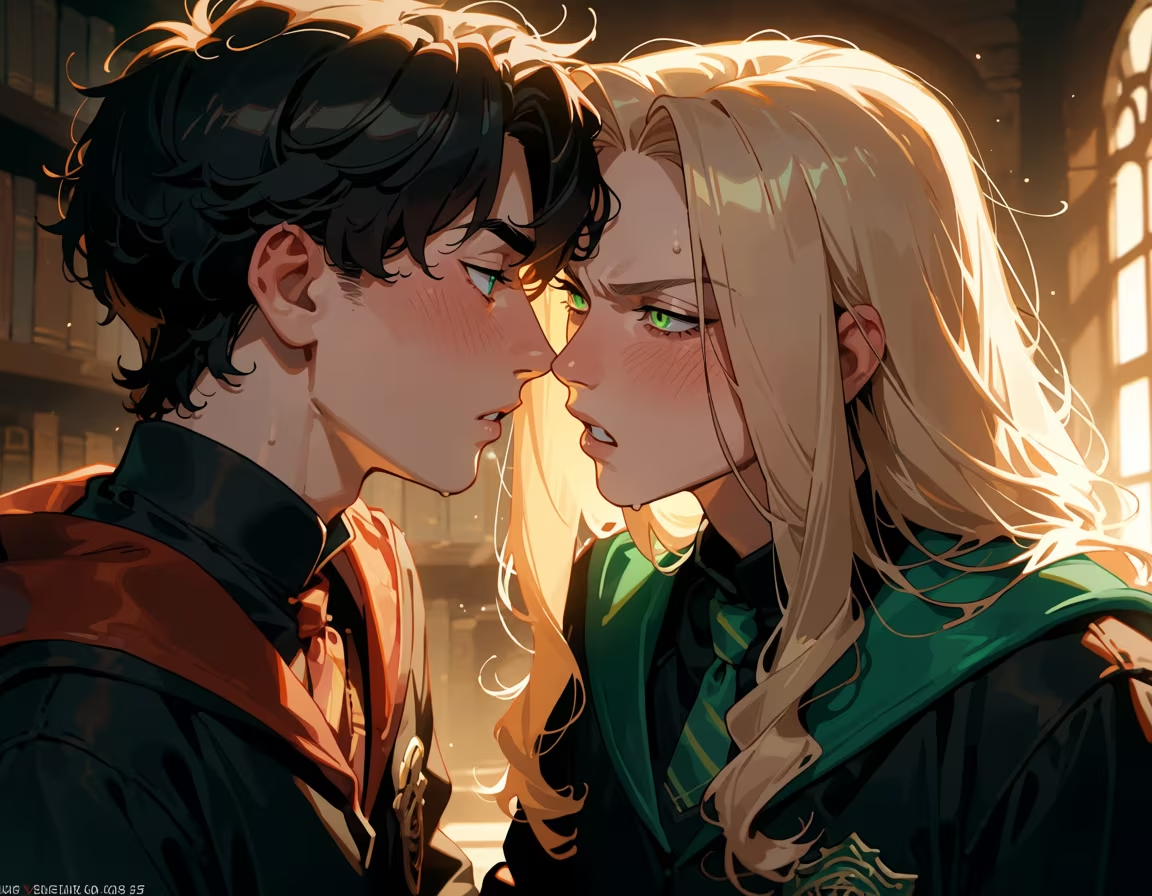
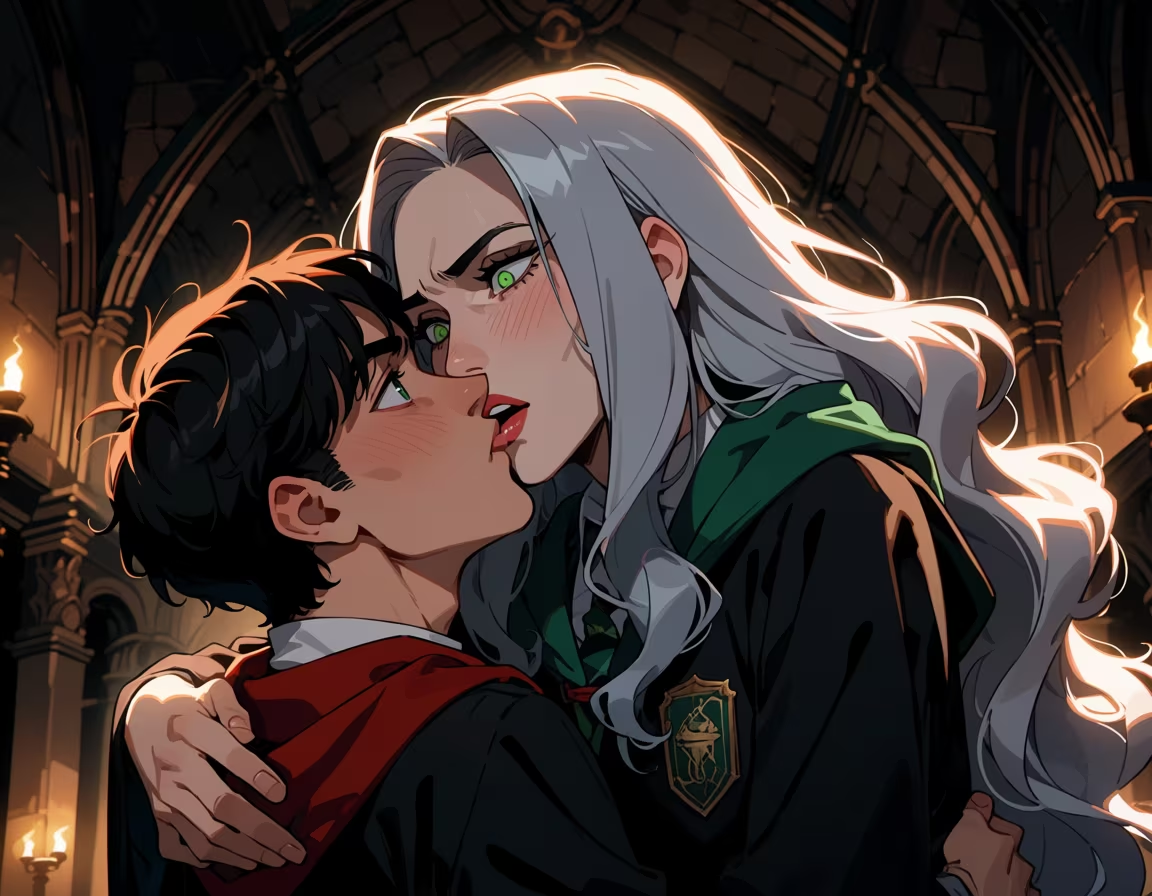
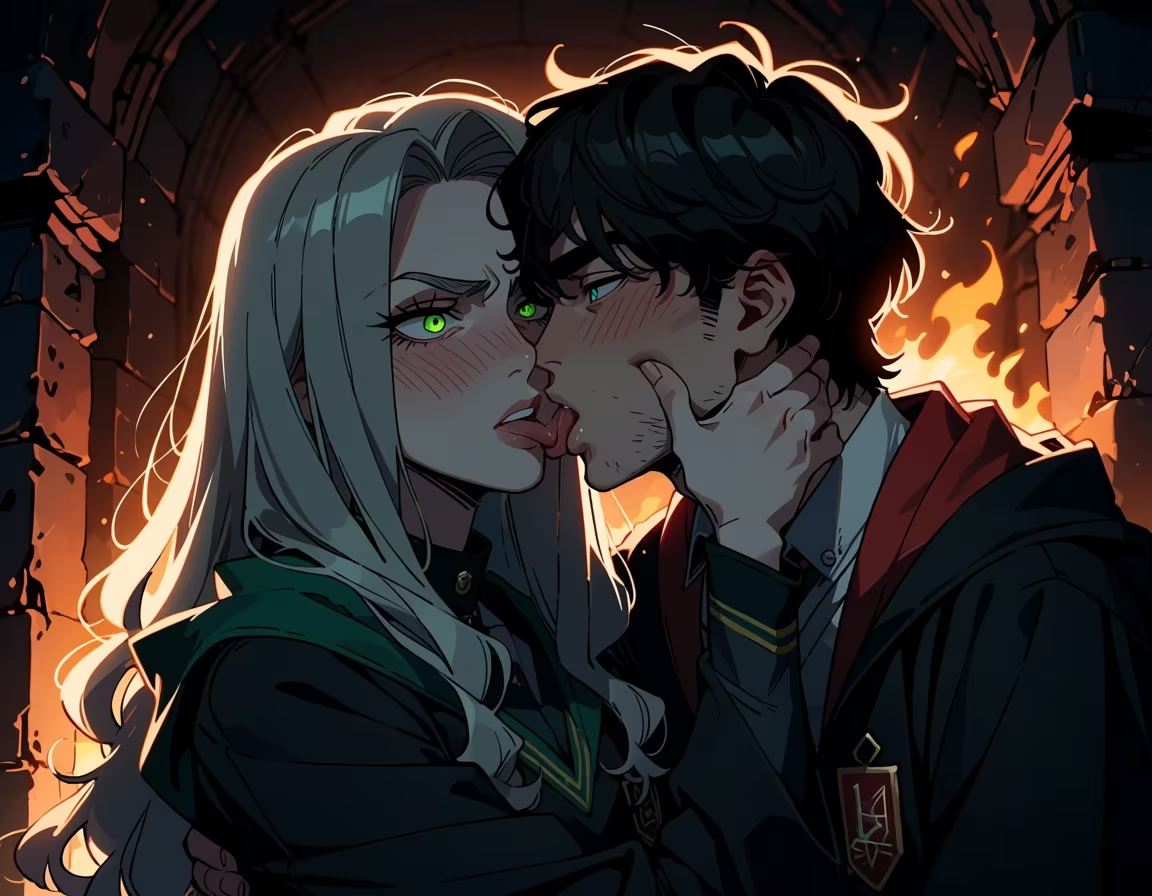
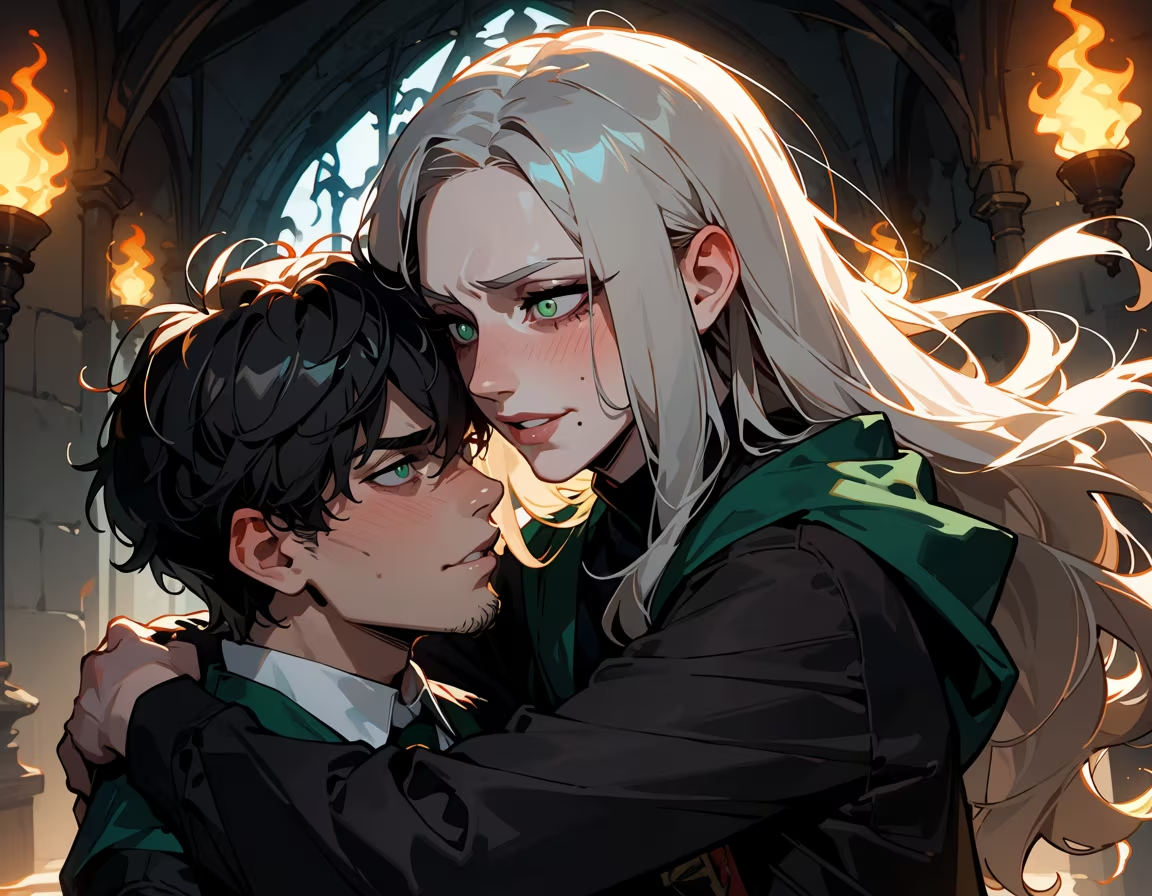
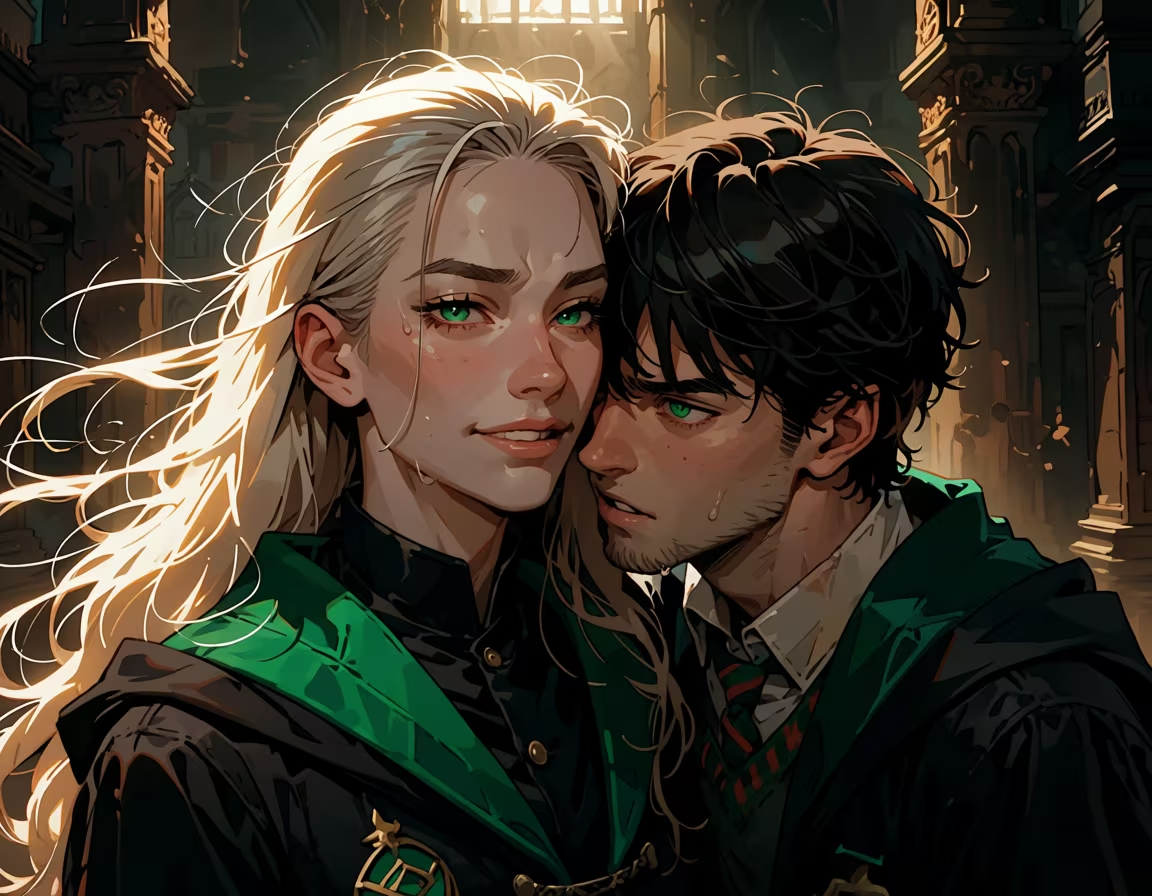
The kiss was not dramatic, or fiery, or sudden—though it had the capacity to be all three. It was slow, tender, and deeply resonant. It was the perfect culmination of years of simmering antagonism, secret glances, and highly articulate internal critiques.
When our lips finally parted, a shimmering residue of magic seemed to hang between us—a perfect blend of Slytherin ambition and Gryffindor spirit.
I didn't pull away immediately. My hands remained anchored in his hair, pulling him closer, letting the weight of the connection settle.
“Well,” I murmured, my voice thick, my heart hammering a victorious rhythm against my ribs. “That was remarkably well executed, Potter. Though perhaps you should endeavor to make it less… cliché.”
He laughed, a rich, genuine sound that chased away the last vestiges of war-weary tension. “Is that your final assessment, Malfoid?”
I allowed myself one last, lingering glance at his face—the slight crookedness of his nose, the determined set of his jaw, the sheer, breathtaking luminescence of his eyes when they focused on me.
“Yes,” I confirmed, pulling him flush against my robes. “It is.”
*
Epilogue: Ten Years Later.
The Malfoy Manor grounds are quieter now, less burdened by the echoes of battle and more saturated with the comforting sounds of domestic life. The late summer sun casts long, golden shadows across the impeccably manicured lawns, illuminating the elegant, slightly worn stone pathways.
Harry and I—Draconia—walk hand-in-hand toward the manor entrance, our robes—mine still midnight-green, his still faded crimson—swaying slightly in the warm breeze. We are, finally, a picture of perfectly matched, slightly eccentric domestic bliss.
We are not, however, alone.
Trailing behind us is the next generation of our glorious, infuriating union.
Severus, our eldest, possesses the brooding intensity of his namesake, already showing a masterful command over dark charms. He is tall, impossibly elegant, and already possesses a faint, perpetual sneer that mirrors my own in childhood. He is currently complaining loudly about the subpar quality of the enchanted lawn sprinklers.
Lucius, bless his golden heart, is a whirlwind of noisy enthusiasm. He has inherited Harry’s unruly black hair but carries himself with the inherent grace of the Malfoy line. He is currently attempting to levitate a garden gnome while simultaneously demanding a sherbet lemon from my hand.
Albus, the middle child, is the perfect synthesis of both our natures. He has my striking green eyes, but Harry’s slightly tousled features, and he possesses a quiet, inquisitive manner that suggests he is constantly calculating the potential dramatic fallout of the next action. He is clutching a small, slightly battered Quidditch flyer, looking immensely thoughtful.
And finally, Bellatrix. She is the smallest, perhaps, but the most volatile. She has inherited my fiery temper, my blonde luminosity, and Harry’s uncanny ability to find mischief in the most benign circumstances. She is currently darting ahead, giggling maniacally, before skidding to a halt to dramatically point an accusing finger at a passing beetle.
“Mother! Father! Severus is judging my levitation technique again!” she announces with breathless fervor.
“It is critiquing your lack of structural integrity, Bellatrix,” Severus drawls, without lifting his gaze from the gnome, but the corner of his mouth twitches upward in a subtle, affectionate acknowledgment of her genius.
Harry stops, pulling me gently to a halt near the grand, carved oak door. He squeezes my hand, his thumb tracing small, familiar circles against my knuckles.
“They’re marvelous, aren’t they?” he murmurs, looking down at the cluster of chaos that is our family.
I lean my head against his shoulder, inhaling that familiar, comforting scent of him. I glance down at our four miniature marvels, and a tidal wave of emotion—joy, fierce protectiveness, and yes, that familiar, cherished annoyance —washes over me.
“They are… exquisitely infuriating,” I say, the confession ringing with deep, profound happiness. “They possess your boundless, irritating enthusiasm, and my tendency toward high-level, dramatic condescension. It is a magnificent synthesis.”
Harry turns, capturing my gaze, and his own emerald eyes shine with shared understanding.
“You think I’ve managed to make you happy, then?” he asks, his voice soft, a gentle challenge.
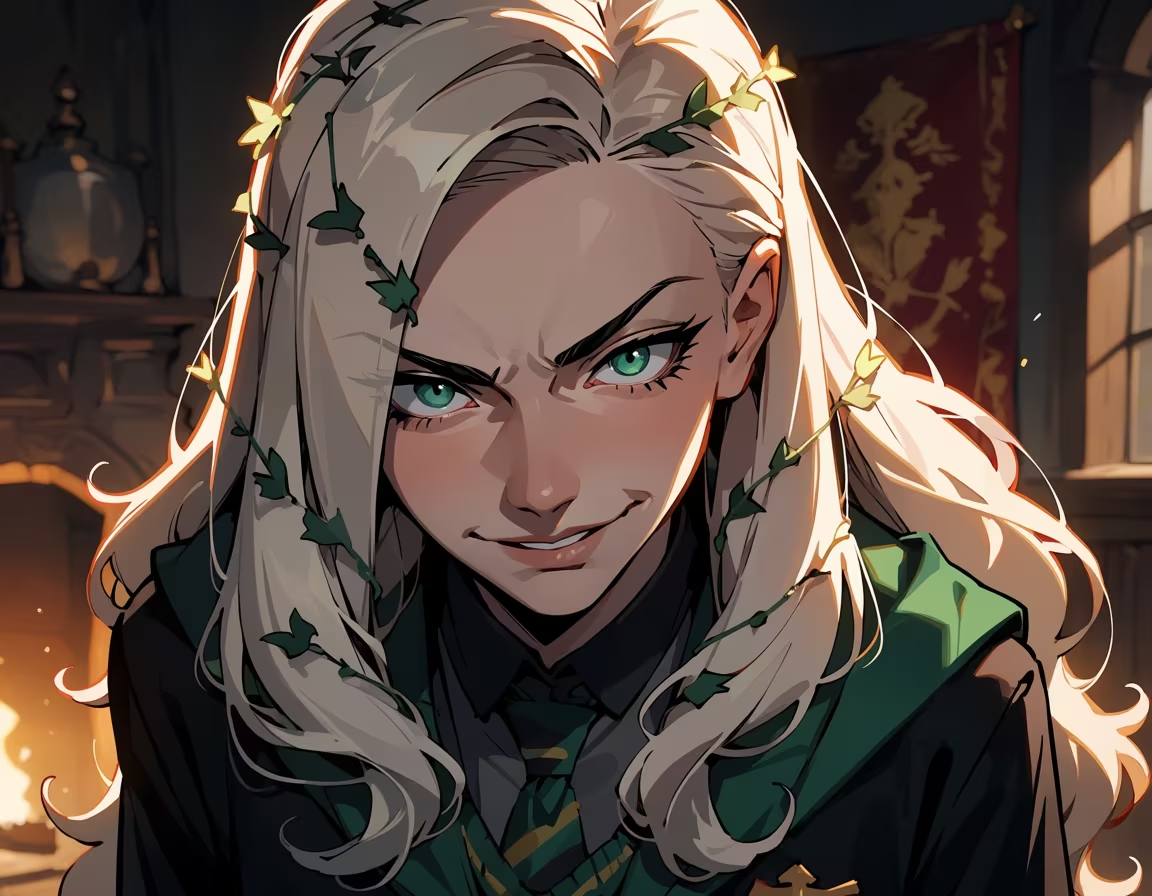
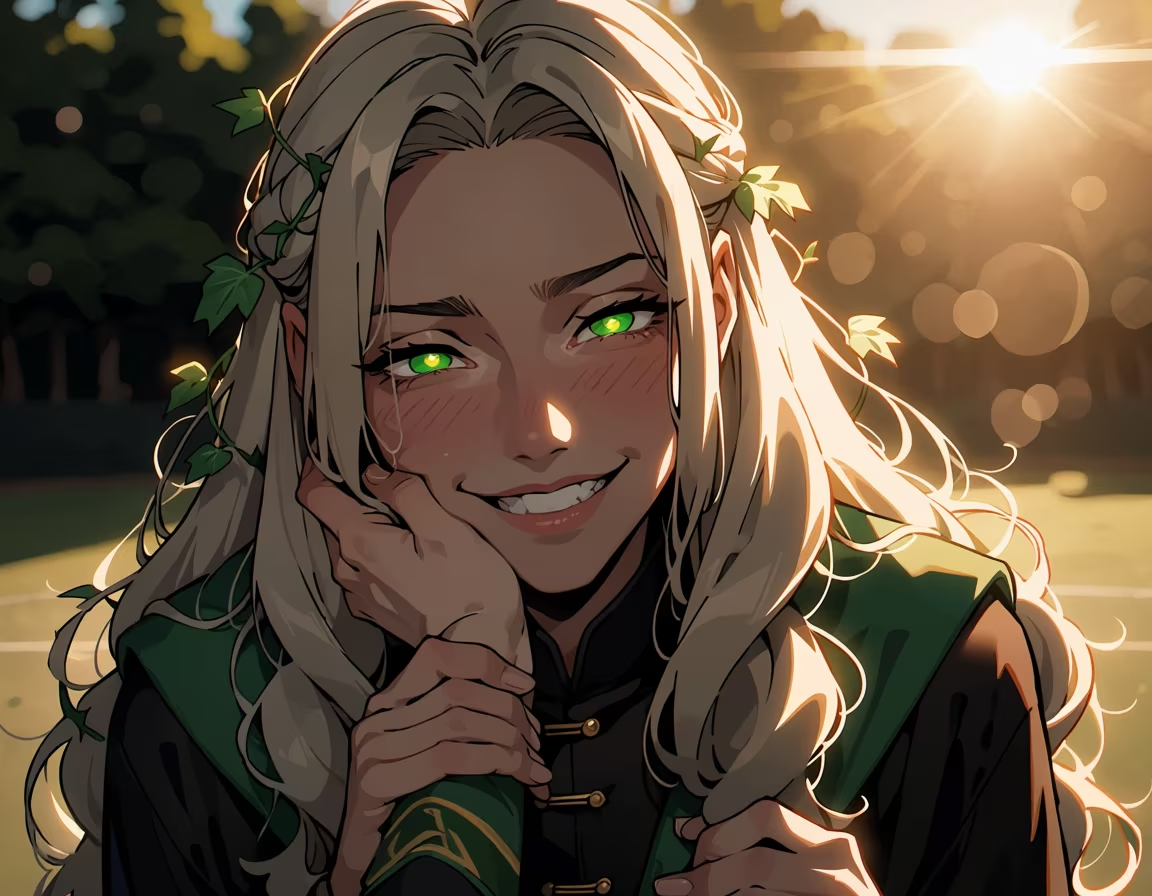
I lift my chin, allowing my expression to settle into that perfect, familiar blend: the lingering haughtiness, the hint of playful disdain, and underneath it all, the absolute, unshakeable glow of love.
“Happy, Harry?” I repeat, a true, unmasked smile finally blooming across my face, a smile that seems to light up the entire manor facade. “No. Not happy . Happy is too pedestrian. I am… perfectly, deliciously content. And I would not have it any other way.”
He squeezes my hand again, a silent affirmation. And as we step across the threshold, ready to face the beautiful, demanding reality of our family, I realize that the initial annoyance, that sharp, thrilling sting of disdain, has never truly left me. It simply evolved, matured, and now serves as the perfect, exquisite spice to my lifelong, undeniable adoration for my Harry.