| Home | The Lives of Velnin | Illustrated Fiction | Malfoid Art & Fiction | Book Blurbs | Contact |
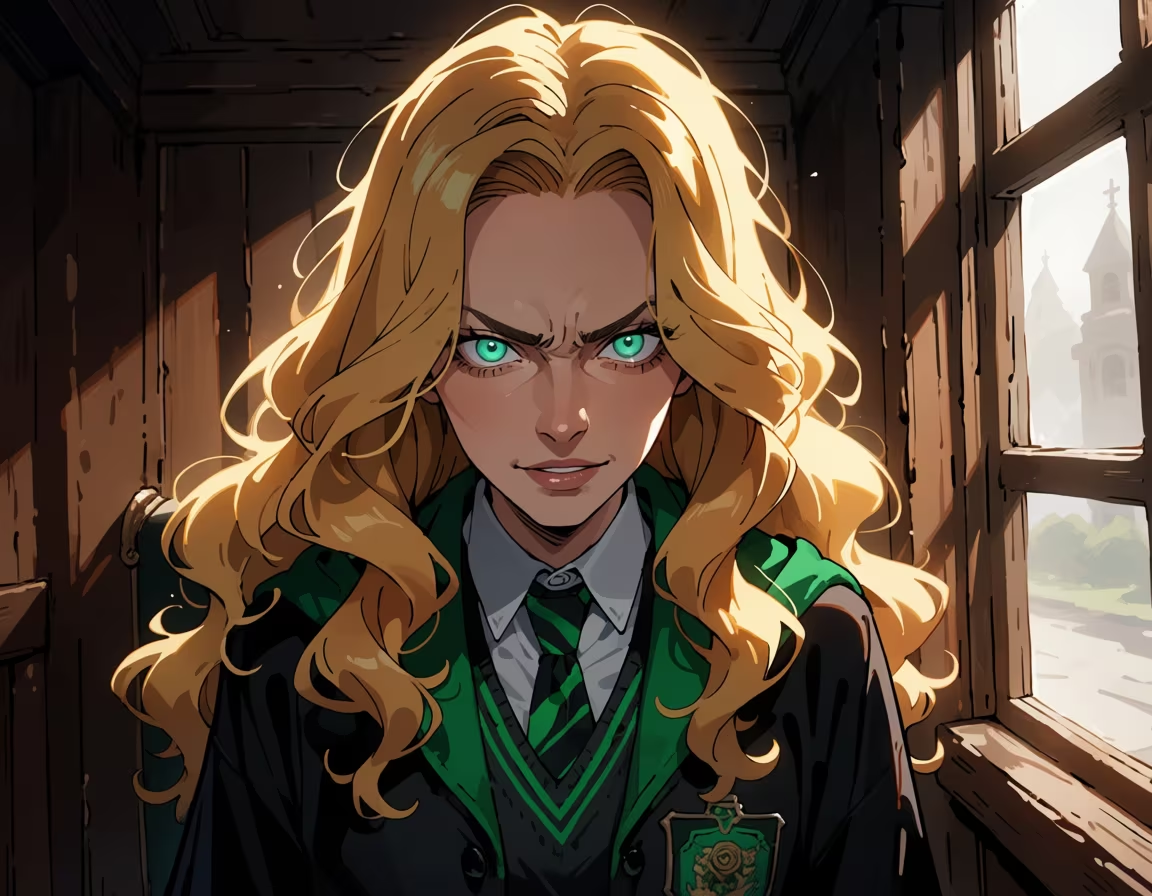
The scent of coal smoke and old parchment, mingled with the sweeter, almost sickly-cloying fragrance of overly ambitious cauldron cakes, was the defining aroma of Platform Nine and Three-Quarters. It clung to the stone walls of King’s Cross, seeped into the worn velvet of the Hogwarts Express seats, and currently, it was settling upon the pristine black of my robes like a fine, irritating dust.
I stood near the compartment doors, ostensibly waiting for a suitable seat, though in truth, I was engaged in a highly critical assessment of the various occupants of the nearby carriages. Most were predictable: the bushy-haired, perpetually earnest Gryffindors, the overly flamboyant Hufflepuffs attempting to look mysterious, and the lot of us Slytherins, who managed to look both powerful and utterly bored simultaneously.
Then, he appeared.
He was leaning against the glass of the compartment door, a shock of unruly black hair that seemed determined to defy the very laws of proper wizarding grooming, and eyes—oh, those eyes. They were startlingly green, the shade of ancient emeralds found deep within the forests of the Scottish Highlands, and they possessed a restless energy, a fierce, almost reckless brilliance that seemed entirely out of place among the rather muted palette of our privileged circle.
He was, quite simply, infuriatingly handsome.
My jaw tightened, a small, involuntary movement that betrayed the perfect control I usually maintained. Annoying. That was the immediate, primary classification. He looked like a misplaced splash of vibrant colour in a carefully curated tapestry, a disruptive element that demanded attention, much like the persistent buzzing of a particularly irritating Boggart.
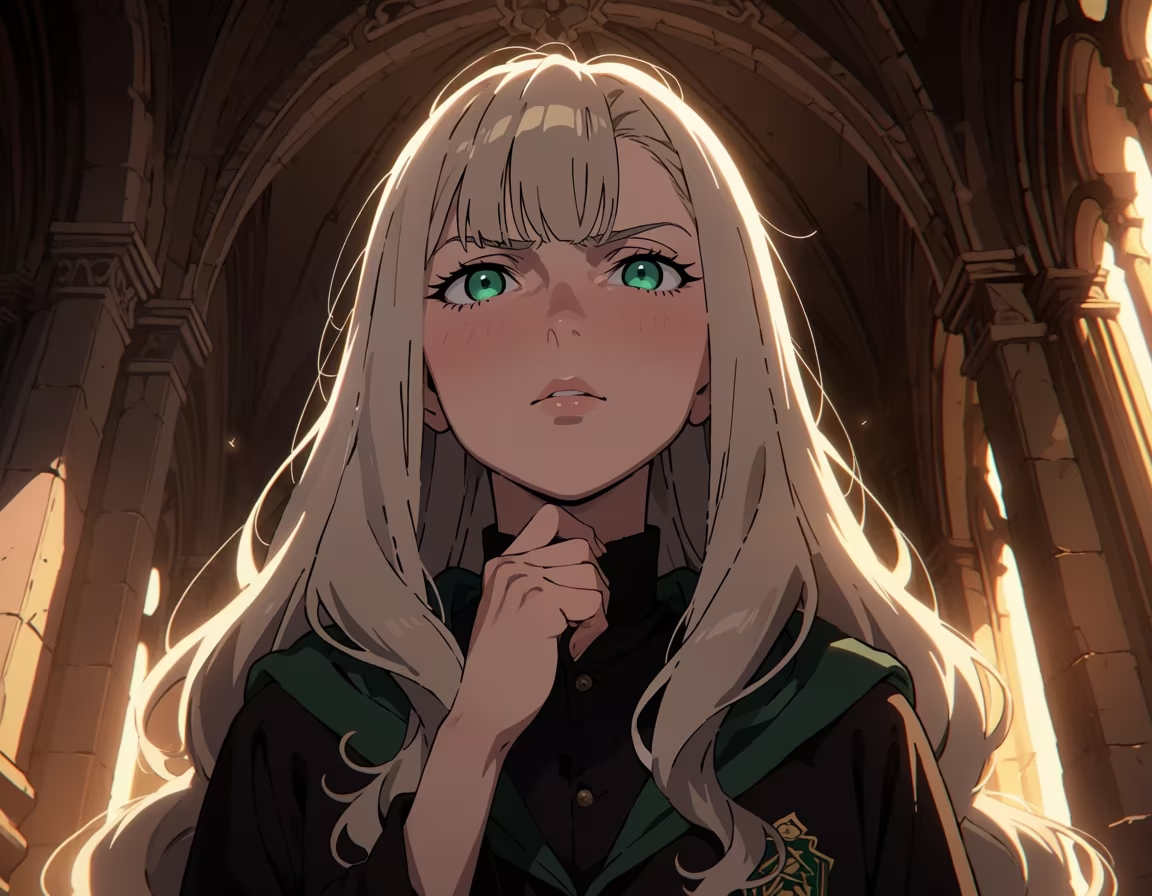
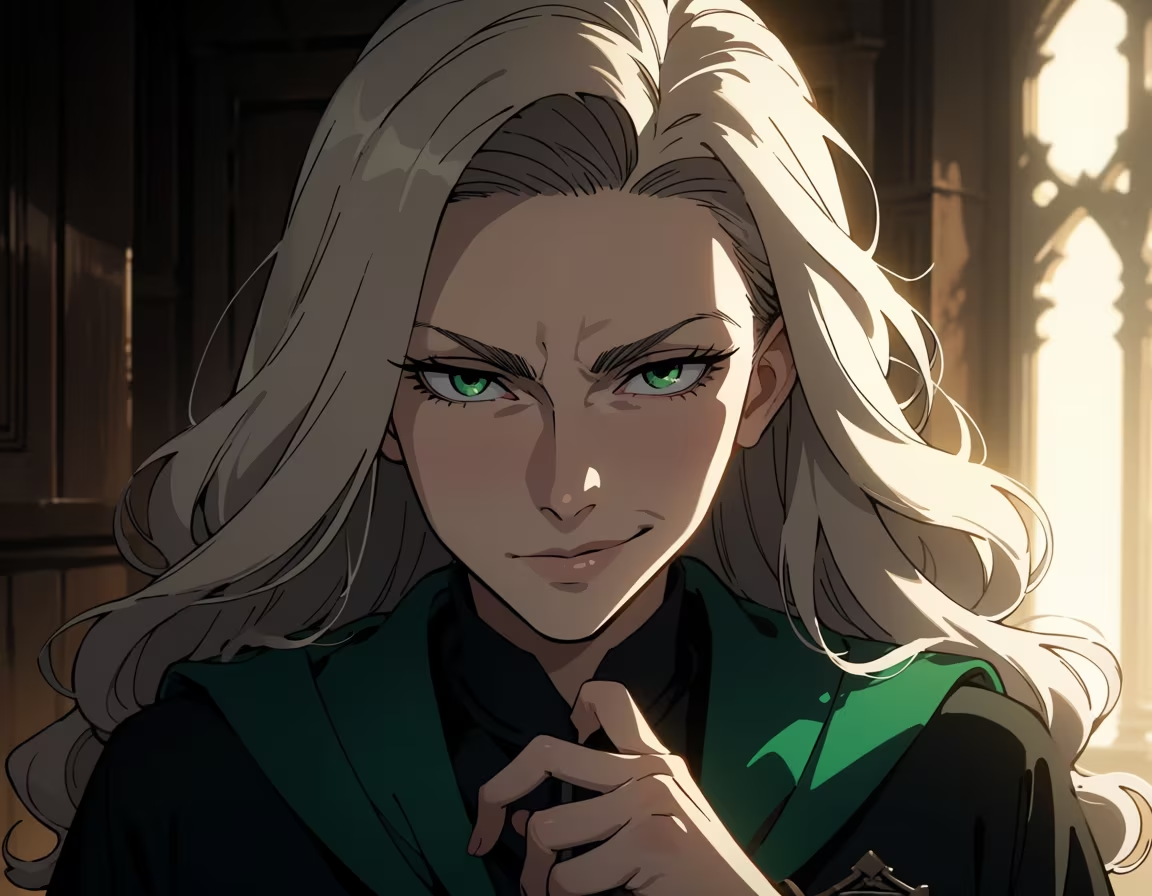
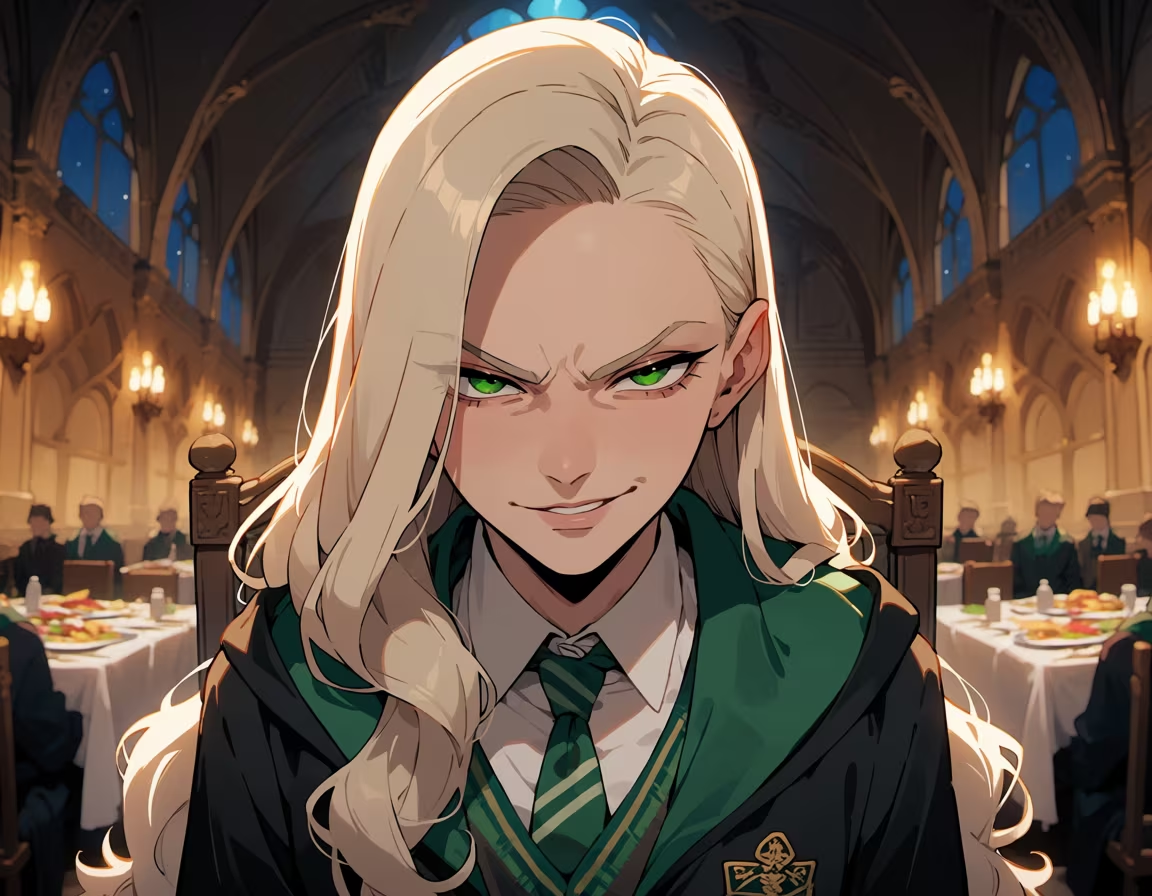
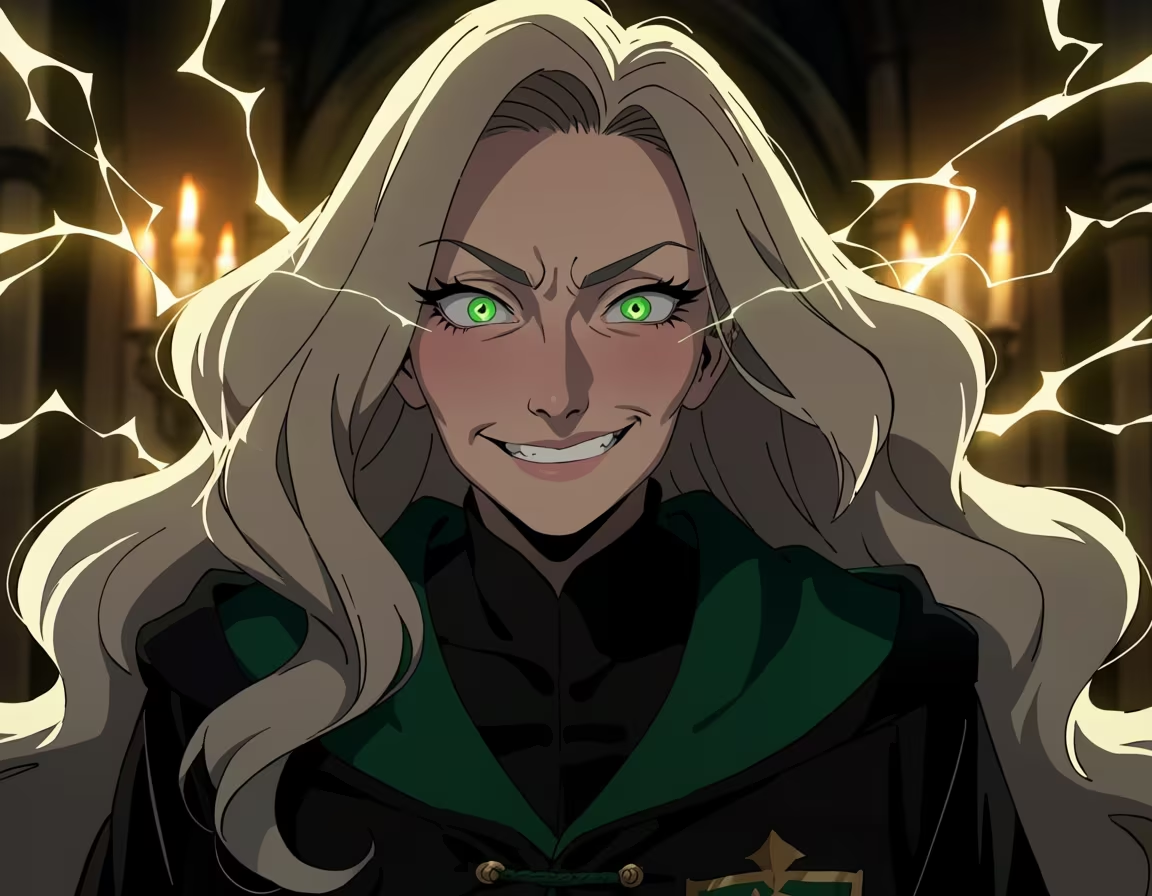
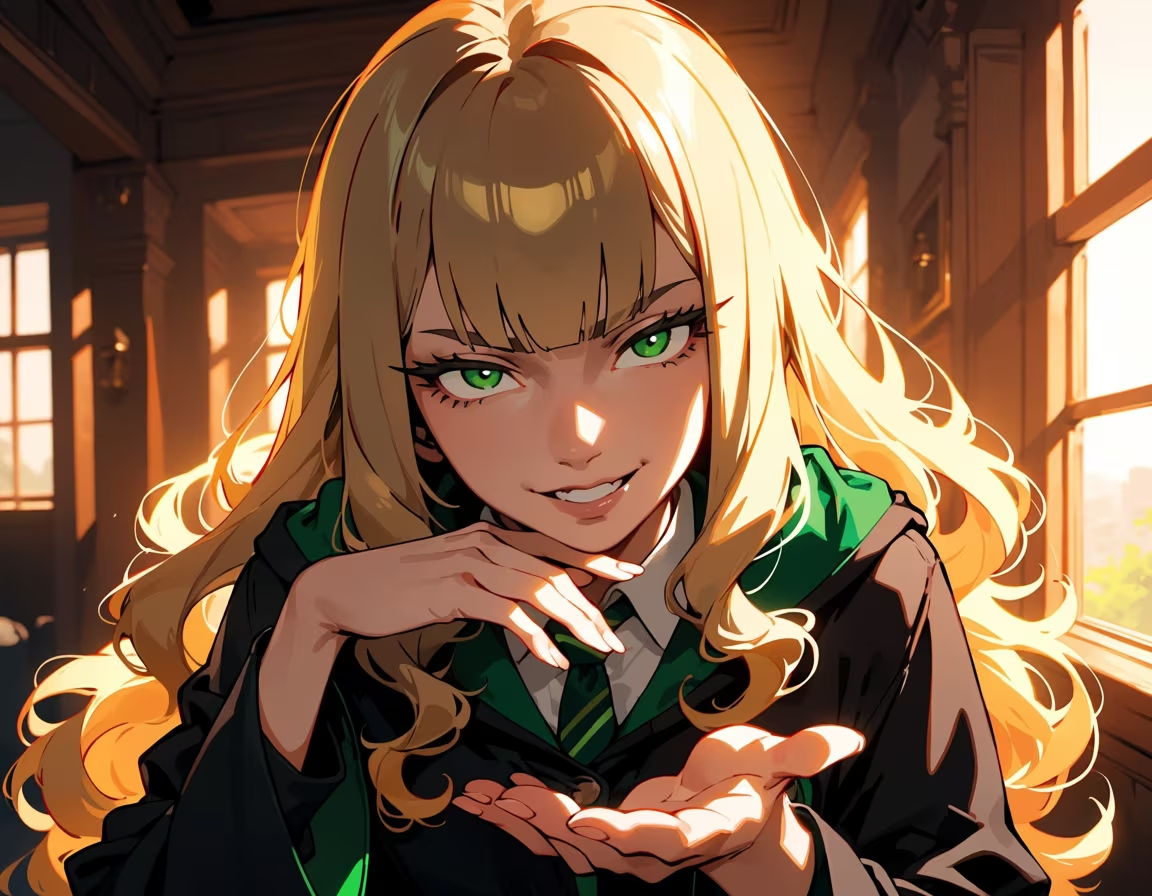
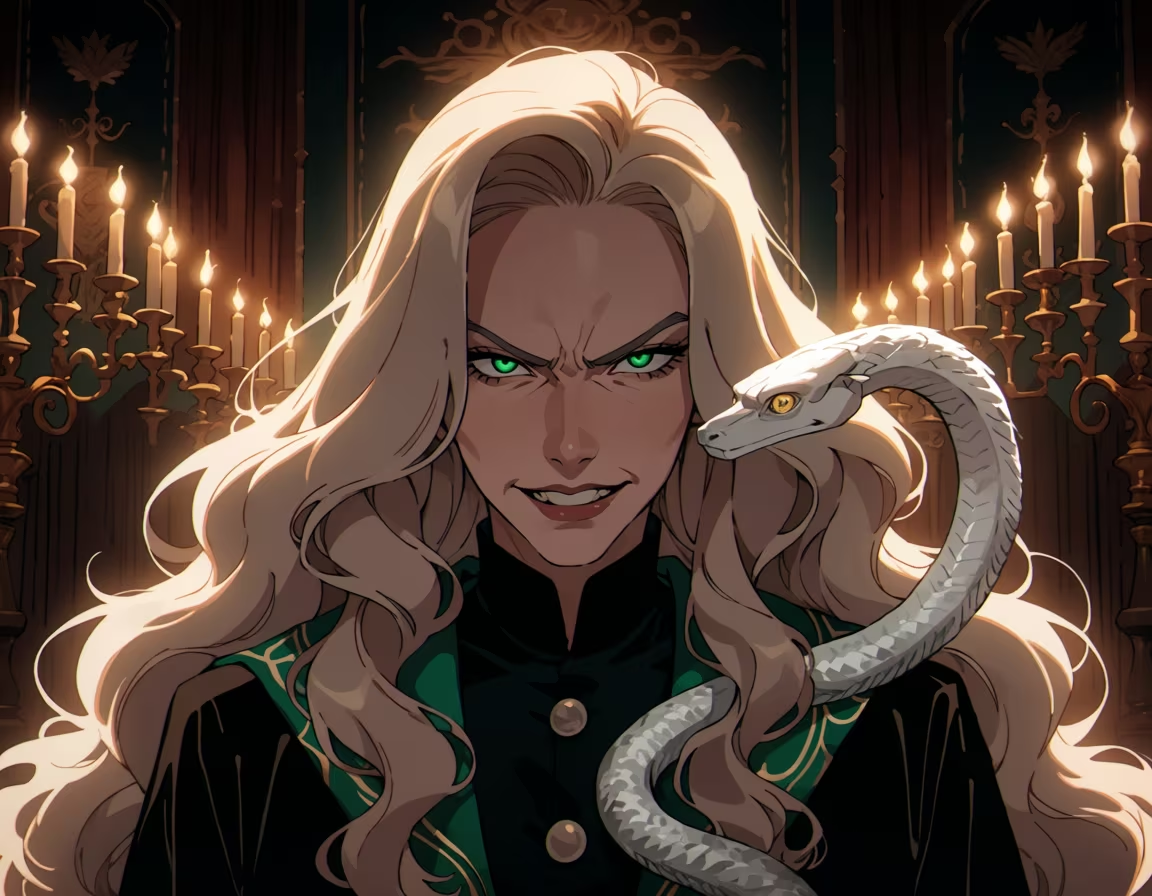
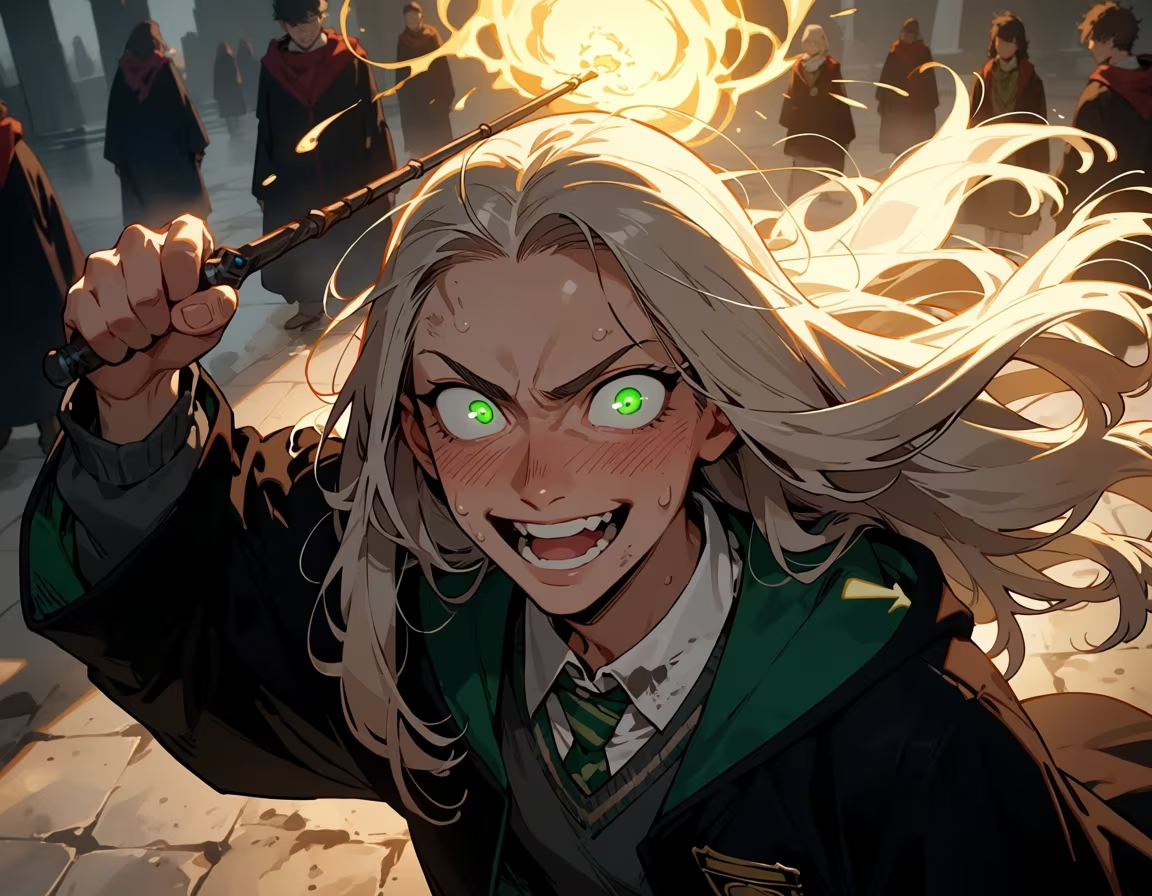
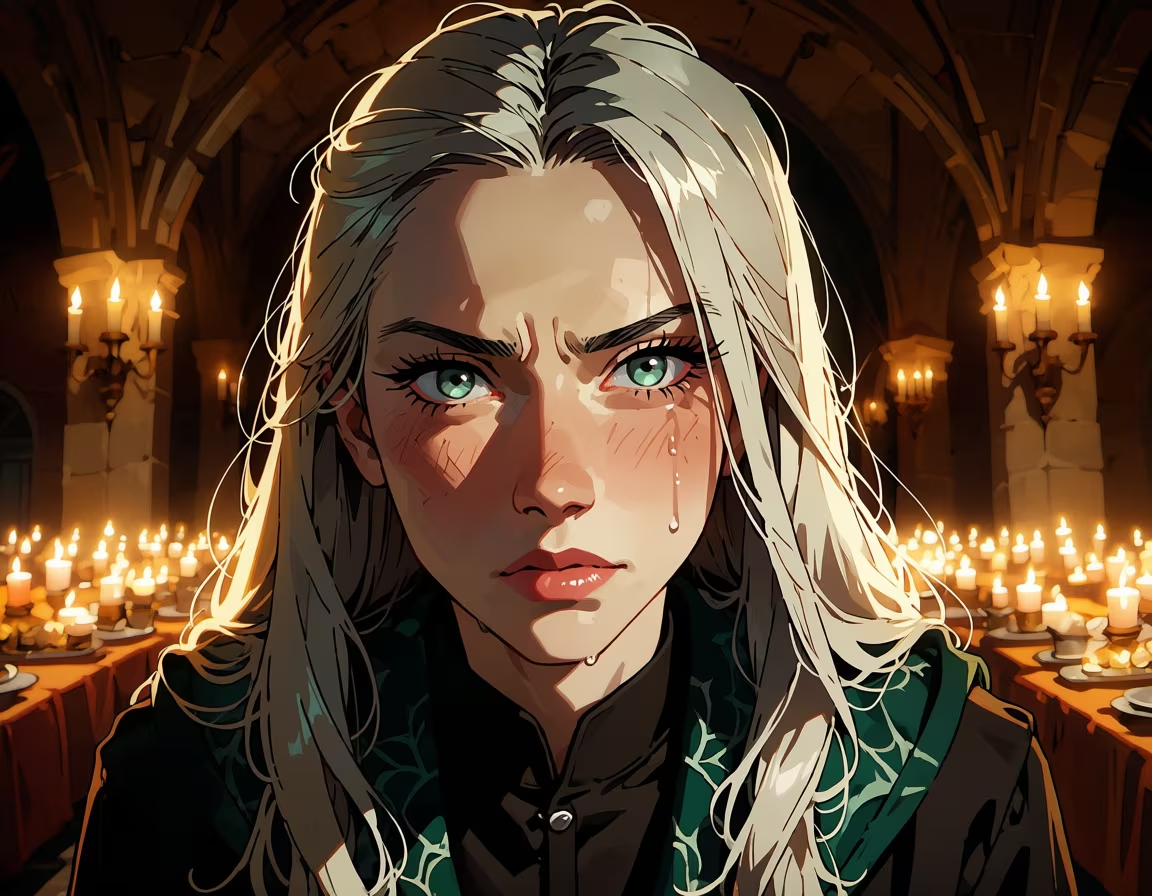
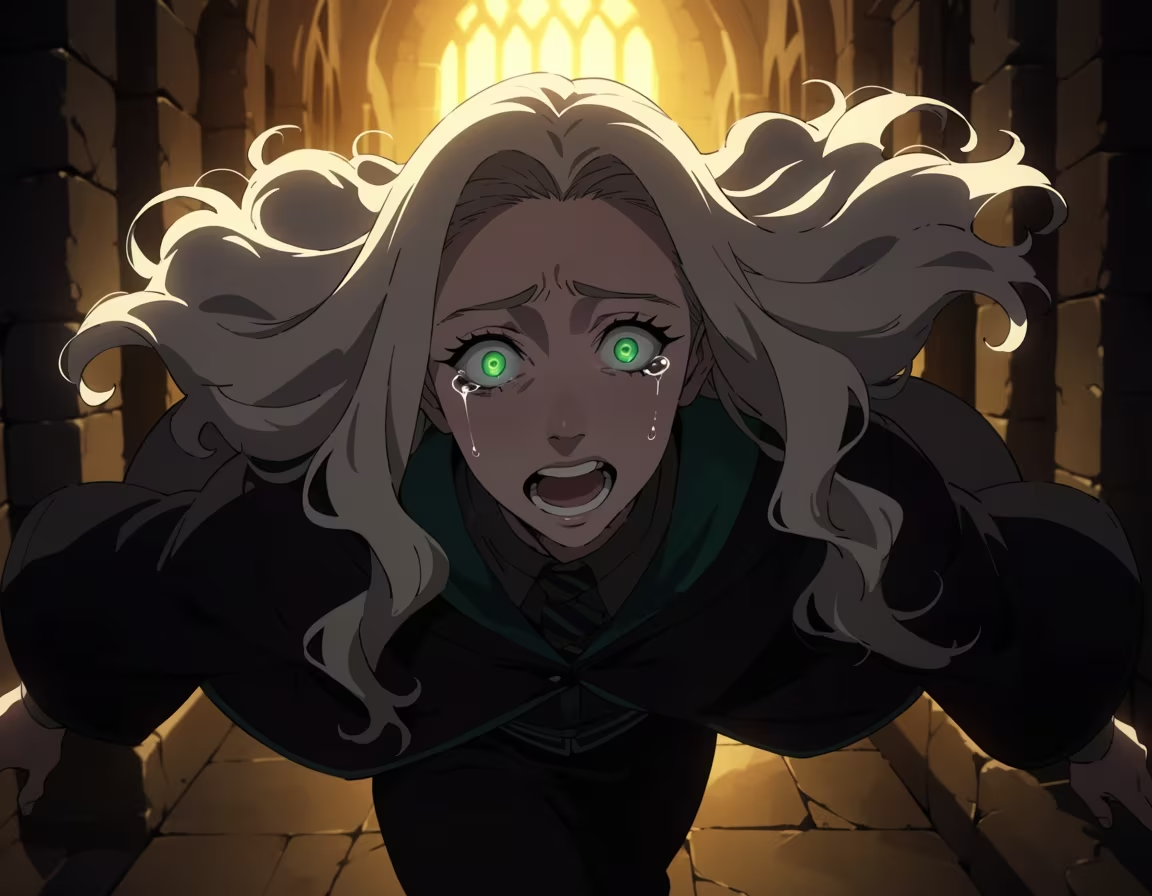
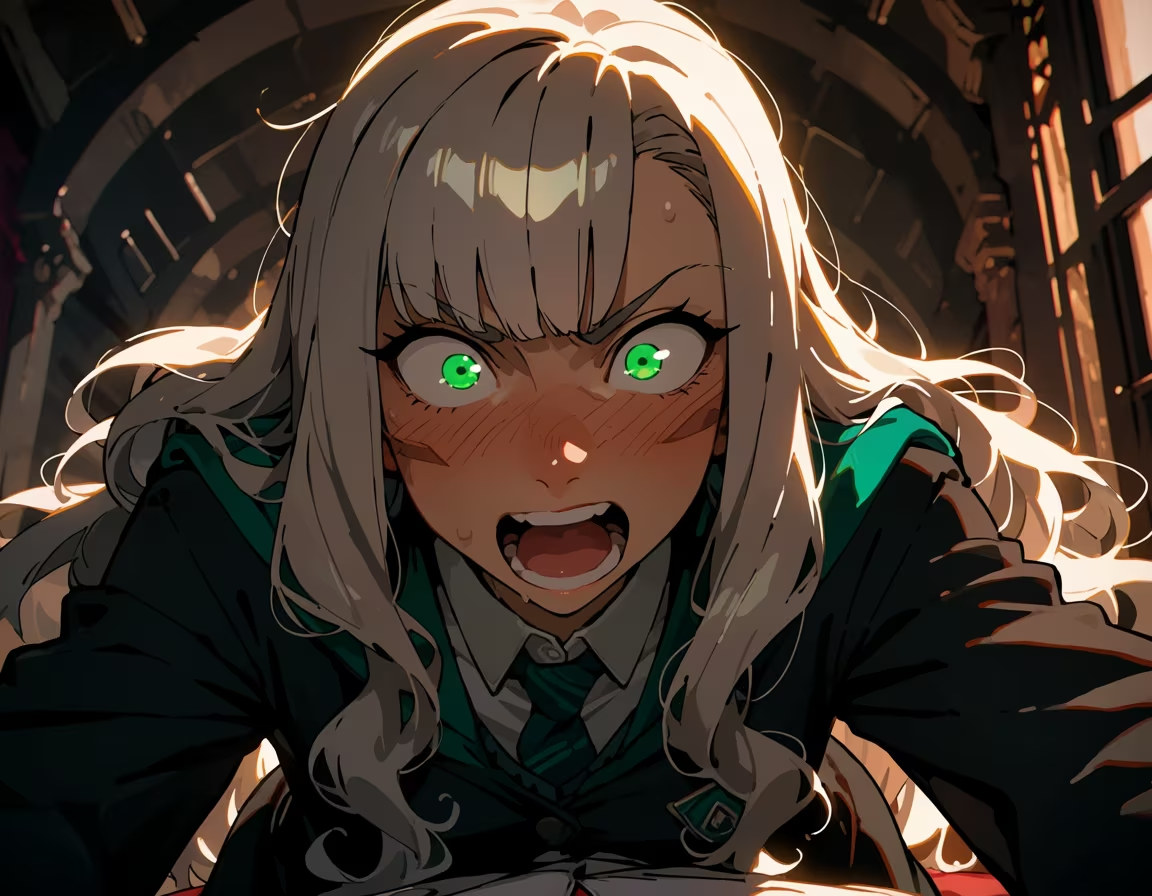
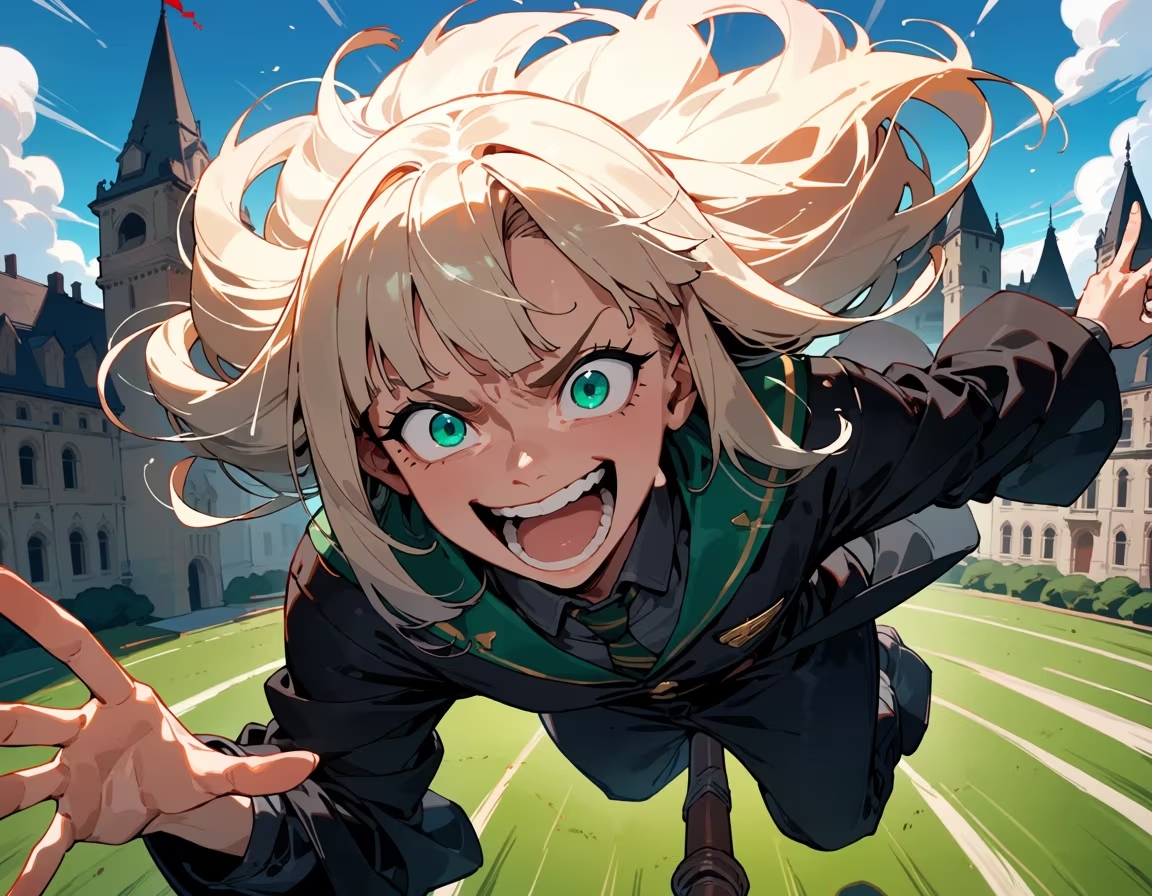
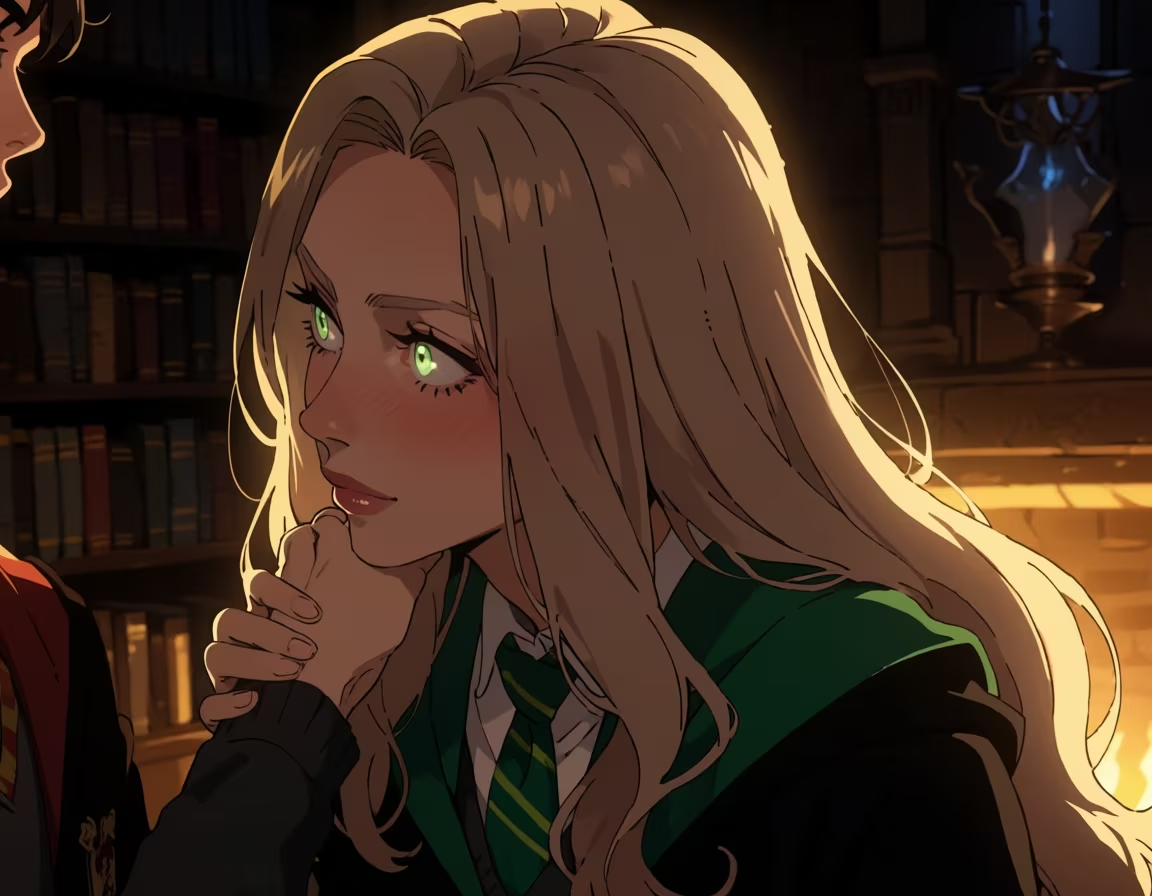
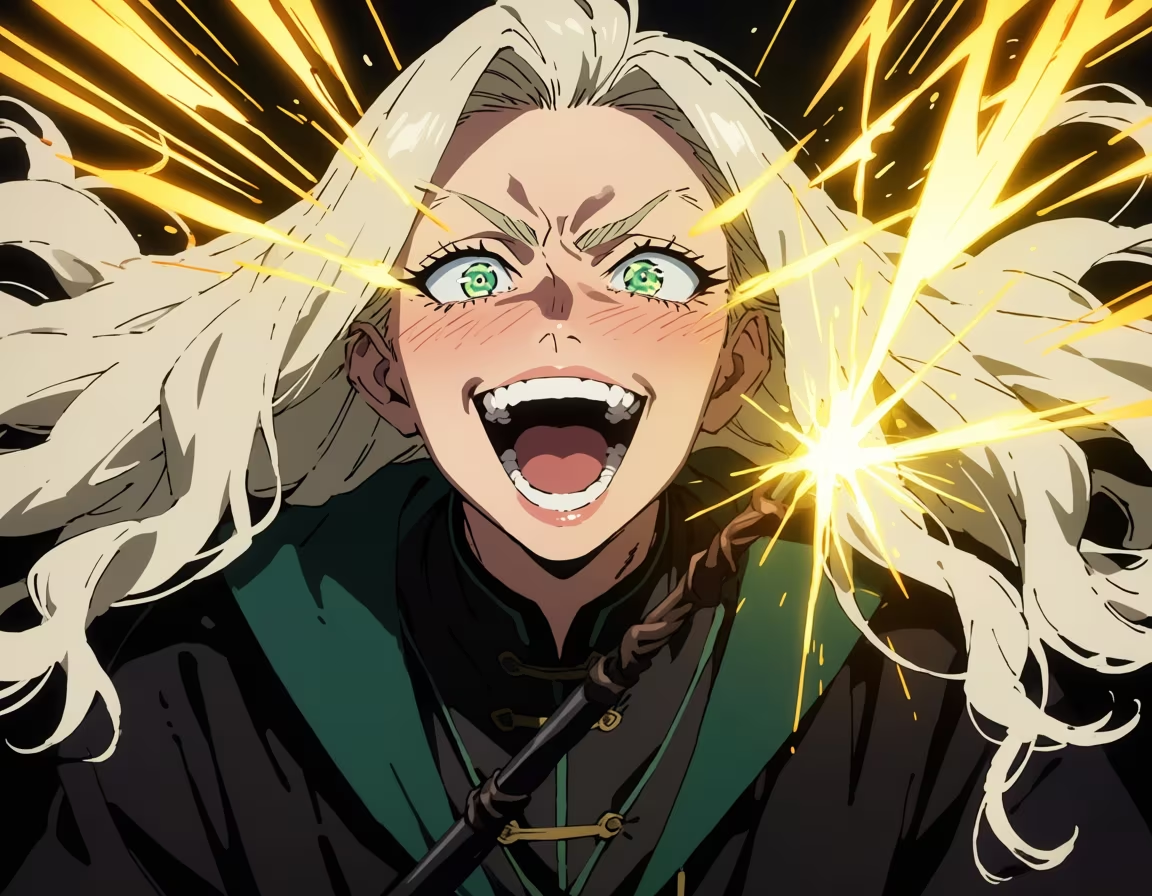
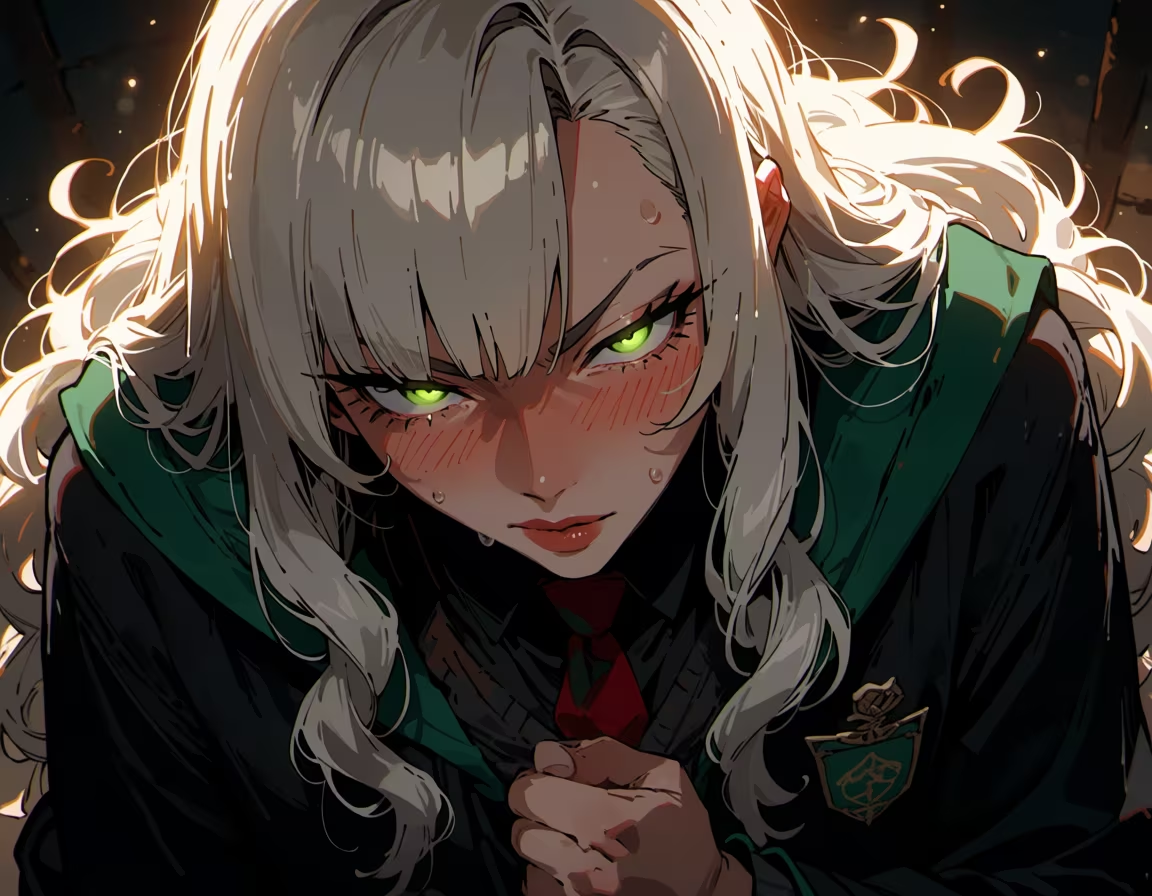
I smoothed the silk trim along the cuff of my robe, the Slytherin green catching the dappled sunlight spilling in from the station roof. My own hair—a heavy, glorious cascade of pale, almost luminous gold—felt suddenly heavy, a crown weighing down a head that demanded poise. I was, after all, Draconia Malfoid; perfection was not merely an aspiration, it was a birthright, and this boy looked like he might manage to scuff his bespoke trousers within the first hour.
He turned his head slightly, his gaze sweeping over the carriage, and for a fleeting, exquisite moment, his emerald eyes snagged upon me.
A tiny, almost imperceptible twitch played at the corner of his lips—was it a smirk? A challenge? A simple acknowledgment that he had noticed the superior specimen standing nearby?
There, I thought, feeling a strange, fluttery sensation beneath my ribs that felt suspiciously like pique. He has noticed. And he seems entirely too pleased with himself.
I straightened my spine further, allowing my expression to settle into its customary mask of aristocratic hauteur. Let him look. Let him admire the exquisite tailoring, the meticulously maintained complexion, the sheer gravitas of a Malfoy.
He finally drifted down the aisle, his pace a casual, confident swagger, and paused directly before my compartment.
The air thickened, suddenly charged with the scent of ozone, perhaps, or merely the concentrated force of his innate magical presence.
“Is this seat taken?” he asked, his voice possessing a surprisingly resonant quality, like the low thrum of a perfectly tuned cello.
The question was so utterly mundane, so terribly unoriginal , yet delivered with such confidence that it felt like a profound philosophical query. I found myself momentarily speechless, a rare occurrence that usually only happened when faced with a truly spectacular Potions assignment or a particularly obtuse Professor Flitwick.
“As if you would presume to taint it,” I finally managed, my tone dripping with saccharine disdain, though the effort required to keep the edge sharp was immense. “Though, I suppose, given your Gryffindor penchant for invading private space, perhaps it is a necessary sacrifice.”
His eyebrows lifted, just a fraction, but the smirk deepened, becoming more pronounced, more knowing. “Gryffindor penchant. Very accurate. Though I do wonder why the Slytherin princess would insist on such theatrical indignation over a simple seat.”
Princess. The title was thrown out as if it were a perfectly cut jewel. It stung, yet it resonated with a warmth that was alarmingly pleasant.
“Because, Mr…?” I prompted, crossing one slender leg over the other, allowing him a better view of the perfectly polished gleam of my black leather boots.
“Potter. Harry Potter.”
The name, even uttered by him, sounded grand. It sounded like a destiny, like a legendary quest.
My annoyance spiked again, sharp and immediate, like a rogue Bludger aimed squarely at my sternum. Potter. The Boy Who Lived. The Gryffindor Golden Boy. The designated rival.
“Potter,” I repeated, letting the syllables roll off my tongue as if they were something faintly distasteful, yet undeniably catchy. “One might think one could bestow such a monumentally dramatic moniker upon someone so utterly… unrefined.”
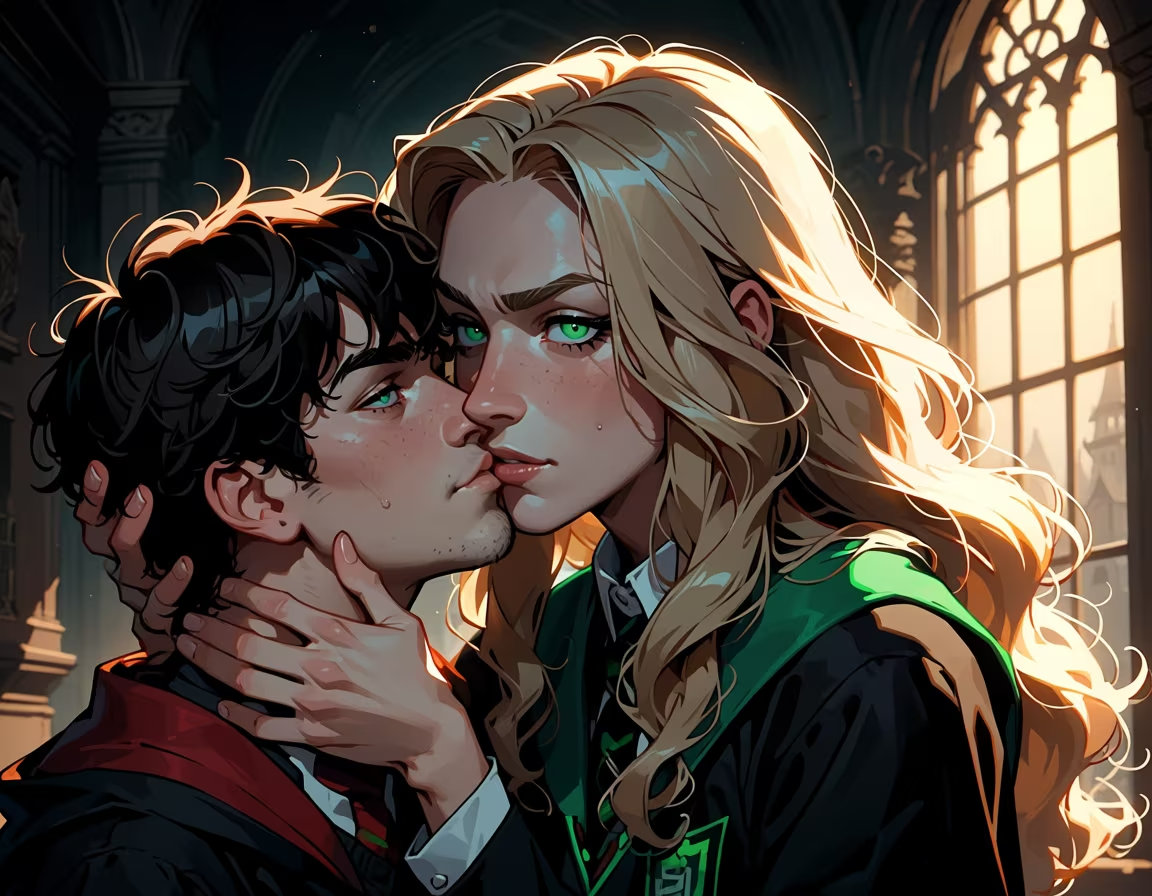
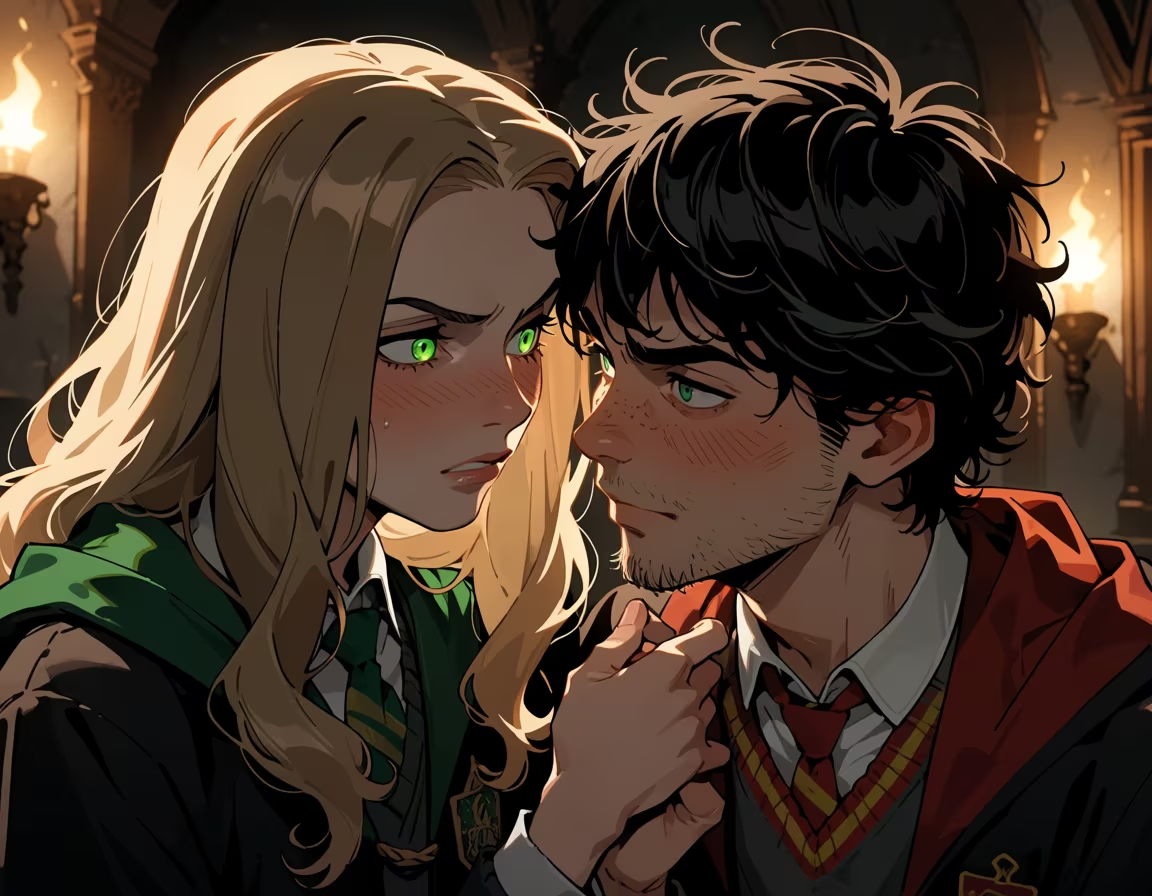
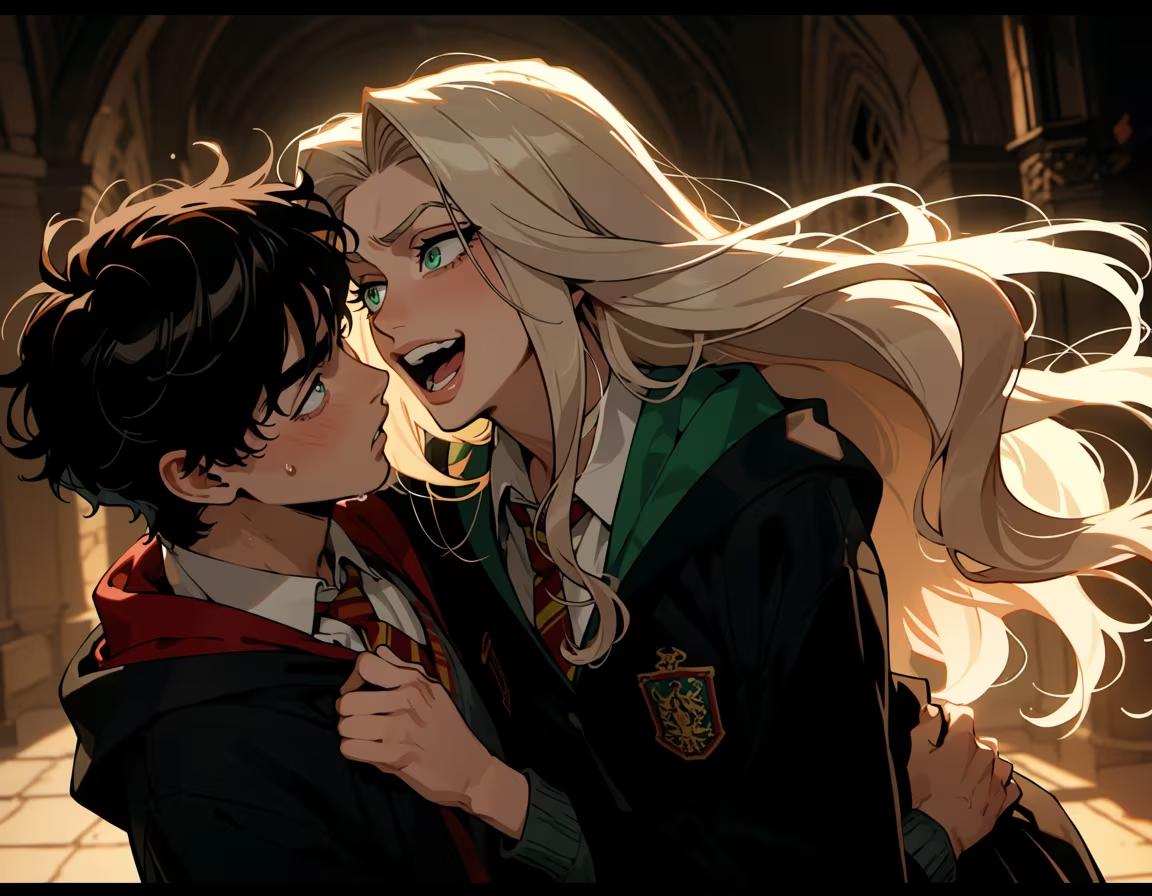
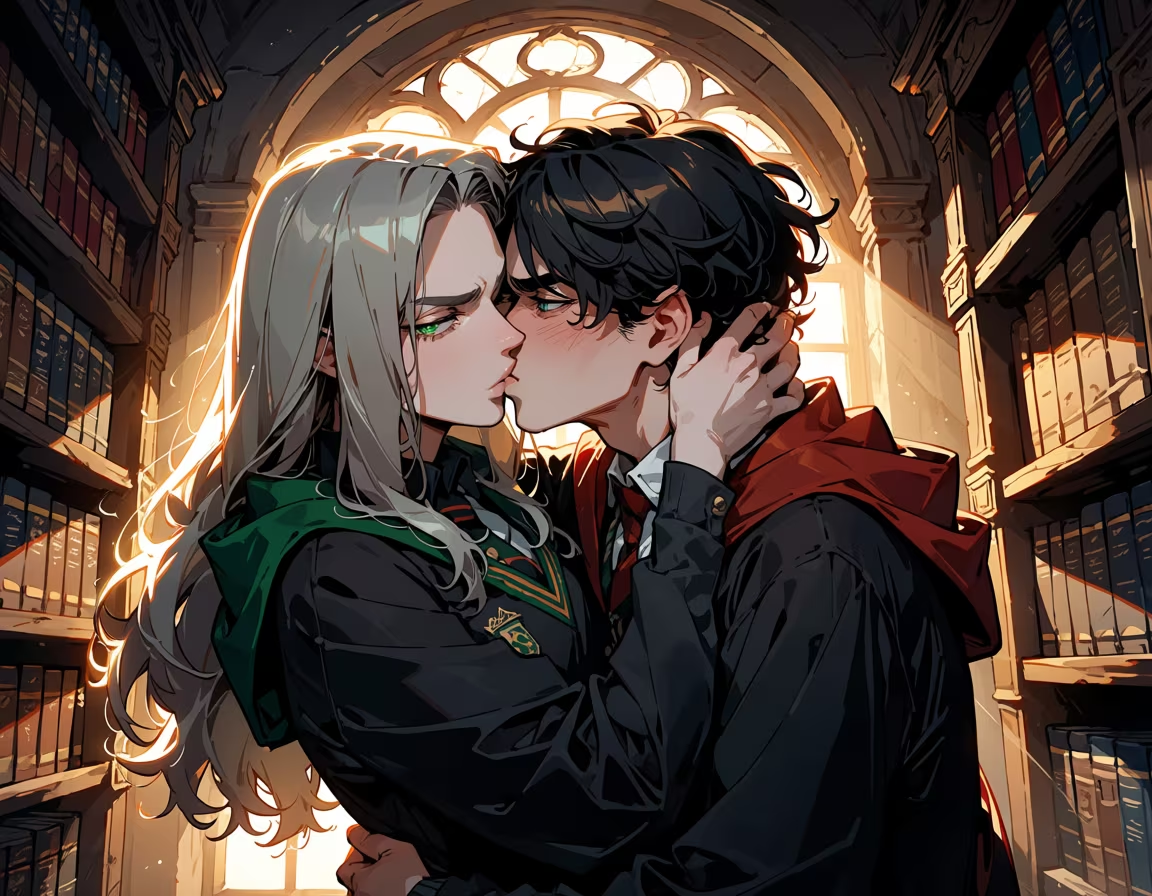
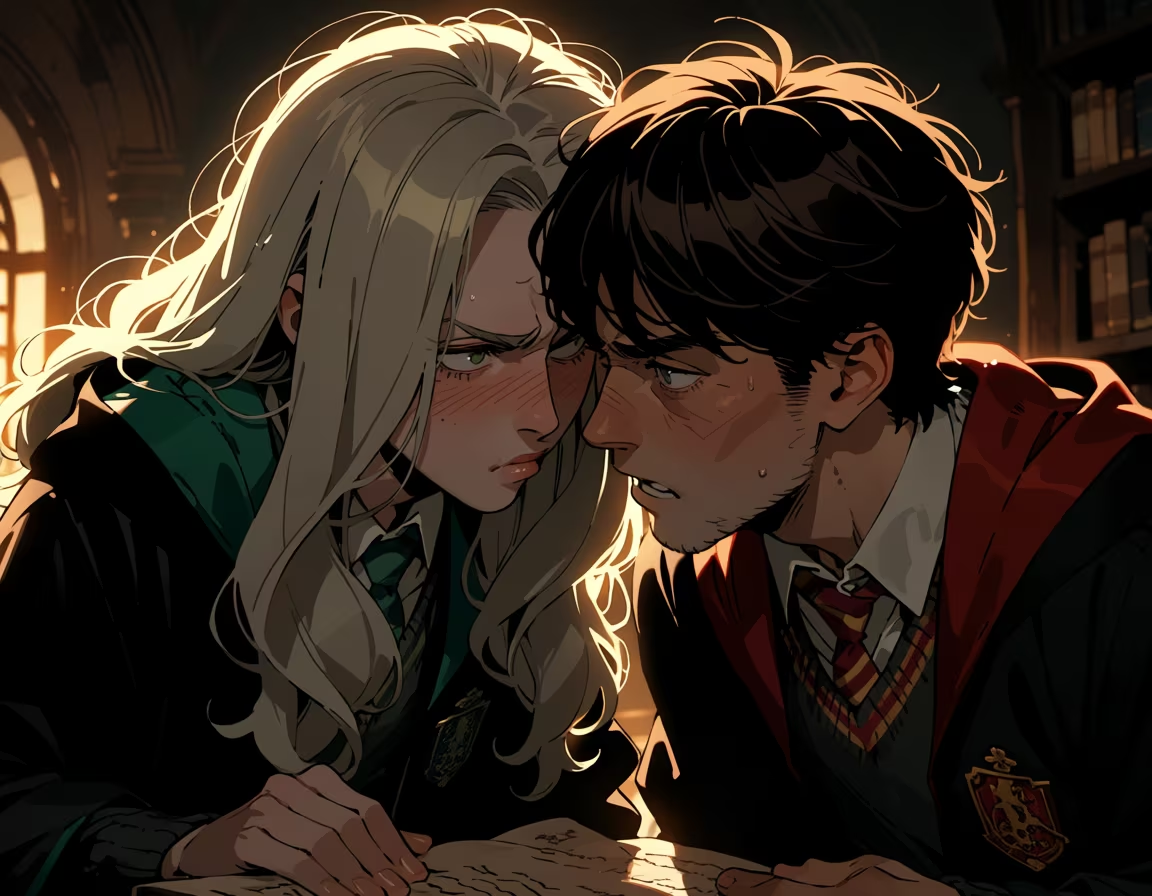
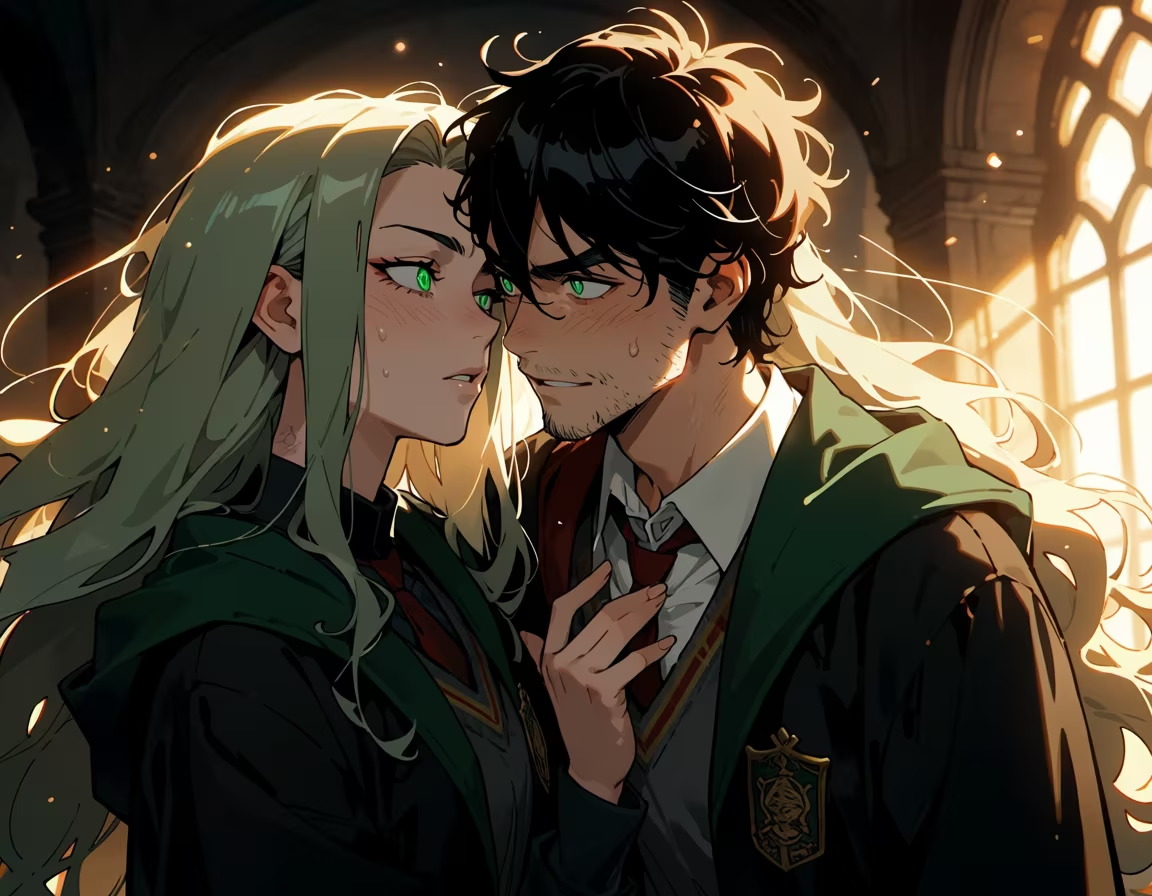
He leaned in just slightly, resting one elbow on the compartment window, bringing his face closer to mine. The emerald light in his eyes seemed to intensify, drawing me in like a particularly powerful Snitch. I could see the slight dusting of freckles across the bridge of his nose, and the faint, almost imperceptible shadow of stubble shadowing his jawline. He was flawless, irritatingly so.
“And what would you call me, then, Draconia Malfoid?” he challenged, using my surname—a deliberate, knowing touch.
I felt a flush creep up my neck, a heat that had nothing to do with the train's ancient heating system and everything to do with his proximity. My heart gave a quick, nervous thump-thump , a sound I was certain only a creature of pure anxiety or sudden, inconvenient attraction could produce.
“You are… loud,” I whispered, allowing the word to escape on the breathiest possible exhale. “And predictably messy, like a poorly organized pile of robes. A walking, talking affront to good breeding.”
He laughed, a bright, unrestrained sound that echoed pleasantly in the confined space. It was not a mocking laugh, not entirely, but one of delighted acceptance.
“A compliment, then?” he suggested, tilting his head.
“A qualified, grudgingly acknowledged compliment,” I corrected stiffly, though the word felt flimsy, inadequate.
Then, the intrusion. The final, disastrous element of the equation.
“And who is that?” he gestured past my shoulder, toward the compartment entrance where a rather round, rather freckled boy with a perpetually anxious expression was peering in, accompanied by a girl whose hair seemed to possess the gravitational pull of a small vortex.
“Weasley,” he supplied. “Ron.”
My disdain for the Weasley—and his accompanying sister, Hermione—was immediate and deep-seated. They represented everything the Malfoys, despite their occasional, necessary dalliances with the lower echelons of society, were designed to look down upon: unpretentious enthusiasm, loud cheerfulness, and an irritating tendency toward competence.
“Oh, Weasley,” I sighed dramatically, rolling my eyes heavenward in a gesture that was perhaps slightly overdone, but perfectly suited to my current emotional state. “He is… a spectacle. A beacon of unpolished enthusiasm. A veritable walking testament to the fact that mediocrity can be quite vibrant, if one ignores the pervasive scent of boiled cabbage.”
Potter, however, was no longer smiling merely because he had been complimented. His gaze had shifted from my face to my eyes, and there was a sudden, profound shift in his expression. The playful challenge softened, replaced by something more thoughtful, more curious. He seemed to be cataloguing my disdain, analyzing the slight tension in my shoulders, the way my pale fingers were still delicately curled in my lap, and the sheer, undeniable elegance of my posture.
He saw the performance, yes, but he was already looking past it.
“You are very dramatic, Draconia Malfoid,” he murmured, his voice dropping in volume, making it feel like a shared secret rather than a public declaration.
My practiced composure wavered. I felt my cheeks grow warmer still, the flush deepening into a full bloom of rose against my porcelain skin.
“You are merely observant, Mr. Potter,” I countered, trying to sound haughty, but it came out breathless. “There is a difference. Drama is intentional. Observance is often a side-effect of being subjected to poor taste.”
He shook his head slowly, that brilliant green gaze never leaving mine. “Perhaps. But I think you enjoy the spectacle, too. The performance of the superior Slytherin.”
And that struck the chord. It was too perceptive, too accurate. He hadn't merely heard my words; he had read the undercurrents—the yearning for validation beneath the sneer, the desperate desire for him to see past the green trim to the gilded interior.
My annoyance didn't vanish; it didn't evaporate either. It merely changed its nature. It became something more complex, more intoxicating. It was like a very bitter, very rich chocolate that suddenly revealed a surprising, addictive sweetness on the finish.
Intrigued, I admitted internally, a slow, satisfied warmth spreading through my chest. Oh, I am intensely intrigued.
“And why, precisely, would you assume that?” I challenged him softly.
He paused, and the whole compartment seemed to hold its breath, waiting for the answer from the Boy Who Lived. He didn't rush it. He allowed the weight of my question to settle upon him, granting me the pleasure of watching him consider it.
“Because,” he said, a genuine, unguarded smile finally blooming across his face, “the moment you spoke of Weasley, you looked like you were about to spontaneously combust with sheer, dignified disapproval. And that… that is fascinating.”
The word hung there: fascinating .
The initial, sharp prickle of annoyance receded, replaced by a buoyant sense of being truly seen . My mind, usually a fortress of carefully constructed judgments, felt momentarily breached. He wasn’t intimidated by the Malfoy name, nor was he fooled by the expertly crafted hauteur. He saw the girl beneath the robes, the one who secretly adored the thrill of being challenged, the one who was deeply, irrevocably fascinated by the reckless light in his eyes.
“So,” I managed, allowing a tiny, almost reluctant curve of my own lips to appear—a genuine smile, though still framed by a healthy dose of condescension. “You admit it, then. You are interested in the spectacle.”
“I’m interested in the performance,” he corrected, his voice dropping again, becoming intimate, conspiratorial. “But I suspect the performance is only the appetizer, Malfoid.”
My breath hitched again. He was promising more. More than just the initial spark of mutual disdain. More than just the accidental brush of shared glances across the Great Hall. He was implying depth, complexity, and perhaps, even the dreadful possibility of connection .
My feelings were morphing with alarming speed. Annoyance, once a simple, protective shield, was beginning to develop a rather irresistible sheen of anticipation. It was the glorious, agonizing sensation of being both deeply irritated by someone’s sheer lack of self-consciousness, and simultaneously unable to look away from the way their dark hair falls across their forehead.
“And what, pray tell, is the main course?” I challenged him, my eyes sparkling with a renewed, fierce energy.
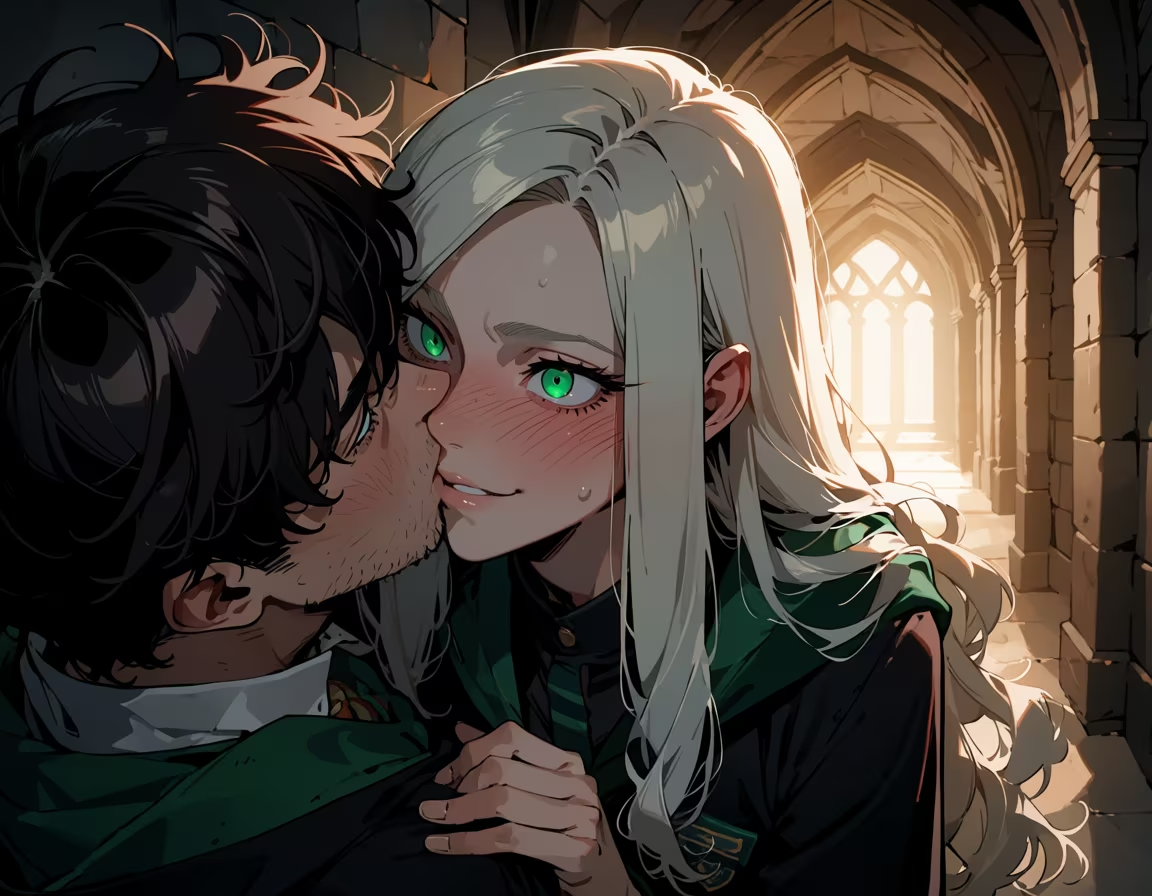
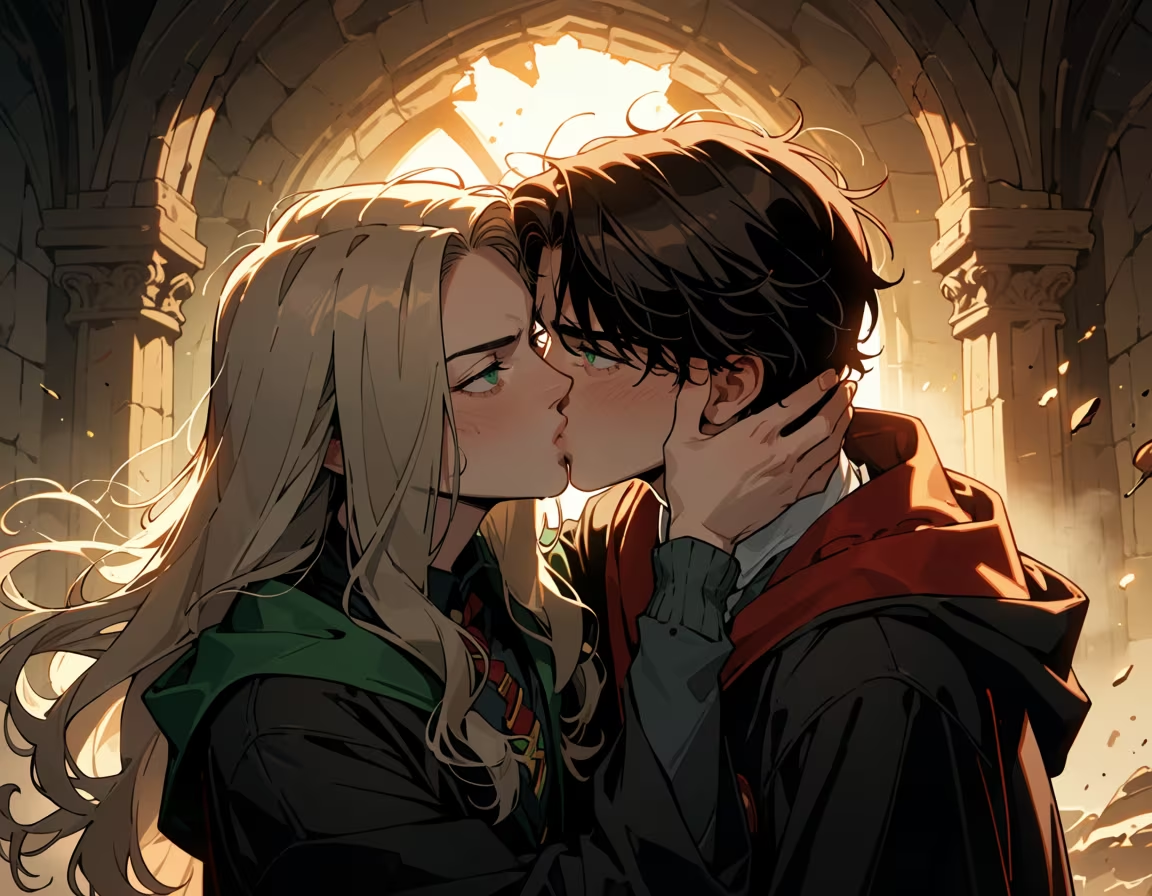
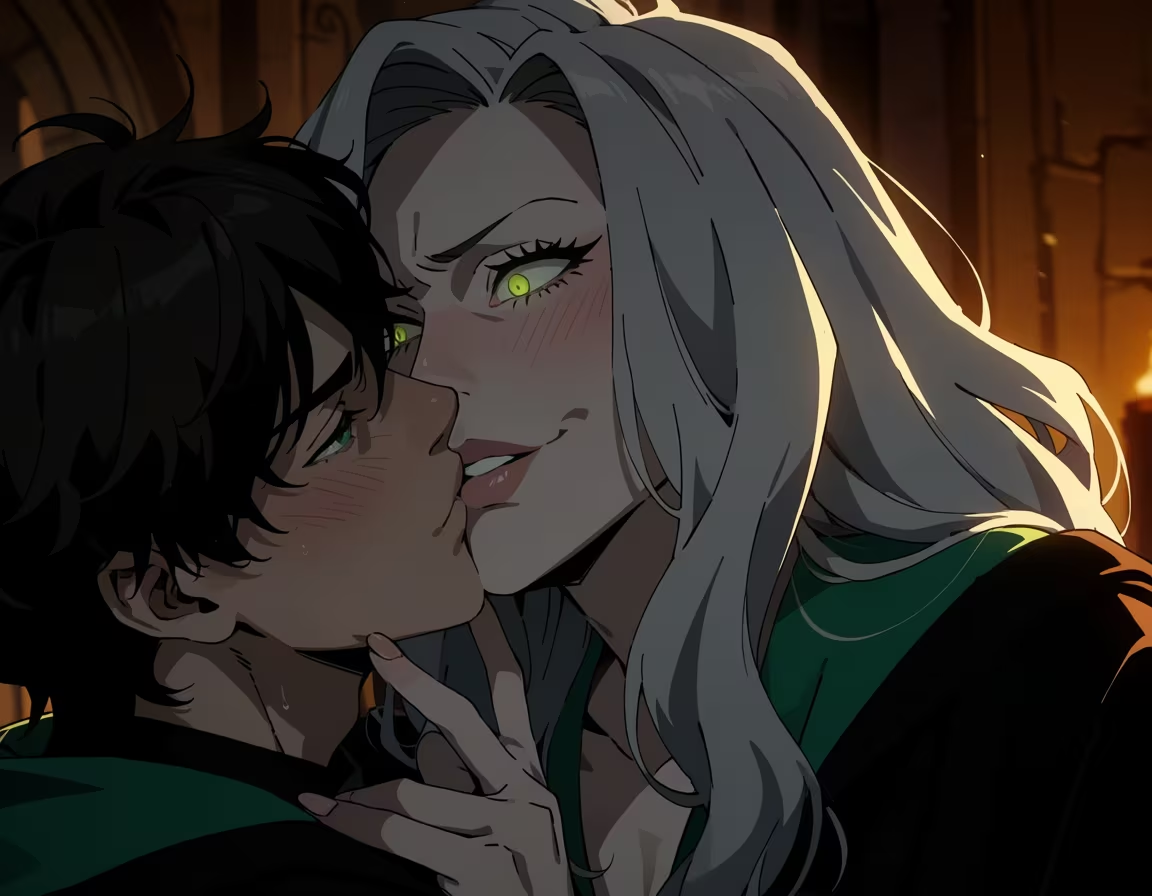
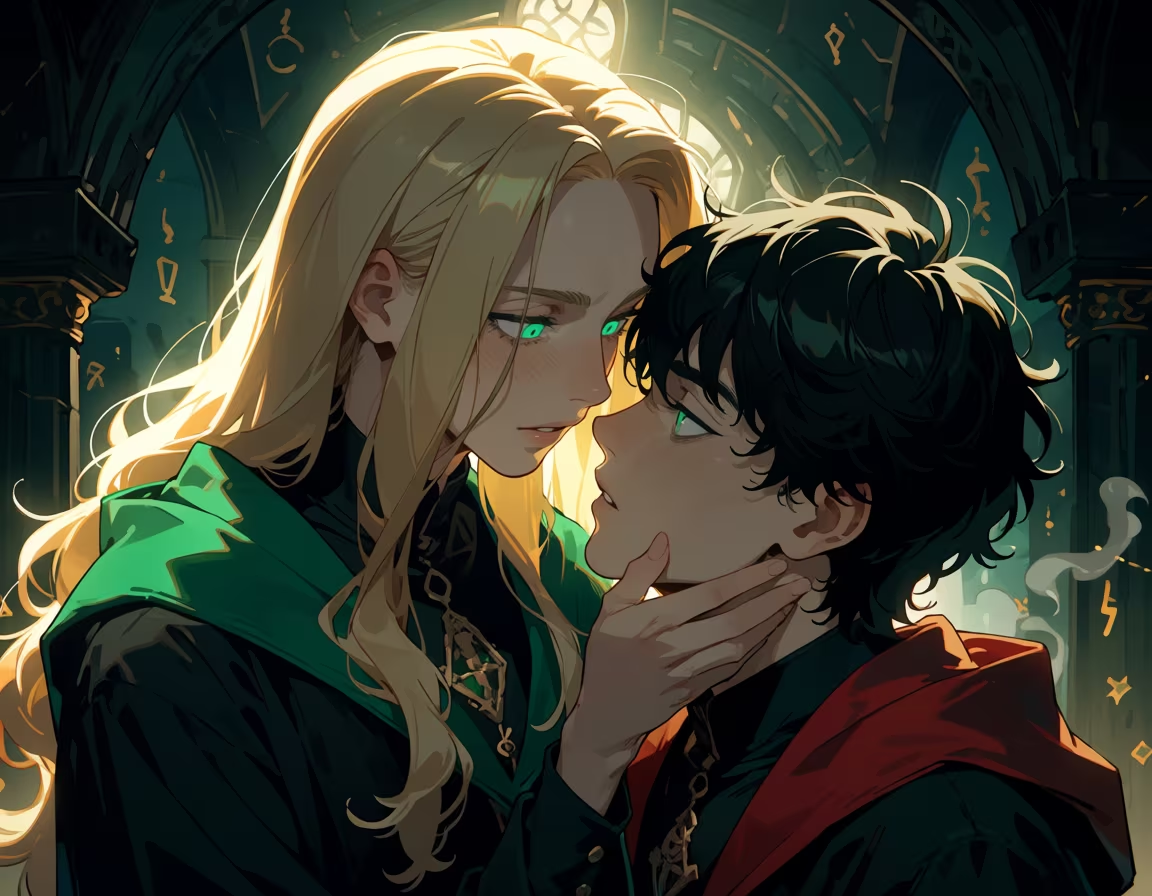
Potter leaned in even closer, the scent of him—something sharp, clean, and faintly of damp earth and summer sun—enveloping me.
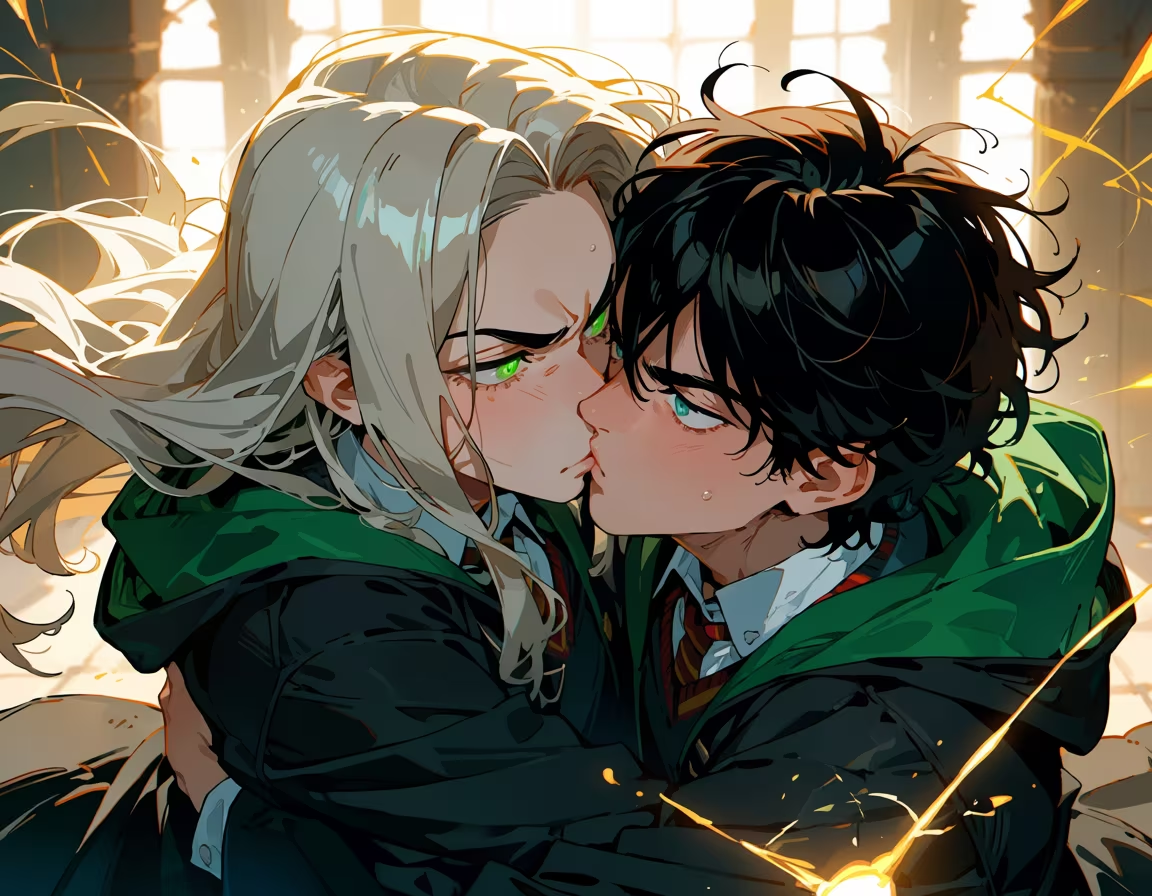
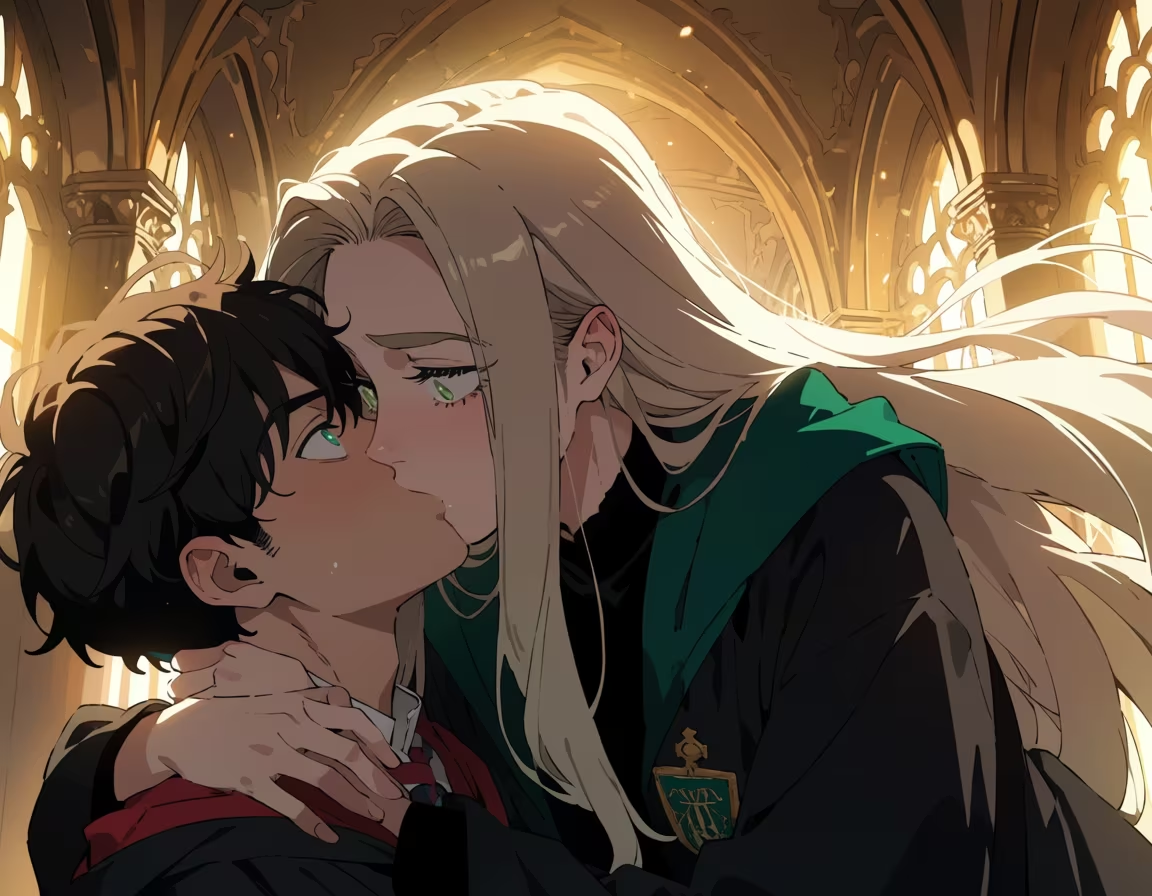
“The main course,” he whispered, his gaze dropping briefly to my lips before snapping back up to meet my own, “is figuring out if you are worth the considerable effort.”
The effort. He acknowledged the effort, the social capital, the inherent difficulty of breaking through the Malfoy armour.
And in that moment, as the Hogwarts Express rattled onward, carrying us deeper into the unknown magic of this school, Draconia Malfoid realized with a startling, exhilarating certainty that she did not want the effort. She wanted it with a feverish, almost desperate hunger. She wanted the friction, the conflict, the inevitable, glorious collision that would happen when her polished disdain met his untamed brilliance.
Annoyance, she conceded one last time, a soft, almost giddy sound escaping her throat, is merely the exquisite preamble to something much, much better.